|
Fantasy Airplane Fleet
by Philip Greenspun; updated June 2008
Site Home : Flying : One Article
|
I keep this file around for personal reference, listing all of the
airplanes that I would like to own if I had infinite money and a
full-time staff to manage the paperwork and maintenance. I'm not
listing the obvious stuff that truly require infinite money such as a
Gulfstream V or Sikorsky S-76 helicopter. I'm also trying to focus on
things that are reasonably efficient and that won't burn tons of fuel
thereby (indirectly) funding Al-Qaeda.
This document is split up into the following sections: (1) aircraft for
enjoying the view, (2) aircraft for getting from Point A to Point B, and
(3) aircraft for getting into the roadless wilderness (generally float
planes).
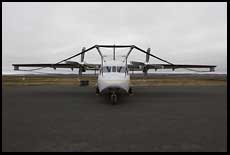
Partenavia Observer
Most piston twin-engine planes have terrible visibility toward the
ground due to (1) a low wing, (2) engine nacelles poking out in front of
those wings. The Partenavia P68 is a high-wing twin with small (cheap
to operate) Lycoming IO-360 engines. The Observer model has a Plexiglas
nose like a helicopter. Air conditioning is available to counteract the
greenhouse effect. Available from www.vulcanair-usa.com.
The Partenavia holds 6 people and can be ordered with bubble windows in
the back to improve downward visibility. It would be perfect for a
small sightseeing business.
Royal Aero Club of Western Australia has a non-observer P68 to rent for
$294/hour, www.racwa.asn.au.
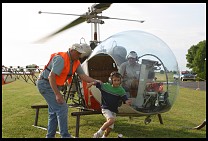
Robinson R44
An easy-to-fly and easy-to-maintain 4-place helicopter. www.robinsonheli.com.
About $400,000.
Piper Malibu
Pressurized and quiet inside, able to climb to 25,000 and get above most
weather. The early Continental-powered version made through 1988 burns
as little as 15-16 gallons per hour and goes 185 knots. For those early
planes you really want the vacuum pump STC that makes it cheap to
replace the pumps and that, more importantly, provides automatic
failover in the event a single pump dies. You also might want the
IO-550 conversion (the original planes had 520 cubic inch engines).
None of the Malibu engines are as reliable as the simple four-cylinder
engines in Cessna 172s and all Malibus are prone to engine failure in
flight. Fortunately they glide at 16:1.
The visibility out of a Malibu isn't so bad. The wing is fairly thin
and there are no engines poking out in front of it.
Wishlist/checklist for a Malibu: electric flaps rather than hydraulic,
windshield with embedded heaters instead of hotplate (can retrofit from
Mirage back to Malibu?), vacuum pump STC, IO-550 conversion, insulator
blanket (Nomex) for interior, 4-blade MT Prop or maybe the 3-blade
composite from Hartzell. Apparently you will be a world of hurt without
the Parker-Hannifin landing gear hydraulics that came out in mid-1986.
This makes a late '86 or an '87 or '88 Malibu perhaps the best deal.
Flying magazine's February 2005 issue carried the following: "One pilot,
who had been charged with 'lewd and lascivious conduct with a minor,'
fell to drinking heavily and spoke of intentionally crashing his Malibu.
The next day he did just that, while in radio communication with
approach control. He reported descending through 11,000 feet, then
through 6,000 just 38 seconds later. He encountered the ground at
4,650 feet."
A Malibu plus a letter from God promising that the engine will never
quit is all the airplane that anyone really needs.
Cessna Mustang
Unfortunately, God does not like me and won't write me a letter for a
Malibu. So I ordered a Cessna
Mustang, the most sensible of the very light jets for personal use,
assuming the person has a bit of experience with turbine multi-engine
airplanes.
Cessna Caravan on Floats
Most float planes can barely get off the lake much less over the
mountains surrounding the lake. This is one case where you really want
a powerful engine, e.g., the jet engine behind the propeller in a Cessna
208 Caravan. Caravans are available on amphibious floats. Caveat: if
you take off from a runway and forget to retract the wheels, which is
easy to do because they presumably hardly affect cruise speed, and then
land in the water... you'll flip over and die.
About $1.4 million. Still cheaper than a lot of lakefront houses these
days and with the Caravan you can fly to any lake in North America and
live out of the plane...
Zenair CH 701 on floats
For about $50,000 there is a Czech two-seater float plane, the CH 701,
that is so slow supposedly people have landed in the water with the
wheels down and the plane did not catch and flip over. Also it is cheap
enough that you don't have to buy insurance (wicked expensive for float
planes due to the fact that people are always crashing them). From
www.zenithair.com.
It is supposedly a kit plane but in practice you can go over and build
it in their factory over a few weeks and then take it home. Now that
the FAA has finished up the sport pilot rules, you should be able to
register a factory-built Zenair but I haven't seen any for sale.
Icon Aircraft is kind of the
same idea, but instead of one smart Czech guy it is a team of about 50
high-powered Americans and a huge quantity of venture capital.
Beriev Be-103
A new Russian amphibious seaplane that floats low on its wings. With
only 210 HP per side it seemed underpowered on one engine, with a
practical single engine service ceiling of sea level plus a crushproof
cigarette pack. From www.beriev-usa.com.
Omissions
There are no aerobatic planes on this list because I'm afraid to be
upside down in an airplane without an aerobatics instructor in the
airplane. So I might as well rent whenever I want to fly aerobatics.
Text and photos (if any) Copyright 2004-8 Philip
Greenspun.
philg@mit.edu
Add a comment | Add a link