Aviation Summer Intern Wanted
for Philip Greenspun, updated August 2010
Site Home : One Job Listing
My Summer 2010 intern just completed her helicopter
rating (video) and is
returning home to Michigan soon. That means this job is open once
again.
Have you always dreamed of earning a pilot's license? Are you
considering a career in aviation? This is an opportunity to spend a
summer learning if the world of aviation is for you. This internship
is designed for one of the following:
- an expert videographer and video editor; or
- someone who already has a pilot certificate for airplanes and excellent customer service and organizational skills; or
- someone with excellent software development and computer system administration skills
The position is available any time that a person with the right skills
and attitude wants to take it. Typically an internship lasts for 3-12
months and could be done during the summer of 2011, for example.
What's Good About Aviation?
Flying offers unlimited challenge. You could spend years building up
the skills that airline pilots use to get people from big airport to big
airport safely. After mastering those skills, you could learn to fly a
seaplane, a bush plane, a helicopter, an aerobatic plane.
Flying puts you into contact with some of the world's most interesting
people. Commercial pilots are folks who've followed their dreams.
Recreational pilots might be miserable when they're at their desk jobs,
but you'll be seeing them at the airport where they are doing what they
love. Pilots aren't afraid to take responsibility for their
decisions. They tend not to sweat the small stuff.
If you want to learn about success in medicine or business, hanging
around the airport is a great way to begin. The most common career
backgrounds for airplane owners are doctor and self-made business
founder and CEO. The doctors are often heads of departments at major
hospitals or operators of their own practices and clinics. These guys
went from nothing to earning enough money to buy and operate a $1
million airplane. They didn't get there with dumb luck or family
connections. Most of these folks wouldn't have time to spare if you
asked them to spend a day educating you. But if you said "I'm also a
pilot; can we spend a day together practicing instrument approaches?"
the response is likely to be much more enthusiastic.
The Internship in Brief
I own an airplane and two helicopters, fly almost every day, and have
airplane flight instructor (single- and multi-engine), airplane
instrument instructor, and helicopter instructor ratings. Many of my
friends own aircraft as well and some are flight instructors. I can
make sure that, if you stick with me for the summer, you will build at
least 40 hours of loggable time in helicopters and airplanes.
If you are applying for this internship on the basis of your video
skills, your primary job will be producing a series of tutorial
videos. By the end of three months, we'd like to have approximately
50 videos completed. An example of a video would be a 20-minute
lecture or interaction following a ground lesson plan within our Private pilot syllabus.
We've produced a few experiments already:
We would expect your work to be higher quality than these.
Your second job is ground support for flight training activities. You
will do flight planning, fuel planning, get relevant weather reports
from the FAA, brief passengers for helicopter rides, keep track of the
schedule for student and personal flights, keep the GPS databases in
the Cirrus and Robinsons up to date, keep the aircraft clean, stock
the fridge for the mechanics, make sure that the dog is not bored
(a Border Collie), shuttle students
around in your car or mine (2007 Infiniti M35x; a four-door sedan as
fast as a Ferrari 348, so don't get any speeding tickets!). I will
provide all necessary training so that you can accomplish these tasks.
What do you get in return? Flight and ground training toward your
pilot's license, both airplane and helicopter. When we don't have
paying customers, we will go up together and work on your flying
skills. On the ground, you will have access to a complete library of
flight training materials and books, plus wireless Internet access.
At the airport, you will also be surrounded by expert flight
instructors and pilots who can answer most of your questions. On
rainy days, I can provide some structured ground school training to
supplement what you're getting from the books. If you're interested
in computer science or photography, I can provide some instruction in
those areas as well.
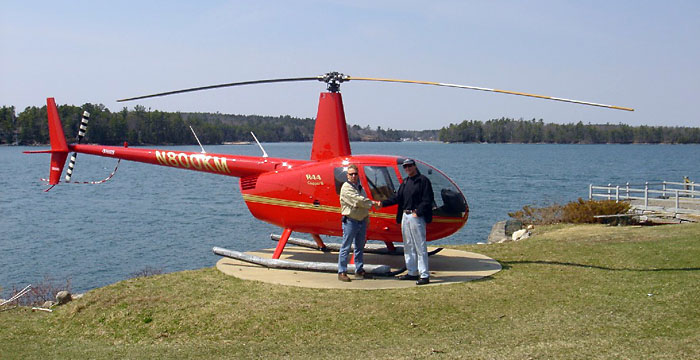
About Me
I am 45 years old and live in suburban Boston, a 15-minute drive from
Hanscom Field. In 2001, I retired from a 23-year career as a software
engineer and began flight training. As of 2010, I have approximately
3500 hours of total time. Currently, I hold an Airline Transport
Pilot certificate with single-engine land, multi-engine land, and
rotorcraft-helicopter ratings. I have a single-engine sea rating at
the Commercial level. I hold a Flight Instructor certificate with
airplane single-engine, airplane multi-engine, instrument airplane,
instrument helicopter, and rotorcraft-helicopter ratings. I have more
light aircraft cross-country experience than most people at my level,
having done Boston-to-Alaska-and-back a couple of times in
single-engine planes and Los Angeles-to-Boston several times in
Robinson helicopters. I have flown 50-seat regional jets for a Delta
Airlines subsidiary.
I have a lot of experience with photography, both film and digital, and
have a better collection of photographic equipment than most
professional photographers. I have taught photography to college
students.
I have a Ph.D. in Electrical Engineering and Computer Science from
M.I.T. and experience teaching EECS subjects at M.I.T.
I enjoy teaching and spending time with young people for whom my advice
and/or the skills that I teach might make a difference for their future.
Video Production Tools
We have the following tools for video production:
- Sony 3-CCD 1080i camcorder that records to HDV tapes
- Sony AVCHD camcorder that records to internal flash memory
- a stereo wireless mic setup with lav mics
- compact fluorescent lights, light stands, and softboxes
- cables and connectors to capture audio from airplane and helicopter radios and intercoms
- digital still cameras
- Adobe Premiere
- Adobe Photoshop
About You
Here are the characteristics that I think will make for a successful
internship:
- experience with videography and video editing or an already-earned
pilot's certificate for airplanes
- driver's license
- intelligent and good at quantitative reasoning (i.e., not afraid of
math and science)
- enthusiastic and fun-loving
- enjoy visiting new places
- enjoy spending time with dogs
- some computer experience, e.g., maintaining a personal Web site
- reasonably light weight, e.g., less than 175 lbs., if we are going
to get into an R44 helicopter and take any passengers
A Typical Day
We meet either at at Hanscom Field at 7:00 am. I give a 7:00 am
helicopter flying lesson. You do ground school or some video editing.
If nobody has booked a lesson, at 10:00 we leave the dog on the ground
and go up in an airplane or helicopter. We return to my house at 1 pm
for lunch, to take a walk or ride a mountain bike in the adjacent
woods (250 acres), and then do video editing. At 4:00 pm, we may go
back to the airport and I'll give a lesson to a customer while you
capture video from the back seat or capture video while another
instructor teaches a ground lesson. We should finish the day by 7:00
pm.
If I am busy, you may go to the airport and fly with one of the other
instructors or fly solo if you've been signed off. You'll do
production with other instructors and editing on your own.
A Typical Month
We go to the airport on all of the good-weather days, which means 4-5
days per week. Once every month, I will go on a 4-7-day trip with an
instrument student or just to visit friends. In some cases, you might
come along on one of these trips.
On at least 5 days per month you'll do some work that is only loosely
related to the flight school, organizing a social event or helping
organize stuff around the house.
You will be working hard and won't be able to have any other summer
employment.
Who Pays for What
I pay for the following items:
- flying in airplanes and helicopters (at least 40 hours logged during
the summer; this would cost you about $325 per hour (averaged over
airplanes and helicopters) or $12,000)
- breakfast, lunch, and dinner if we work together all day
- travel expenses if we go anywhere
Previous interns have earned bonus checks of $750 or $1000 upon
completion of various projects.
Where You'll be After Three Months
After three months, even if you have not done any flight training
before, you will have a good understanding of recreational and
commercial aviation in both helicopters and airplanes. You'll be about
halfway toward getting your private pilot's license, perhaps further if
you study hard and turn out to be a quick learner.
How to Apply
To demonstrate your ability with video, submit an application by
emailing philg@mit.edu the URL of a
video application. The video should include the following: a bit
about yourself; you with a dog; why you're interested in aviation; two
references (interviews with teachers or mentors saying good things
about you). You're the video expert, but I would think that five
minutes would be the maximum reasonable length.
Foreign Applicants
If you are not a U.S. citizen or Green Card holder, it has become
difficult, since the attacks of September 11, 2001, to do flight
training in the U.S. You would need to have some legal basis for
being in the U.S. before applying for this internship.
Longer-Term Internships
I am considering offering a four-year internship to a person who is
ready to begin an undergraduate program in "aviation science". The
intern would do the bachelor's degree online with Utah Valley
University and the flight training with me, as well as learning
computer science and photography. I would pay for all living
expenses, tuition, and flight training. The intern would graduate
with no debt and ready to work at an airline.
philg@mit.edu
Add a comment | Add a link