Site Home : Flying : One Article
All life is the management of risk, not its elimination.The idea of plunging thousands of feet straight towards the ground and then exploding in a fireball seems to bring out the bourgeois fear of death in many people.
-- Walter Wriston, former Chairman of Citibank
First of all, let's be clear that dying in a plane crash of any kind is one of the hazards of wealth. Welfare mothers sitting at home watching soap operas are not going to become victims of the Islamic Jihad on a commercial flight. A Walmart greeter is not going to take a vacation on a private island so exclusive that it can only be reached via chartered Cessna 182. The Kennedys keep dying because they are rich enough to become expert skiers and fool around on the slopes. Or rich enough to buy their own airplanes and crash them into the water at night.
 How dangerous is flying? There are 16 fatal accidents per million hours
of general aviation. It is fairly safe to assume that when a plane
crashes and someone dies, everyone on board dies. By contrast, the
death rate for automobile driving is roughly 1.7 deaths per 100 million
vehicle-miles. Car crashes don't always kill everyone in the car so
let's use this statistic as provided, which is for an individual
traveling in a car rather than for the entire car. So considering that
the average airplane accomplishes a groundspeed of at least 100 miles
per hour, those million hours of flight push the occupants of the plane
over more than 100 million miles of terrain. Comparing 16 fatal
accidents to the 1.7 rate for driving, we find that flying is no more
than 10 times as dangerous per mile of travel. And since most accidents
happen on takeoff or landing, a modern fast light airplane traveling a
longish distance might be comparable in safety to a car.
How dangerous is flying? There are 16 fatal accidents per million hours
of general aviation. It is fairly safe to assume that when a plane
crashes and someone dies, everyone on board dies. By contrast, the
death rate for automobile driving is roughly 1.7 deaths per 100 million
vehicle-miles. Car crashes don't always kill everyone in the car so
let's use this statistic as provided, which is for an individual
traveling in a car rather than for the entire car. So considering that
the average airplane accomplishes a groundspeed of at least 100 miles
per hour, those million hours of flight push the occupants of the plane
over more than 100 million miles of terrain. Comparing 16 fatal
accidents to the 1.7 rate for driving, we find that flying is no more
than 10 times as dangerous per mile of travel. And since most accidents
happen on takeoff or landing, a modern fast light airplane traveling a
longish distance might be comparable in safety to a car.
We can also look at safety per hour. This makes sense for recreational pilots who have the alternative of spending a few hours flying around or spending those hours taking a scenic drive. If the average speed of car travel is 50 miles per hour, those 1.7 deaths occur in 2 million hours of driving. This makes general aviation, with 16 deaths per 1 million hours, roughly 20 times as dangerous per hour than driving.
Risk management is much easier with airplanes than with cars. In a car, you are constantly at the mercy of other drivers. If an 18-wheeler crosses the yellow line, you're toast. Except in the immediate vicinity of a busy airport, traffic is seldom an issue for pilots. If you die it is because something went wrong with your plane or because you flew it into the ground by mistake.
If you don't want to die like JFK, Jr., who became disoriented on a dark and hazy night over water, don't fly at night or don't fly at night unless you're absolutely sure that it will be clear with a bright moon. If you don't want to die when a 25-year-old part fails in mid-air, get a new airplane.
If you're really really scared, try flying commercial. Big airliners have a fatal crash rate of 0.34 per million flight hours, approximately 50 times safer than general aviation. Try to avoid that final commuter hop, though. Those smaller turboprops crash 10 times as frequently per hour of operation, making them only 5 times as safe as general aviation. See the FAA's Aviation Safety Statistical Handbook for more detail.
Better yet, stay home, crack open a 40 oz. malt liquor, and turn on the TV. It is difficult to get seriously injured falling off a sofa.
More aviation safety statistics:
Consider JFK, Jr.'s famous last flight. He wanted to get a passenger to Martha's Vineyard on a particular evening. Some folks blame the fact that the weather was dark, hazy, and marginal VFR. Some folks blame the fact that JFK, Jr. chose to fly mostly over the featureless waterscape of the Long Island Sound instead of over the well-lit sprawl of the mainland. Some folks blame JFK, Jr.'s failure to complete his instrument rating before the accident flight. Some pilots reassure themselves by noting that they've completed much more challenging instrument flights than JFK, Jr.'s simple summer trip to Martha's Vineyard. All of these perspectives are reasonable but all ignore a fundamental fact: using a small aircraft for scheduled transportation, as opposed to recreation, is an accident waiting to happen.
How do the airlines manage to keep their schedules and safety records intact? An airliner has jet engines that enable it to climb over most weather and therefore the airliner doesn't spend much time in the clouds. An airliner has de-icing equipment for climbing or descending through clouds that are below freezing and might ice up the wings. An airliner has two pilots in the front who do nothing but fly instrument approaches all day every day. An airliner usually goes from one big airport with instrument landing systems and RADAR-equipped controllers. A private pilot with a little single-engine piston-powered airplane doesn't have any of this going for him or her, especially not when going to a favorite out-of-the-way airport.
A safe attitude with a small airplane starts with the assumption that no flight is going to be made at the time and date planned. It might happen if the weather happens to be good and the flight looks as though it will be enjoyable. The plane is a recreational toy with transportation as a side benefit.
Example of how this works in practice: I planned a flight from Boston to Washington, DC for Thanksgiving with my parents. I left Boston on Tuesday because the forecast for Wednesday was rain. I stopped in Teterboro, New Jersey to see some cousins on Tuesday night, planing to proceed to DC on Thursday morning when the rain had cleared out. By Thursday morning it was still raining in New Jersey but not enough to make an instrument flight unsafe. However, down in Washington, DC the surface winds were gusting up to 50 knots and Boeing 737s were reporting "severe turbulence" at the altitudes where I expected to fly. I had my dog Alex with me and didn't think he would enjoy being slammed around. So I ended up being 24 hours late for Thanksgiving dinner and took three days to do a trip that could have been done by car in 8 hours.
Example #2: As a novice pilot I took a trip from Boston to Alaska to Baja, Mexico and back to Boston. On at least 10 occasions I had to wait a few days or change plans in order to avoid situations that were frightening and/or beyond my capabilities as a pilot. I managed to complete the trip, however, without ever getting into an unsafe or even especially challenging situation.
 What is the Federal Aviation Administration (FAA) doing to improve
general aviation safety? Not as much as it could. For example, as a
pilot it is very nice to know about the portion of the earth over which
one is flying. How high is the terrain underneath me? Over to the
left? If I am forced to start descending out of the clouds due to ice
forming on my wings, which way should I go for maximum terrain
clearance? Are there any radio transmission towers nearby that I might
hit? All of these questions are answered by reference to paper charts
called "sectionals" published by the FAA. A new small airplane in 2002
comes equipped with large high resolution color displays and powerful
computers but cannot show the pilot answers to any of these questions.
A pilot planning a cross-country trip must juggle about 20 of these
charts in the cockpit and constantly plot his or her position on the
paper chart, while dividing attention between the displays on the panel
and the paper.
What is the Federal Aviation Administration (FAA) doing to improve
general aviation safety? Not as much as it could. For example, as a
pilot it is very nice to know about the portion of the earth over which
one is flying. How high is the terrain underneath me? Over to the
left? If I am forced to start descending out of the clouds due to ice
forming on my wings, which way should I go for maximum terrain
clearance? Are there any radio transmission towers nearby that I might
hit? All of these questions are answered by reference to paper charts
called "sectionals" published by the FAA. A new small airplane in 2002
comes equipped with large high resolution color displays and powerful
computers but cannot show the pilot answers to any of these questions.
A pilot planning a cross-country trip must juggle about 20 of these
charts in the cockpit and constantly plot his or her position on the
paper chart, while dividing attention between the displays on the panel
and the paper.
Because the FAA does not publish the charts or the underlying terrain database on its Web servers, a typical $20,000+ avionics package for a small plane will have no provision to accept these data even if they were available. It is possible to buy the information in electronic form but only from a private company whose prices are beyond the reach of the average general aviation pilot (the company is Jeppesen, which is a division of Boeing and whose customers are primarily airlines). Thus the device market is stunted because the underlying data are trapped in government-published paper. A user of the $50 Microsoft Flight Simulator program gets more terrain information than the pilot of a $250,000 airplane.
If it is a lack of budget that prevents the FAA from putting their charts on a Web site one wonders how the FAA manages to send out so many nicely printed mass mailings to the nation's more than 600,000 certificated pilots.
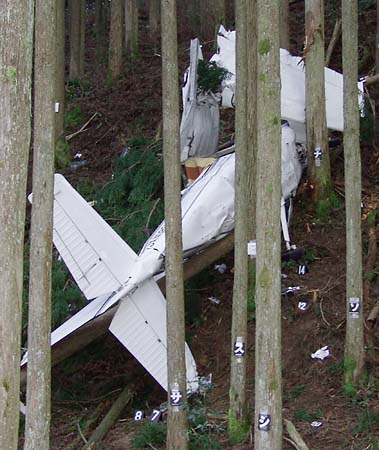
172 Crash at Kagoshima, Japan
2002-1-04, Pilot(46 yrs),and co-pilot seat were dead, son of pilot, 16 and friend were survived. After, Sea Diving trip. Kagoshima, Japan
-- Teruo Miyagawa, January 6, 2002
It's not entirely true that the factors in aviation safety are hard to do anything about. Something like half of all GA accidents are related to either flying into clouds while not instrument-rated and current, or running out of fuel. It's easy to avoid both of those.The fuel-exhaustion accidents aren't usually fatal, but loss of control in instrument conditions almost invariably is.
Joe
-- Joe Thomas, February 11, 2002
The Kennedys keep dying because they are rich enough to become expert skiers and fool around on the slopes. Or rich enough to buy their own airplanes and crash them into the water at night.Der Philip I think the above remarks are insensitive. Not that I consider the Kennedys special souls than other mortals. But accidents and tragedies do happen and for reasons we may or not know best, should avoid using the fate of others as examples on why flying can be dangerous.
No offense intended Chris Desouza
-- Chris Desouza, February 16, 2002
You fail to point out that at 0.34 fatal commercial airline crashes per million flight hours, if I flew for every hour of my life then I would expect to wait for about 350 years before I died. Surely this statistic suggests that being alive is riskier than flying?
-- James Smith, February 16, 2002
For sensible statistics on air safety visit THIS SITE
-- James Smith, February 17, 2002
As a co-techie contemplating aviation as a hobby, I carried out a similar back-of-the-envelope risk assessment recently, with similar conclusions. However, I approached it by trying to answer the question 'How likely is it that I will die in a plane during a lifetime of recreational flying?'.Assuming, say, 4hrs flying for just under half the weekends in a year, spread over 30 years of active flying gives an approximate lifetime total of 2500hrs. So the chance of dying is (16/10^6)*2500 - a rather scary 4%.
But compare that to a lifetime of commuting 20,000 miles a year and you get around a 1.4% chance of dying in a car.
So flying isn't so bad after all.
-- Jim Hanmer, April 5, 2002
I suggest you seek help in battling your fear of flying; you are obviously suffering from a phobia, probably induced by what you see in the media which is hardly reliable.As a pilot myself i can tell you that flying is far safer than you protray, usually. The VAST majority of GA accidents are caused by weather and, specifically, rookie and even experienced pilots who end up flying into it. With proper maintenance, the probability of a component failure in an aircraft is quite rare. Most accidents do not occur during takeoff and landing in GA - it occurs when pilots fly into poor weather situations, which can be attirbuted to the poor quality of flight instruction at many "be a pilot in a month" type schools.
Yes, fewer airliners crash than GA aircraft, but put into perspective how many MORE g.a. aircraft there are in service... the crash rate ends up being about equal. Also, a GA plane crashes, for example, worst case scenario 6 people lose their lives. An airliner crashes, worst case scenario 400 people lose their lives.
It is not fair to attribute flight safety with the size of the aircraft; nor can you compare flying with driving. It just doesn't work. Before you go out and blame aviation for deaths of celebrities and announce that flying is a death trap, please do your homework to avoid looking like such a moron.
CM
-- Captain Matt, April 19, 2002
Though driving is safer than GA, you can actually control the risk factors much more in GA. For example there is very little chance of being hit by a drunk pilot.On the other hand if you fly only in good weather, to large obstruction free runways, in a well maintained modern plane and most importantly fly over flat terrain where you can always make an emergency landing - GA is much safer than the averages suggest.
In addition the accident record is clear than experienced pilots get into trouble not becuase of lack of skill - but because of lack of judgement. Another intersting quesion is how many GA accidents are suicides. There are very few accidents overall, and there are many accidents that are so stupid that one has to wonder if many are not high risk flights by pilots who don't care if they survive. These could greatly effect the statistics.
The safest flying I know of:
There has never been a fatal accident in a Katana in the US and only 1 worldwide. They have a stall speed of 38kts, a glide ratio of 15-1, and a very strong seat/cockpit design.
This may not be the most exciting flying in the world. But it is a lot more exciting than crusing down the freeway.
-- Larry Sama, May 13, 2002
My boyfriend recently crashed the Piper he was flying during takeoff. He had engine failure and crashed through power lines into someone's front yard. The wing fell off, fuel was spilling all over him, but remarkably, he walked away with cuts and bruises. He had borrowed the plane from another pilot and had flown it for a year without any problems. I'm terrified of him flying again. I'd really like some reliable statistics to gauge the risk of flying small planes.
-- jen Ho, August 8, 2003
One more comment... I've been a pilot for some years and there are very few people in the US that can pilot a plane and the beauty of flying a plane is more them most people could ever experience in a lifetime. I've seen more beauty then most could ever imagine. I've also been in several emergency situations but I assure you that with the intenense training of being a pilot you are apped for most situations. When you are up a 10000 feet with the moon gleaming off a big lake you realize that in your lifetime you out of very few will ever experience that beauty.I guess I could spend my life smoking and drinking not to accomplish anything in life or fly a plane knowing I've accomplished what billions of others only dream of, so I guess it is all about choices.
-- James Paul, May 17, 2005
GA is a hobbie just like collecting motorcycles, playing sports or what so ever... The thing I can assure you of is that pilots are the most highly trained of all. Accidents happens and I don't know what is safer but sometimes you have to ask yourself are you really doing what you love to do? If you put GA in perspective to motorcycles and to some sports there is no comparison. So many people get wrapped up into comparing GA to cars when really there is no comparision as the proportions don't compare but after watching my mom pass do to cancer which kills more people then both combined. I have to believe that you have to let people fullfill there dreams. You can never tell someone their chances are greater one way or the other, because you are limiting their dreams and hence are they truly happy.
-- James Paul, May 17, 2005
I survived a plane crash in Dijon, France in 1998...We were flying in a Rockwell Commander (4-seater). Both the pilot and co-pilot (who was a Flying Instructor/Examiner) were killed instantly. Both myself and the other passenger sustained critical injuries. Prior to the accident, I myself had flown light aircraft for just under 100 hours in the UK. I witnessed many near-misses and often heard of planes creashing,usually on landing. From my own experience and of hearing of the circumstances of other light aircraft crashes invariably it is put down to pilot error or occasionally bad weather (but then in my mind a good pilot wouldn't take chances knowing the weather may change....).I think some people, once they have their PPL, become laisez-faire and very often, especially when taking friends on trips, tend to show off and that's where the trouble lies. They also become complacent. Of course, not all pilots act this way but many do.
-- jan mansfield, August 6, 2005
I'm just starting with lessons. I'm not worried about dying in a crash. For one thing, EVERYBODY dies of something eventually. Life is a terminal disease. Second, though it is true that flying a light plane is statistically "more dangerous" than driving, it is also true that the odds of dying in a plane crash are still very low. "20 times more likely...." sounds scary, but if you're talking about 20 chances out of a MILLION, that's still pretty darned small. Lastly, flying safety is something a pilot can actively do something about. You have control over most of the risk factors. Since I'm doing it strictly for fun, there is simply no reason to tempt fate by flying in less-than-ideal conditions. With experience I'll probably push my own envelope a little bit more, but how big that "envelope" is is still a choice that I make. Nearly all so-called "accidents", in planes or otherwise, happen because somebody does something they shouldn't have done...or didn't do something they should have. Human error is not an "accident."
-- Eric Anderson, July 4, 2006
You conclude that "General Aviation" is not as safe as flying with an Airline. Some users comment that General Aviation is a hobby only.What about General Aviation Corporate Jet Companies, Rescue Operations (Medevac Jets and Helicopters) etc...
I think the difference in safety is directly related to standards and quality of training.
If you are a professional, no matter if at an Airline or GA outfit, your qualifications and subsequently your training is of higher standard.
I think flying on a Clay Lacy Jet or any aircraft of a similar outfit is just as if not safer than an Airline (for statistics: who do you think builds up those 1000000 hours faster, a major carrier or your rental Gulfstream).
Finally..what hell will aviation come to if people who do this as a "hobby" only (therefore having less qualification and training) suddenly fly little Jets up in an airspace where the above mentioned "traffic" might suddenly become a factor, not at last if you knock out a widebody carrying hundreds of people.
Really like this website! Keep it up, Patrick
-- Patrick L., February 11, 2007
I've got to agree with Phil here...There is a fundamental difference between using an aircraft for transportation (time sensitive or not) and using an aircraft for recreation. There's a reason that long-leg, cross country flights are part of the private pilots license requirement. The first is that, well, aircraft are used primarily for transportation; you, as a general aviation private pilot need to be prepared to do this. Second is that there are a bunch of extra parameters that must be managed when using an aircraft as transportation (far-end weather, fuel management, navigation, air traffic control, potential night time arrival at an unknown/unflown location, passenger expectations, get-homeitis, flying closer to gross, etc.).
If you're flying is transportation oriented, you're doubling or tripling your workload as a pilot. From a technology prospective there are a bunch of things that have been done and still remain to be done to decrease that workload and put traveling general aviation pilots back into their comfort/ability zone... the fact of the matter is, though, vast majority of general aviation cockpits are chock full of 1950s technology. FAA chart and data policies don't help matters either.
-- anond trol, April 17, 2007
Franklin E. Fraitus wrote: "Homebuilt/experimental aircraft have a much higher fatality rate (5-6 times worse?)"According to the EAA that statement is incorrect:
"Studies by FAA and the National Transportation Safety Board (NTSB) show that Amateur-Built/Homebuilt aircraft have an accident rate less than one percentage point higher than the general aviation fleet. In fact, the accident rate for Amateur-Built/homebuilt aircraft is dropping. The total number of registered homebuilt aircraft is increasing by about 1,000 per year, while the total number of accidents has stayed virtually the same. Another good barometer of safety is insurance rates. Companies that insure both homebuilts and production aircraft charge about the same rates for owners of either type of airplane. That indicates a similar level of risk." (http://www.eaa.org/education/homebuilt_faq.html)
-- Stephen Kearney, September 26, 2007
Flying is a unique experience. Some of best hours I've ever spent were at the controls of a little Piper at 5,000. If YOU have the itch and have to scratch it, do like Phil did on his Thanksgiving trip: when you have a choice and can either take a chance or play it safe, ALWAYS play it safe. That will go a long way towards keeping you healthy, but don't think that you aren't still accepting some risk - the cold statistics are that flying your own aircraft is about as dangerous as riding a motorcycle. Trying to ignore that sad fact ("you'll be safe if you just stay out of weather, and don't run out of gas") is just sticking your head into the sand.
-- Bill Barry, October 1, 2007
I agree with above "The Most Dangerous Words a Pilot Can Say". Two of my friends died in a fatal light plane crash over the Alps a few weeks ago. The pilot and passenger on the right hand side of the plane survived. At the moment, I find none of the above statistics, comparisons and usercomments helpful, as the 200% reality for me at the moment is not the statistics but the fate of my two friends. The weather was a factor in this one. Since all had work the next morning I am wondering if this was also a factor. I can understand a PP would accept the risks of the hobby .... but tell me.. do your passengers understand and accept the risks ? I was also offered a seat on that plane, without anyone explaining the risks I would have been taking, and it was (what turned out to be not such an irrational) fear that stopped accepting. When we fly we are at the mercy of enormous physical forces, far greater than that in a car, or indeed a motorcycle."A safe attitude with a small airplane starts with the assumption that no flight is going to be made at the time and date planned. It might happen if the weather happens to be good and the flight looks as though it will be enjoyable. The plane is a recreational toy with transportation as a side benefit." Wise words on private flying in small airplanes.
-- Izy Scott, October 3, 2007
To clarify my somewhat inaccurate statement about homebuilt aircraft safety in comparison to certified aircraft. Please take the time to go to the NTSB website. In particular please visit the following address: http://www.ntsb.gov/publictn/2007/ARG0701.pdfMake sure to view page 15.
However, I was incorrect in thinking that the data was not fully processed. Homebuilt aircraft are not factored in to single engine piston (as far as I can tell).
Using the 2003 NTSB published numbers:
1) certified single engine piston fatal accident rate of 1.41/100,000 flt hours.
2 Amateur built aircraft have a rate of 5.5/100,000. The statistic quoted by the EAA is simply that the ratio of fatals to the number of accidents is not different than in certified aircraft. In other words, if you have an "accident", you are no more likely to die in a homebuilt than in a certified. The fact remains that one is about 4 times more likely to have an accident, and therefore 4 times as likely to die in a homebuilt, depending on the statistical year in question.
In fact, twins, rotorcraft, gliders, turboprop and homebuilts have a worse fatal record than certified single engine aircraft.
As I learn more about this subject, I have come to respect those who manage a lifetime of safe flying. I will do my best to achieve that goal. I am sure some serious study is in order.
Franklin E. Fraitus
-- Franklin E. Fraitus, October 20, 2007
Dr Phil,I am currently doing my risk management and assessment. I took an elementary statistics course in college, so, you can understand my complete confusion. In any case, I agree with your comparison of aviation vs. automotive risk. However I would like to see a more targeted comparison for the following reasons:
1) Automotive risk is roughly half if you are not drinking. 2) Automotive risk is lower still if you are in the moderate age group, maybe 35-65 years old? 3) Automotive risk is also reduced by daytime driving. 4) Homebuilt/experimental aircraft have a much higher fatality rate (4 times worse?). I think these are included in general aviation's statistics (edit: maybe not?). What would the result be if this one item is removed? 5) The statistics also include large single engine aircraft, such as warbirds (edit: maybe not?).
I am sure there are plenty of other ways to "modify" the data.
Since I do not drink at all, and I am within the "safe" age group, from my calculations, if I drive during the day, it is actually safer to drive than to fly airlines on a trip less than 300 miles.
There are so many ways to look at this situation, how do we look at it accurately? How does one get a meaningful number that actually reflects that individual's situation?
Franklin E. Fraitus
-- Franklin E. Fraitus, November 3, 2007
Im an instructor in the busy skys of phoenix az.I have a close call on a monthly basis mostly because other people arent talking on the radio and or complacency of the other "weekend warriors" out there. Pilots have the second most dangerous job in the US. Its not weather however a mid air that scares me.There too many underqualified people out there that have no idea that the next five minutes has not happened yet.SEE AND AVOID!! TRANSMIT YOUR LOCATION!! THERE IS NO SUCH THING AS THE BIG SKY IDEA ANYWHERE WITH THE EXCEPTION OF ANARTICA!!AVOID FORMATION FLYING UNLESS YOU KNOW AND HAVE RECIEVED TRAINING!! AND DONT DO ANYTHING STUPID!!fly safe folks
-- Jesse S, January 8, 2008
At 36, I have three young boys and a stay at home wife. I wonder if my need to take the risk of general aviation is simply a selfish pleasure or comes from somewhere deeper within. I wear my seatbelt, have never been ticketed for speeding, manage my finances with the needs of my family first, and generally attempt to put the needs of those who absolutely depend on me first and foremost.Why then do I strap myself into a 2,500lb flying Honda and accept a risk that others would never, in a million years, accept?
While I still struggle with the answer, I continue to come to this conclusion. I, simply, was made to fly. Where so many others look at flight instruments with complete bewilderment, I literally could not wait to find out how to use them.
Sitting behind a Southwest 737 at a Class Bravo airport for the 1st time, with less total hours than the pilot in front of me gets in a month, I anxiously await my next my next ATC instruction, and hope my training has prepared me. It's simply irresistable.
-- Chad Degges, April 16, 2008
Excuse me, but the proper statistical comparison would have to be between flying a small airplane in a straight line from San Francisco to Catalina Island at an elevation of 9000 feet, versus driving a small car in a straight line from San Francisco to Catalina Island at an elevation of 9000 feet, would it not?
-- mark crane, April 28, 2008
One should never assume that only stupid pilots run out of fuel. First of all, there are no gas stations in the sky. Second, filling all the seats often means taking off with partial tanks. Third, unexpected weather can cause a change in routing or a greater fuel burn due to winds. Fourth, forgetting to lean or switch tanks can be a factor. But lastly, one of the biggest problems is that UNLIKE many other emergencies, running out of fuel is a very gradual problem. Just like the lobster that is put in a pot of cold water then heated, you may not know you are "cooked" until it is too late.
-- David Sanford, September 29, 2008
Looking at the most recent NTSB General Aviation Accident Data (2005, http://www.ntsb.gov/Publictn/A_Stat.htm), one thing struck me - the vast majority of accidents occurred without a flight plan, even though the majority of accidents were on non-local flights. Correlating with FAA activity data (http://www.faa.gov/data_research/aviation_data_statistics/general_aviation/CY2005/) suggests that filing a flight plan is a very good thing. The FAA activity data includes air taxi, but even assuming all the air taxi hours were on a flight plan, the accident rate per hour for flights without a flight plan was nearly five times that for flights with a flight plan. Factoring out the (higher accident rate) amateur-built, rotorcraft, and glider accidents doesn't change this much. The data on local vs. point-to-point accidents is harder to discern, but removing the 618 local accidents from the
no flight plan totals(and not removing the corresponding flight hours, as this data doesn't seem to be available), non-local flights without a flight plan still had a much higher accident rate.This does make sense: filing a flight plan demonstrates a level of preparation (weather briefing, etc.) consistent with an informed go/no-go decision.
-- Clifton Bingham, July 13, 2009
The trip examples that Philip gives, being 24 hours late and severe turbulence are really quite rare, and far from the norm.Also, filing a flight plan has NOTHING to do with the quality of the pilot or his flight planning.
GA can be as safe as one wants. It's not a toy, it's a valuable method of transportation like a car or airliner, that fills a gap very well between 100 and 1000 miles.
Now, pilot skills and training are a requirement for safe flight, but with training and reasonable planning GA can come very close to the reliability of airline flying, without the hassles and delays.
I hope I'm a good example, with 8 Million accident free air miles (22K hours), with good training and good equipment, my dispatch reliability is 99%. And when the trip can't be flown safely, I just delay or cancel... period.
It's a GREAT way to travel.
-- steve SMITH, October 13, 2009
Steve (immediately above): Congratulations on your 99 percent dispatch rate, but I don't see how it is possible in a standard GA airplane (not approved for known icing conditions) in a four-seasons climate. Here in Massachusetts, for example, icing conditions prevail for at least four months out of the year at typical IFR altitudes for non-pressurized planes. Even a pressurized plane would have to climb through icing conditions. As I type this comment, there is an airmet for icing covering all of Massachusetts from 2000' to 16,000' MSL. The ceiling at KBED, our home base, is 300' AGL. Unless you think that you can scud-run underneath a 300' layer of clouds (a tough challenge given that we have hills and antennae that are 1500' high), you would not be able to fly legally out of our airport right now (i.e., if you had a business meeting scheduled you would miss it).I'm not sure how you're dodging thunderstorms to achieve your 99 percent dispatch rate, but let me share a few stories of flying around the Northeast U.S. in just the month of August 2008. Our aircraft was a 50-seat airliner with two jet engines, hot wings, onboard radar, and a two-pilot crew. We sat on the ramp for several hours because the airports were closed and all personnel had to retreat inside to avoid being struck by lightning. We sat on the ramp for several hours while personnel and passengers in Cincinnati went underground to wait out a few tornado watches. We landed in Scranton, PA instead of Newark, NJ because thunderstorms were blocking our path to Newark and we were getting low on holding fuel. We waited on the ground at JFK, DCA, and other airports for perhaps 15 hours total because thunderstorms blocked enough of the IFR routes that the system's capacity was reduced. We taxied back to the gate to add more fuel, after waiting an hour or so on a taxiway, because our new route assignment was longer and would have required more fuel than we had on board. All of these delays and diversions occurred in about 21 calendar days. A GA pilot might have escaped some of these problems by going to/from less busy airports, but remember that we were backed up by all of the resources of one of the world's largest airlines.
-- Philip Greenspun, October 13, 2009
Hi Phillip,I've been following your website (all aspects) for a few years now--great material. Quick comment on one of your sections: "Why a Beginner Pilot Can Be Safer than a Retired Fighter Jet Pilot." I'm getting ready to retire from the military as--yes--a fighter jet pilot.
The "experienced guy--GO; new guy--NO-GO" decision isn't as described. After flying many years in the Air Force, we've come to develop outstanding "GO/NO-GO" criteria to mitigate risks. It is based on aircraft maintenance condition, numerous weather factors, 24-hour lookback for fatigue, and recent flying history and hours in type. We truly understand real hazards and mitigate them pretty well. Most of those airline pilots (.34/million) flying you around are said retired military guys.
I would challenge you to think of that experienced fighter pilot as a pretty good "GO/NO-GO" barometer even as he transitions back to GA flying--like I'm doing now. I realize the GA plane is not my F-16. We are even MORE cautious for that reason. So if you are on the ramp, and see the crusty-retired guy look at the weather, shake his head, and walk away from his sortie--you probably should too.
To correct the analogy-- I think (and have statistics to back it up, and experience) the 100-hour to 500-hour guy is about the highest risk taker out there. Freshly confident, but not yet experienced in real hazards--I.e. hasn't had the s*&# scared out of her yet.
Again, love the photography/book/computer/aviation discussions. Fly safe!
Darrell Thomas, Maj USAF
-- Darrell Thomas, February 9, 2010
Major Thomas: I think that you misread the article. I did not say that a beginner pilot could be safer than every retired Air Force fighter jet pilot. Nor did I say that the average beginner pilot could be safer than the average retired Air Force fighter jet pilot. I said that a cautious beginner pilot, realistic about his or her own limitations, could be safer than an overconfident expert pilot.A friend down in Panama bought an ultralight. My friend had about 20 hours of flying experience and operated the ultralight uneventfully. He shared the aircraft with a retired F-16 pilot. The former F-16 pilot justifiably had much more confidence in his abilities than my friend, a raw beginner. He flew it low and fast up a twisty winding river, snagged a wing tip on a tree, and wrecked it.
Air Force pilots are not immune from making GA-style mistakes. http://www.delawareonline.com/article/20060614/NEWS/60614001/Air-Force-blames-crew-for-C-5-crash is about the three very experienced USAF pilots and two flight engineers who, after shutting down an engine, (1) elected not to fly around and burn off some fuel before landing (so they were heavy), (2) elected to use full flaps despite the reduced power available from three engines (because they were heavy and didn't want to be fast and therefore stress the brakes), and (3) inadvertently reduced power to idle on one of the operating engines (thinking it was the thrust lever on a shut-down engine), thus leaving the aircraft with full flaps and two engines. This resulted in the C5 coming down short of the runway and the destruction of the $170 million airplane.
-- Philip Greenspun, February 11, 2010
I like the article. As a low time private pilot (<200 hours) with 2 young kids and a wife who depends on me, I have spent quite some time reading the NTSB reports. I focus on the deadly accidents and the accidents for the airplanes I fly or aspire to own. The goal is to learn about why and then eliminate those risks that I can from my flying.What I see is: Stay out of light helicopters - These are 20% of the fatal accidents in a given month - I don't know the ratio of fixed wing to rotor wing pilots but am sure it is much higher than 5:1. Stay out of high performance Home Builts - These are also about 20% of the fatal accidents in any givng month - lots of landing accidents. Continued VFR flight into IFR is fully 60% of the fatal airplane accidents. Running out of fuel or fuel contamination accounts for 20% of the fatal airplane accidents. The remaining 20% are a smattering of various mechanical failures and other things.
The way I see it, if I stay in factory built certified airplanes and avoid the helicopters I have cut my risk by 40%. If I do a proper pre-flight and verify fuel quantity and quality and stay out of the IFR environment (until properly trained and certified) then I can cut 80% of the remaining risk.
If I practice what I preach, I can reduce my risk of dying in a plane wreck to 2 x the risk of dying in a car wreck. In comparison to more common activities, a motor cycle rider is ~ 5 times more likely to have a fatal accident than a person in a car.
As you pointed out, the risks are manageable, but it does take discipline.
-- Hans Mathews, December 11, 2010
Hans: Thanks for your personal perspective on helicopters. The Nall Report (latest at http://www.aopa.org/asf/publications/09nall.pdf ) says that the "overall accident rate [for non-commercial helicopters] was only 7% higher than that for non-commercial fixed-wing fixed-wing flights; the fatal accident rate was 15% higher."Remember that non-commercial helicopter flights are often from backyards and out to yachts bobbing in a harbor. Or they are students practicing autorotations (i.e., intentionally rolling the throttle to idle, which is a much more challenging situation than in an airplane). A helicopter operated airport to airport and without any simulated failures may well have a lower accident rate than fixed wing.
-- Philip Greenspun, December 11, 2010
As a 43 year old aviation enthusiast for many years, I have decided to seek my PPL and have scheduled an introductory flight 2 days from today. After reading the info on this site about managing risks in GA, I have decided to call the flight school and reschedule my introductory flight for another day because the weather outlook is for 15 knot winds with gusts to 26 knots. This may not be a big deal to some, but I count it as my very first decision in an attempt to manage risks as a (future) pilot. God bless you and thank you.
-- William Joseph, January 3, 2011
William: Gusting 26 isn't much fun in a light airplane. One of the luxuries of private/recreational flying is that any of our flights can be rescheduled for maximum enjoyment, comfort, and safety.[Gusting 26 isn't that bad if you're planning on going somewhere because you'll climb up to 7500' or so where the air is typically much smoother than near the ground. Flight training, however, tends to stay close to the ground and therefore the bumps.]
-- Philip Greenspun, January 8, 2011
Hi Phil, In January I lost a friend in an accident that arose from the loss of power on take off http://www.ntsb.gov/ntsb/brief.asp?ev_id=20110105X25845&key=1 He was an ex-boyfriend of my youngest sister. He was quite accomplished for a private pilot, 3000 hours or so of time.My friend lost an engine shortly after takeoff. He was leaving a pilot community and there were multiple witnesses. One interviewed on TV said he made 300 ft or so, the NTSB say 100. Shortly after the loss of power the plane turned left and crashed.
As I think back on my own training, I clearly recall the instructor pulling power at just a hundred feet or so of altitude after take off and flying ahead to the cow pasture that was at the end of the runway (we never landed - but we got within just a few feet of doing so - the cow pasture belonged to the airport owner). However, 15 years and at least 2 BFR's later (I quit flying for a while), I have only had discussions, no practice. There is an excellent article in the December 2010 Flying called "Big Push, Impossible Turn" that deals with this situation. I read it, but not with any thought. Less than a month later, I lost my budy to exactly the type of accident described. I am a bit more motivated now.
So, my budy was in a "high performance (originally home built design) aircraft", he had an accident during the take off phase. Basically everything was stacked against him. High angle of attack,low air speed, high glyde speed (in excess of 100 knts) and an unforgiving high performance airplane. The only thing he could have had in his favor was training, but nearly 20 year into flying I bet it was way back there.
Before every flight, take a moment and say outloud "I will fly straight ahead if my engine fails on takeoff and I am less than XXX ft" (500 for me and small turns are allowed miss obstructions), "I will not attempt to turn around below XXX feet" (700 for me, by now I am turning crosswind), then remember "BIG PUSH" visualize what you are going do.
The only chance we have in this situation is training. Chopping the throttle for practice is not practical at many airports, but a mental reminder and visualization will at least give you a chance.
Hans Mathews
-- Hans Mathews, February 24, 2011
I have to agree with Philip here. Not to say that each aircraft disaster has the potential to be chaotic, or sad; but rather that for the amount of time (total) all pilots spend in the cockpit of an airplane with the engines running, the amount of people dead is far less substantial than the numbers of people who die in vehicular related crashes/mishaps. Just as a small example: (http://en.wikipedia.or/wiki/Aviation_accidents_and_incidents#Statistics) Even though wikipedia is not always 100% credible;e, the statistic in 2005 with 1,459 lives lost in 185 accidents is far less than the amount of people who dies, not to mention permanently injured by car related incidents. (http://www.car-accidents.com/pages/stats.html) This website states that, "nearly 6,420,000 auto accidents in the United States in 2005 were reported, "and that, "there were 2.9 million injuries and 42,643 people were killed in auto accidents." That is quite a few people killed in vehicles to airplanes. The correlation will be similar, I guarantee you, in the years to follow. Kirk
-- Kirk Choquette, June 6, 2011
'Not only stupid pilots run out of fuel'. A visiting flying instructor was discoursing in our club house about pilots that run out of fuel. One of our 'old hands', confessed that he had once run out of fuel himself. "and what was your excuse?" fumed the instructor. The reply, "Bullet holes in the wing."
-- Christopher Johnson, August 21, 2012
The words "absurd", "ridiculous", and "asinine" do not even begin to quantify how idiotically stupid it is that sectionals are not available on line or as a cd-rom.
-- Michael Cockrell, November 15, 2013
It seems to me that the arithmetic on the number of events per mile are incorrect for pilots and is wrong for two reasons. One the speed is usually closer to 150 mph than 100 mph for most small planes, and much faster for the larger and more powerful, often over 250 mph. And, (two) the number of incidents per hour was not divided by the mph to determine the incident per mile, even though that was what was claimed to have been done. Ie 1.6 incidents per hour, is 0.016 incidents per mile at 100 mph, and about 0.007 at 150 mph or much safer per mile than driving.
-- William Brutus, August 14, 2014
Flying aircraft with reciprocating engines is far more dangerous than the general aviation data indicates. I am familiar with the risks of small aircraft. I have flown some 350 hours in a Mooney and another 150 hours in a variety of aircraft, including Cessna singles (172, 182, 206), Pipers (PA-22, PA-28, PA38), Aercoupes, Pitts S2 and gliders. The overwhelming majority of general aviation hours are logged by corporate jets, which have most of the equipment that airliners have. My educated guess is that those who fly aircraft powered by reciprocating engines have a fatality rate of about 0.1 for each 1,000 hours flown. In other words, a plane that flies 1000 hours has a 90 percent chance of making it to the next 1,000 hours without a fatal crash. I have personally flown in five different aircraft that were subsequently involved in fatal crashes. My father (C-172), five cousins (Beechcraft 35), an uncle, my next-door neighbors (Beechcraft 33), several friends, and four polygamists to whom I sold my first Mooney M-20A have all been killed in aircraft powered by reciprocating engines. Flying small aircraft does not, of course, mean certain death. However, anyone who flies small planes ought to keep his life insurance policy current.
-- Angus Fox, January 28, 2015
Angus: Your estimate of 1 fatal accident in 10,000 hours is at variance with the data in http://www.aopa.org/Pilot-Resources/Safety-and-Technique/Accident-Analysis/Joseph-T-Nall-Report (the 2010 report is the last one with rates per flight hour).The fatal accident rate for home-built airplanes, nearly all of which are piston-powered, was about 0.4 per 10,000 flight hours. As noted above, in a comment, this falls to about 0.14 for certified per 10,000 hours. Still bad, but not as bad as your personal experience. And of course there are flight schools that operate 10,000 hours every couple of years for instruction and rental and yet don't have any fatal accidents (anecdotal evidence that 1 in 10,000 hours is an overestimate and the NTSB numbers are more or less right).
-- Philip Greenspun, January 29, 2015
This is a great discussion about an important topic. As a low time pilot with a young family to support, I think about this alot. The problem with flying as a hobby is that you are choosing to do something that is both unnecessary and 20 times more likely to kill you than driving a car. For 20 to 40 year olds in the USA, unintentional injuries (i.e. motor vehicle accidents) is the most common cause of death. By flying as a hobby you are significantly and unnecessarily increasing your chances of a premature death. VFR into IMC is hard to do if you take up fishing instead of flying.
-- Alec Macrae, December 30, 2016
I have seen a lot of comments about no FAA online charts, etc. I am curious how those people, last comment 2012, now feel with the advent of sky vector, foreflight etc. On a personal note about crashes, I recently flew a Sportstar. The ground handling was horrible (ultra sensitive nose wheel steering), no attitude indicator in many of them, not unflyable by any means, think old old school, the real forizon is the attitude indicator. I used alt indicator, airspeed and turn-bank indicators to compensate. Was actually good practice in that respect. DAY VFR ONLY! Any way on my second takeoff the aircraft slewed to the left side of the runway almost 30ı. I was holding the nose wheel light in a soft field way due to sensitive nws. I also had in right rudder as is typical, it still was going left. Airspeed was alive so got her into ground effect, banked her right taking my feet off the rudders completely gained speed and took off. I noticed rudder flutter with feet off and it went away as soon as I touched the rudders (adjustment/rigging issue?) anyway I flew the pattern, parked it after.Research that afternoon, revealed accident hx. That plane had been in RLOC and seems many other Sportstars.have as well. The Pilotıs foot can slide from the right rudder pedal onto the co-pilotıs left rudder pedal inadvertently ( I was solo). Seems this was my situation. This has taught me 2 things (pilots are always learning -24 years ago I started learning HaHa) and second, a check out is half the job for a new aircraft you are going to fly. Some research on model can be valuable. Case in point, out of the 98 or so Sportstars in the US, 20+ had been involved in accidents, most were Runway Loss of Control. Needless to say, even though soome adıs have come out since those accidents, I choose not to fly that plane anymore. By the way, air handling was great! Awesome website! Nice to see some rotarywing articles as well! Safe flying to all of you!
-- Ted Collins, February 6, 2018
The Aircraft from above comment
Image: EEEABC88-EDB0-49C8-BD9E-6EA0D05EBFFD.jpeg
-- Ted Collins, February 6, 2018