How was 2020 measured against the principles of Kwanzaa?
Today is the last day of Kwanzaa. From the History Channel:
Dr. Maulana Karenga, professor and chairman of Black Studies at California State University, Long Beach, created Kwanzaa in 1966. … Karenga combined aspects of several different harvest celebrations, such as those of the Ashanti and those of the Zulu, to form the basis of Kwanzaa. … The seven principles, or Nguzo Saba are a set of ideals created by Dr. Maulana Karenga. Each day of Kwanzaa emphasizes a different principle.
(Wikipedia notes that Dr. Karenga (a colleague of Dr. Jill Biden, MD?) was convicted of imprisoning and torturing two women.)
The Unity Cup ritual might struggle in the Age of Coronapanic:
The kikombe cha umoja is a special cup that is used to perform the libation (tambiko) ritual during the Karamu feast on the sixth day of Kwanzaa. … During the Karamu feast, the kikombe cha umoja is passed to family member and guests, who drink from it to promote unity.
The principle of Kwanzaa that is easiest to benchmark:
Cooperative Economics: Ujamaa (oo–JAH–mah)
To build and maintain our own stores, shops, and other businesses and to profit from them together.
As the largest, generally white-owned, enterprises ran away with all of the good stuff in the U.S. economy in 2020, leaving smaller stores and shops devastated, is it fair to say that 2020 was a terrible year for those who observe Kwanzaa?
Here are two that seem at odds with what happened in American cities:
Purpose: Nia (nee–YAH)
To make our collective vocation the building and developing of our community in order to restore our people to their traditional greatness.Creativity: Kuumba (koo–OOM–bah)
To do always as much as we can, in the way we can, in order to leave our community more beautiful and beneficial than we inherited it.
To the extent that the Black community is an urban community, isn’t it fair to say that American urban environments were first depopulated, as those with money fled to the suburbs and countryside, and then made “less beautiful” by the mostly peaceful protests?
On the bright side, here’s a 6,000-square-foot house in suburban Lincoln, Maskachusetts whose value is estimated by Zillow at $2 million. It is in a neighborhood of McMansions that is entirely Black-free in my experience. The residents have placed two signs reading “Black Lives Matter” on their lawn.
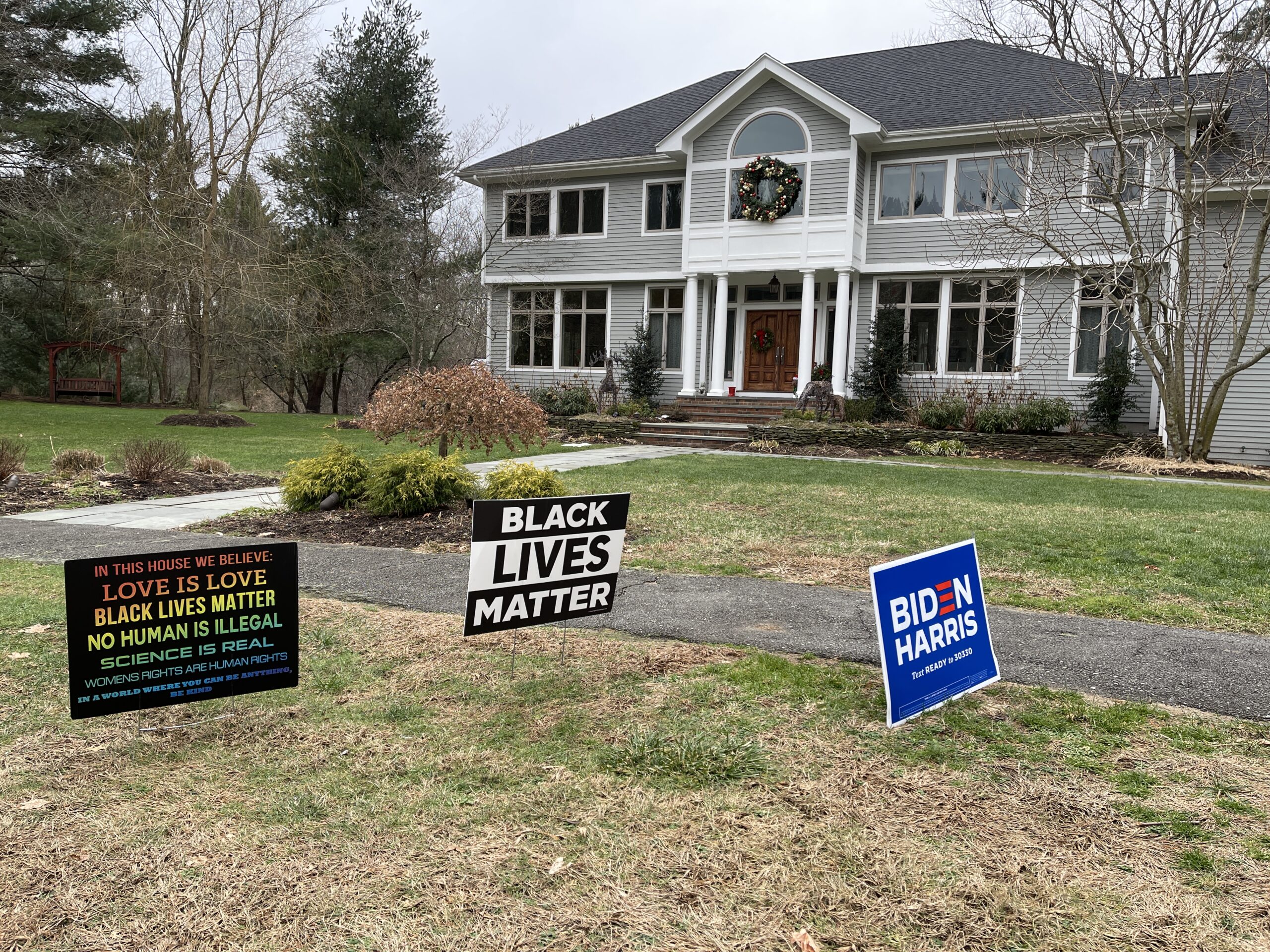
(also a sign for a political candidate who promises to keep schools for Black children shut for years, if a “scientist” tells him to order it (USA Today) and/or if the coronavirus manages to evolve to thrive amongst masked-and-vaccinated humans (double secret panic from the Atlantic))
Readers: Do you think the U.S. made progress or slipped backward in 2020 on the principles set forth by Dr. Karenga?
Also… Happy New Year to everyone!
Full post, including comments