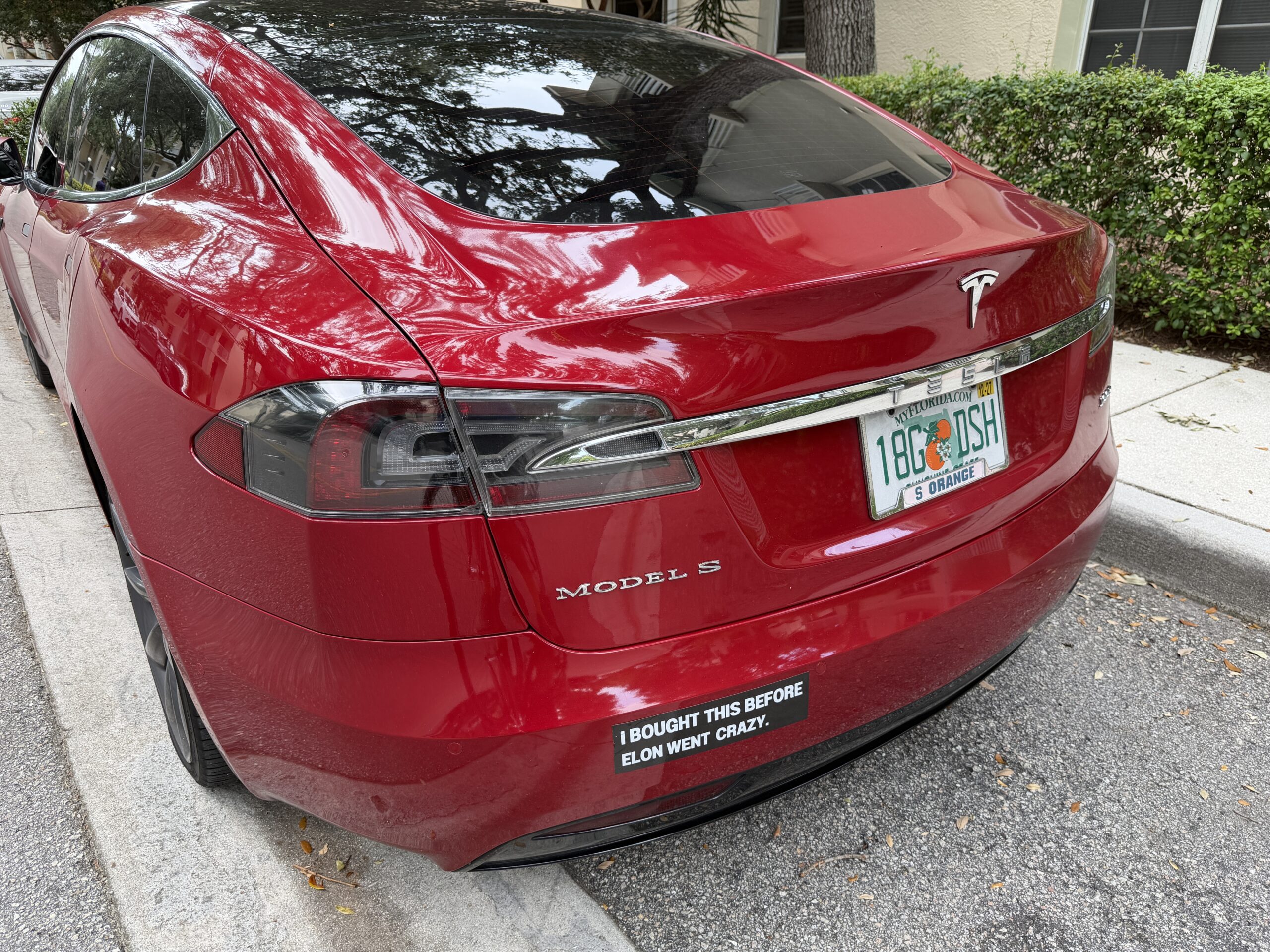
A righteous neighbor here in Abacoa (not everyone in Florida is Deplorable, especially here in Palm Beach County, though it is rare even for the Righteous to have a political/social justice bumper sticker), this afternoon:
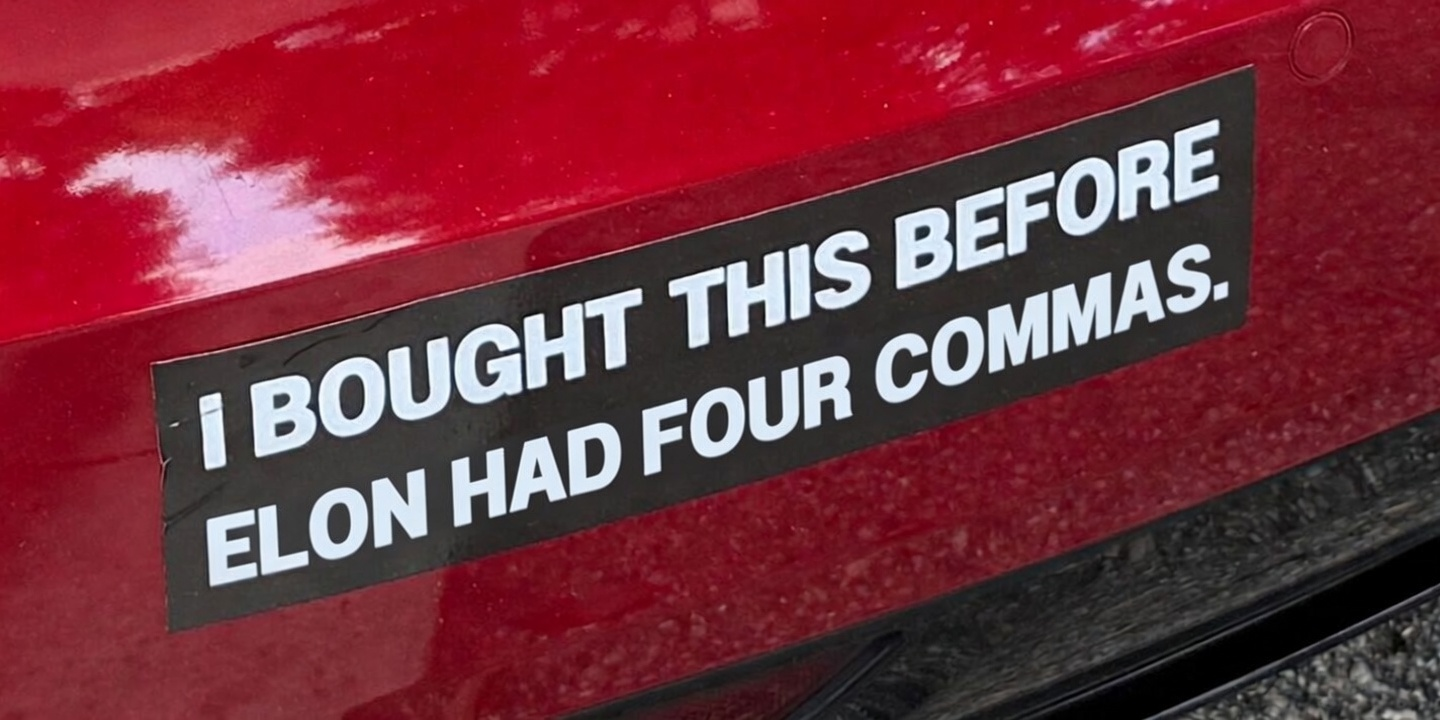
I asked Grok to redo it to read “I bought this before Elon had four commas” rather than “I bought this before Elon went crazy”:
The updated sticker is perfect for adorning any Tesla, of course, but it also makes sense for those of us with non-Tesla cars. We can proudly proclaim that we didn’t help Elon get to his envy-stoking level of wealth.
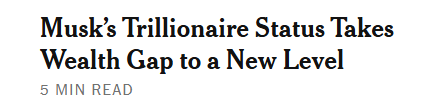
How are others dealing with their grief? New York Times front page:
The Native American community:
Elon Musk just became the world's first trillionaire.
The typical American household would have to work more than 11 MILLION years to make Elon Musk's level of wealth.
Elon Musk just became the world's first trillionaire. While working people struggle to get by, the billionaire class is becoming the TRILLIONAIRE class. It's disgusting. I'm fighting to tax the rich so we stop rewarding trading stocks over punching clocks.
(What evidence does Ms. Markey have that Elon ever “traded stocks”?
Bernie:
Today, Elon Musk, a trillionaire, pays the same amount into Social Security as someone making $184,500.
If we end that absurdity and lift the cap on taxable income, we can make Social Security solvent for 75 years and expand benefits by $2,400. My Social Security bill does that.
An envious California progressive at the peasant level of wealth for Palm Beach County (at least $30 million for Mx. Newsom and the female companion he/she/ze/they plucked from Harvey Weinstein’s hotel rooms):
Americans are struggling to pay for groceries and gas while Elon Musk becomes a TRILLIONAIRE.
When the federal government is for sale, the rich get richer and everyone else gets shafted.
(If California could confiscate 100% of Elon’s $1 trillion would that be sufficient to realize at least part of their high-speed rail dream?)
The grandson of Muhammad Kenyatta:
An economy that makes it possible for a trillionaire to exist, while the average American can’t afford gas and groceries, is fundamentally broken and rigged.
— Rep. Malcolm Kenyatta (@malcolmkenyatta) June 12, 2026
The pro-Hamas next U.S. Senator from the Islamic Republic of Michigan:
Happy IPO Day to SpaceX, which its investors presumably hope will be the future of space travel. Via this post, we can also look at the past of space travel.
Most air and space museums, including the Smithsonian, are primarily about showing artifacts and make little attempt to educate visitors. Seattle’s Museum of Flight is a notable exception and, thus, could easily occupy a nerdy family for a day. Here are some snapshots from an early June 2026 visit.
The SR-71, the world’s fastest airplane and one that reached the edge of space (85,000′), with the world’s slowest, Gossamer Albatross II, ironically placed just above it (in real life, the Albatross II flew mostly at 5-15′ in order to take advantage of ground effect).
How did the SR-71’s engines, designed for slower aircraft, function? A sign explains:
Maintenance might not be simple…
Notice that there is an aircraft on top of the SR-71. This is thoroughly explained (also sadly, since Roy Torick was killed in testing for the D-21B drone):
How about the camera? The museum displays the 30-inch Itek lens:
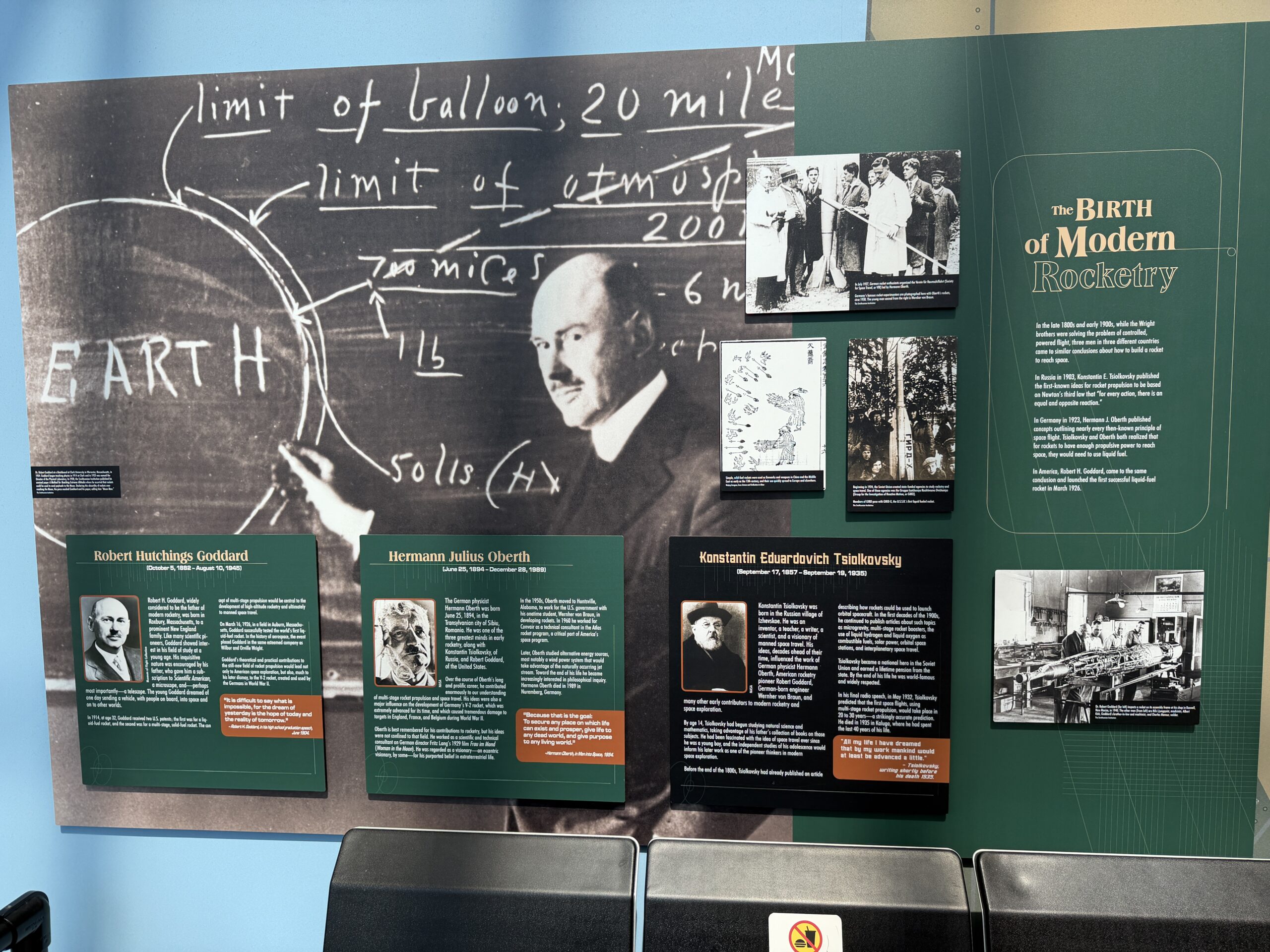
The Museum avoids American chauvinism, pointing out that modern rocketry was developed independently in three countries and that, before Goddard, there was Konstantin Tsiolkovsky in Russia.
(There is a big section on the Apollo program and the role of Boeing, and companies later acquired by Boeing, building equipment for it, but the photos aren’t too exciting.)
The World War II exhibit gives reasonable space to allied and enemy aircraft, e.g., a Yakovlev and a Nakajima:
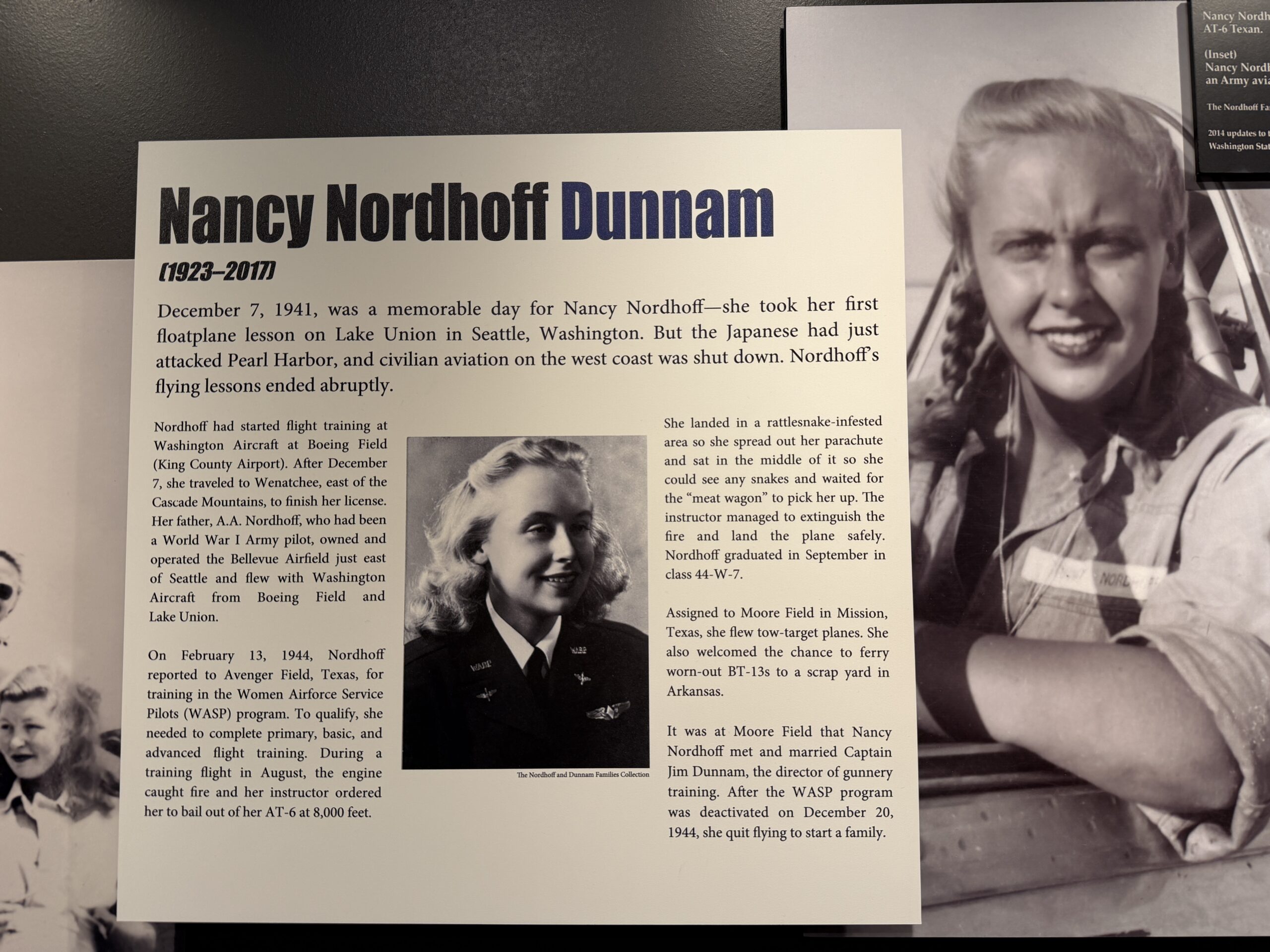
Equal space is accorded to female pilots who ferried aircraft over friendly skies and male pilots who flew in combat. Nancy Nordhoff Dunnam served in the U.S. between February 1944 and December 1944, most of which was spent in training. She lived until 2017. Richard Bong spent about two years in combat in the Pacific, shooting down 28 heavily armed Japanese planes, and died in 1945 while helping to bring the U.S. military into the jet age.
Were there any male pilots in WWII who did the same jobs as these heroic females, i.e., ferrying airplanes? ChatGPT:
In the U.S., aircraft ferrying was run mainly through the Army Air Forces Ferrying Command, later part of the Air Transport Command (ATC). Its Ferrying Division delivered newly built aircraft from factories to training bases and ports of embarkation. That system used AAF military pilots, civilian pilots, airline pilots, and women pilots including WAFS/WASP. The Air Force history page for the Twenty-Second Air Force says the Domestic Wing/Ferrying Division moved newly produced aircraft using “AAF pilots, civilian pilots, and women pilots” from the WAFS/WASP. The male civilian pilots came from several pools: airline pilots, commercial/private pilots, bush pilots, air-taxi pilots, crop dusters, business pilots, and pleasure pilots. … 27 male pilots per female pilot.
So… the gender that did 27/28ths of the work gets no credit in the museum. Congress and President Obama awarded the Congressional Gold Medal in 2009 to the civilian female pilots. Did the civilian male pilots who performed similar jobs get a similar honor? ChatGPT says “no”.
The Museum’s outdoor-but-covered exhibits include most of Boeing’s greatest hits, including the 747, an Air Force One 707, a 787, a B-17, and a B-29.
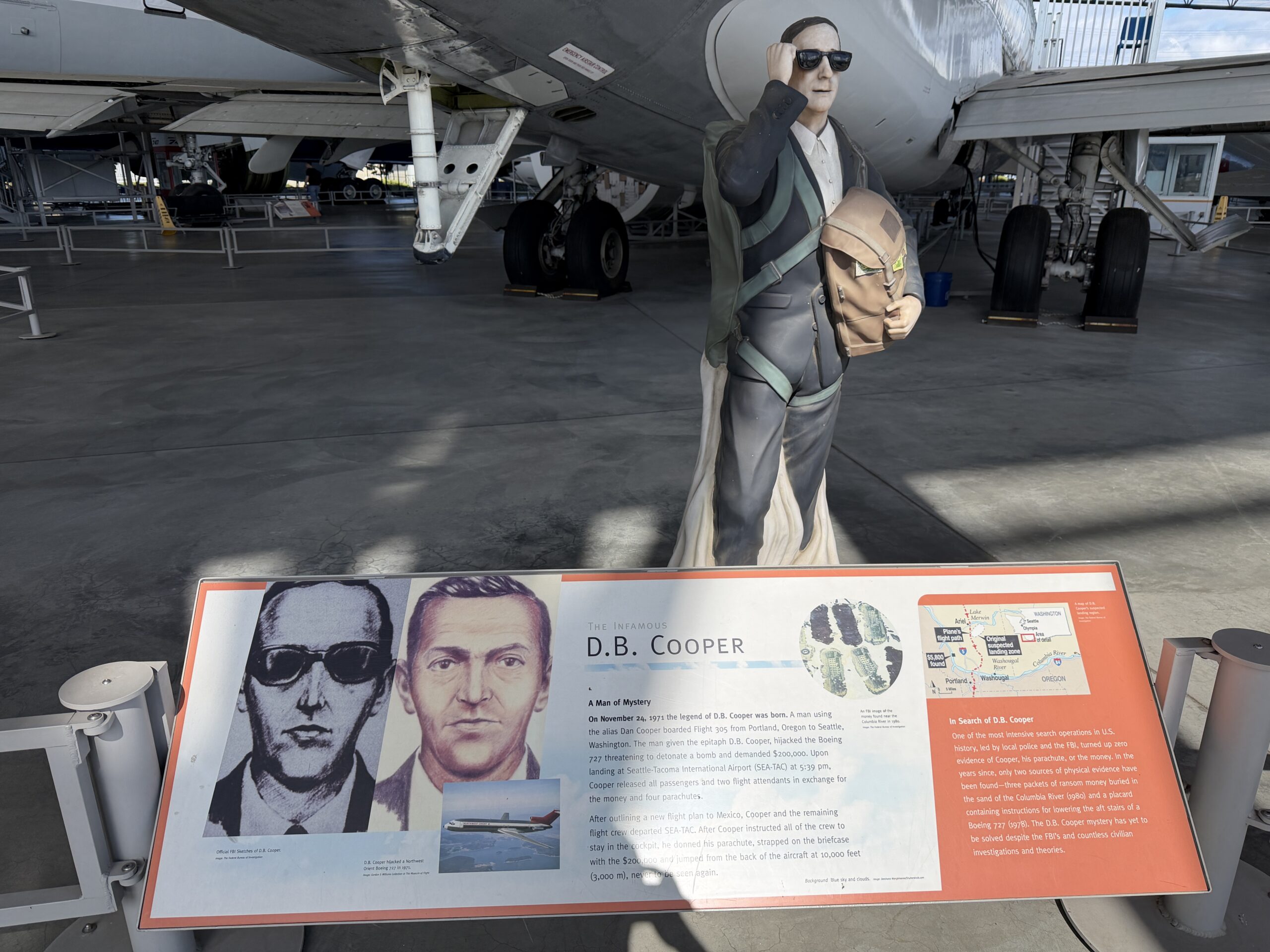
The 727 on display is accompanied by a D.B. Cooper sign:
There is a sobering Vietnam memorial, displaying a beautiful B-52 and also reminding us of the cost of war, nothing that we lost 10,000 aircraft in the war.
A notable omission from the plaques of names of men who were held as POWs: Robert L. Stirm. AP:
Stirm, a decorated pilot, was serving with the 333rd Tactical Fighter Squadron based in Thailand in 1967. During a bombing mission over North Vietnam that Oct. 27, his F-105 Thunderchief was hit and he was shot three times while parachuting. He was captured immediately upon landing.
He was held captive for 1,966 days in five different POW camps in Hanoi and North Vietnam, including the notorious “Hanoi Hilton,” known for torturing and starving its captives, primarily American pilots shot down during bombing raids. Its most famous prisoner was the late U.S. Sen. John McCain, who also was shot down in 1967.
As Wikipedia notes, however, the principal welcome that he received was being sued for divorce, under the nation’s then-new no-fault divorce laws, by the wife who’d been having sex with various new friends while the pilot was held prisoner. She obtained the house and car that he’d purchased, a child support revenue stream, and 43 percent of his military pension for her service on the home front (maybe her name should be on the wall as the person who made the greater sacrifice during the Vietnam War? A judge decided that fairness required that she receive the majority of the money that Robert L. Stirm was paid during his USAF career (only 43 percent of the pension, but she got 100 percent of his pay while he was a POW)).
Circling back to the interior, the museum shows a seemingly crazy rescue apparatus for pulling downed pilots out of the jungle (now “rainforest”) by helicopter:
What about compliance with the Washington State religion? Employees at the front desk are fully masked:
The museum costs $29 to enter or $3 if you’ve been wise enough to get an EBT card for SNAP or have any other evidence of being on “any form of government or public assistance”:
Anyone on what used to be called “welfare” can also get a family membership for $29 that includes an unlimited number of children and grandchildren for one year (normally $140).
As one turns away from the masked ticket agents (6+ years after coronapanic they haven’t been able to find a job that won’t expose them to tens of thousands of potentially infected humans every year?), the gift shop reminds visitors to “Celebrate Pride”:
The front desk near the outdoor section displays the sacred Rainbow Flag along with a U.S. Navy flag.
Although Seattle is an oasis of tolerance amidst a country full of haters, the Museum has had to set up a segregated “All Gender Restroom” separated from the main restrooms.
The gift shop also reminds us that aircraft are primarily designed, built, and flown by people who identify as “women”:
Let’s close by reminding ourselves just how much of the aviation industry was once controlled by Bill Boeing. The United Aircraft and Transport Corporation owned Boeing, Pratt, and United Airlines, among other companies, until it was broken up the U.S. government in 1934. It would be interesting to imagine an alternative history in which the vertically integrated company had stayed together. For one thing, founder Bill Boeing might have stayed in aviation instead of devoting his time to horses and racially restricted real estate development (Mr. Boeing agreed with future Harvard research that diversity makes a community worse, not better).
Finally, the 140 mph (supposedly!) Taylor Aerocar and the SR-71:
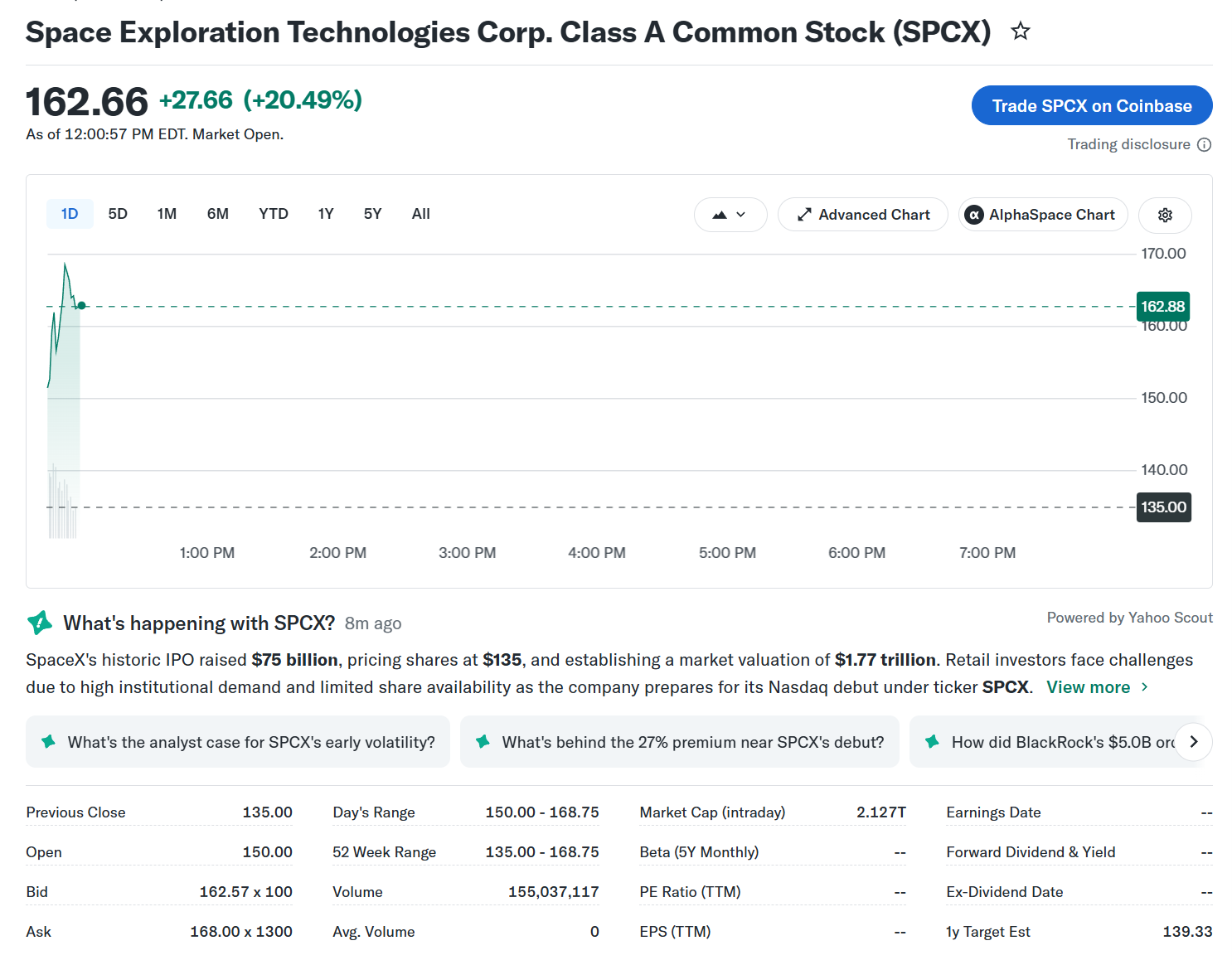
After about 15 minutes of trading, 155 million SpaceX shares had already traded. The total size of the IPO was roughly 555 million shares (plus the underwriters have the option of buying another 83 million). I don’t think that the pre-IPO investors have the ability to sell their shares yet, a lockup period being conventional. Are people truly flipping their shares for a 20% profit within 15 minutes? (10% profit after paying short-term capital gains tax to Graham Platner.)
The total shares sold:
Speaking of Graham Platner…
Elon Musk just became the world’s first trillionaire.
Let’s make sure he’s also the last.
— Graham Platner for Senate (@grahamformaine) June 12, 2026
Update: After one hour of trading, 272 million shares had been bought/sold on the exchange. Price is up to $168 without dramatic swings, suggesting some stabilization action by the underwriters?
As an index fund investor, I used to (indirectly) buy stocks that had been public for a while and only of companies that made a profit. The rules have apparently been tossed so now I will be a(n indirect) SpaceX shareholder. NYT:
Nasdaq, the exchange where SpaceX plans to list its stock, announced a rule change in May to allow “fast entry” into the Nasdaq-100 index by large private companies like SpaceX that go public.
Others followed. FTSE Russell recently altered its methodology, which will result in listing SpaceX in its indexes within a week of its going public.
The changes mean a large swath of index funds — which millions of Americans own in their retirement funds, pension plans and personal portfolios — are poised to hold SpaceX shares soon after the company goes public. Anthropic and OpenAI, the artificial intelligence start-ups that are planning to go public this year, would also land in index funds quickly, potentially exposing everyday investors to more financial risk whether they like it or not.
“It’s historically unprecedented,” said John Polonis, a former Wall Street lawyer who worked at J.P. Morgan and now offers financial analysis on social media. “You can try to reorient your retirement accounts to avoid funds invested in A.I. companies, but most people aren’t going to be doing that. They’re kind of left out in the dust here.”
Is there any integrity left on Wall Street?
One index provider has declined to budge. On Thursday, Standard & Poor’s said it would not change its criteria for inclusion in the S&P 500, one of the most-followed indexes, meaning SpaceX will not be eligible for inclusion until at least mid-2027. Standard & Poor’s said it had determined that exceptions to its rules “should not be granted solely based on market capitalization.”
What’s the long-term value estimate for this company? Humans cluster in metro areas, thus making fiber Internet and cell towers better than Starlink for most of us. ChatGPT: “roughly 75–85% of people worldwide who have at least a global middle-class/consumer-class standard of living live in urban, suburban, or peri-urban areas. I’d use 80% as the best single-number answer.”
SpaceX has the best rocket tech, but unless you’re Iran and want to kill infidels worldwide how many rockets do you need? Maybe the answer is military use of space rather than sending up packages that will rain down on the enemies of the righteous? But military equipment for use in space is incredibly expensive and takes forever to develop and build. Does a cheaper launch capability matter for the U.S. Department of War?
Elon says space makes sense for data centers, but I have a tough enough time maintaining the computer on my desk. If we want solar power and cheap land why isn’t Arizona, a Texas ranch, or central Florida a more sensible location?
How about the value of going to Mars? If a spaceship could accelerate continuously and indefinitely at 1g and decelerate at 1g how long would it take humans to get to Mars from Earth, all the while experiencing Earth-like gravity? Prof. Dr. ChatGPT, PhD Physics says 2-5 days. That would be an awesome tourism business. But, of course, SpaceX has no technology like that.
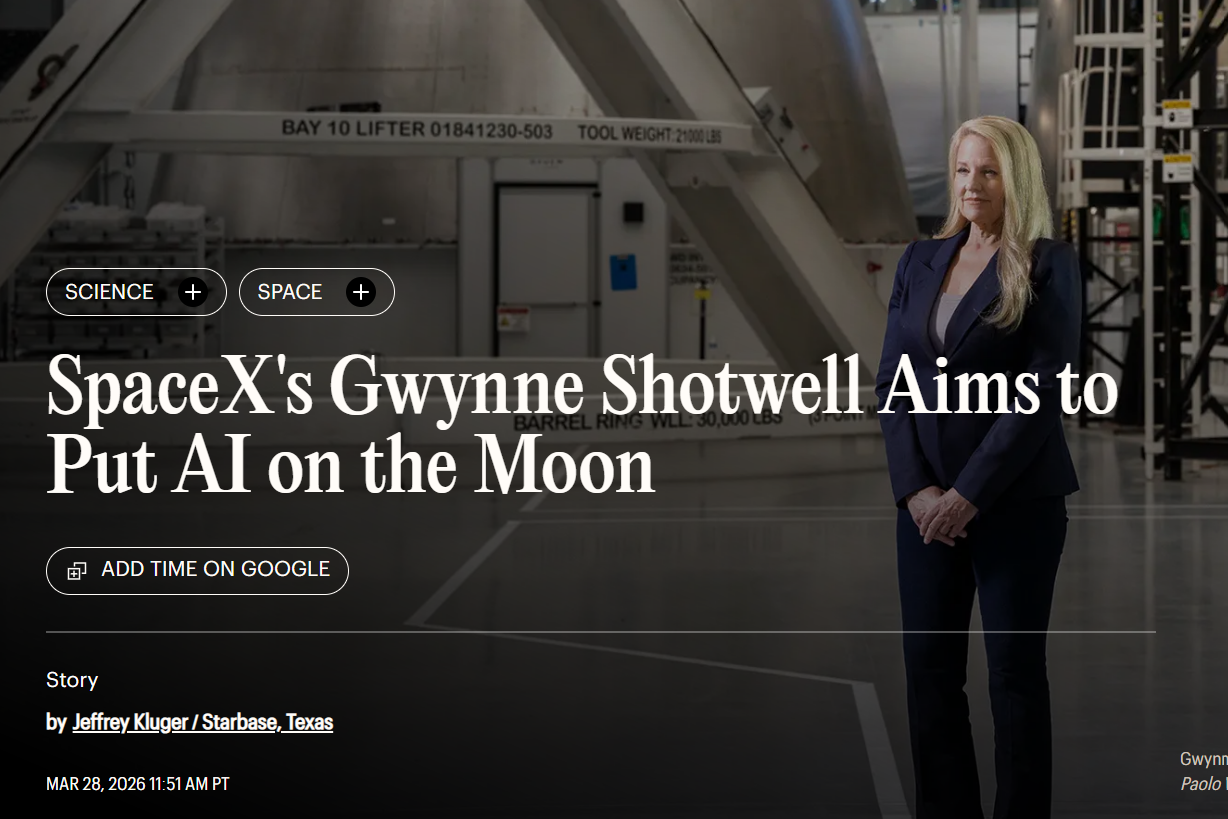
Perhaps the answer to the orbital-level valuation for SpaceX is that the company is run by a woman and we’re informed that female-led companies outperform their male-led peers. TIME:
Readers: What will SpaceX be worth five or ten years from now (in 2026 dollars)? What will have been seen as the main driver of value?
I’ll go first… because I believe in efficient markets, SpaceX in five years will be worth its IPO price plus 4% real return annually (about 21% over the IPO price). A narrow majority of the value will be from Starlink. (Note that this is like a probability expectation. I’m pretty sure that something dramatically good or dramatically bad will happen to SpaceX, but I can’t predict which is more likely and therefore my guess is right at the center. Analogous to the expected value of a coin flip game for $1 being $1 even though we know it will either be $0 or $2 and can’t be $1.)
A professional investor friend says that SpaceX would be a good buy at the IPO price because of the high percentage of retail purchases. “These retail investors come back in and support the price even after the inevitable post-IPO slump,” he said. “The more retail the better, contrary to previous prevailing wisdom.” If he had access to a large bock of SpaceX at the IPO price and without a lock-up, he would buy the block and sell it after a few days (i.e., right when a lot of index funds will be buying!).
SpaceX’s initial public offering has attracted demand for more than four times the available shares, according to people familiar with the matter, ahead of the Elon Musk-led rocket, satellite and artificial intelligence firm stopping taking orders.
SpaceX’s IPO is set to price June 11 and trade the following day. The company is offering 555.6 million shares at a fixed price of $135 each, which would raise about $75 billion, and value it at about $1.8 trillion.
I’m confused by the above. It says “set to price June 11” and the article is dated June 10. How was the price of $135/share already known on June 10? Separately, if the offering is oversubscribed by 4X, doesn’t that suggest the price is being set way too low? What about the duty to protect SpaceX’s existing shareholders by not giving away shares at such a low price that there are 4X as many buyers as shares? To avoid this abuse of shareholders, Google did a Dutch auction at its IPO (Google AI)
Google’s historic August 2004 Initial Public Offering (IPO) famously utilized a modified Dutch auction instead of the traditional wall street underwriting process. In this method, instead of investment banks setting a fixed price, individual and institutional investors bid directly on how many shares they wanted and the price they were willing to pay.
In mid-August the bidding began, based on our published expected IPO price range of $106 to $135 a share. … There weren’t a lot of orders, and to be frank, we wondered if we’d made a mistake in choosing an auction-based approach. The offers that did come in were at or below the low end of the range we’d anticipated. When the bidding period ended, it was clear that we weren’t going to be able to sell all the shares we had planned to sell in the price range we wanted. I met with the board to discuss whether we should delay our IPO and hope to get a higher price later. Our underwriters believed that we could close the IPO with a price around $80 to $90 a share if we reduced the number of shares for sale—a disappointing outcome. In the end we decided to close the IPO for a number of reasons, the most important being that it was time to put this chapter behind us and get back to running our business. So on August 18 we agreed to price it at $85 a share.
The rationale was simple: Take the short-term gains away from Wall Street and big money and give at least some ownership to the many consumers whose obsessive use of the search engine had allowed it to grow from a garage start-up into a multibillion-dollar phenomenon in half a decade.
But instead of pioneering a new formula for IPOs, with investment banks and big investment shops ceding control to the issuing companies and a wider universe of investors, the Google deal remains a historical anomaly.
Experts offer up two main explanations. The first is that auctions are risky. Banks get paid handsomely (7 percent of the offering amount is typical) to sell a deal to their clients, and in the process make sure prospective investors understand the business, competitive landscape and the state of the market. Through that work, they find what investors are willing to pay, so companies can be fairly confident that there’s adequate demand at the set price. An auction, meanwhile, is more like an investors’ Wild West.
The second reason is that Google’s offering wasn’t a real auction, but more of a hybrid. After all, there was clearly enough investor demand to price the stock at closer to $100, because that’s where the stock opened, but at the last minute lead underwriters Morgan Stanley and dropped it to $85. The low end of the expected range had been $108.
David Golden, a banker at JPMorgan, one of the many banks that served as an underwriter for the IPO, said the big investors decided just before the offering that without a reduction in price, they’d wait until the stock started trading and buy it on the open market rather than pay $100 a share or more in the IPO.
“Lo and behold, it was set at $85 a share, which built in a 15 to 18 percent profit that banks like to deliver to big institutional investors and that investors like to receive,” said Golden, who is now a managing partner at Revolution Ventures in San Francisco. Institutions “want to know that when they’re buying risky, illiquid securities, they’re going to have a built-in gain.”
Our government has provided us with a fresh fictitious inflation report today (the fiction is that a person can rent the same single-family home in the U.S. for 20 years and do so at a cost lower than mortgage, property tax, maintenance, insurance, etc.; “owners’ equivalent rent”).
Conventional advice for retirement saving is to buy at least some bonds rather than hold an all-stock portfolio. How can that work given the miserably low yields on inflation-protected bonds (TIPS) and the payments in nominal dollars that get ravaged by inflation any time our wise politicians feel the need to print money?
The formula’s central insight is that the future paychecks and retirement benefits that someone has yet to receive in their life are, when taken as a whole, like a bond because fluctuations in earnings aren’t strongly correlated with stock-market returns. For this 25-year-old, that big, bondlike chunk of future money means they could more easily weather a steep drop in stocks.
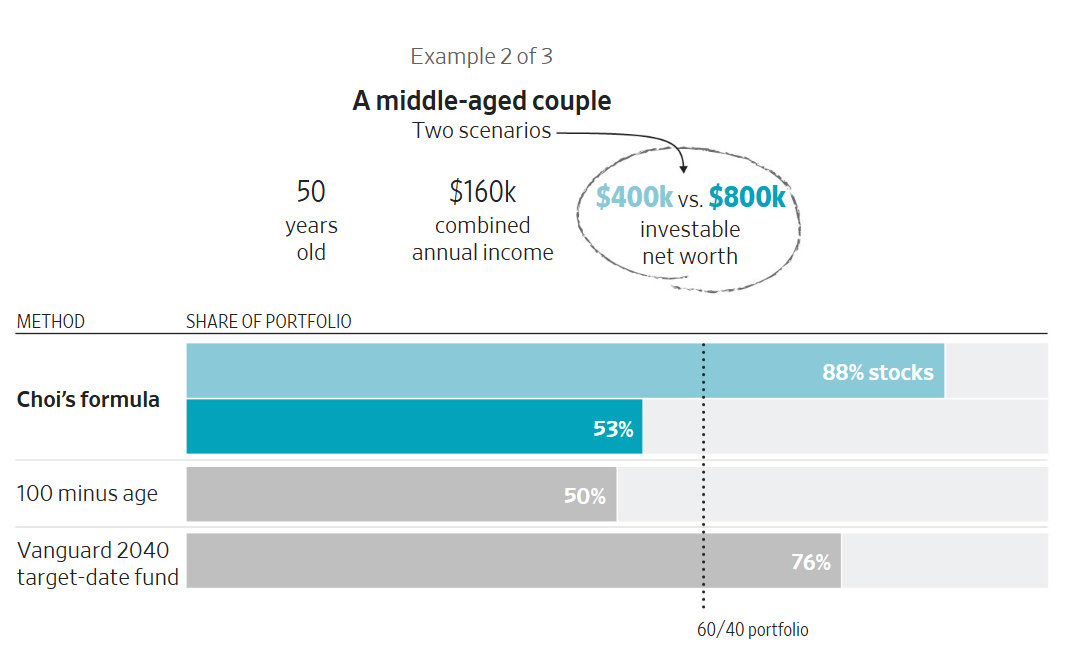
As another example, the way it treats a hypothetical middle-aged couple differs based on the amount they have saved up.
In both scenarios, the formula steers the couple toward a lower equity allocation than it did the 25-year-old, because a smaller share of their lifetime income is still to come.
But it recommends a much lower allocation, 53%, when the couple has twice as much money to invest, because in that scenario upping the equity allocation would alter the risk profile of a larger proportion of their projected lifetime resources.
“It’s more conservative when you have more money saved up,” Choi said.
For a middle-aged couple with what someone in Miami would call “no money” (either $400,000 or $800,000 saved, neither of which will pay for a kitchen renovation), the Yale genius says that two men (it’s the WSJ so both participants in the “couple” must be guys in order that they can eventually form an all-male throuple) should have as much as half their portfolio in bonds (the non-academic non-geniuses at Vanguard give these two guys only 24% bonds):
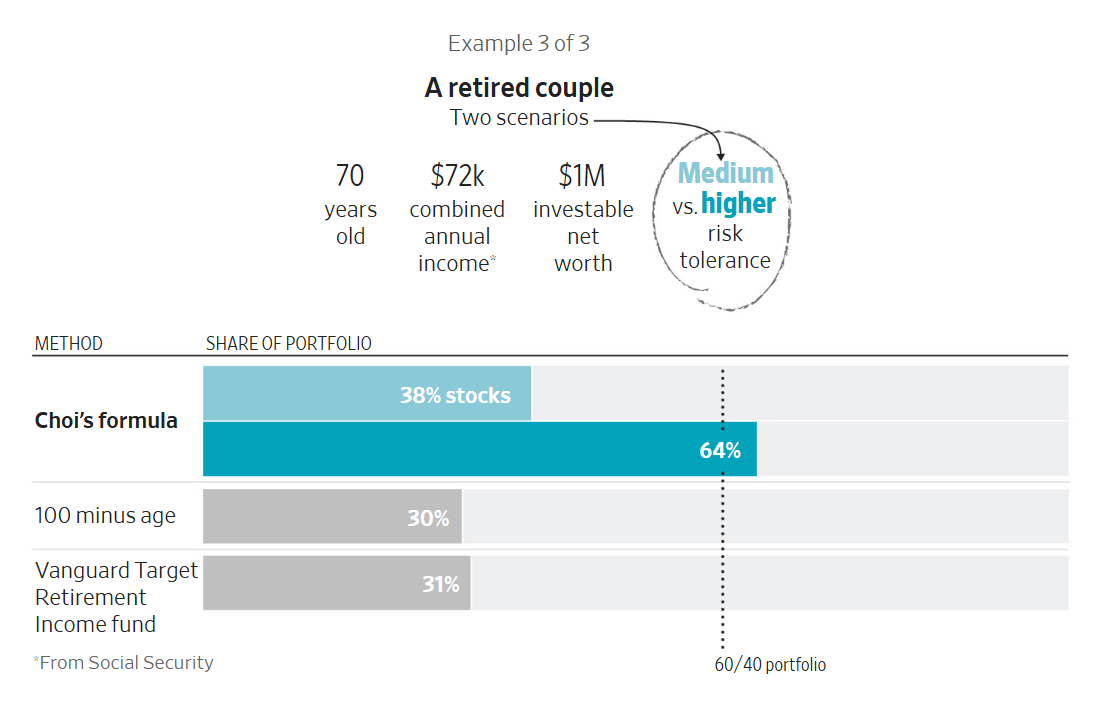
What drops out of this thinking, for people aged 70, is that they should have somewhere between 35 and 70 percent of their investments in bonds:
After living just recently through Bidenflation and having a personal memory of the Jimmy Carter-era inflation (maybe not too different, actually, if CPI were calculated in the same way), this seems intuitively wrong. The 70-year-olds could live to be 100 via GLP-1 and whatever medical miracles LLMs can come up with. The 70-year-olds might care about leaving some money for their children and grandchildren, now forced to compete with 70+ million immigrants with whom the Boomers didn’t have to.
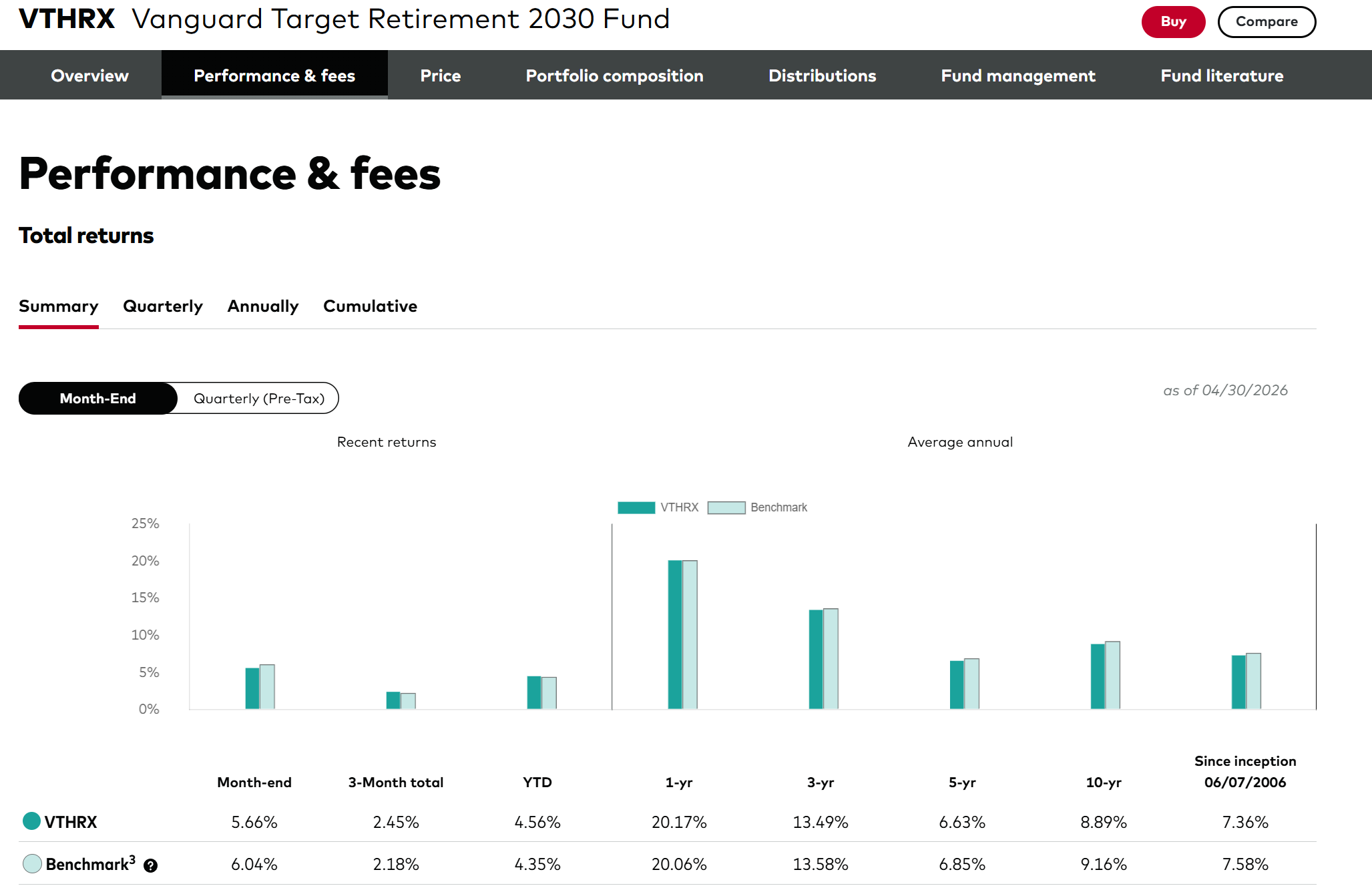
Maybe we can simply look back. The “keep adding bonds with age” strategy is embodied in the Vanguard funds. The Vanguard 2030 fund was created almost exactly 30 years ago. It has returned about 7% per year:
2006 wasn’t a great time to buy an all-stock portfolio, since you had to make it through the Collapse of 2008. Nonetheless, ChatGPT says that SPY has enjoyed a total return (dividends reinvested) of over 11% annually since then. The difference of 4% doesn’t sound huge, but that’s 100 percent of the standard formula of how much a person can spend in retirement from his/her/zir/their assets and not go broke for 30 years. For someone who started with $100,000, the S&P 500 investment would have grown to over $830,000. The same investor in the Vanguard part-bond fund would have only $430,000. That’s the difference between a totally-pimped house in The Villages (the fun center of Elder Florida) and a used/basic house in The Villages.
Note that the above calculations don’t include federal, state, and/or local income taxes that the investor would have had to pay on the dividends received into any non-retirement account. Taxes are worse for the part-bond investor because the yield is taxed as ordinary income and not subject to the qualified dividend discount. Also, stocks deliver much of their return via appreciation rather than by paying dividends. So the corporation may pay income tax, but the investor need not. ChatGPT says the $830,000 stock portfolio would be more like $625,000.
How about all bonds for 20 years? ChatGPT says the return would have been only 3.1% year. The $100,000 would have become $184,000, a laughable $12,000 in appreciation after adjusting for official CPI (i.e., it would have shrunk in terms of the ability to buy and maintain a single-family home). This turns into a real-dollar loss if held in a taxable account, having appreciated to only $144,000 in nominal dollars. The $100,000 became $87,600 in 2006 purchasing power (official CPI).
I’ve always struggled to comprehend why investors are willing to buy bonds priced in nominal dollars, which nearly all bonds are. Someone took the other side of our absurd mortgage, issued at 3.125% just as Bidenflation was gathering a major head of steam in February 2022. I would love to meet that person and ask “What did you think was going to happen?”
Readers: Can someone please sell me on why a typical investor would have even 1% bonds in his/her/zir/their portfolio? Let’s assume we’re talking about a 65-year-old. Because this person has money, it is likely that he/she/ze/they has children (fertility vs. income shows it is Americans with zero income and those with high incomes who have kids; the working class are being bred out of existence). Our hypothetical saver wants to not run out of money even if death comes at 111, which was the age of the oldest person receiving General Motors pension and health care benefits before the company went bankrupt/got bailed out by us in 2009 because they couldn’t pay their union retirees all of the promised pension and health care benefits. Our hypothetical saver would rather leave more than less to his/her/zir/their children and grandchildren. We’ll assume that 30 percent of the saver’s portfolio is in a tax-exempt retirement account. Could the answer be “It makes sense to buy bonds when the S&P 500’s average P/E ratio exceeds a threshold and trade them for stocks when the S&P dips”?
We’re informed that Americans who are currently receiving an entirely taxpayer-funded lifestyle (housing, health care, food, smartphone) would prefer to work and be self-sufficient (“strong and independent” if female; “just a man” if male). We’re informed that there is an affordable housing crisis, which prevents Americans who choose to work from living decently (because of this shortage of housing, we should maintain an open border and maximize the number of immigrants we bring in; an increase in the number of people who need housing will necessarily result in a lower price for housing).
Wouldn’t the most obvious course of action for an able-bodied American on welfare be to apply for a job on a cruise ship? An American is easier and cheaper for a US homeported cruise line to hire because no visa is required and the cost of getting the worker back home after a contract is much lower than for a Filipino or an Indian. If the American on welfare is a native-born American, he/she/ze/they likely speaks English, which is a requirement for many cruise lines.
The skills required for entry-level cruise ship jobs are minimal. There is plenty of work sweeping up in public areas and cleaning crew areas, for example. The cruise line provides unlimited food (no need for SNAP). The cruise line provides comfortable climate-controlled housing. “The Maritime Labour Convention requires that medical care and health-protection services for seafarers while onboard or landed in a foreign port be provided free of charge to seafarers.” (ChatGPT) In other words, the cruise ship is already a dream environment from a classical socialist point of view (not from a modern progressive’s point of view since work is actually required).
Why don’t we ever hear of an American who transitions from welfare to gainful employment on a ship?
ChatGPT agrees that every American on welfare wants to work and it is mostly an accident that anyone is on welfare for 1-4 generations. Why won’t Americans on welfare apply for a cruise ship job then?
they prefer benefits plus local autonomy to hard, regimented, full-time work with room and board
Losing subsidized housing is a huge risk. SNAP and phone service are relatively small. A housing voucher or public-housing slot can be enormously valuable and hard to regain. A single person who leaves for a cruise contract might lose eligibility, fail local recertification, or have nowhere affordable to return.
(It’s interesting that ChatGPT considers a taxpayer-funded house or apartment to be valuable. In nearly all studies of American poverty or inequality, taxpayer-funded housing is valued at $0 and a person with a lifetime entitlement to live in public housing is considered destitute and completely lacking in wealth.)
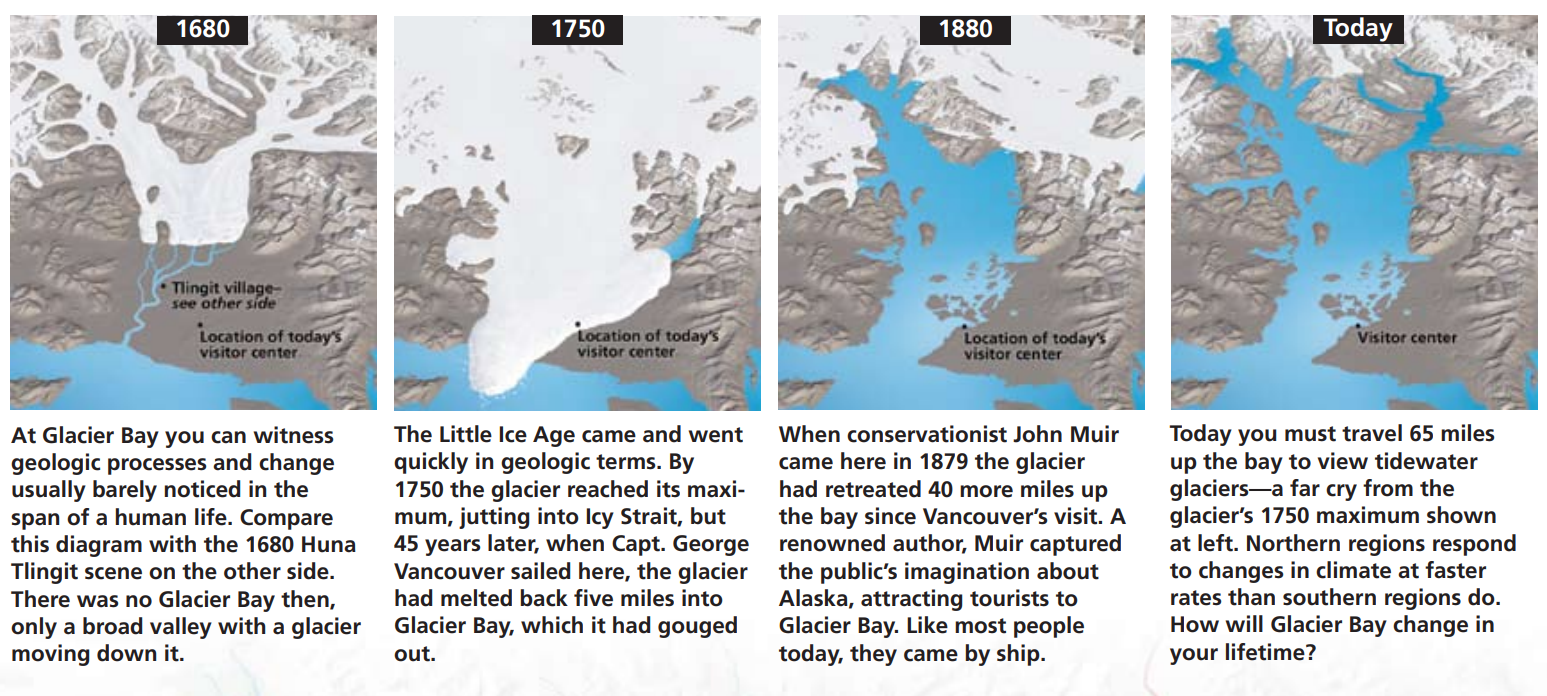
Loosely related… Norwegian Joy at Icy Strait Point, Alaska (home of the Huna Tlingit who were expelled from Glacier Bay first by a glacier and then by the National Park Service, which acknowledges that the land belongs to the Huna Tlingit):
But wouldn’t the players have to be some flavor of 2SLGBTQQIA+ in order to “play WITH Pride”? If they’re cisgender heterosexual then perhaps they can play while celebrating others’ pride. Should waving a rainbow flag entitle a person with boring conventional sexuality to don the mantle of Pride?
Note that the hockey season is over now so the Florida Panthers and other NHL teams claimed to be “Playing with Pride” a few months early. Gemini:
As of March 2026, there are no active NHL players, including those on the Florida Panthers roster, who are publicly out as gay. While the league hosts annual Pride nights and supports LGBTQ+ initiatives, no player currently on an NHL roster has publicly identified as gay.
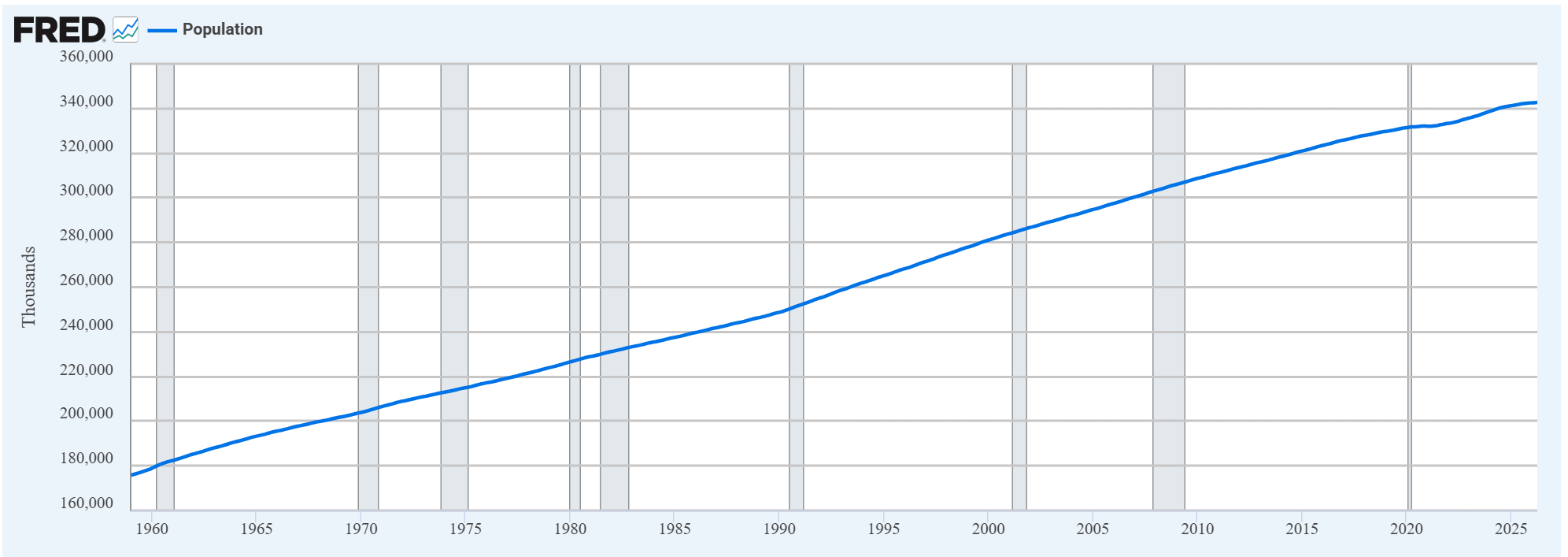
Americans have collectively decided, through our elected representatives, to boost U.S. population to Chinese/Indian levels, mostly via low-skill immigration:
Democrats now agree with Republicans, apparently, that cheap oil/gas is desirable and that Climate Change (TM) need no longer be fought by cutting CO2 emissions.
If the heat in the Lower 48 becomes unbearable and the seas inundate Boston, New York City, DC, Miami, and other major coastal cities, Alaska seems like a natural evacuation destination. There is plenty of high ground in mountainous Alaska and the weather is pleasantly cool all year along the coast. The all-time record high for Juneau is 90 degrees, set in July 1975, and the average daily high temp for Juneau in July is 63.
One critical problem with life in the low-density parts of SE Alaska is transportation. Today’s airplanes typically can’t fly in the 0/0 foggy conditions that often plague this part of the country. There isn’t a high enough population density to support frequent nonstop flights among the various towns, nearly all of which are cut off from any road network, e.g., due to being on islands. The fabled Alaska Marine Highway (see Chapter XII of Travels with Samantha) is expensive and infrequent, perhaps partly due to the Jones Act that requires them to use U.S.-built vessels and that prevents an Asian-run company from offering competitive service. Below, the Alaskan-built MV Hubbard (cost $60 million in pre-Biden dollars; a “dayboat” that holds 53 cars; launched 2019):
What about a machine that can fly itself the 40-80 nm. legs that are required to get around this part of the world and that can navigate safely around terrain via reference to GPS and a database? That’s the autonomous electric aircraft (vertical takeoff and landing isn’t necessary, actually, since nearly all of these places have high-quality airports/runways, but eVTOL would work). Could that encourage more Americans (and “New Americans”) to settle in this part of the U.S.? Want to see a friend or shop? That will be a 20-minute flight. Need to see a medical specialist? The regional hospital in Juneau can be reached easily and you’ll be home in time for dinner. Need to be evacuated to Seattle or Anchorage for specialized hospital care? That’s done with a 20-minute electric air ambulance ride followed by a jet flight.
We’ve already seen this trend to some extent with islands for the rich. Martha’s Vineyard and Nantucket weren’t beyond peasant means until private jet ownership became common. A house near ACK had no value to a rich Texas family until the rich Texans got their Gulfstream and could fly directly to ACK rather than flying commercial to Boston and taking a piston-powered airplane or the road+ferry.
The Native Americans enjoyed life in their village within what is today Glacier Bay prior to the eponymous glacier expanding all the way into the ocean:
Due to President Calvin Coolidge’s designation of the bay as a “national monument” in 1925 (Wikipedia), the natives were forever cut off from residing in their Connecticut-sized homeland.
Given that it is a violation of federal law for an Indian to return what the acknowledger says is “home”, is it fair to call this Peak Land Acknowledgement?
Note that if we ever did give Glacier Bay back to the Native Alaskans they would immediately become insanely rich. The National Park Service disdains filthy lucre and therefore imposes a two-ship-per-day limit while charging an absurdly low $8/passenger fee (i.e., about what a cruise passenger might pay for a drink at the onboard Starbucks). Each ship parks itself in front of the headline glacier for only about one hour and, therefore, given the number of hours of daylight in the summer, it would be trivial to increase the number of ships to accommodate nearly all of the 1.7 million passengers who visit Juneau each year. The Indians could hike the price to $60 per passenger, the standard fee for a seat at specialty dining, and thus harvest about $100 million per year for doing almost nothing.
(Currently most of the profit from the land is extracted by Princess, Holland, and Norwegian because these are the major cruise lines that have long-term contracts with the National Park Service. I.e., the U.S. Treasury gets almost nothing and the government cronies get nearly all of the profit that is obtainable from the park. (The itineraries that include Glacier Bay can support higher prices even though the cost to the cruise line is no higher.))
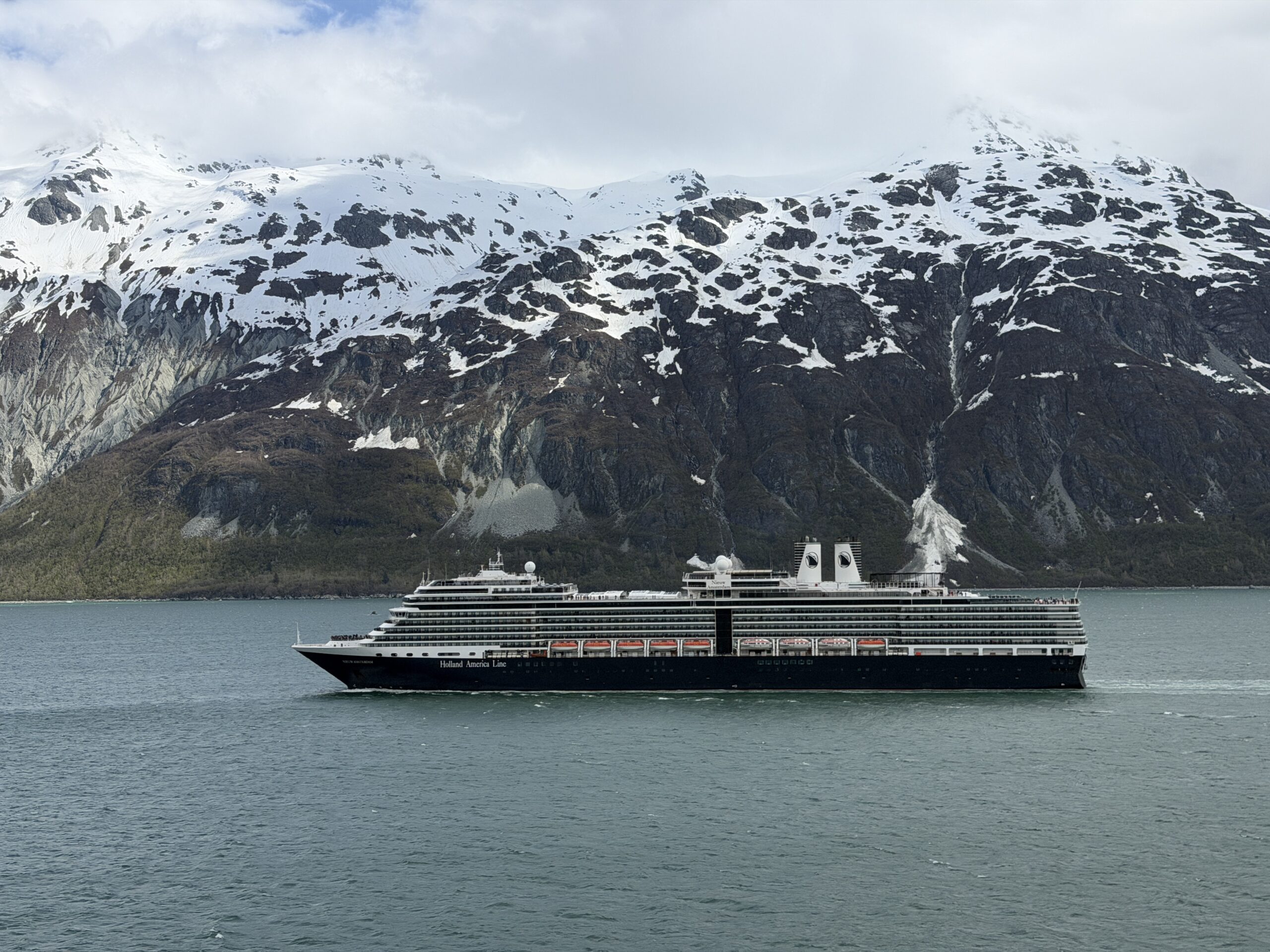
A present-day Glacier Bay village of 2,000+ passengers on Holland America, owned since 1989 by Florida-based Carnival, which was founded by Ted Arison, a Palestinian born in Tel Aviv, Palestine.
In case you were wondering whether to take investment advice from me, 15-20 years I confidently predicted that Honda and Toyota would jump in and take the EV market away from Tesla as soon as Tesla had run out of early adopters. Honda and Toyota were so much more experienced and better at making cars than Tesla that of course they’d be able to make better electrically-powered cars. (Honda is, apparently, able to design a better electric car than what Ferrari is offering, but that’s like being a dwarf among midgets.)
The automaker reported a net loss of $2.7 billion for the fiscal year that ended March 31. Earnings were weighed down by more than $9 billion in restructuring charges and write-downs after a retrenchment of its E.V. strategy. It is the first loss that the 77-year-old company has reported since listing on the Tokyo Stock Exchange in 1957.
“The business environment and customer demand have changed beyond our expectations,” Toshihiro Mibe, Honda’s chief executive, said in a news conference in Tokyo on Thursday. “We were not able to respond flexibly enough.”
Is there a comic-book villain who can be blamed?
On Thursday, Mr. Mibe said the company would nix its 2040 target of selling only electric and hydrogen-powered cars. That target was based on the Biden administration’s environmental policies in the United States, the company’s biggest market, he said.
“A year ago, there was a drastic change. We have seen a shift from a focus on the environment to the opposite,” Mr. Mibe said. Honda’s previous target, he added, “is now not realistic.”
Hmm… if Joe Biden was virtuous and wise who might be “the opposite” in terms of virtue and wisdom levels?
Greta Thunberg (pre-Queers for Palestine version) won’t be happy with the recovery plan:
For now, Honda said, it will double down on gasoline-electric hybrids, introducing 15 next-generation, high-efficiency models, including larger vehicles in North America, by 2030. Combined with plans to cut costs and accelerate development, this push is intended to restore Honda to record profits by the end of the decade, Mr. Mibe said. The company is also forecasting a return to profitability this year.
If Tesla is close to cracking self-driving and Honda hasn’t even begun to try (the 2026 Odyssey has the same feeble driver assistance features as the 2018 Odyssey), how could Honda conceivably compete? Maybe some sort of monster pseudo-military vehicle like the G-Wagen? Here’s one in military green at the Stuart, Florida airport:
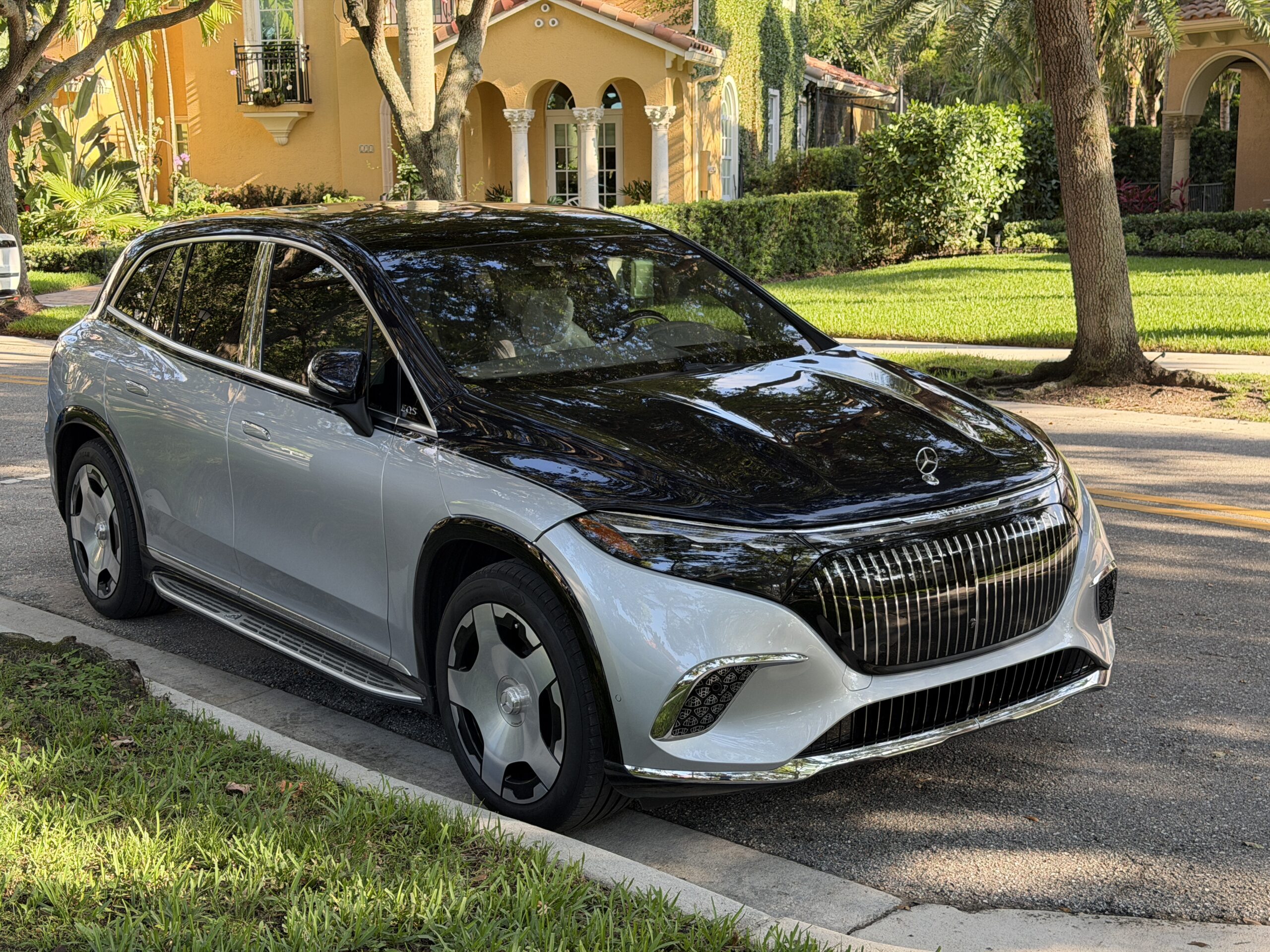
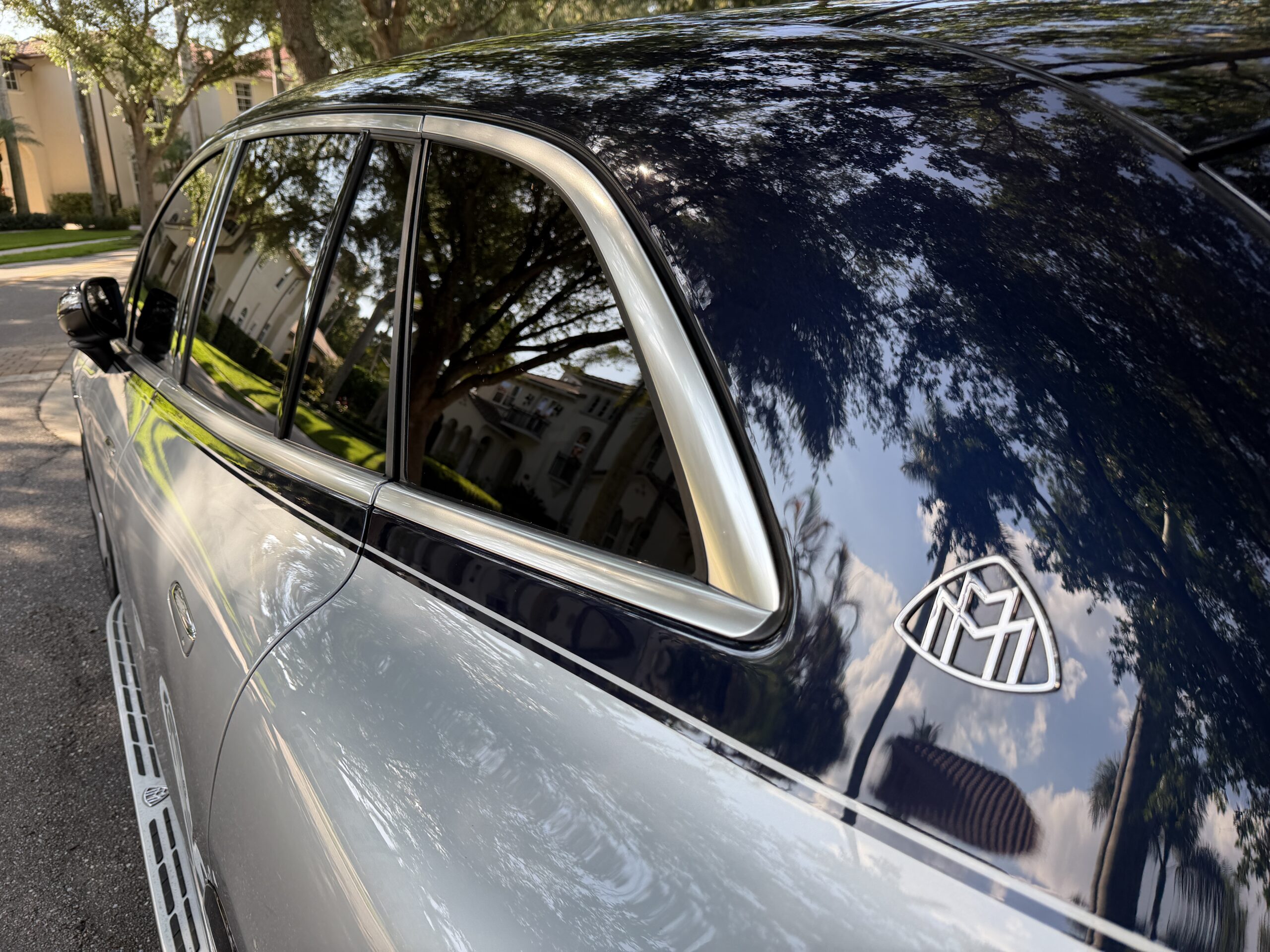
People have demonstrated a willingness to pay huge $$ for this truly terrible car. Speaking of huge $$, one of our neighbors apparently bought a Maybach EV:
Imagine being rich enough to spend $200,000 on an EV that can’t drive itself and will be worth $30,000 after a year or two. (See Mercedes EQE review for my own attempt at living with a Mercedes EV.)
Will it truly be possible for Honda to muddle through to profitability and significance with slight improvements on the Accord, Civic, CR-V, etc.? The stock market doesn’t seem to think so. Tesla is worth more than 10X what Honda is worth (and at least 6X Toyota’s market cap).
Our own Honda seems to be giving up. At five years of age and 62,000 miles, the dealer said that the rubber boots on the lower control arms, which protect the ball joints, are cracked and should be replaced soon ($1100 plus $130 for an alignment that is necessary after the replacement). They also want $70 to replace the pollen filter for the ventilation system, $160 to cleaning the A/C evaporator (is that a thing?), and $230 for “Platinum Fuel Induction Service (GDI). ChatGPT says that the filter should be regularly replaced, but it is a $20 part that can be replaced with no tools (behind glove box) last three suggestions are fraud. ChatGPT says that the second two suggestions are fraud:
Yes, “A/C evaporator cleaning” is a real thing, but I would do it only if you have symptoms.
It usually means spraying a foaming cleaner or disinfectant into the evaporator case or intake area to reduce mold/mildew smell. It can help if the A/C smells musty, especially at startup or after the car sits.
But if your Odyssey’s A/C smells fine and drains normally, this is not a routine “must do at 62,000 miles” service.
Verdict: Real service, but mostly for odor/mildew complaints. I’d skip unless the vents smell musty.
Your Odyssey’s V6 is direct-injected, so in theory intake-valve carbon buildup can be an issue on GDI engines because gasoline does not wash over the back of the intake valves the way it does in port-injected engines. But a dealer “fuel induction service” can mean a lot of things:
Fuel-tank additive
Throttle-body cleaning
Intake cleaner misted through the intake
More involved intake-valve cleaning
For $230, it is probably not a true walnut-blast intake-valve cleaning. It is likely a chemical cleaning package. If the van starts smoothly, idles smoothly, has no check-engine light, no misfires, and fuel economy is normal, I would not consider this urgent.
Verdict: Plausible but likely optional upsell. I’d skip unless there are drivability symptoms, or unless Honda’s maintenance schedule specifically calls for it, which I do not think it does as a routine 62k service.