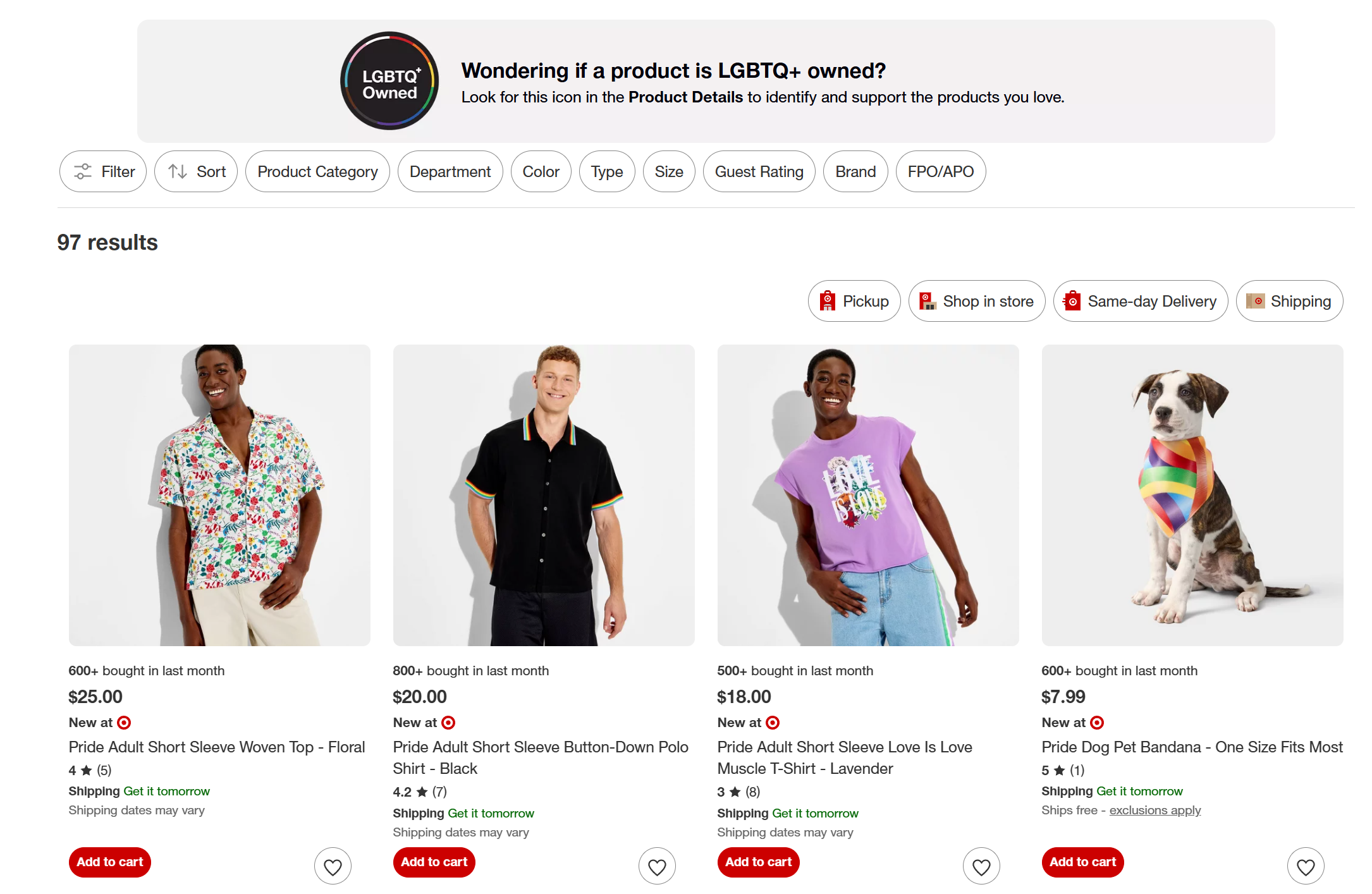
Did anyone go to Target yesterday to purhcase Pridewear for a beloved 2SLGBTQQI+ canine?
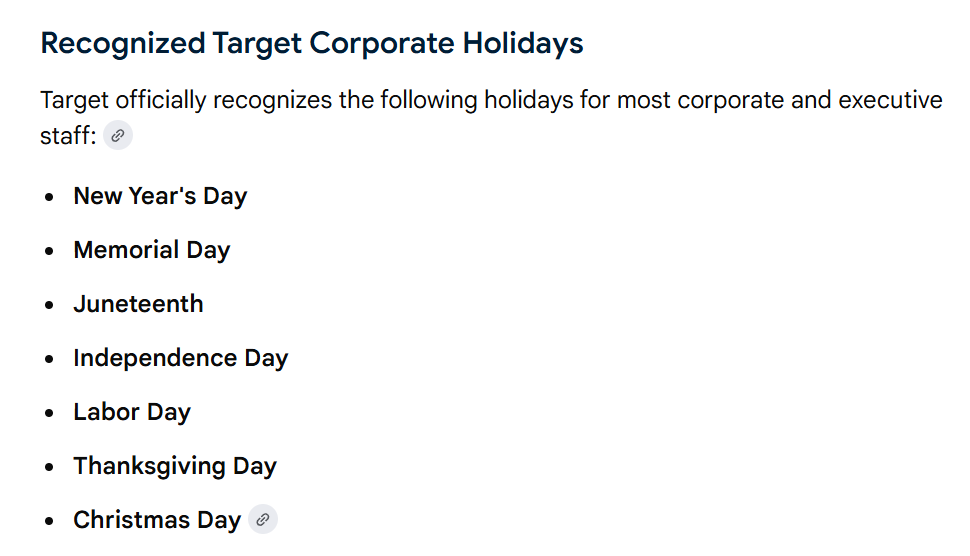
It seems that Target is the ultimate example of Juneteenth. Elite white corporate executives at the headquarters in Minnesota, a state in which slavery was never legal, get a paid day off. Black retail workers in former slave states must toil to help customers if they want to be paid for working on June 19th. Google:
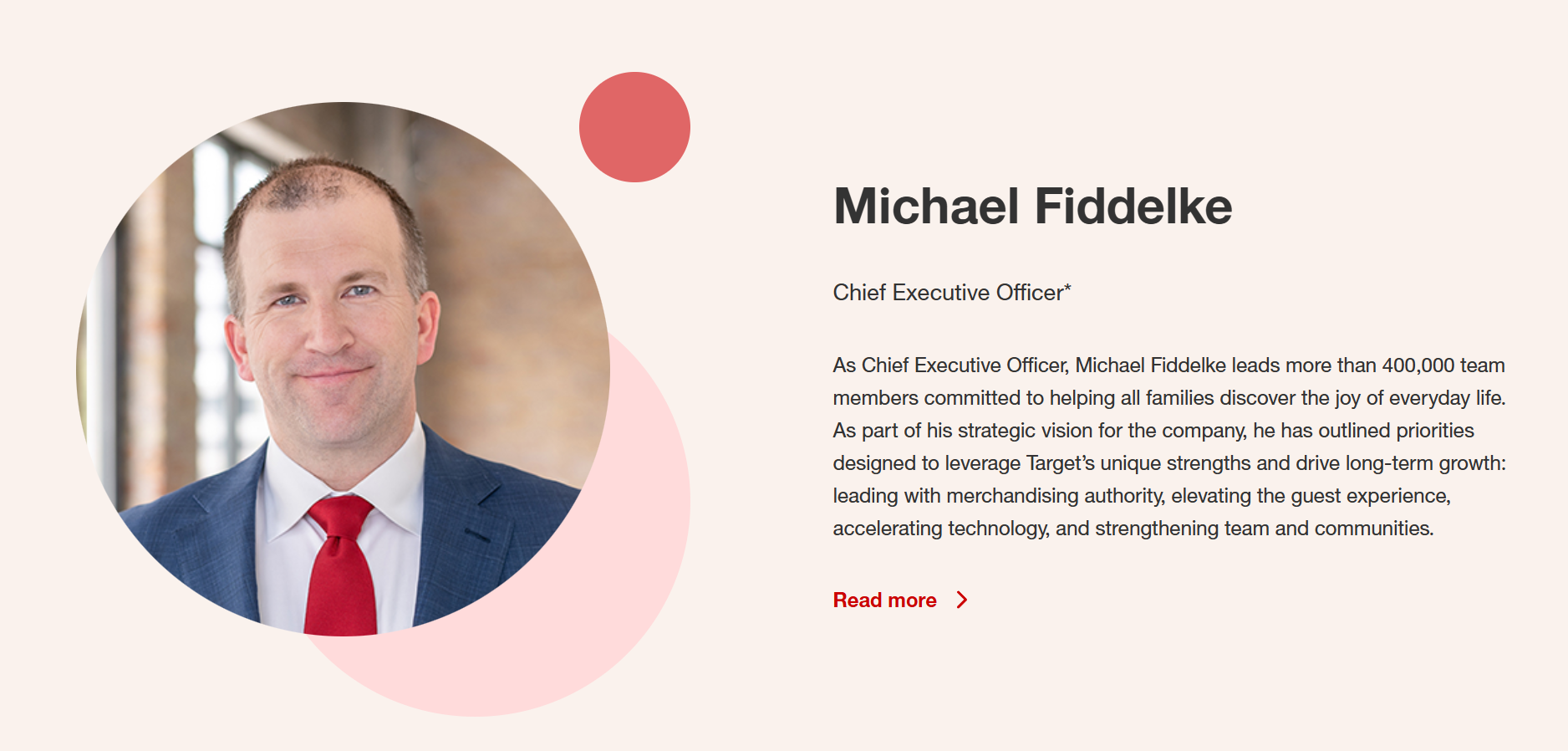
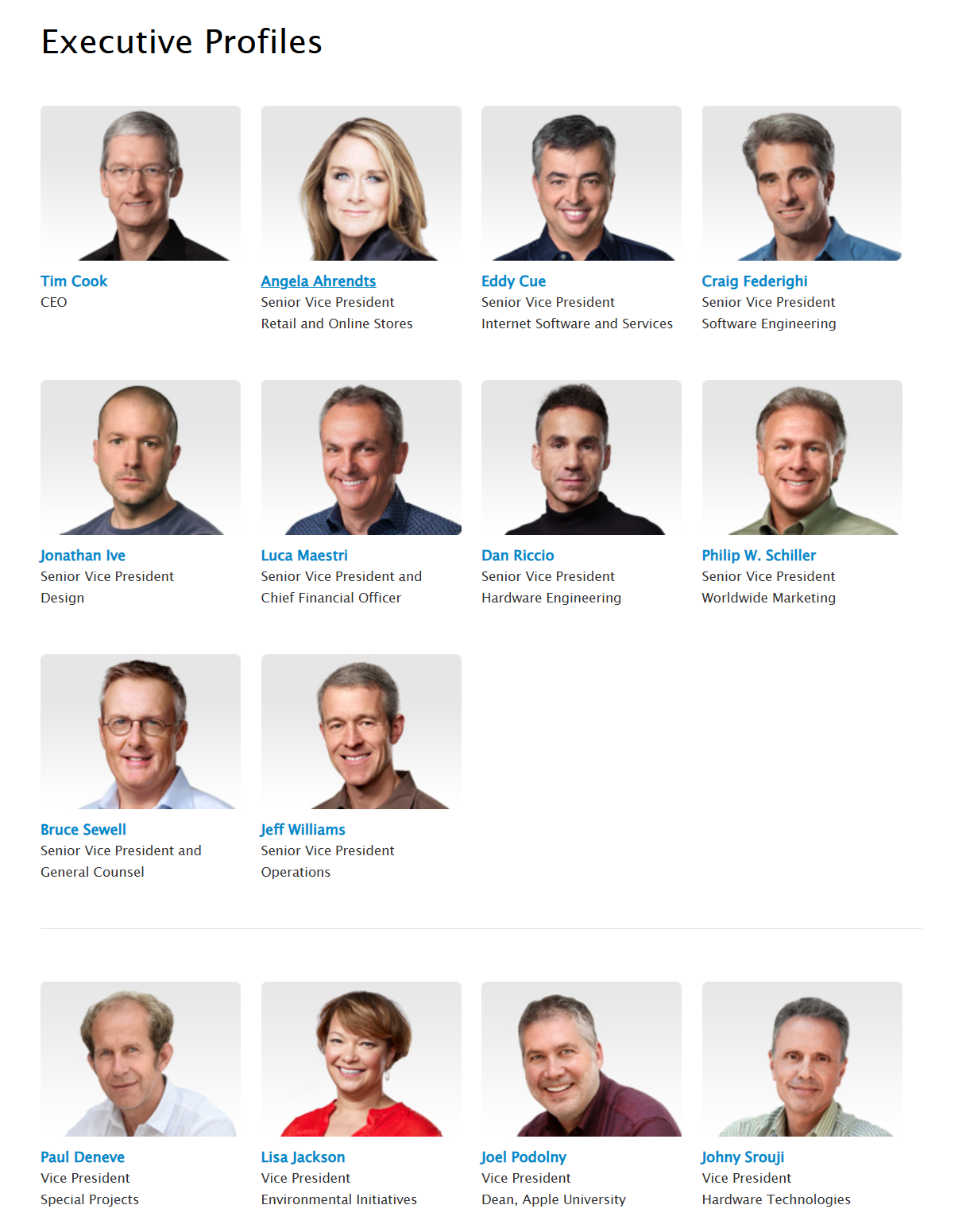
(The Target leadership team page depicts not a single person who appears to be African American. Screen shots below.)
If any reader happened to be at Target and happened to get a photo of a Black worker toiling while the above elites enjoyed their day off, I would love to receive it!
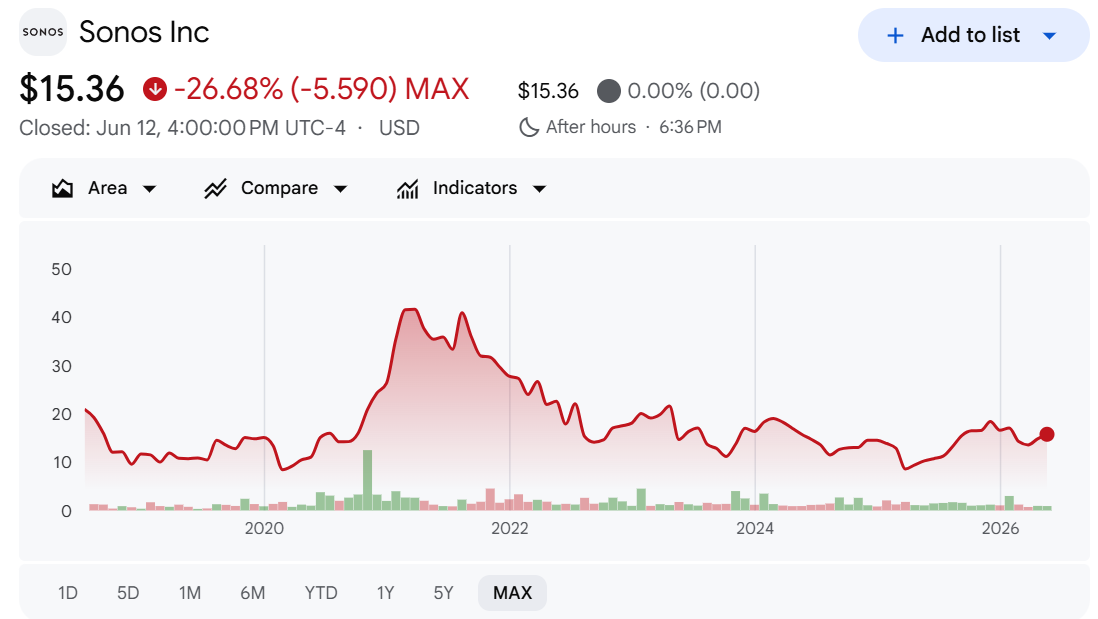
Readers are likely aware of my fondness for whole-house audio and, since 2005, Sonos, a company that has roots in Santa Barbara, CA and Boston, MA. The company went public at $15 per share almost exactly eight years ago. How’s the stock done? If you don’t adjust for inflation, it’s right at its original IPO price (down from the first-day bump, though). Adjusted at official CPI, though, someone who got IPO shares is down 25 percent. Adjusted for South Florida real estate costs, the investor is down about 50 percent.
Given that state governors ordered peasants to stay home for 2-3 years in a lot of high-income states, how do we account for a home audio company having done this badly? Sony has doubled, in nominal dollars, over the same period. Consumers don’t care about multi-room audio because they always have their AirPods in and the sound thus follows them?
In celebration of global Pride the Internet radio service introduced a limited-edition station, initiated by a group of LGBTQ+ employees.
Dmitri Siegel, VP Global Brand, extended his support becoming Pride@’s official executive sponsor. “I am so grateful to have the opportunity to be an ally in the Pride@ group,” he said. “As a straight white male, it’s common to feel intimidated or uncomfortable engaging on LGBTQ+ issues because you feel like you are going to say the wrong thing or be offensive in some way. Being a part of Pride@ has given me the opportunity to do my work—listen and learn. Getting over insecurity and discomfort unlocks all these amazing people and a whole aspect of the human experience that I would otherwise miss out on.”
The article references a corporate tweet:
Announcing Full Spectrum on Sonos Radio. Music from LGBTQ+ artists, allies, and icons; personal liner notes recorded by Sonos employees; and interviews with beloved LGBTQ+ artists including Brandi Carlile, Laura Jane Grace, and more. Read today's blog post to learn more.
How about this month? The radio web site features state-sponsored NPR and Democratic Party-affiliated MSNBC, but I didn’t see anything about Pride.
Sonos Radio has an Instagram account. No Pride station is mentioned. (The “Full Spectrum; Celebrate Child” station is still available in the app, however.)
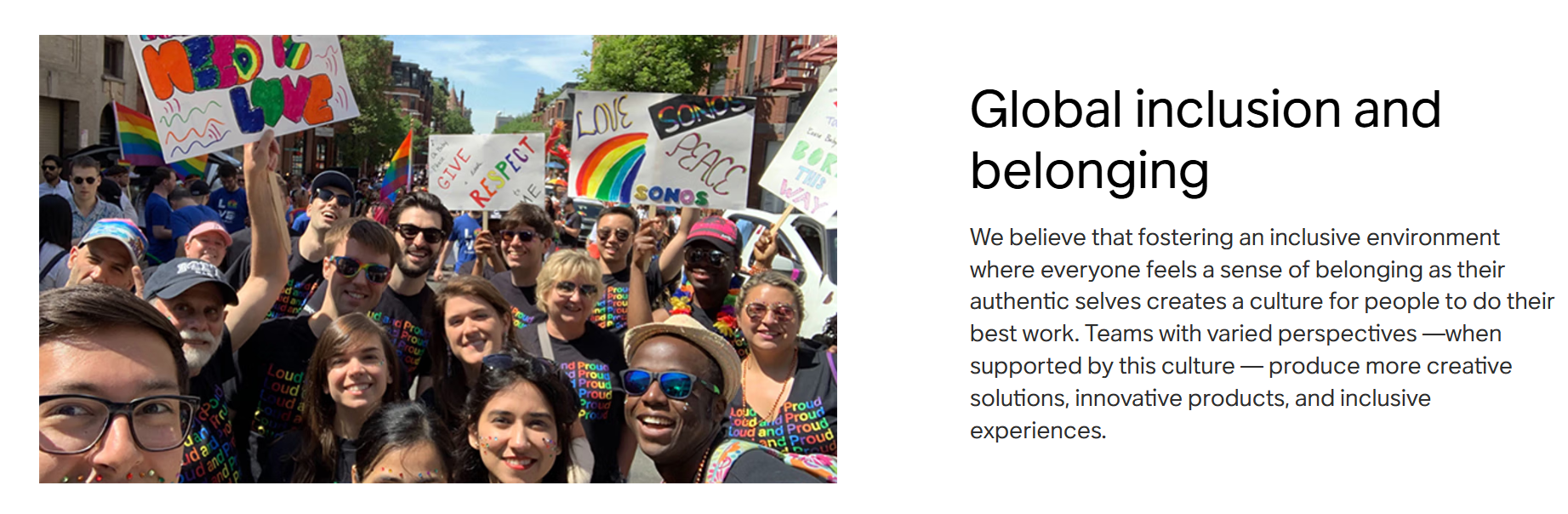
Sonos has an X account(!), but hasn’t posted anything for Pride 2026. Nor did they post anything regarding Pride on their (rather thin) Facebook account. Their careers page assures today’s young people that working life can be a continuous Pride celebration:
It looks as though the company has abandoned its commitment to proselytizing for Rainbow Flagism to consumers, reminding consumers that Black history is more important than other kinds of history, etc. In other words, Sonos has abandoned its principles and still can’t make money, the worst of all possible worlds for a corporation.
I still love the product, even if their lightweight powered speakers can’t overcome the laws of physics (see below regarding the latest Sonos S2 gear versus their old amps driving heavier passive (ancient) speakers). They also have great support compared to most companies. I’m wondering what they could make that would be profitable in an Apple-takes-all world.
In case you were wondering whether to take investment advice from me, 15-20 years I confidently predicted that Honda and Toyota would jump in and take the EV market away from Tesla as soon as Tesla had run out of early adopters. Honda and Toyota were so much more experienced and better at making cars than Tesla that of course they’d be able to make better electrically-powered cars. (Honda is, apparently, able to design a better electric car than what Ferrari is offering, but that’s like being a dwarf among midgets.)
The automaker reported a net loss of $2.7 billion for the fiscal year that ended March 31. Earnings were weighed down by more than $9 billion in restructuring charges and write-downs after a retrenchment of its E.V. strategy. It is the first loss that the 77-year-old company has reported since listing on the Tokyo Stock Exchange in 1957.
“The business environment and customer demand have changed beyond our expectations,” Toshihiro Mibe, Honda’s chief executive, said in a news conference in Tokyo on Thursday. “We were not able to respond flexibly enough.”
Is there a comic-book villain who can be blamed?
On Thursday, Mr. Mibe said the company would nix its 2040 target of selling only electric and hydrogen-powered cars. That target was based on the Biden administration’s environmental policies in the United States, the company’s biggest market, he said.
“A year ago, there was a drastic change. We have seen a shift from a focus on the environment to the opposite,” Mr. Mibe said. Honda’s previous target, he added, “is now not realistic.”
Hmm… if Joe Biden was virtuous and wise who might be “the opposite” in terms of virtue and wisdom levels?
Greta Thunberg (pre-Queers for Palestine version) won’t be happy with the recovery plan:
For now, Honda said, it will double down on gasoline-electric hybrids, introducing 15 next-generation, high-efficiency models, including larger vehicles in North America, by 2030. Combined with plans to cut costs and accelerate development, this push is intended to restore Honda to record profits by the end of the decade, Mr. Mibe said. The company is also forecasting a return to profitability this year.
If Tesla is close to cracking self-driving and Honda hasn’t even begun to try (the 2026 Odyssey has the same feeble driver assistance features as the 2018 Odyssey), how could Honda conceivably compete? Maybe some sort of monster pseudo-military vehicle like the G-Wagen? Here’s one in military green at the Stuart, Florida airport:
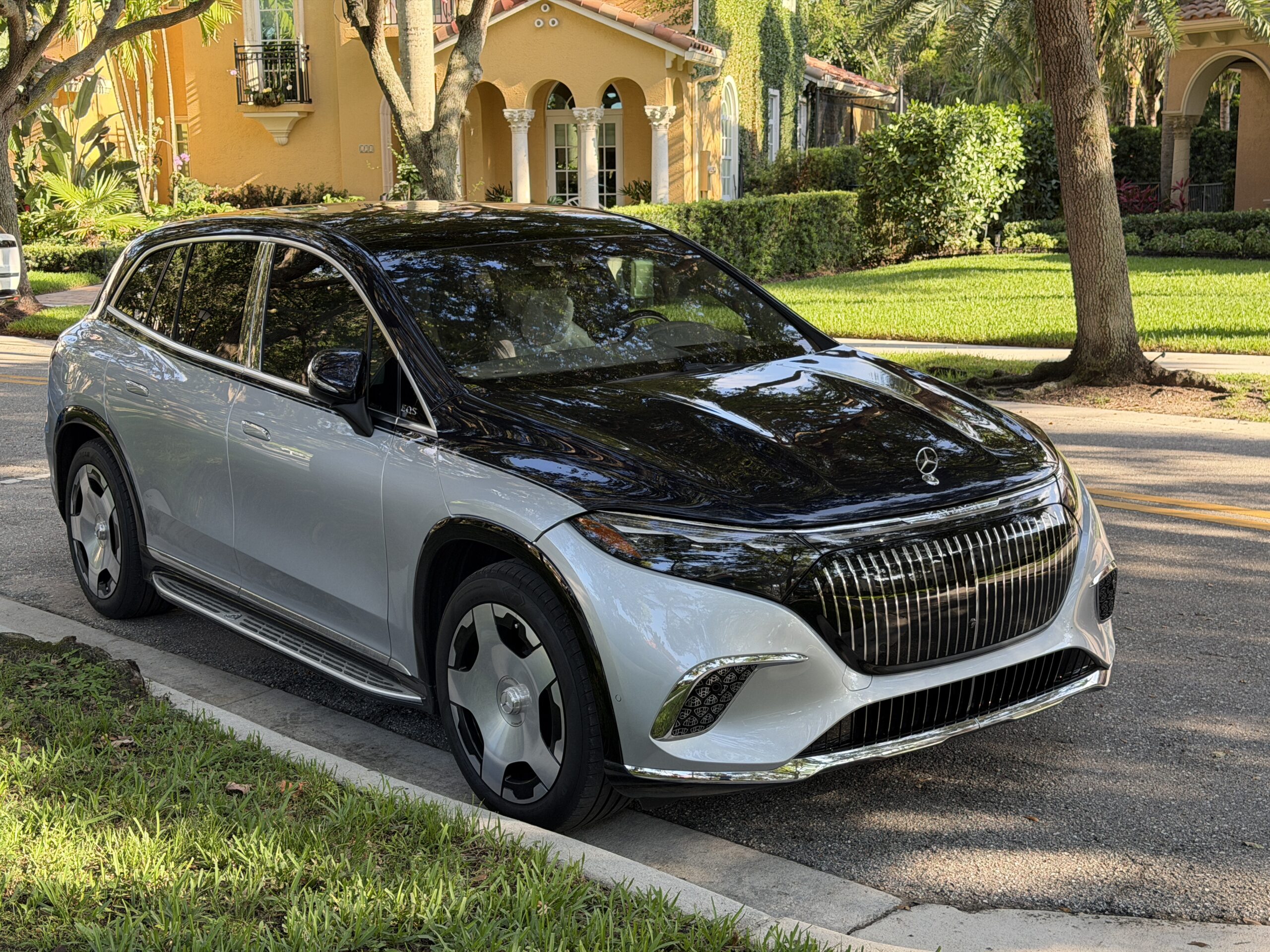
People have demonstrated a willingness to pay huge $$ for this truly terrible car. Speaking of huge $$, one of our neighbors apparently bought a Maybach EV:
Imagine being rich enough to spend $200,000 on an EV that can’t drive itself and will be worth $30,000 after a year or two. (See Mercedes EQE review for my own attempt at living with a Mercedes EV.)
Will it truly be possible for Honda to muddle through to profitability and significance with slight improvements on the Accord, Civic, CR-V, etc.? The stock market doesn’t seem to think so. Tesla is worth more than 10X what Honda is worth (and at least 6X Toyota’s market cap).
Our own Honda seems to be giving up. At five years of age and 62,000 miles, the dealer said that the rubber boots on the lower control arms, which protect the ball joints, are cracked and should be replaced soon ($1100 plus $130 for an alignment that is necessary after the replacement). They also want $70 to replace the pollen filter for the ventilation system, $160 to cleaning the A/C evaporator (is that a thing?), and $230 for “Platinum Fuel Induction Service (GDI). ChatGPT says that the filter should be regularly replaced, but it is a $20 part that can be replaced with no tools (behind glove box) last three suggestions are fraud. ChatGPT says that the second two suggestions are fraud:
Yes, “A/C evaporator cleaning” is a real thing, but I would do it only if you have symptoms.
It usually means spraying a foaming cleaner or disinfectant into the evaporator case or intake area to reduce mold/mildew smell. It can help if the A/C smells musty, especially at startup or after the car sits.
But if your Odyssey’s A/C smells fine and drains normally, this is not a routine “must do at 62,000 miles” service.
Verdict: Real service, but mostly for odor/mildew complaints. I’d skip unless the vents smell musty.
Your Odyssey’s V6 is direct-injected, so in theory intake-valve carbon buildup can be an issue on GDI engines because gasoline does not wash over the back of the intake valves the way it does in port-injected engines. But a dealer “fuel induction service” can mean a lot of things:
Fuel-tank additive
Throttle-body cleaning
Intake cleaner misted through the intake
More involved intake-valve cleaning
For $230, it is probably not a true walnut-blast intake-valve cleaning. It is likely a chemical cleaning package. If the van starts smoothly, idles smoothly, has no check-engine light, no misfires, and fuel economy is normal, I would not consider this urgent.
Verdict: Plausible but likely optional upsell. I’d skip unless there are drivability symptoms, or unless Honda’s maintenance schedule specifically calls for it, which I do not think it does as a routine 62k service.
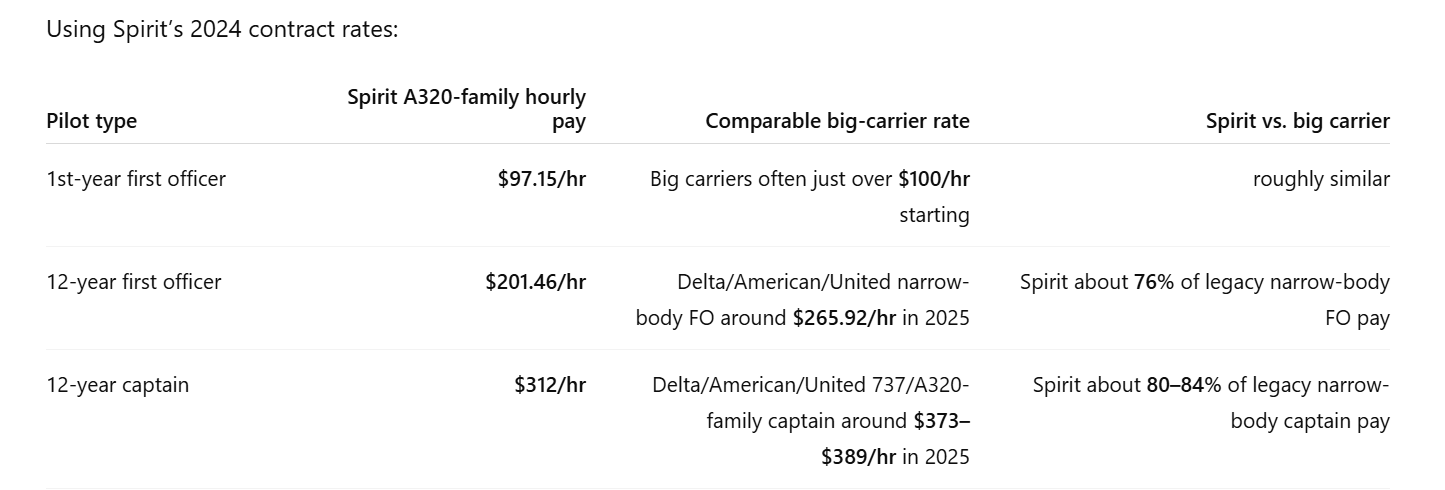
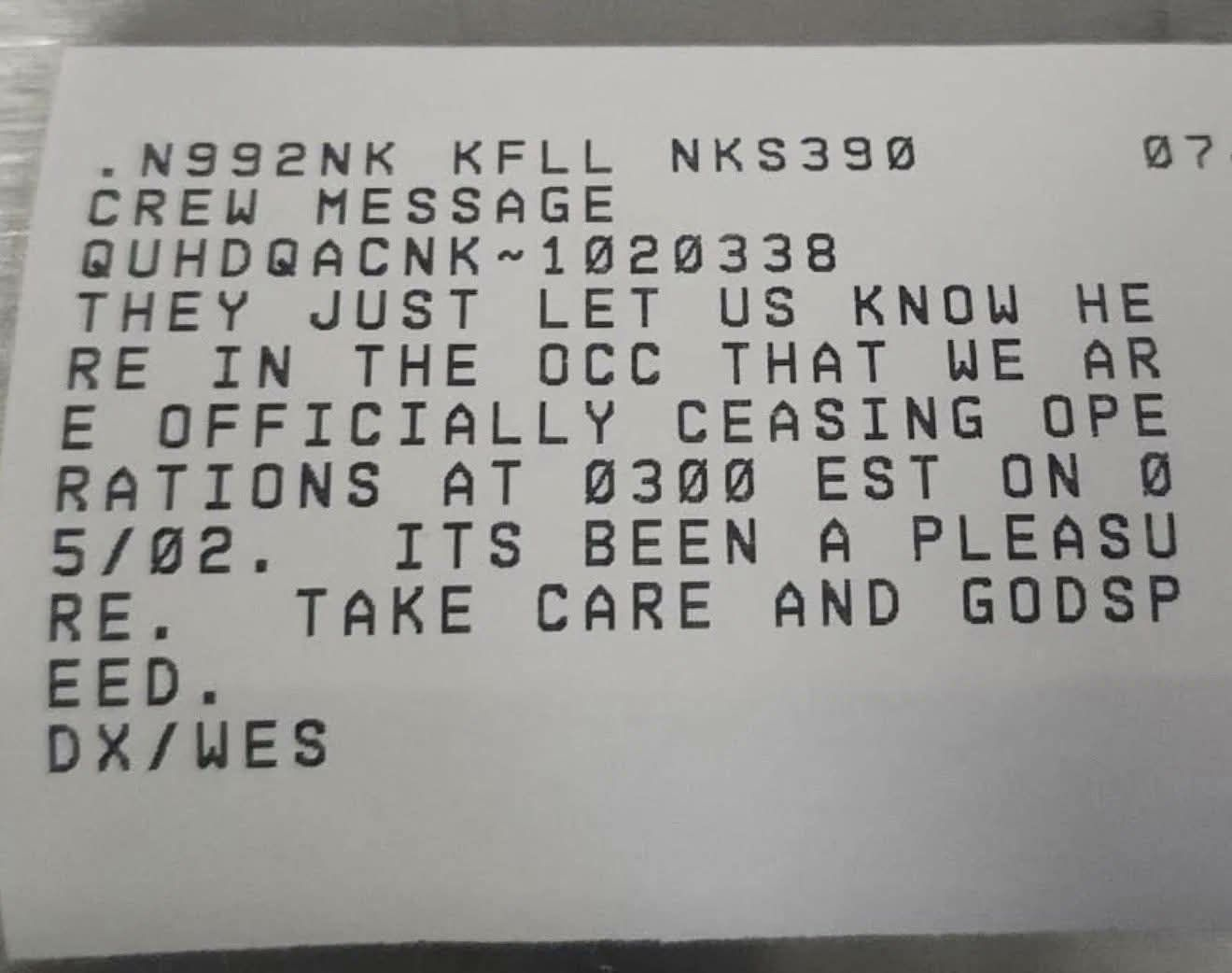
Spirit is dead. I flew Spirit a few times and especially enjoyed their “Big Front Seat”. One flight out of FLL, I think, was delayed for hours due to a delay of the incoming plane on a perfect-weather day. Why can’t we have competition among airlines as they do in Europe and a wide range of low-cost carriers? First, Spirit was low cost to consumers, but it didn’t have low costs. Labor is the largest cost for an airline and Spirit’s union labor costs were similar to what the biggest airlines pay (ChatGPT):
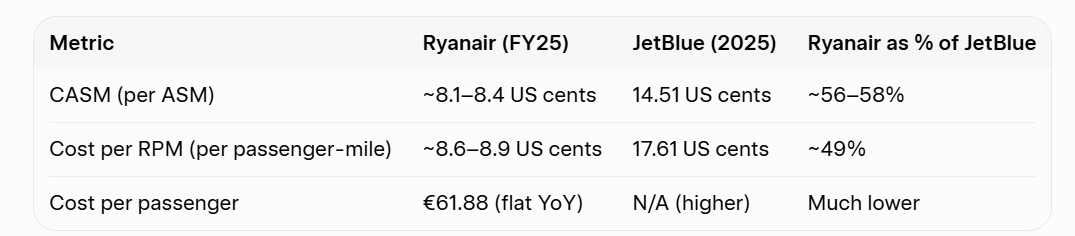
ChatGPT on total cost for low-cost Ryanair vs. originally-low-cost JetBlue:
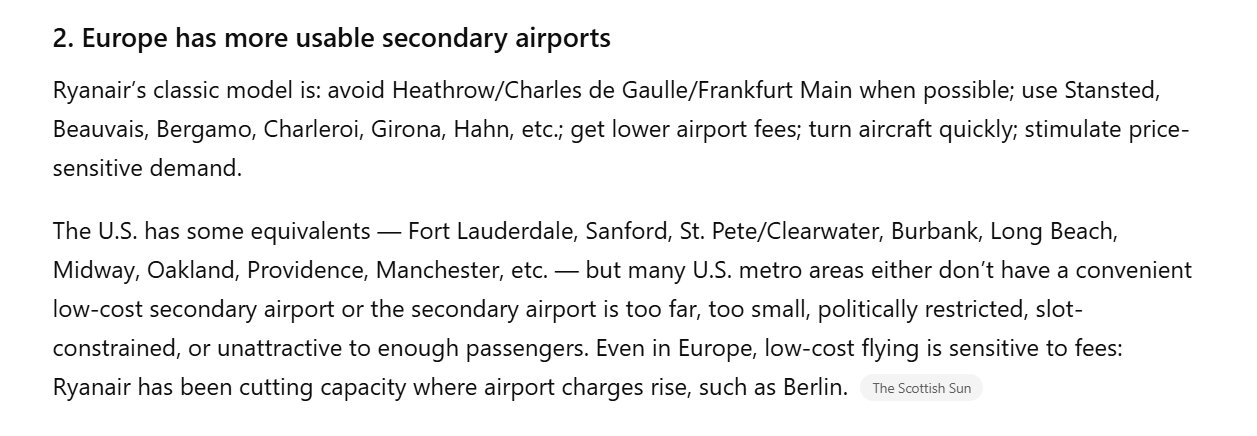
ChatGPT claims, incredibly, that Europe has more secondary airports:
I don’t think that this is correct, since the U.S. has tons of general aviation airports with long runways. Maybe the answer is that U.S. airports are monopolized, e.g., Massport owns both Logan Airport and Hanscom Field, the most obvious competitor for airline service to Boston. Massport isn’t going to undercut its own fees. A single port authority in NY/NJ owns LGA, JFK, EWR (Newark), TEB (the Teterboro airport for the Gulfstream crowd), and SWF (Stewart, too far from NYC unless a high-speed rail were built). There is more competition in Greater Los Angeles and the air carrier airports are owned by different agencies (LAX, LGB, BUR, SNA, and ONT are owned by their respective cities/counties).
Grok:
[in Europe] Many airports are privatized or compete aggressively for traffic, offering incentives to new carriers. US major airports have higher fees, complex slot controls (often grandfathered to legacies), and fewer viable low-cost alternatives near population centers. This raises barriers for new entrants or ultra-low-cost models
All publicly owned U.S. airports are paid for with federal tax dollars, e.g., from taxes on airline tickets, taxes on charters, and taxes on general aviation fuel (the one time that billionaires pay tax, according to Elizabeth Warren?). The Feds can’t seem to break up the airline oligopoly using antitrust laws and, in fact, may have contributed to our high-fare immiseration by blocking a JetBlue-Spirit merger (NYT: “JetBlue Airways and Spirit Airlines announced on Monday that they would not seek to overturn a court ruling that blocked their planned $3.8 billion merger. The decision is a big win for the Biden administration, which has sough to limit corporate consolidation.”; for the record, my first thought regarding the merger was that it shouldn’t be allowed because U.S. airlines were already far too concentrated). Maybe a good starting point would be to break up airport ownership. The five above-mentioned NY/NJ airports would have to be owned by separate competing government entities. Massport couldn’t own both Logan and Hanscom. Palm Beach County couldn’t own PBI/DJT and North County (F45; approved for a runway extension in 2024, but because the U.S. is incapable of working at Chinese speeds, construction isn’t even dreamed of before 2027). Miami-Dade County couldn’t own five airports (“Why do I own five airports? Because I couldn’t afford six.”).
Maybe robot 50-seater airliners would disrupt the market and enable some new carriers to thrive between city pairs in which a secondary airport isn’t owned by the same public agency that owns the main airport. But until “Big Airport” monopolies are broken up, it seems as though incumbent carriers could block most competition merely via a cozy relationship with each of the big airport authorities.
Meanwhile, let’s see how idiotic my investing advice has been. Back in 2010 I wrote “Unions and Airlines”, in which the take-away for investors is not to buy airline stocks because the unions will harvest any additional profits rather than the benefits flowing to investors.
Grok:
Airline stocks have significantly underperformed the S&P 500 since 2010 (roughly early 2010 through early May 2026, or ~16+ years). The S&P 500 (tracked via SPY total return, including dividends) delivered approximately +536% cumulative return, or roughly 12.0% annualized CAGR. In contrast, a broad airline index like the NYSE Arca Global Airline Index (^XAL) rose only about 70% on a price basis (from ~35.7 to ~60.5), equating to roughly 3.3% annualized price-only CAGR—and even adding typical dividends, the sector lagged dramatically behind the S&P 500’s total return (which compounded to roughly 7.8x your money). … Over a more recent ~10-year window (roughly 2015–2025), most major airline stocks delivered minimal gains or outright losses, while the broader market soared.
ChatGPT:
Since 2010, airline stocks have generally underperformed the S&P 500, despite some spectacular rebounds in individual years. … A cleaner “airlines as a sector” benchmark is JETS, the U.S. Global Jets ETF, but it only started in April 2015, so it cannot measure the full 2010 period. Its sponsor reports a 10-year annualized market-value return of only about 0.25% and a since-inception annualized return of about 0.38% as of March 31, 2026. That is dramatically worse than the S&P 500 over the same broad period. … If you cherry-picked Delta or United in 2010, you did pretty well, but still roughly trailed the S&P 500. If you bought airlines broadly, or bought Southwest, American, JetBlue, or JETS, you massively underperformed.
The investment story is consistent with the industry economics: airlines can have good earnings cycles, but shareholders have repeatedly been hit by fuel spikes, recessions, labor cost resets, aircraft shortages, fare wars, bankruptcies, pandemic shocks, and the need to constantly reinvest capital. As businesses, airlines can be necessary and sometimes profitable; as long-term compounders, they have mostly been inferior to owning the broad U.S. equity market.
Note “labor cost resets”!
Let’s close with a shout-out to Spirit for apparently having no serious accidents during its decades of operation, though one pilot may have died from toxic fumes, a known vulnerability with the Airbus. According to Wokipedia:
November 11, 2024 – Spirit Airlines Flight 951, an Airbus A320neo (registered as N966NK), was hit by multiple bullets on final approach into Port-au-Prince, Haiti after a flight from Fort Lauderdale, Florida. A flight attendant was grazed by a bullet and the flight diverted to Santiago de los Caballeros, Dominican Republic.
(This reminds us that (1) Haiti is a wonderful place and that only racism can explain Donald Trump’s negative attitude toward the nation, and (2) no migrant from Haiti can be sent back to Haiti due to the extreme risk of being killed.)
It’s a suprisingly interesting book on an uninteresting subject. The author is an economist so he is expecially weak on the engineering challenges of building ever-larger container ships and cranes. Nonetheless, we do learn about some of the engineering that went into designing the containers themselves, e.g., the corner connectors and figuring out how to support the weight of additional containers piled on top.
Like AI today, container shipping was perceived in its early days (1960s) as potentially saving a huge amount of human labor, especially dockside. Breakbulk shipping required large crews of longshoremen working for days to pack items into cargo holds, thus giving the mariners a relaxed week in port. Because longshoremen were usually unionized and had the power to shut down ports completely, they were able to negotiate the transfer of a massive share of the expected profits from container shipping to their members, either for not working at all or for working part-time. Non-unionized workers in the breakbulk shipping industry were completely out of luck. Future workers were also out of luck. As members of longshoremen unions died, the benefits of the union contract flowed only to those who were still alive and/or working. Crane operators in Los Angeles can make over $300,000 per year, but there aren’t many of them.
Practical advice for young people: Get a union job now and in a union that can shut down something important to the rest of the economy and/or the public. If containerization is any guide, unionized schoolteachers will be able to keep their wages even if Optimus can teach better. It would be ideal if one could think of a union that can shut down all AI data centers, but I am not sure there is one. Maybe the people who handle cooling? Even then, however, the data centers theoretically have the right to hire replacement workers during a strike. (School districts have this right too and it would be trivial to hire some adults to take over teaching/daycare responsibilities, but they don’t do it because, I guess, the union and the people who run the city are part of the same political party.)
Container shipping caused a massive shift in employment. Docks and their associated jobs in Manhattan and Brooklyn disappeared. So did factories that had been close to the docks in order to faciliate shipping to Europe. The replacement was Port Elizabeth in New Jersey, set up in 1963 to handle containers for Malcom McLean‘s Sea-Land. The factories moved to Upstate New York, Pennsylvania, Connecticut because with container shipping they just needed to be able to put a box on a railroad car headed for Port Elizabeth.
The advent of container shipping did not highlight the merits of technocratic government or credentialed experts. Governments, armed with expert advice and forecasts, were investing huge quantities of tax dollars in wharves for breakbulk ships just as the container boom was becoming established. Experts predicted minimal savings and disruption from containerization, perhaps partly due to government regulations that stifled the growth of the industry. Until President Gerald Ford kicked off the deregulation trend in the U.S., rates for shipping via rail and truck were set by a central planning agency (the ICC). International shipping rates over water were similarly regulated by a combination of bilateral agreements, cartels among shipping lines, etc. The rate to ship a load of refrigerators, for example, might not be different whether they were in a container or not. It wasn’t until the 1980s that the full benefits of containerization began to be experienced by shippers and consumers. In other words, government intervention in the market delayed the benefits of the technology by 15-20 years.
As with AI, which has made receptionists at NVIDIA richer than 99% of the people who live in Michigan (Detroit was once the richest city in the US and maybe the world!), the benefits of container shipping haven’t been equally distributed. A privately-owned non-union (at the time) port in Felixstowe took away thousands of jobs from unionized government-owned ports in other parts of the UK. Intelligent and efficient countries got dramatically richer, e.g., Singapore and the Netherlands, while countries that couldn’t get organized were left much farther behind than in the breakbulk days, where everyone was inefficient. It’s almost free to ship cargo among the world’s leading container ports and expensive/slow to ship cargo to places that aren’t regularly visited by big ships. The cycle tends to be a virtuous one. Because Panama has a busy container port that’s also the logical place to put factories that divide up and repackage pharmaceuticals for re-export to other Latin American countries. Being a landlocked country was already bad, but the penalty increased with containerization. (Our family experienced this with roofing tile. We got $30,000 of clay tiles from Spain, including container shipping and a truck ride up from Miami. It was going to cost $16,000 for tiles from Ohio…. just for the shipping.)
Consider Haiti, one of the world’s most violent and dysfunctional societies (which is why the U.S. is eager to import as many people from this society as possible?). It also has a violent and dysfunctional container port. UNICEF:
Armed groups breached the city’s main port a week ago, severing one of the capital’s last remaining lifelines for food and supplies as the country edges closer to collapse. Currently, over 260 humanitarian-owned containers are controlled by armed groups at the port.
Even if the rest of Haiti weren’t violent and dysfunctional, no factory could be set up profitably given the violent and dysfunctional nature of the port.
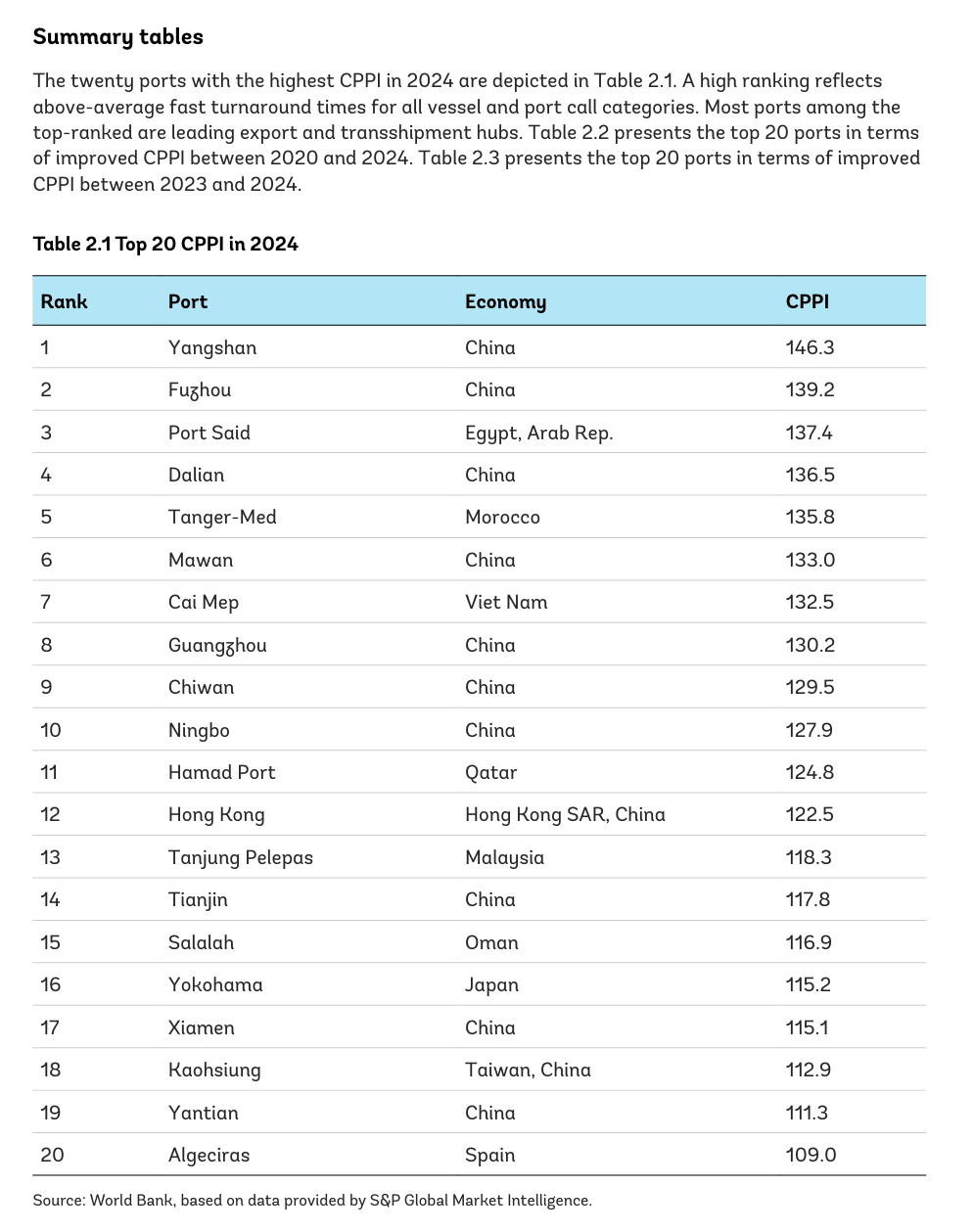
State-owned Transnet Port Terminals is pouring investment into cranes and new equipment after years of corruption and mismanagement that eroded the quality of its operations. The Container Port Performance Index from 2020 to 2024 took note of the upgrades and measures, including better weather forecasting at two local facilities. … Still, Cape Town was 400th in the survey, with Coega and Durban the penultimate and last of the 403 ports ranked.
The countries with high-ranked container ports are likely to be more advantageous spots for factories, at least the parts of those countries connected by good rail links to the efficient ports. Note that even today it can cost more to ship a container a few hundred miles by rail than thousands of miles by ship.
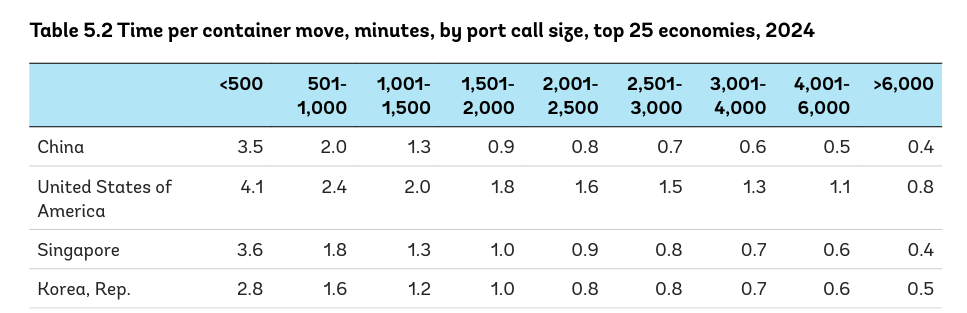
Also interesting from the above-cited report, what happens when you compare the best that Americans can do, considering all union and cultural factors, to our brothers, sisters, and binary-resisters in Asia?
(Note that some of this inferior performance might be robot vs. human. American unions have had a lot of success in obstructing the installation of automation at our ports.)
So… if the AI revolution turns out to have dramatic economic effects, as predicted, the benefits will be radically unequal. Maybe Californians won’t complain so much about inequality if it turns out that nearly all of the wealth of the U.S. ends up in California as a result of the AI economy? Will they be eager for federal tax policy that plucks wealth from California AI Achievers and pays it out to Left-Behind Mainers and Michiganders?
Can we predict the people and places that the AI boom will enrich the most? I hope that SE Florida will be fine, even if money is earned elsewhere in the U.S., thanks to the spectacular mismanagement and consequent high taxes of a lot of other parts of the U.S. (Maybe Jensen Huang will eventually retire and bring his personal $trillions to tax-free Florida?) California is an obvious candidate for a place where a lot of individuals will keep getting richer, but mostly the rich AI nerds will leave the other 40 million Californians in the dust.
Maybe the answer is that AI is most useful to the smartest humans and, therefore, the big winners from AI will be the smartest humans and places where smart humans cluster. This was the core point of the book The Bell Curve, improperly characterized as a book about IQ as a function of race. In fact, the main point is that, unlike in medieval times, the modern industrial economy delivers enormous rewards to the smartest people. A potato-picking peasant in 1500 who happened to have an IQ of 130 wasn’t going to earn a lot more than his counterpart with an IQ of 100. If AI accelerates the trend identified by The Bell Curve then maybe Korea, China, Japan, Singapore, and Taiwan will be the ultimate winners. (Average IQ in the U.S. started to fall shortly after our post-1965 opening of our borders to immigrants from countries with lower-than-100 IQs.)
Containerization was invented by an American. The first purpose-built container ships were built in U.S. shipyards. All of the early leaders in container shipping were American companies. One of the biggest early adopters of container shipping was the U.S. military (to support our ultimately futile efforts in South Vietnam). Today, however, the U.S. is insignificant in building and operating container ships. Merely because the world’s current AI leaders are in the U.S. we shouldn’t be complacent!
Readers: Who wants to make some predictions?
Fresh on X today, from the Financial Times, about how AI makes the cognitive elite more elite (i.e., another reason why the majority of Americans will eventually vote for everything that Bernie Sanders, Elizabeth Warren, and AOC propose):
The highest-earning and most experienced workers are adopting AI in their jobs far faster than others, in a divide that risks widening inequality as the technology spreads through the workplace https://t.co/ekDF96Z6TTpic.twitter.com/VRy0BAL9zP
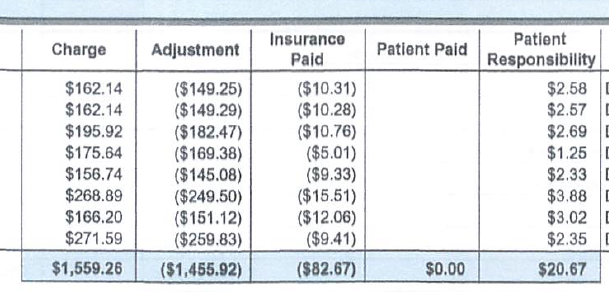
An average day in the U.S. health care system. Here’s a Quest Diagnostics bill for some blood tests:
The good news is that the patient paid only $103 for the tests ($83 via insurance; $20.67 via an efficient paper bill mailed in USPS) that are worth $1,559. The rain on this parade is that there is no world in which these tests are worth 15X what Quest gladly accepted as payment under United Healthcare’s negotiated rate. The only time that $1,559 would have kicked in is if Quest were pursuing a patient whose insurance fell through the cracks somehow.
I still can’t figure out how it is legal for Quest or any other health care provider to pursue an uninsured patient for 15X the fair price for its services (where “fair” = what 98% of customers pay).
Related:
San Francisco’s city-owned, Mark Zuckerberg-financed hospital ripping off patients with bills that are 6X the fair price: New York Post
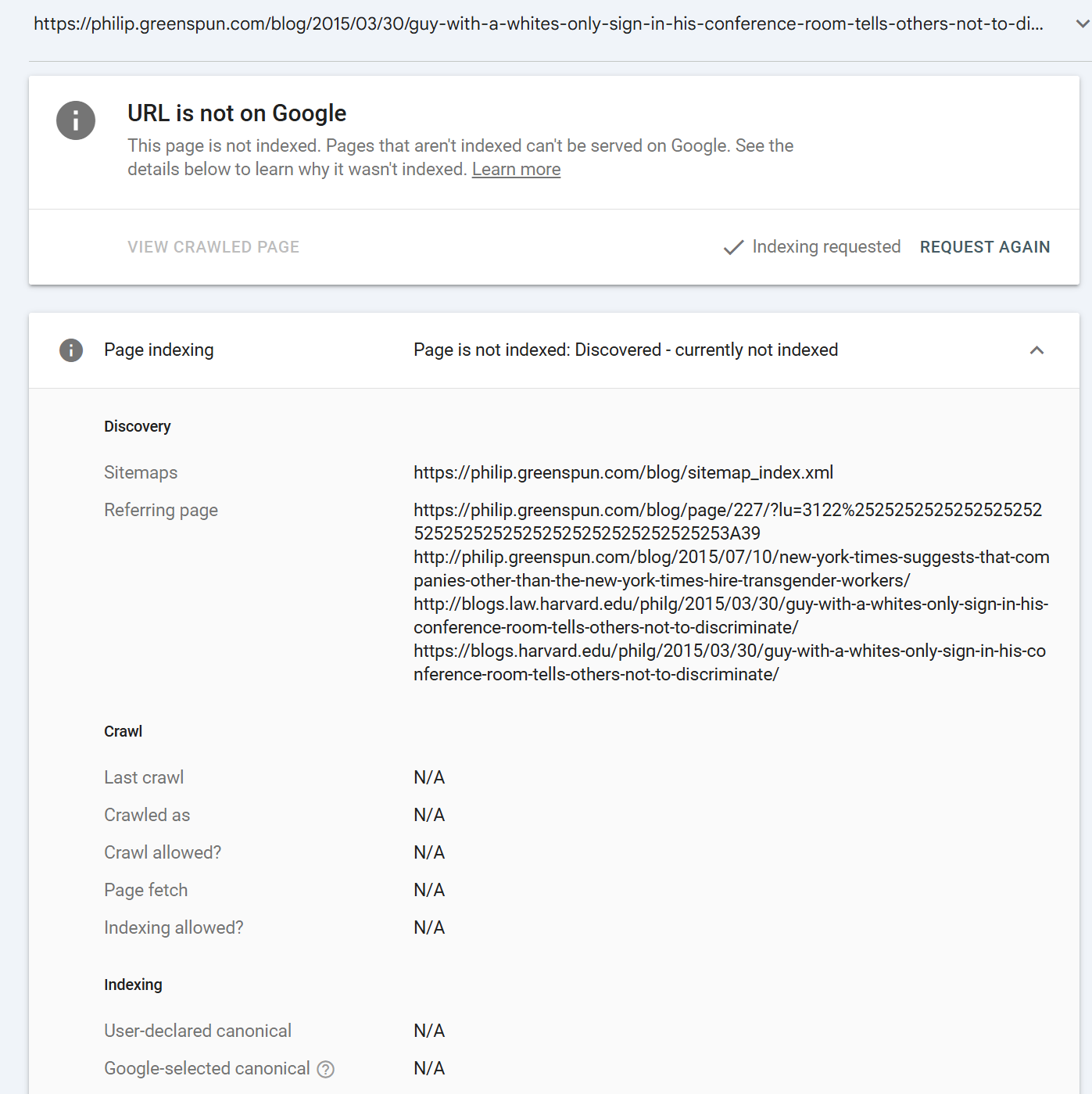
One of my favorite posts from 11 years ago, Guy with a “Whites Only” sign in his conference room tells others not to discriminate, poked fun at Tim Cook for complaining that people he’d never met in Indiana and Arkansas were racist and might put up a “whites only” sign while simultaneously going to work every day in a white-only environment:
Microsoft has been publishing data about the gender, race, and ethnic breakdown of its employees for more than a decade. Since 2019 it’s been publishing a full diversity and inclusion report annually, and at the same time made reporting on diversity a requirement for employee performance reviews. Now it’s scrapping its diversity report and dropping diversity and inclusion as a companywide core priority for performance reviews, just months after President Donald Trump issued an executive order to try and eradicate workforce diversity, equity, and inclusion (DEI) initiatives.
… employees no longer have to submit exactly what they did to improve security and diversity and what they plan to do in the future. … replaced with a simplified form that asks employees to reflect on the results they delivered and how they achieved them, and any recent setbacks and goals for the future. … In HR documentation, the company doesn’t even use the word “diversity” anymore, opting for just “inclusion” instead.
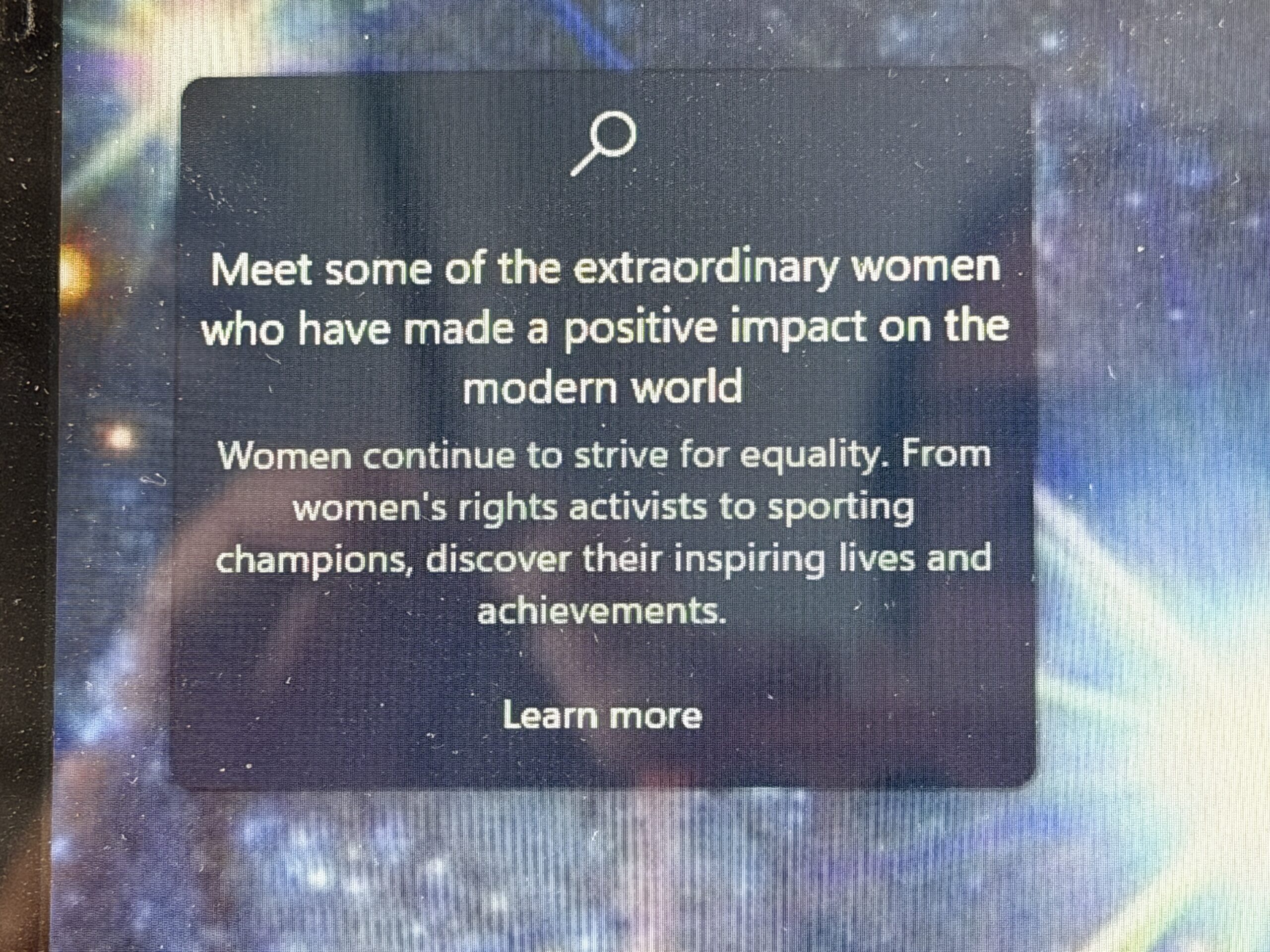
Also on December 4, 2025, pictures of my Windows 11 login screen:
Microsoft knows that I have chosen to use the Windows operating system and it reminds me about “the extraordinary women who have made a positive impact on the modern world.”
Who are the extraordinary women who built Microsoft Windows? I asked ChatGPT, “Who were the most important programmers of Microsoft Windows operating system that are identifiable by name?” and received the following answer:
Tim Paterson, wrote original QDOS/MS-DOS
Mark Zbikowski, designed MZ executable format
Dave Cutler, lead architect Windows NT
Lou Perazzoli, NT memory manager author
Mark Lucovsky, NT kernel/I-O subsystem
Rob Short, core NT kernel engineer
Jim Horne, NT cache manager author
Tom Miller, original NT kernel team
Darryl Havens, original NT kernel team
Steve Wood, original NT kernel team
Ralph Lipe, Win32 input/driver stack
Ken Reneris, GDI graphics subsystem
Philip Fortier, early USER window manager
Bob Day, GDI and USER components
Raymond Chen, Win32 compatibility steward
David Thompson, Windows 95 lead architect
Brad Silverberg, Windows 95 project leader
Jim Allchin, merged 95/NT codebases
Mark Russinovich, modern kernel authority
Dave Plummer, wrote Task Manager/Pinball
What do the people behind Microsoft Windows know about “extraordinary women” that the typical user doesn’t know? How did Microsoft become an expert on this subject? Will an extraordinary woman figure out a way for Windows 11 to run smoothly in less than 128 GB of RAM? Will an extraordinary woman figure out a way for Windows 11 to delete a file from the C: drive (M.2 SSD) without waiting for spin-up of the D: drive (HDD)?
We’ve read about a variety of frauds lately, some in the business world and some at the government trough. We hear about the fraudsters being sanctioned, but never the people who were responsible for ladling out the cash. Our first example happened at JPMorgan (source: Association of Certified Fraud Examiners):
In late 2021, JPMorgan announced they were acquiring Frank, a fintech startup founded by [precious female entrepreneur] Charlie Javice that promised to simplify the college financial aid application process. The company reportedly had more than four million users who used the app to help them navigate the complex and difficult process of applying for financial aid. However, by December 2022, JPMorgan filed a civil lawsuit against Javice, alleging fraudulent claims over the amount of customers Frank had. Instead of the around four million customers Javice reported, Frank had fewer than 300,000 actual users. Federal prosecutors then brought criminal charges in early 2023, and in March 2025, Javice was found guilty on multiple counts, including securities fraud, wire fraud, bank fraud and conspiracy charges.
The discrepancy was significant, as Frank had only about 7% of the users it claimed to have during negotiations with JPMorgan Chase. Evidence showed that Javice had actually hired a data scientist for around $18,000 to create synthetic user data, which was then presented to JPMorgan during the acquisition process as a selling point.
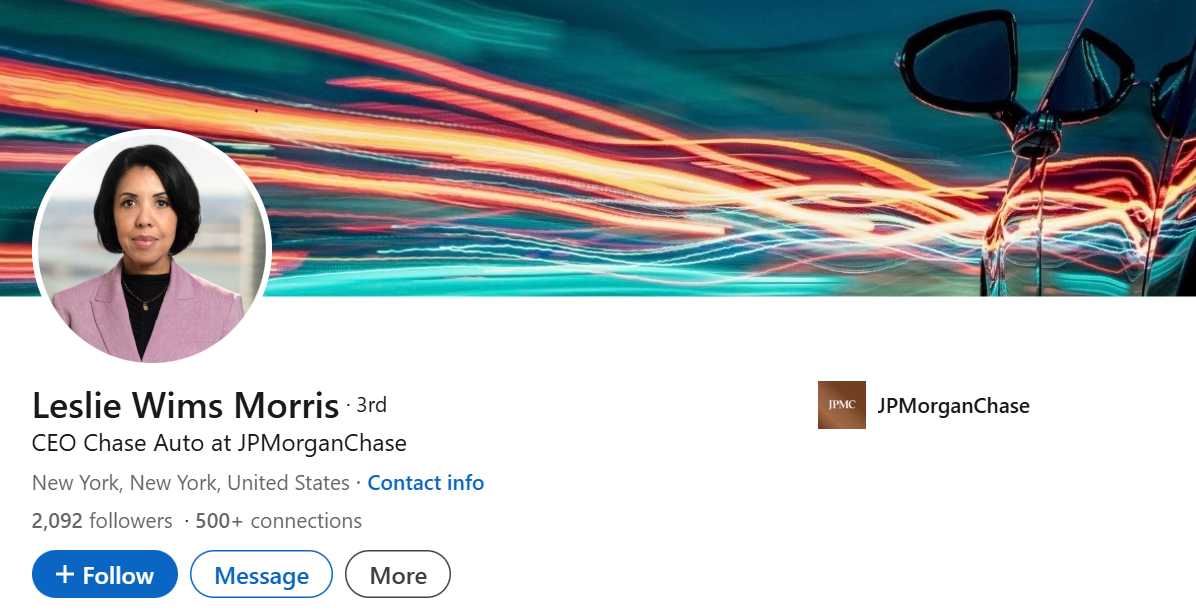
Wims Morris, a JPMorgan executive, relied heavily on Javice’s claims about user data.
How’s Wims Morris doing now? Her LinkedIn profile says that she’s now in charge of $88 billion in auto loans:
The lenders have accused [enricher] Bankim Brahmbhatt, the owner of little-known telecom-services companies Broadband Telecom and Bridgevoice, of fabricating accounts receivable that were supposed to be used as loan collateral. The lenders filed suit in August. They said Brahmbhatt’s companies owe them more than $500 million.
The lenders allege in their complaint that their investigation determined that every customer email Brahmbhatt-owned companies had provided to verify invoices over the past two years was fake. They also said they discovered fraudulent contracts from customers dating back to 2018.
In other words, it seems that anyone able to type “Please generate some invoices and customer emails for my hypothetical telecom company” into an LLM could collect $500 million from the smartest folks on Wall Street. A Google search for “BlackRock firings after Brahmbhatt fraud” yields zero relevant results.
The same lack of accountability can be observed in government. Somalis living in Minnesota managed to defraud taxpayers of more than $1 billion via various welfare program schemes (on top of the taxpayer-funded housing, health care, food, and smartphone to which two-thirds of Somali households in Minnesota are entitled by virtue of having over-the-table income lower than 200 percent of the poverty line (MNCompass)). It got to the point that even the New York Times was willing to implicitly criticize war veteran Tim Walz: “How Fraud Swamped Minnesota’s Social Services System on Tim Walz’s Watch”:
The fraud scandal that rattled Minnesota was staggering in its scale and brazenness. … fraud took root in pockets of Minnesota’s Somali diaspora as scores of individuals made small fortunes by setting up companies that billed state agencies for millions of dollars’ worth of social services that were never provided. Federal prosecutors say that 59 people have been convicted in those schemes so far, and that more than $1 billion in taxpayers’ money has been stolen in three plots they are investigating. That is more than Minnesota spends annually to run its Department of Corrections. … Ms. Hassan is of Somali ancestry, as are all but eight of the 86 people charged in the meals, housing and autism therapy fraud cases, according to prosecutors. A vast majority are American citizens, by birth or naturalization.
“The message here in Minnesota,” [Tampon Tim] Walz said, “is if you commit a crime, if you commit fraud against public dollars, you are going to go to prison.”
The worst part is not the $1 billion extracted from taxpayers who had to work extra hours to send money to Somalis and Somalia, but that people might mistakenly believe that Somalis, two-thirds of whom are entitled to every form of welfare (see above), aren’t “hardworking”:
“The actions of a small group have made it easier for people already inclined to reject us to double down,” said Abdi Mohamed, a filmmaker in Minneapolis. “The broader Somali community — hardworking, family-oriented, deeply committed to Minnesota — is left carrying that burden.”
Missing from the article: “Joe Bureaucrat was fired for not noticing this obvious fraud and ladling out more than one $billion in tax dollars.” Also missing… reader comments. The NYT disabled comments on the article from the beginning so that none of their readers could commit Wrongthink and erroneously suggest that Minnesota would be better off without enrichment by Somalis.
The Somalis who defrauded the white say-gooders of Minnesota weren’t Hollywood-style supervillains with IQs of 160. JPMorgan could have discovered precious female entrepreneur Charlie Javice’s fraud by making about 10 phone calls. Ditto for BlackRock and Bankim Brahmbhatt (believed to be back in India now after enriching the U.S. for enough years to obtain U.S. citizenship (FCC filings)). If nobody can be fired then what’s the incentive to perform basic due diligence?
Maybe I am out of step with the rest of humanity. For example, I would have imprisoned the Theranos Board, its attorneys, and anyone who invested other people’s money in Theranos rather than prosecuting and imprisoning Elizabeth Holmes. Believing that a Stanford dropout knew stuff that all of Europe’s PhD chemists didn’t know is criminal-level idiocy in my opinion! I would have sent Elizabeth Holmes out on a speaking tour (not a Hillary-style “listening tour”) where she could tell venture capitalists and money managers that sometimes credentials actually do matter.
Readers may recall my passion for doing something with the dead/black/huge televisions that are on many walls of our houses (the house that we bought in Florida actually came with six flat-screen TVs at no extra charge because the previous owners didn’t feel like demounting and moving them), e.g.,
I’m surprised that nobody has implemented a business idea that I proposed to entrepreneurial friends about 10 years ago: a streaming service that turns any television into a “virtual window”, but not a window onto the boring street where one actually lives. A subscriber could choose to be looking out at the Champs Elysée, at the crazy intersection in Shibuya (Tokyo), a lake/mountain view from a famous resort hotel, etc. Since all of my ideas are terrible, from a business point of view, the original concept was a cable TV channel. Cable companies offer roughly 50 music channels for ambient use. Why not 50 virtual windows as well?
High quality webcams have only gotten cheaper in the decade since I proposed this idea. Internet has become faster and more reliable. Why hasn’t this idea caught on?
There is a construction documentation company that branched out into this market a little and offers earthcamtv.com, which seems to be supported by low-rent ads rather than subscription. They have an Android TV app so I guess it would work on a Sony, TCL, or HiSense . I don’t think anyone would want this running continuously in his/her/zir/their house.
Here’s a newer twist on the idea: Immigration TV. This could have virtual windows into the countries that enrich us, e.g., Venezuela, Haiti, Colombia, India, Pakistan, etc. It could be sponsored by both the Democratic Party (channels that show how great life is in places that migrants claim are too dangerous to inhabit) and the Republicans (channels that show the crowded, dirty, and disorganized conditions that people in source countries have created for themselves).
As far as I know, all current TVs lack the interface required to be programmed to “wake up at 0900 and start up the Virtual Windows app” so it would be somewhat tedious to go around to every TV in the house every morning and configure this.
Samsung is still trying to sell people on its absurdly deficient The Frame system (requires an external box that nobody has a place to put except maybe if a house was built from scratch with The Frame in mind; they make a wireless version of the box, but of course everyone says that it doesn’t stay connected). Most humans are much more drawn to moving pictures than to still images, even still images of great art (art museums that are free still struggle to attract a wide audience). Why wouldn’t LG introduce The Window in which the television comes preloaded with the ability to show streams from curated webcams around the world?
Partial personal list of desired virtual windows:
One for each of the nicest Japanese gardens in Japan (that would be around 50 window choices?)
One for the bonsai collection with pond behind at Morikami Japanese garden in Palm Beach County, Florida (good for the Japanese winter months)
Ngorongoro Crater (Tanzania)
Churchill, Manitoba (polar bars)
Piazza San Marco, Venice (from a second-story window since nobody needs to see the pigeons up close)
Miradouro de São Pedro de Alcântara, Lisbon
Portofino South condo rooftop in West Palm Beach (looks out towards Mar-a-Lago so we can keep our envy levels appropriately high)
Miami waterfront skyscraper (any) looking out toward Biscayne Bay and Miami Beach (watch the cruise ships come and go)
Looking out on the main square of Santiago de Compostela to watch pilgrims who’ve completed their walks