“Microsoft is quietly walking back its diversity efforts/Microsoft is toeing the line in Trump’s America” (The Verge, December 4, 2025):
Microsoft has been publishing data about the gender, race, and ethnic breakdown of its employees for more than a decade. Since 2019 it’s been publishing a full diversity and inclusion report annually, and at the same time made reporting on diversity a requirement for employee performance reviews. Now it’s scrapping its diversity report and dropping diversity and inclusion as a companywide core priority for performance reviews, just months after President Donald Trump issued an executive order to try and eradicate workforce diversity, equity, and inclusion (DEI) initiatives.
… employees no longer have to submit exactly what they did to improve security and diversity and what they plan to do in the future. … replaced with a simplified form that asks employees to reflect on the results they delivered and how they achieved them, and any recent setbacks and goals for the future. … In HR documentation, the company doesn’t even use the word “diversity” anymore, opting for just “inclusion” instead.
Also on December 4, 2025, pictures of my Windows 11 login screen:
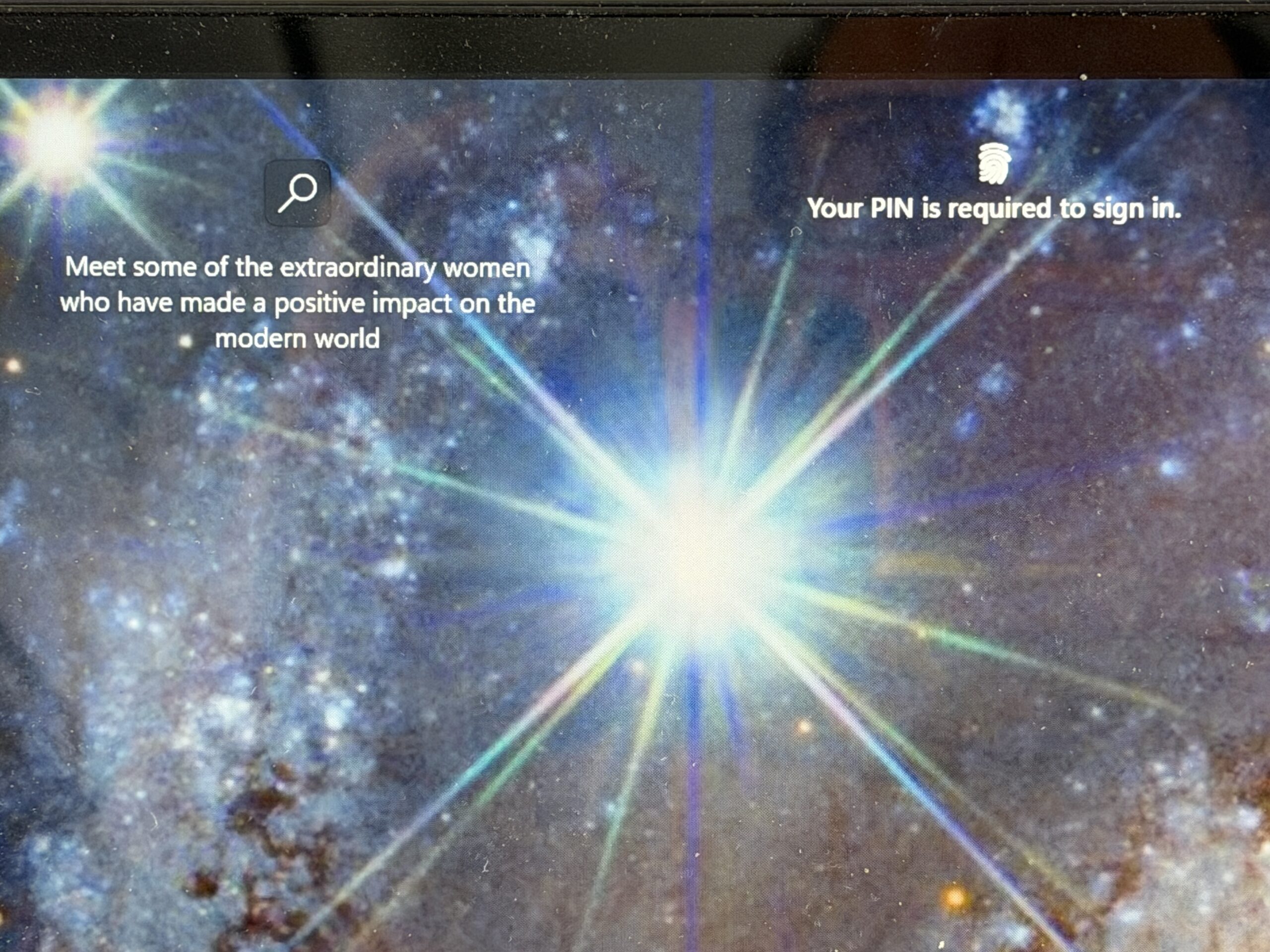
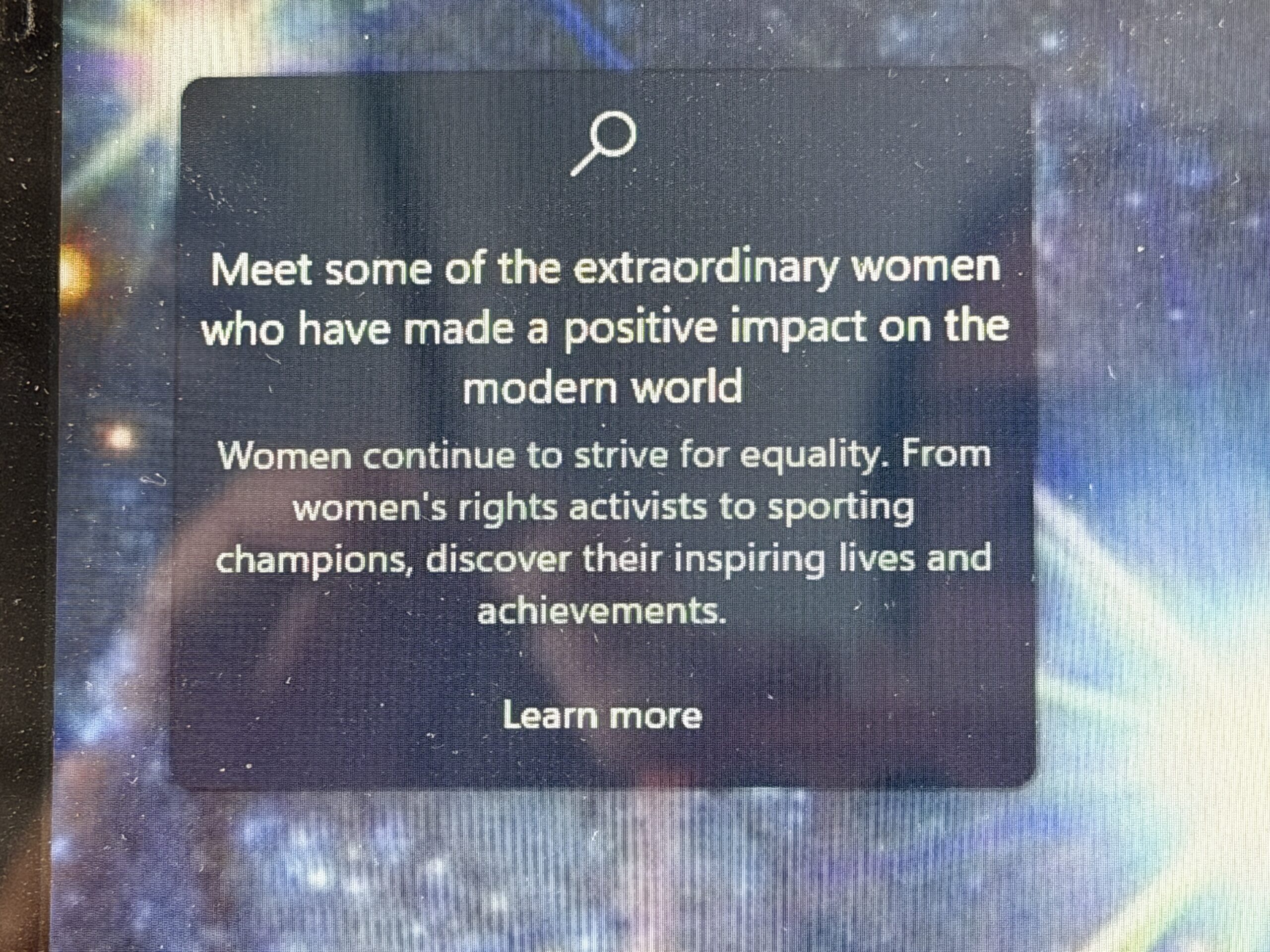
Microsoft knows that I have chosen to use the Windows operating system and it reminds me about “the extraordinary women who have made a positive impact on the modern world.”
Who are the extraordinary women who built Microsoft Windows? I asked ChatGPT, “Who were the most important programmers of Microsoft Windows operating system that are identifiable by name?” and received the following answer:
- Tim Paterson, wrote original QDOS/MS-DOS
- Mark Zbikowski, designed MZ executable format
- Dave Cutler, lead architect Windows NT
- Lou Perazzoli, NT memory manager author
- Mark Lucovsky, NT kernel/I-O subsystem
- Rob Short, core NT kernel engineer
- Jim Horne, NT cache manager author
- Tom Miller, original NT kernel team
- Darryl Havens, original NT kernel team
- Steve Wood, original NT kernel team
- Ralph Lipe, Win32 input/driver stack
- Ken Reneris, GDI graphics subsystem
- Philip Fortier, early USER window manager
- Bob Day, GDI and USER components
- Raymond Chen, Win32 compatibility steward
- David Thompson, Windows 95 lead architect
- Brad Silverberg, Windows 95 project leader
- Jim Allchin, merged 95/NT codebases
- Mark Russinovich, modern kernel authority
- Dave Plummer, wrote Task Manager/Pinball
What do the people behind Microsoft Windows know about “extraordinary women” that the typical user doesn’t know? How did Microsoft become an expert on this subject? Will an extraordinary woman figure out a way for Windows 11 to run smoothly in less than 128 GB of RAM? Will an extraordinary woman figure out a way for Windows 11 to delete a file from the C: drive (M.2 SSD) without waiting for spin-up of the D: drive (HDD)?
> programmers
It is fallacious reasoning to make your point based on the success of Microsoft Windows being only due to programmers. It is in fact only due to marketing. Women intelligently avoid cube-farms full of brogrammers, unless they have carbon-filtered respirators. Sadly, like drug companies, Microsoft resorted to using pretty faces to sell their product:
https://en.wikipedia.org/wiki/Bill_Gates
Oh, he’s male too. Melinda mostly worked on application marketing until she married her male boss and focused on being a mommy.
I don’t see Cutler anywhere on this page, but on paper they are still woke AF, only 1 brogrammer in a hoodie:
https://www.microsoft.com/en-us/diversity/default
Not to be missed — someone who identifies as a programming language, “C” (oddly, though, xhe is an admin writing .BAT files):
> As I became more comfortable presenting as my actual self, my confidence just gradually started increasing and I was able to do more at work because I was more comfortable.
When I presented my actual self at work, I always got a reprimand from H.R. about obscenity.
Thanks for the https://www.microsoft.com/en-us/diversity/default link. I’m a little confused by “he Hispanic and Latinx communities at Microsoft”. How are these two communities distinct?
“C shares their distinctive qualities with pride. Drawing from their Puerto Rican heritage and love for self-expression, C blends humor with originality and compassion in their role, redefining norms through unique understanding.” is also beautiful! If C met someone named C++ would they fall in love or immediately get into a fight?
I also like the True or False where they say that “Teamwork matters more than individual success in tech”. One of my jet-owning friends says the opposite: “I’m having AI build almost all of the code for my new company. I think in five years we will have companies worth $1 trillion with a single founder.”
C looks like Gate’s non-binary relative they keep in the attic when there is company. What if we introduced a love-triangle with C#? Come to think of it, wouldn’t it be fun to have a pride party and dress up like our favorite language? I call dibs on Ada (Lovelace). COBOL (Grace Hopper) is still available. (Two cis females who where pioneer programmers, by the way.)
“I think in five years we will have companies worth $1 trillion with a single founder.”
Isn’t Berkshire Hathaway worth $1 trillion already?
I think C is a good language to represent the neurodivergent. If you aren’t in your own little world before programming in it, you will be after using it a while.
Aside, anyone else ever notice the 1984 reference with the “++” operator, as in “doubleplus ungood”? The naming of C++ makes more sense to me now.
It seemed to scrape Dave Plummer from his gootube channel. Don’t believe he was that prominent in windows history until the task manager videos 5 years ago. Wonder how easy it would be for anyone manipulate the training set to become as famous as Greenspun.
Related: “Microsoft Invests $17.5 Billion in India as It Lays Off Americans, Imports H-1B Visa Workers”
https://www.breitbart.com/tech/2025/12/10/microsoft-invests-17-5-billion-in-india-as-it-lays-off-americans-imports-h-1b-visa-workers/
Cry harder
If there’s a better recipe for garbage code than offshore teams and AI, I cannot imagine what it might be.
@SM
IDK, MS-DOS was reportedly Straight Out the Dumpster, yo (literally).
A bit off-topic, but relevant for anyone who uses paywall bypass sites: “FBI Wants to Know Who Runs Archive.ph” [1].
Because of this, my company has now blocked access to all archive.* domains.
Thus, I cannot access https://archive.is/DNBQa from work.
[1] https://hackread.com/fbi-wants-to-know-who-runs-archive-ph/
Cope
” …employees no longer have to submit exactly what they did to improve security and diversity and what they plan to do in the future…”
What do “security” and “diversity” have to do with each other? This is wordplay meant to lump DEI into unrelated topics.
As a side note, at my BIG company (not Microsoft), I have seen a sharp decline in DEI-related emails and events over the past two months. In fact, I haven’t seen a single DEI email in the last four weeks. Should I file a complaint with HR?
> What do the people behind Microsoft Windows know about “extraordinary women” that the typical user doesn’t know? How did Microsoft become an expert on this subject? Will an extraordinary woman figure out a way for Windows 11 to run smoothly in less than 128 GB of RAM? Will an extraordinary woman figure out a way for Windows 11 to delete a file from the C: drive (M.2 SSD) without waiting for spin-up of the D: drive (HDD)?
Dr. Greenspun seems to know all the answers but doesn’t want to accept it. He knows that repeating something many times is how you make people believe it’s true without questioning. It’s a good technique to save time for a well-meaning leader, if the people involved are very emotional and unable to question things in an unbiased and neutral manner. Like, maybe, most children.