Every now and then the New York Times takes a break from Trump bad/progressive Democrats good and does some actual journalism. “Scams, Schemes, Ruthless Cons: The Untold Story of How Jeffrey Epstein Got Rich” (December 16, 2025) answers the only interesting question, in my opinion, about Jeffrey Epstein, i.e., How does a guy who doesn’t seem to be either smart or hard-working get rich enough to operate a Gulfstream?
I know some people who’ve gotten rich by working in finance. All had more advanced educations than Jeffrey Epstein (a college dropout) and none of them had time to party on a private island, with or without a stable of paid females.
How did Epstein get rich, then? According to the NYT, he stole it all. Not the 2 and 20 stealing that a hedge fund might do every year, but grabbing most or all of the principal with which he was entrusted.
In his first two decades of business, we found that Epstein was less a financial genius than a prodigious manipulator and liar. Abundant conspiracy theories hold that Epstein worked for spy services or ran a lucrative blackmail operation, but we found a more prosaic explanation for how he built a fortune. A relentless scammer, he abused expense accounts, engineered inside deals and demonstrated a remarkable knack for separating seemingly sophisticated investors and businessmen from their money. He started small, testing his tactics and seeing what he could get away with. His early successes laid the foundation for more ambitious ploys down the road. Again and again, he proved willing to operate on the edge of criminality and burn bridges in his pursuit of wealth and power.
One funny part: in 1980, making $1 million/year was considered successful:
He was regularly flying to Palm Beach, Fla., to visit young women. That summer, Cosmopolitan named Epstein its “bachelor of the month,” describing him as a “dynamo” who “talks only to people who make over a million a year!” The magazine encouraged interested parties to write to Epstein at his work address.
It was easier to steal because the clients themselves were trying to steal from the IRS and, therefore, they couldn’t easily complain to the government that Epstein stole from them before they could steal from the government:
According to Epstein’s friend Bob Gold, Epstein and the Pottingers pitched tax-avoidance strategies to wealthy clients, including some whom Gold believes Epstein met through Bear Stearns.
Bear Stearns, which took down the entire U.S. economy with its 2008 failure, briefly employed Epstein and its managers kept helping him:
In 1982, [Clark Schubach of Bear] introduced Epstein to Michael Stroll, who ran a pinball and video-game company. Stroll trusted Bear Stearns and Schubach. He gave Epstein $450,000 — about 10 percent of his net worth — to invest in a supposed crude-oil deal that Epstein told him he was planning.
Within two years, most of the money had vanished, Stroll later said in an unpublished interview with Thomas Volscho, a professor at the College of Staten Island who has spent years researching Epstein’s early years and shared some of his notes and documents with us. Epstein began dodging Stroll’s phone calls; at one point, he sent Stroll a quart of oil in an attempt to convince him that a deal was, in fact, in the works. The dispute ended up in civil court, with Stroll arguing that Epstein had promised to return his money but never did. In 1993, Epstein prevailed on technical grounds, and a judge ruled that he wasn’t personally liable. Decades later, Stroll remains bitter. “He’s a despicable prick,” he told us.
…
But Epstein’s perfidy ran deeper. Ed Epstein discovered that dozens of the people Epstein recruited to invest in Pennwalt, including Snyder, had written to him demanding that he repay their money. In other words, Epstein had lured investors in, used their money to book big profits and then refused to return their funds. There is no record of Epstein facing any consequences — or repaying the money. A result was that by the end of 1988, he reported being worth about $15 million, according to a previously undisclosed document from a Swiss bank, which Thomas Volscho, the professor, shared with us.
Epstein got a lot of help from “daughters of famous, powerful men”:
Epstein seems to have had a keen sense of which benefactors he could quickly suck dry, leaving them angry and betrayed, and which were worth nurturing for the long haul as sources of connections and prestige. One of those was Sir James Goldsmith — a financier and European politician who was embedded in Manhattan’s upper crust. One evening, he hosted a gathering at his mansion on the Upper East Side. Among the guests was Stuart Pivar, who had amassed a fortune before becoming a renowned art collector. When Pivar arrived, he encountered Epstein playing a Beethoven sonata at a piano in Goldsmith’s spacious entrance hall. Pivar told us he was transfixed: Epstein had an irresistible “magnetism” — especially with “the beautiful daughters of famous, powerful men.”
There are no rewards for being smart and honest:
A fateful flight to Florida that year would launch Epstein from a mere millionaire into a plutocrat with palatial estates, two private islands and luxury aircraft. The transformation came about through a new client: Les Wexner, the billionaire who built brands like the Limited and Victoria’s Secret. The two were introduced by Wexner’s friend Robert Meister, an insurance executive who happened to sit next to Epstein on the plane to Palm Beach. Meister suggested that Wexner get in touch with Epstein for financial advice.
Wexner soon had a financial adviser, Harold Levin, fly to New York to meet Epstein. Levin told us that he spent an hour with Epstein in his office and immediately got a bad vibe. He found a pay phone and called Wexner. “I smell a rat,” Levin reported. “I don’t trust him.”
Wexner apparently didn’t listen. About a year later, he hired Epstein to be Levin’s boss. As far as Levin could tell, Epstein won the billionaire’s confidence by falsely telling him that Levin had been stealing. Levin decided to quit rather than work for Epstein. Before long, Wexner had given Epstein essentially free rein by granting him power of attorney over his finances. Epstein’s name began appearing in government filings as responsible for Wexner’s businesses and charities.
Another price/inflation shocker:
He bought a waterfront mansion in Palm Beach for $2.5 million, about a mile from Donald Trump’s Mar-a-Lago estate.
It’s now worth about $40 million, according to Zillow, after a rebuild and address change. (i.e., more than twice as much as the National Historic Landmark of Mar-a-Lago, if we accept the New York judiciary’s finding that Donald Trump’s house had a fair market value of $18 million)
Washington, D.C. was a good place to hunt for the next batch of money to steal.
On a freezing Thursday in February 1993, Epstein and Wexner arrived at 1600 Pennsylvania Avenue in Washington. Just weeks earlier, Bill Clinton had been sworn in as the 42nd president. It was the first of many visits Epstein would pay to the Clinton White House.
Epstein had become a political donor — including, later that year, $10,000 to help refurbish the White House, earning him a spot at a reception with the Clintons — and that gave him a certain amount of cachet with the new president. But Epstein had something else going for him as well: a new connection named Lynn Forester.
Forester told us that she met Epstein at a reception for George Mitchell, the Senate majority leader, whom Epstein had befriended. Forester was a successful telecommunications executive, but she rose to greater prominence through her marriage to Andrew Stein, the Manhattan politician who in 1993 ran unsuccessfully for New York City mayor. The end of his mayoral campaign coincided with the end of their 10-year marriage. Now Forester and Stein were feuding over how to divvy up millions of dollars, and Epstein apparently convinced Forester that he could protect her from getting ripped off. It was a version of the same tactic he used to get in Wexner’s good graces years earlier.
It was an opportune moment for Epstein to ingratiate himself with Forester, whom Clinton had appointed to a White House advisory commission. On at least one occasion, Forester brought up Epstein in a brief private conversation with the president, according to a letter, first reported by The Daily Beast, that she wrote that mentioned Epstein. He became a regular visitor to the White House, sometimes with a girlfriend in tow, according to records housed at Clinton’s presidential library.
Via this photo, the NYT reminds young readers to enjoy their youth and beauty while it lasts (though maybe using youth/beauty to assist Jeffrey Epstein wasn’t the highest and best use?):
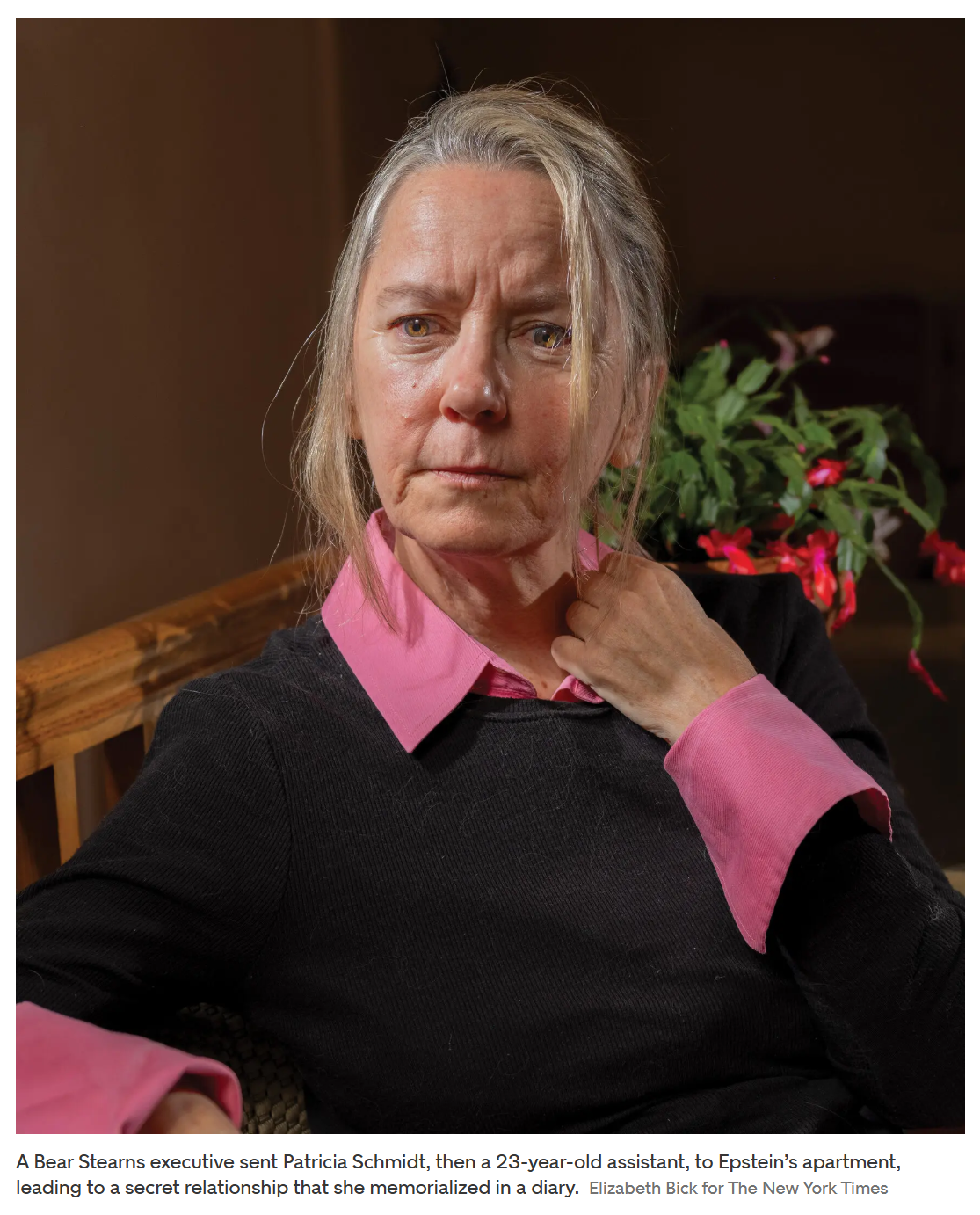
(Why is the man-bites-dog story of an apparently mediocre and lazy person getting rich enough to operate a Gulfstream the most interesting aspect of the Emmanuel Goldstein saga? I don’t understand the fascination with Jeffrey Epstein’s after-hours frolics with a stable of paid young females. The ideas that middle-aged guys would find young females attractive (example study and research summary) or that females would be interested in having sex with rich men and/or men who were paying them are dog-bites-man stories, in my view. There is a linguistic twist in that the female employees of Epstein, who got housing, health care, dental care, transportation, entertainment, cash, etc. on the job and then later got $millions each (from Epstein’s estate and from a JP Morgan settlement), all of it tax-free, are considered “victims”. Even the ones who started their paid work with Epstein at age 18 or older may have received more money than the average American woman could earn in a lifetime of 9-5 toil. Regarding the moral outrage about “underage women”, the most frequently cited victim is Virginia Giuffre and she was turning 17 in mid-2000 when she says she met Epstein for the first time, i.e., older than the Massachusetts age of consent of 16. Epstein was indicted for being involved with females “as young as 14” (justice.gov). That is more shocking to the puritan mind of a Legacy American, but fourteen is the age of consent in a lot of European countries and was the typical age of marriage in Ancient Greece. Fourteen is five years older than Aisha was when her marriage with Muhammad was consummated (according to the Hadiths). Roughly half of Americans support filling the United States with Muslims, all of whom are supposed to follow the Hadiths. Why would the same people then express moral condemnation of Jeffrey Epstein’s harem, none of whose members were anywhere near as young as Aisha? Alternatively, if they reject a culture in which women under 18 can choose to have sex, get married, exchange sex for money, etc. then why would they advocate for continued expansion of Muslim immigration?)
Related:
- Department of American nation-building… “Critics say new bill passed by Iraqi lawmakers opens door to child marriage” (CBC/AP 2025): “New changes in Iraq’s law would allow marriage of girls in early teens or as young as 9, say critics”
So the thesis is, Epstein was basically Bernie Madoff except his victims forgave him?
Here is an unrelated article on a topic which I think is close to Phil’s heart: https://nypost.com/2026/01/09/business/bill-gates-sends-8b-to-ex-wife-melinda-in-one-of-largest-divorce-related-payouts-ever/
Thanks, Tom. It is great to know that someone wise enough to have sex with her boss will now be disbursing $8 billion in never-taxed funds.
What US authorities have always been good for is protecting investors wealth, and yes, I have not been there in 1980, but economic statistics show that$4.5 million net worth put you in a wealthy category in 1980. Unbelievable that Epstein had no governmental or at least elite (can you tell the difference) help in this, and I do not mean Scotland Yard or Mossad.
Interesting, maybe, but not surprising at all. Think of all the lives that would have been spared if they could detect and treat psychopathy, before the damage is done.
“A sucker is born every minute.” — P.T. Barnum, which applies to rich or poor
So Epstein was an ordinary con man. But what exactly was his con? Did he claim to have unusual investing skills, or inside connections to investment opportunities? Or was he selling a questionable tax dodge? What was the pitch that persuaded his rich clients?
I didn’t have “Dr” Phil condoning child sex trafficking on my 2026 bingo card.
Wait…yes, in fact I did. The depths of “Dr” Phil’s depravity knows no bounds.
Megyn Kylly already said she wouldn’t have a problem if her 15 year old daughter was sex trafficked, so this isn’t the hot take you think it is. You are months behind on the right-wing-gross-take-on-the-news curve.
Mike: your concern for Emmanuel Goldstein’s paid sex partners is laudable. However, Emmanuel Goldstein died 6.5 years ago. If you’re actually concerned about women younger than 18 working as prostitutes, what have you personally done to save such women in the past 6.5 years? If the answer is “nothing” then the most reasonable inference is you’re not actually concerned.
Phil, I have a vague memory of raping my daughter Ashley. How does that fit in with your analysis?
Well, here is yet another NYT article that does not make a lot of sense. At the outset, wouldn’t it be amazing that a NYT reporter would really be able to figure out the financial side of Epstein? Getting at the truth would require a lot of legal and financial sophistication, and why would anyone with those skills be working as a reporter for the NYT titillating readers rather than making a lot of money? I have delt with lots of financial journalist and have yet to meet one who could read a financial statement or an SEC filing much less really uncover a fraud. We are told that Epstein became “wealthy” by fiddling with his expenses but that doesn’t sound like the best way to become wealthy and who really knows how wealthy Epstein was anyway? His plane for all we know was paid for with borrowed money. Some wealthy investors say they gave Epstein money to invest in X and then he did not do it and just pocketed the money. And these wealthy investors didn’t have the dough to hire a lawyer to pursue Epstein? The more likely explanation as to whatever wealth he had was that he received fees for arranging transactions and may be have paid by both the buyer and seller. His “expenses,” “arrangement fees,” “consulting fees,” “board fees” were likely added to his base but that would be about what the hedge funds do- you don’t really think that all it is is 2 &20? And there are lots and lots of ways to rake off fees working as a “helper” to those with money. But we need to keep the story going because the dopes love conspiracies – the Kennedy assassination ran for about 60 years till Epstein replaced it & this one has sexual titillation – grifters and low lifes trying to get a piece of the pie. And Epstein is a Jew and Jews cheating the go’eem, though Wexner was not one of those, is a story that has been around for around 2,000 years and the dopes eat that up.
You really don’s see anything wrong with a guy gathering up poor teen girls under false pretenses and maneuvering them into being whores? (Because years later they got settlements?)
Also the dog that didn’t bark about the mediocrity is that it was a big honey-pot/blackmail scam. Why would all these sophisticated investors hire this apparently charismatic dipshit to manage their money? Why would a billionaire give him power of attorney? Not only should these men known better, many of them had trusted, qualified advisors who absolutely should have known better. Wexner had other financial guys (most of whom went to college, one imagines), and Gates has had a real security team since he got pied in the face in 1998. Either group should have ferreted out that something just didn’t add up. For “whatever reason”, these guys chose to hang out with him. The reason was young girls. (and the men having already been compromised)
SuperMike, a little secret I wanted to share with you (please keep it on the down low). I think the New York Times should hire you because in one sentence you homed in “how Jeffrey Epstein got rich” (“The reason was the girls.”). The NYT wrote multiple pages, yet never seemed to get it. Comprende?