In order to be cruel to MIT students, tortured daily with math and physics problems that make them feel stupid, the flight planning lecture of our FAA Ground School class covers a hypothetical trip from MIT to Bennington College in Vermont. Every year I try to pick what seems like the easiest class at Bennington and remind them that, had they chosen a school more wisely, they could be getting credit for it. This year I picked “Ghostly Body- The Art of Absence”:
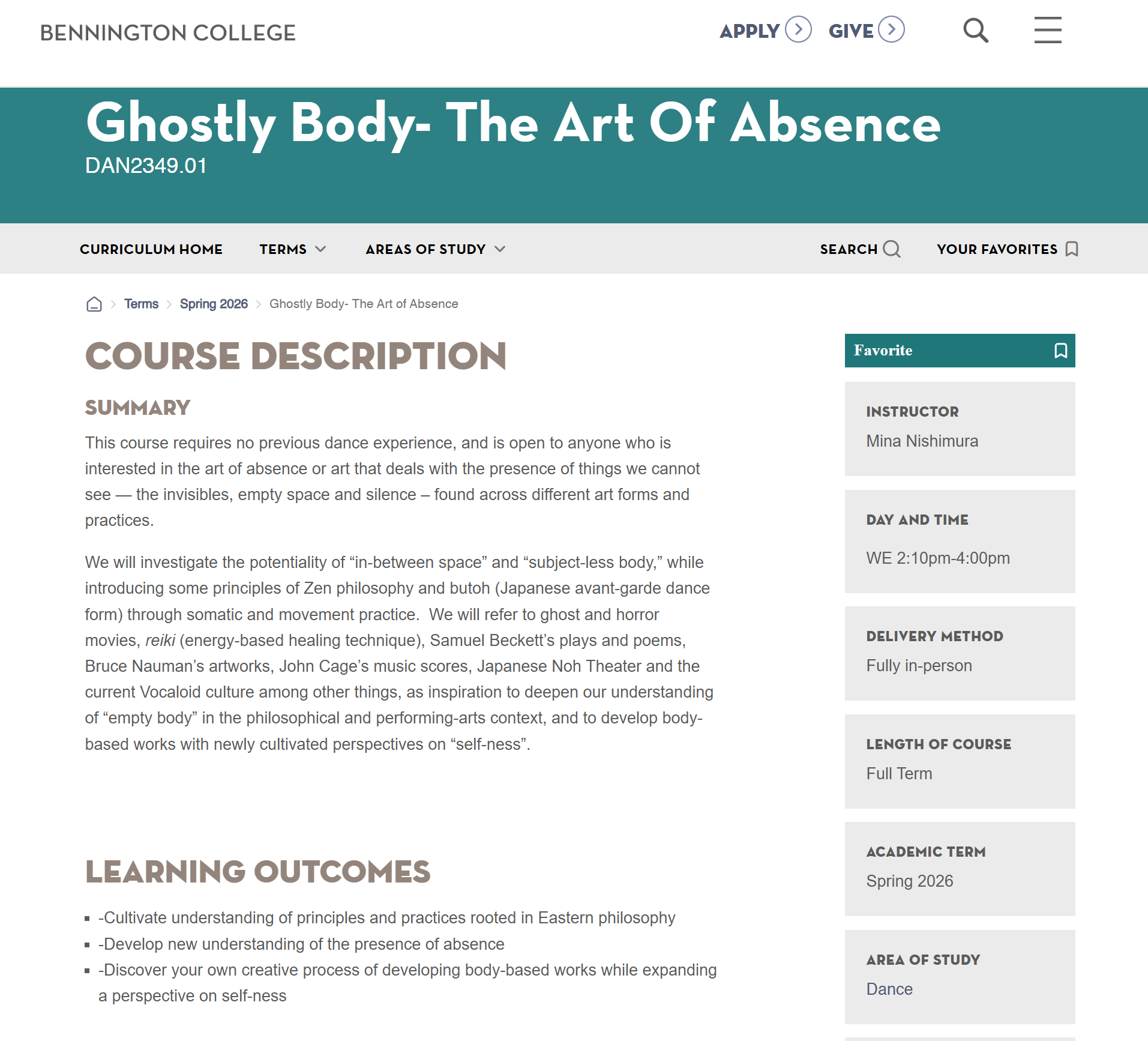
I stressed that they’d need to “develop new understanding of the presence of absence” (the class requires no previous dance experience so it is unclear what the students’ old understanding of the presence of absence might be).
Before I highlighted this as an example of the presence of absence of academic and intellectual rigor, I questioned ChatGPT 5.2: “Please explain to me your understanding of the presence of absence as it relates to dance.” What came back was, I think, worthy of a Ph.D. in Dance Theory:
In dance, the “presence of absence” names a paradox: what is not physically there can be as perceptible, meaningful, and active as what is. Absence is not emptiness; it is a charged field that shapes attention, sensation, and interpretation.
Here are the main ways this idea operates in dance.
1. The Body as a Trace, Not Just a Fact
Dance exists only while it is happening. Once a movement ends, it survives as afterimage, memory, or expectation.
- A lifted arm leaves a trace in the viewer’s perception even after it lowers.
- A dancer who exits the stage continues to “occupy” space through memory.
- Stillness is not neutral—it holds the residue of previous motion and the promise of what might come.
In this sense, dance is always haunted by what has just happened and what is about to happen.
2. Negative Space as Active Partner
Absence appears physically as space:
- The gap between dancers
- Empty areas of the stage
- The air carved by movement
Choreography often makes absence legible by framing it:
- A duet defined by distance rather than touch
- A solo surrounded by emptiness
- Movement that gestures toward, but never reaches, another body
The audience reads these voids as intentional, emotionally loaded presences.
3. Stillness and Non-Movement
Not moving is one of the clearest embodiments of the presence of absence.
Stillness can signal:
- Withheld action
- Resistance
- Grief or loss
- Listening or readiness
Because dance trains us to expect motion, the absence of motion becomes loud. The body remains present, but movement is absent—creating tension and meaning.
4. The Absent Body
Dance frequently invokes bodies that are not there:
- A partner imagined but never visible
- A former dancer referenced by repetition of their choreography
- Cultural or ancestral bodies remembered through gesture
This is especially powerful in works dealing with loss, exile, trauma, or memory. The dancer becomes a conduit for someone else’s absence.
5. Temporality and Ephemerality
Unlike visual art objects, dance disappears.
- You cannot fully “return” to a dance—only to documentation or memory.
- Each performance replaces the last.
- The dance’s absence after the performance is part of its meaning.
The presence of absence here is existential: dance is disappearance made visible.
6. Audience Perception: Filling the Void
Absence activates the viewer.
When something is withheld:
- The audience projects meaning
- Memory and imagination complete the work
- The viewer becomes a participant
What is absent invites interpretation more strongly than what is fully shown.
7. Philosophical Undercurrent
Philosophically, this idea resonates with phenomenology:
- We perceive bodies not just as objects, but as intentional beings
- Absence is felt through expectation and anticipation
- Meaning emerges in the gap between perception and completion
In dance, this gap is continuously exposed.
In Summary
The presence of absence in dance means that:
- What is missing can be felt
- What has disappeared still acts
- What does not move still speaks
- What is not shown still shapes meaning
Dance is not only about bodies in motion, but about what motion leaves behind.
If you’d like, I can also explore this through:
- A specific choreographer (e.g., Cunningham, Pina Bausch, Forsythe)
- Somatic practice or improvisation
- Performance philosophy
- Or how absence operates differently in ballet vs. contemporary dance
LLMs are known for their high quality BSing, your results don’t surprise me.
My inner poet is reminded of:
And the vision that was planted in my brain
Still remains
Within the sound of silence
— Simon and Garfunkel, The Sound of Silence
My inner nerd is reminded of the monochome monitor for the original IBM PC. The green P39 phosphor had a long decay time (to reduce flicker), which had an artistic effect.
All that for the low, low tuition price of $67,850 per year, and if you throw-in room, board, etc., and miscellaneous fees (books, supplies, etc.) the average annual budget suggested by Bennington for domestic students is $93,122.00. See, https://www.bennington.edu/admissions/apply/financing-your-education/tuition-and-fees/undergraduate-sample-budget.
Dr. Phil – maybe this is an electrical engineering course in disguise? EE students study “holes” that flow across the boundaries of semiconductor junctions. Holes (electron deficiencies) are not physically there, but can be as perceptible, meaningful, and active as what is. Absence is not emptiness; it is a charged field that shapes attention, sensation, and interpretation. As a learning outcome, EE students develop an understanding of the presence of absence.
I think you underestimate how difficult a college-level creative art type class might be for many STEM students. Many otherwise excellent students are great at regurgitating information, but might find the generation, execution, sharing, and critiquing of novel creative ideas quite exhausting. I took a grand total of one studio art class in college, and it was, by far, the most challenging class I took that term. I found it much easier to take tests on material I had had the opportunity to study, than to create a concept, execute it, and then subject it to withering critique once a week for the entire term.