I’m reading Strangers: A Memoir of Marriage by Belle Burden (wife) and co-starring “James” (a pseudonym for the husband). It’s a good illustration of how the American no-fault divorce culture plays out over two generations.
Generation 0: Both spouses had married grandparents. Divorce was obtainable, but in the typical case only if the parties cooperated and came to an agreement.
Generation 1: Both spouses had divorced parents.
Generation 2: the book.
TL;DR version: The author/wife says that she was 50 when the husband decided to avail himself of our unilateral divorce system. His new sweetheart was “was thirty-five but looked twenty“. She was happy to leave her own husband, breaking up her own kids’ home, and, in the magical world of no-fault, there was no way for the husband to obstruct her plan (in fact, he would likely have had to pay her to execute the plan).
One area of agreement between the parties is on the appropriate level of coronapanic. They abandon NYC for Martha’s Vineyard, but the husband returns to NYC to spend more time with his new sex partner.
By late April, I knew I could not keep hiding the truth from the kids. I texted James that it was time to tell them and that we needed to do it together. We hadn’t spoken in several weeks. He said he thought it would be better if I told them alone. Initially, I agreed with him. I was afraid that he would expose us to COVID. He was not in quarantine; he was having an affair in the middle of New York City. We decided we would do a family Zoom call to break the news. James’s boss texted me the next day. He was a kind man, and a friend to both of us. He wrote that he understood why I was angry, but I needed to allow James to be there to tell our kids. He spoke from experience, having been divorced, having broken the news to children himself. He wrote that he was giving James his seaplane and pilot to fly to the Vineyard.
James landed on the Vineyard just before 2 p.m. He drove down our driveway in a Jeep our caretaker had left for him at the airport, a model similar to the one he’d driven onto the ferry a month earlier. He walked up the brick path to our door. He wore a mask, so I couldn’t see his whole face, but my first thought was that he seemed happy, his step brisk and optimistic. He was carrying an empty duffel bag over his shoulder.
He said, “Mom and I are separated and we’re going to divorce. I haven’t been happy.”
James turned to me and said, “I’m starving, can you make me a sandwich?”
A lot to unpack here. If there truly was a “seaplane” why did James go to Connecticut to start his journey (a seaplane can pull up to a dock on E. 23rd St.) and then why was there a landing at the MVY airport? The principal fear 8 weeks into coronapanic is not that the children will be harmed by separation and divorce litigation, but of some tweenage kids getting infected by a virus that was killing Maskachusetts residents at a median age of 82.
One question is why the U.S. still has wedding ceremonies with vows exchanged. If, by cultural and legal design, the marriage lasts only until one partner thinks that a better deal is available, why do friends and family have to gather and sit through the charade of a wedding? If James can say to a judge “I discovered that I preferred banging 35-year-old women to sleeping with a 50-year-old woman” and get what he asks for (a divorce), what stops people from laughing when they hear the vows?
(Note that even if New York family courts are aggressively biased against men, James could still come out ahead financially by swapping out the 50-year-old wife to marry the 35-year-old. He just needs the courts to be consistent, for his girlfriend to divorce her husband, and for the husband she’s divorcing to earn more money than James. In that case, everything that James loses to his ex-wife will be made up for in child support revenue paid to the new 35-year-old wife by her former husband.)
Loosely related, I’m proud to have been interviewed by the New York Times: “I Let My Wife Have an Affair. Do I Have to Console Her Now That It’s Over?”
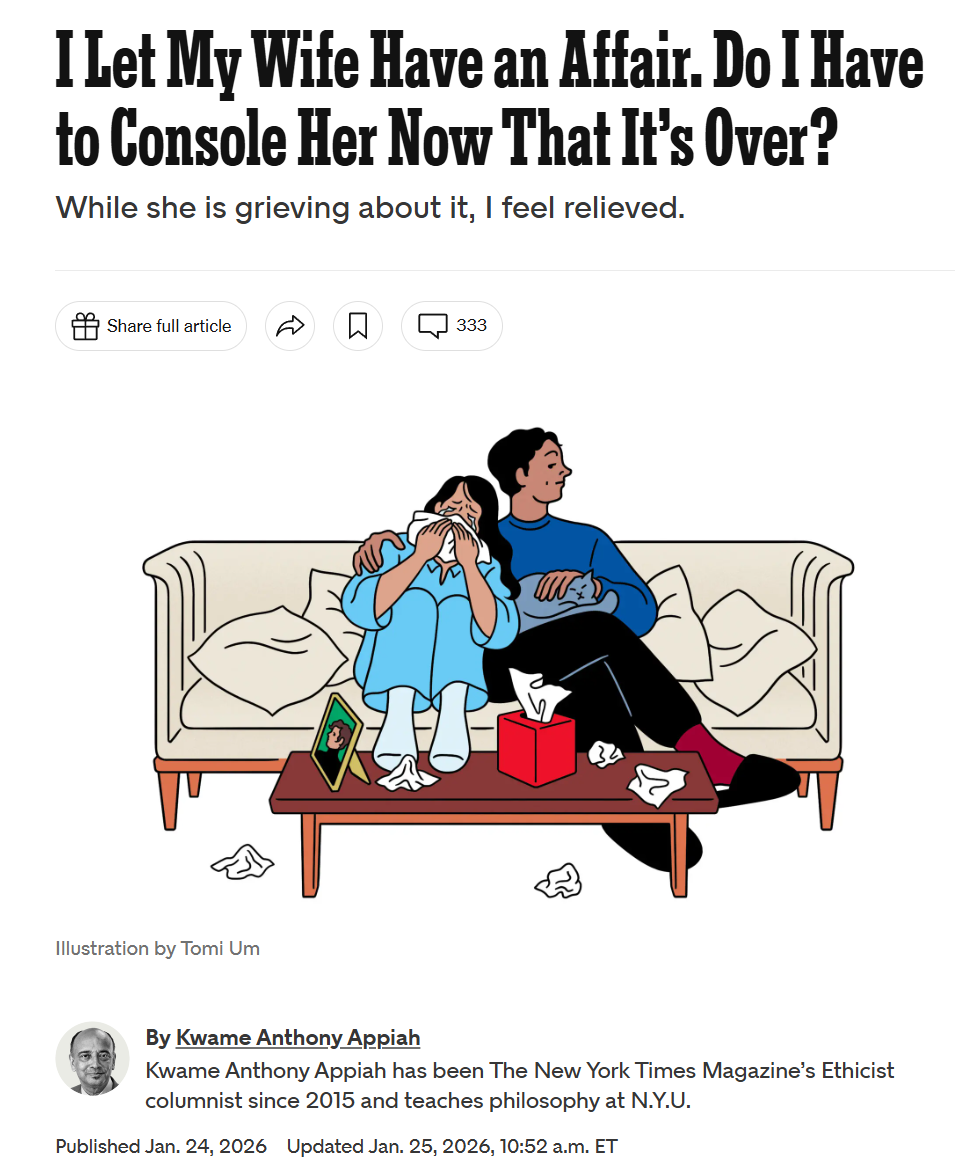
(The answer turns out to be Yes: “it may be worth your both talking this all through with a counselor” (i.e., “Yes, and also you will have to pay for assistance in consoling her”))
Admission: While the NYT story is genuine, I ripped off the above introduction from this X parody account.
Given the depicted melanin content, any answer would be just as good.
Silicon valley has 35 year old hotties, but they’re all banging the same guy. Don’t get between a polyamorous billionaire & his 35 year old hotties.
FYI the guy is Eric Schmidt, former chairman of Google.
E.g., https://nypost.com/2024/05/21/us-news/eric-schmidt-on-outs-with-michelle-ritter-seen-with-wife/
That excerpt contains far too many pronouns. Wonder how it got to be a “Instant #1 New York Times Bestseller”.
Maybe people enjoy the concept more than the book? One amazon review shows “Sarah” holding a paperback copy, of which the inside is essentially a notebook, and calling it a scam. Yet, she still rates the book 5 stars despite being scammed out of the actual book?
Men are supposed to roam plains impregnating women whenever they can. We are animals.
> One area of agreement between the parties is on the appropriate level of coronapanic. They abandon NYC for Martha’s Vineyard, but the husband returns to NYC to spend more time with his new sex partner.
LOL!
> If, by cultural and legal design, the marriage lasts only until one partner thinks that a better deal is available, why do friends and family have to gather and sit through the charade of a wedding?
Here’s the complement to what you’re saying from India:
“The big fat ‘fake’ Indian wedding – Gen Z’s latest party trend”
https://www.bbc.com/news/articles/cdxyrk04kd0o
Note that weddings used to be a more solemn affair in my parents’ generation in India.