It’s the 61st anniversary of Lyndon Johnson going all-in on the Vietnam War. Wikipedia:
On March 8, 1965, 3,500 troops went ashore near Da Nang, the first time U.S. combat forces had been sent to mainland Asia since the Korean War.
Last month, I visited the LBJ Presidential Library in Austin. One of the challenges was coordinating a meeting there with an Austin-based friend and not referring to it as the “LGBTQ Library”. LBJ is the author of the modern U.S.:
- He opened the borders for the first time since 1924 by signing The Immigration and Nationality Act of 1965, ultimately driving the percentage of immigrants in the U.S. to an all-time high and with an explicit rejection of the idea that immigrants should share language, culture, or religion with existing Americans or with each other
- Johnson created the first federal programs, Medicare and Medicaid, for which there is no Congressional control of spending. (I.e., spending expands according to how many medical procedures doctors and hospitals can dream up and bill for) These have grown into the largest federal spending programs, a “hold my beer” situation for those who asked “What could possibly cost more than running the U.S. military?” (nearly 90 million Americans are on Medicaid, originally characterized as a “safety net” program)
- He signed the Gun Control Act of 1968, which dialed back Americans’ Second Amendment rights
- Johnson set up food stamps (later “SNAP/EBT”)
- He signed the Housing and Urban Development Act of 1965, which created a bizarre patchwork of taxpayer-funded housing for some, but not all, Americans who met income criteria (apparently contrary to the 14th Amendment’s promise of Equal Protection; Person A gets a free apartment while Person B, identically situated, gets a place on a waiting list or is told that the waiting list is full (contrast to Medicaid and food stamps, in which every eligible person is treated equally).
- Johnson signed the Public Broadcasting Act of 1967, thus giving us NPR and PBS to sing the praises of all of the above
Most of the above Great Society legislation was opposed by Republicans, but didn’t seem crazy because it was done during a period when the U.S. was enjoying rapid economic growth. Had that rate of growth continued forever, the new programs might have been affordable.
(Note that Lyndon Johnson was the anti-Milton Friedman. Friedman said that one couldn’t have open borders and a welfare state. Johnson opened the borders and simultaneously dramatically expanded the welfare state.)
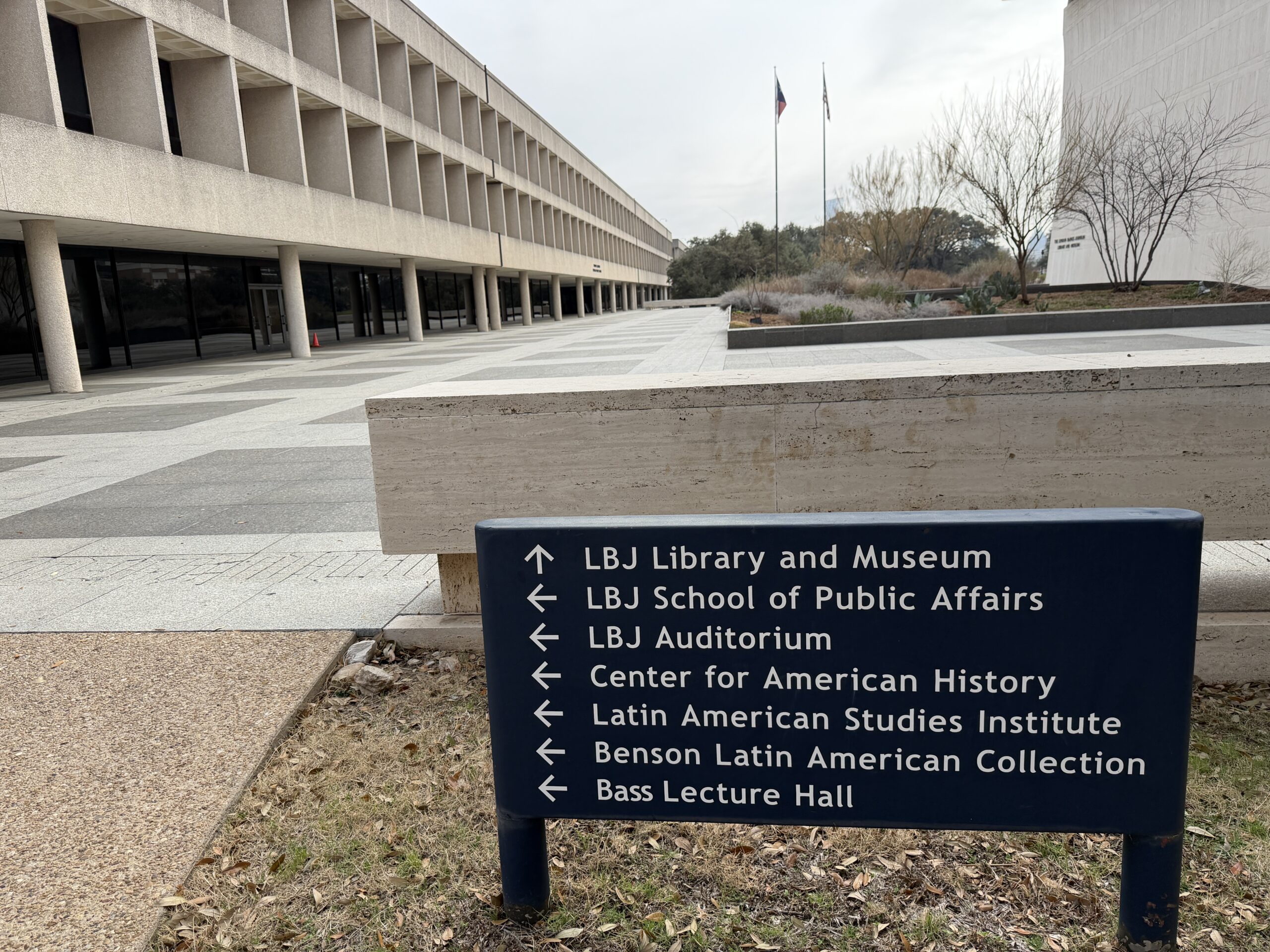
Approaching the library, one sees the effects of Johnson’s immigration policy. There is a sign encouraging people who don’t know enough English to understand the word “here” (a translation to “aqui” is required) to decide who will run roughly 40 percent of GDP (local, state, and federal governments):

If you love concrete you’ll love the architecture:
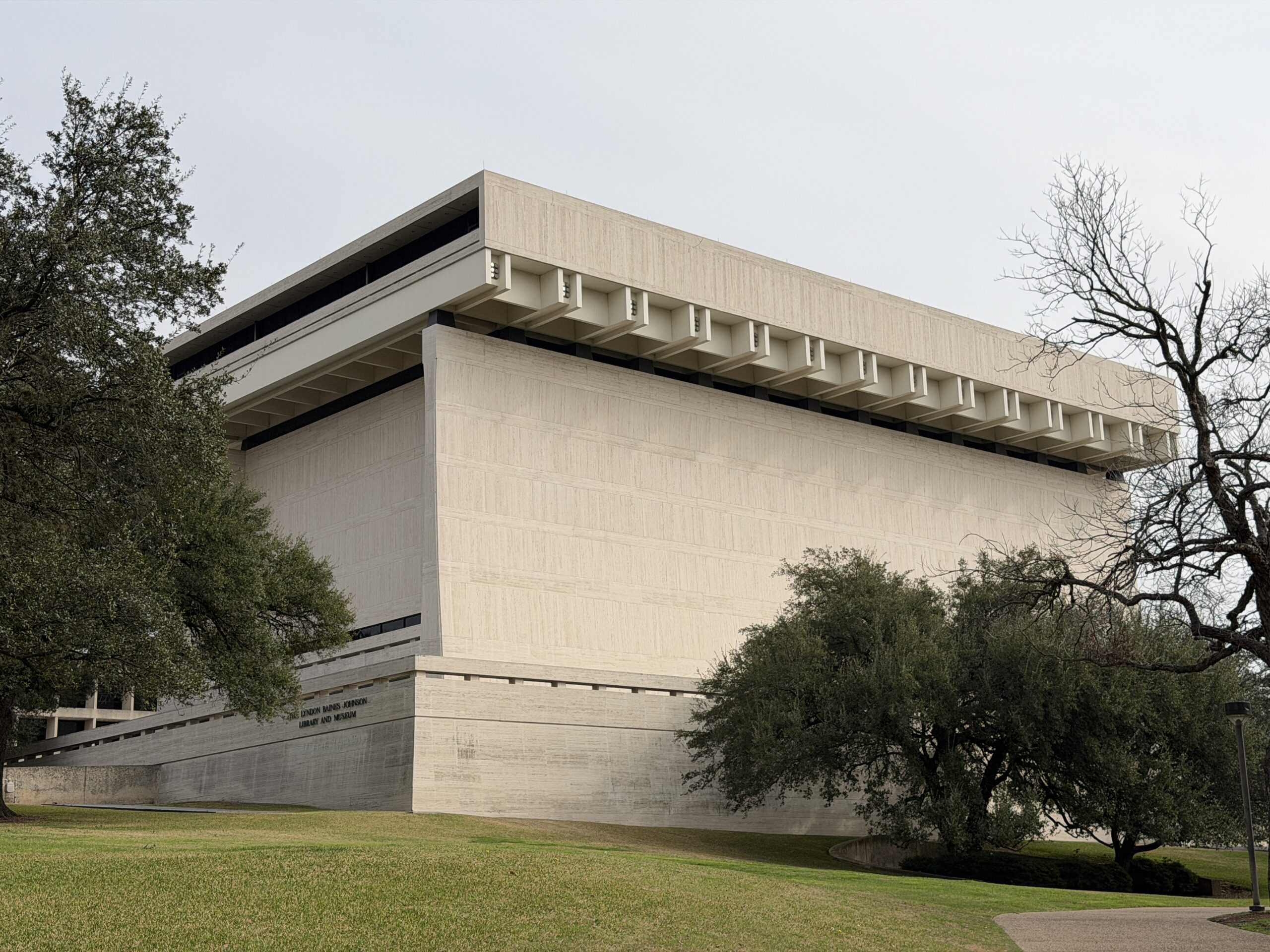
Johnson was an early adopter of technology, apparently. While he was serving in Congress, his wife purchased a radio station, which became fantastically more valuable due to favorable FCC rulings on what hours and power it could use and also due to advertisements placed on the radio station by businesses who wanted Representative Johnson to vote in particular ways. (“Johnson, Virtually Penniless in 1937, Left a Fortune Valued at $20‐Million” (NYT, 1973; that’s about $150 million in today’s mini-dollars)) This foray into government-regulated entrepreneurship and subsequent personal wealth isn’t highlighted at the library! Johnson campaigned by helicopter in 1948, a type of machine that wasn’t mass-produced until 1943:

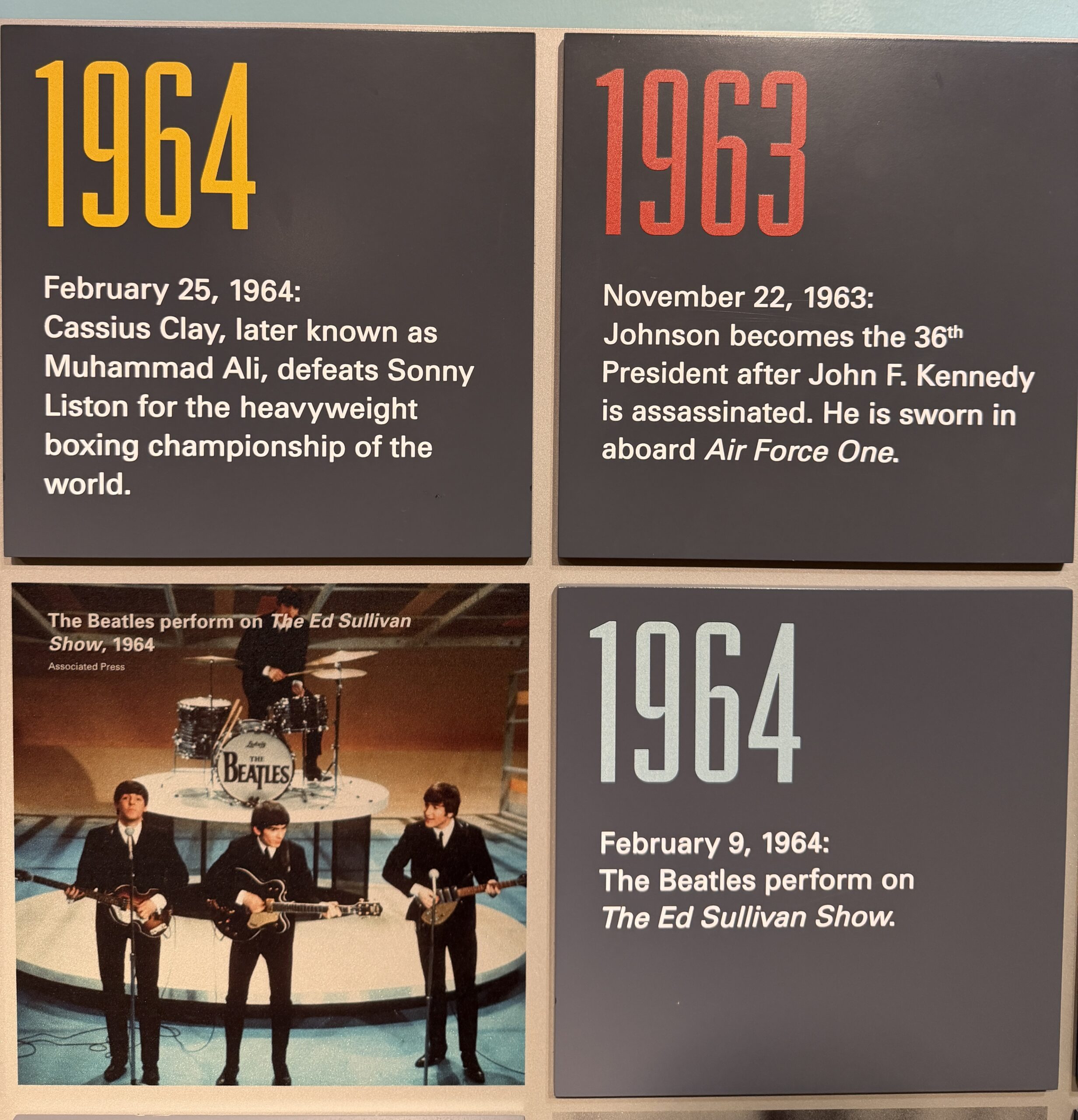
The history wall gives equal weight to the Beatles playing on TV and to a U.S. President being shot and killed:
Who will agree with me that Johnson was the most consequential U.S. president? Even if he had done nothing other than open our borders, I think it is fair to say that Lyndon Johnson changed the U.S. more than any previous president. Some might cite Abraham Lincoln, but we could easily have ended up in an EU-type situation with our brothers, sisters, and binary-resisters in the Confederate States of America (which would have certainly abandoned slavery within a few years after 1865 since slavery was abolished nearly everywhere outside of the Arab/African world by 1888 (timeline)).
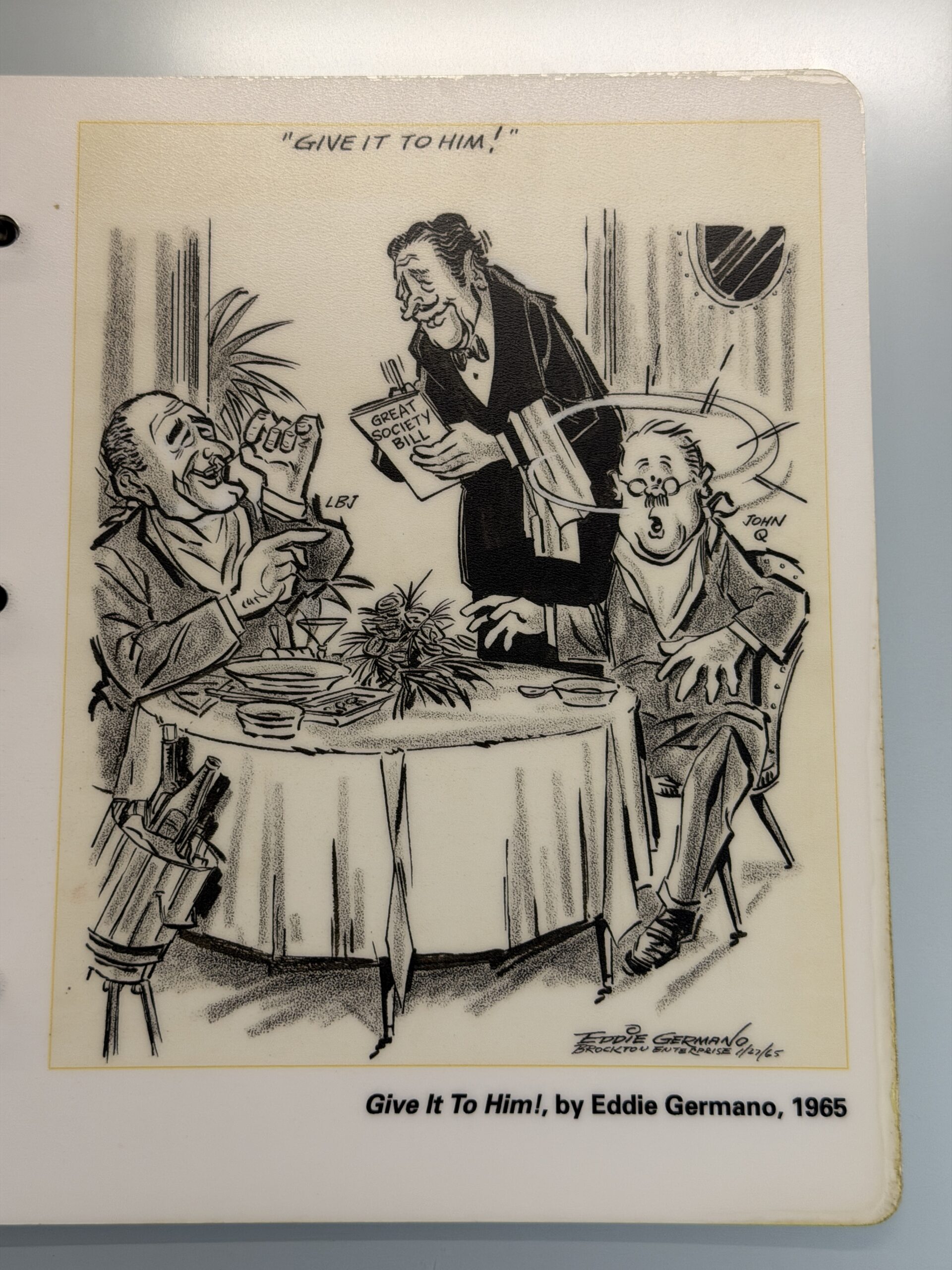
Still relevant, John Q. Public pays for whatever Lyndon Johnson dreamed up…
Related:
- “‘War on Poverty’ May Have Created a Permanent Underclass, Economists Say” (March 2026): “A January report by the Congressional Budget Office found that, for the poorest 20% of Americans, government payments increased from 26% of total income in 1979 to 42% in 2022. And as welfare programs expanded, market income for America’s poorest declined as a share of total income. Whereas in 1979, welfare payments were only about half the amount of private income sources for the lowest quintile, the two income sources were roughly equal by 2022.”
Let’s not forget the Gulf of Tonkin. And remember not to mess with Lady Bird’s big beautiful highways.
Phil I am yet to understand your concern for immigration. Do you think that Jews were magically included in “native” populations? Do you think that the first main waves of Jewish immigrants (German and Eastern European) spoke English?
Do you realize that for most of American history until 1921 there weren’t even any practical limits on immigration and that Ellis Island admitted 98% of everyone present?
I would agree with you that the welfare state should be eliminated and you can’t really have a welfare state with massive open borders. But I’ve never understood your vigorous opposition to the same kind of immigration policy that brought your own ancestors to the USA.
Anon: The statement “the same kind of immigration policy that brought your own ancestors to the USA” doesn’t make sense. We can’t separate immigration policy from whether or not there is a welfare state. The 19th century immigration system wasn’t “the same kind” as the system today because there was no welfare state in 19th century U.S.
Separately, there is nothing illogical about a person believing that his/her/zir/their own ancestors’ immigration harmed natives at the time and that most immigrants today harm natives via their presence. Cesar Chavez came from a Mexican immigrant family and he was also against further immigration of Mexicans on the grounds that an increased supply of low-skill labor would reduce wages for Mexicans already living in the U.S., e.g., Mexicans who were members of his union. Chavez was neither stupid nor illogical.
Finally, you have to consider population size and the cost of building infrastructure to accommodate population expansion. U.S. population in 1820, when the first wave of German-Jewish immigrants arrived, was 9.6 million. It isn’t irrational to say that a country benefits when it grows beyond 10 million in population and that the same country would be harmed when it grows beyond 350 million people, whether through natural increase or import of low-skill migrants.
Anon, Jewish immigration to Americas is very old, started with Jewish sailors escaping Spanish inquisition, whom as we know nobody expects, in Columbus’s crew. First synagogue in New Amsterdam, ie Manhattan, predates Anglican churches there. Jews were established in colony of Rhode Island long before American revolution. Read about Polish Jew Haym Solomon, a member of Sons of Liberty, who sacrificed everything for American Independence, about Francis Salvador and others.
Yiddish is 65% Germanic language, formed at about the same time with German and English languages, Yiddish speaker would have same effort to integrate into English speaking world as German-speakers, Yiddish maybe even closer to English due to English using more words from other languages, including Hebrew.
Sephardi Jews had no problem learning English there, somehow. Sephardi and other Eastern Jews are usually polyglots, speak many regional and international languages.