TL;DR: An LLM might take your job but it can’t take your public housing entitlement.
Let’s suppose that the AI/Robotics revolution happens gradually enough that Americans don’t feel that a total revamp of Lyndon Johnson’s Great Society welfare state is required. Those employed as drivers, for example, get replaced over a 20-year period as vehicles that don’t have the requisite hardware for self-driving age out of the fleet. FAA regulation for supplemental type certificates remain so onerous that it is cheaper to pay two pilots on each flight than to retrofit an Airbus A320 or Boeing 787 for self-flying.
Let’s assume that AI/robotics renders only about half of the U.S. workforce unemployable (we’ll keep our high minimum wages so anyone with below-median skills, health, beauty, or strength won’t be able to work legally). That means there will be a gradual, but huge, increase in demand for taxpayer-funded housing (public housing or Section 8). Even before ChatGPT was launched (November 2022), there was already a long waiting list for a taxpayer-funded apartment and, oftentimes, the waiting list was so long that authorities closed. Here’s a March 4, 2026 snapshots from New York City’s taxpayer-subsidized housing web site:
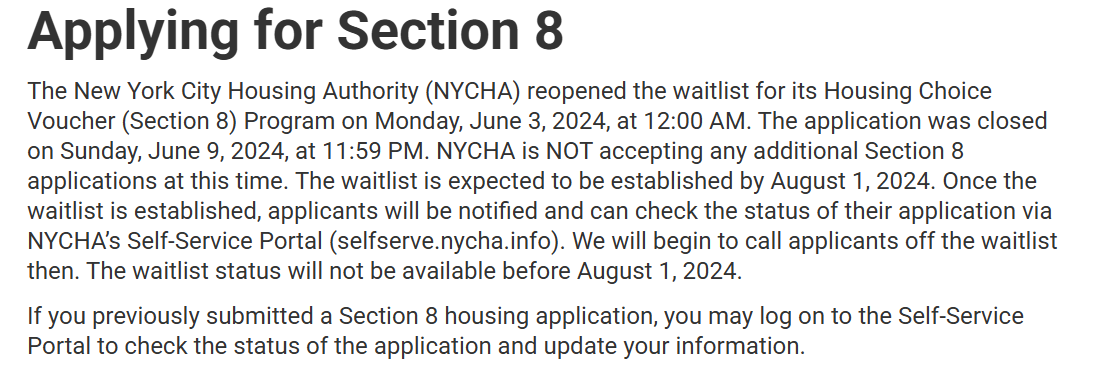
The last window of application to be placed on a waitlist (not to get housing!) was almost two years ago. Nationwide, waiting times, for those who are fortunate enough to have gotten on the waitlist, are apparently typically between 2 and 10 years.
Is the smart move for a young person to get into the welfare system now while the waitlists are still no more longer than 10 years? He/she/ze/they can (1) refrain from work, (2) have a child, and/or (3) be diagnosed with a disability.
Related:
Phil, so great that you are thinking ahead (as always)! Here’s an alternative idea for your wunderfol readers: spend a few years at Harvard to earn a PhD in Black Studies Plagiarism and then teach that rigorous discipline to future Harvardians. The pay is great ($900k per year along with all sorts of benefits and guaranteed for your lifetime) and you get to interact with the greatist thinkers in the world like Jeffrey Epstein, Pocahontas Warren, Larry Summers etc.
Thanks for your kind words, best. — P.G.
P.S.
I make $900k per year, with my Hahvaad Ph.D. in comparative literature. Not that good of pay, quite frankly.
Claudine: Thanks for your advice and congratulations on finding the one academic degree that is worth more than a degree in LLMs!
@philg
Sorry about that boss bro. Thought you were O3. I had you penciled-in Outlook for a “Party on E.M.’s yacht #3” today. I’m sure Mindy from H.R. will give me a formal reprimand in my permanent record. Best. (I’m off tomorrow for a ride in Bill G.’s backup Gulfstream, Hahvaad alum only, sorry.)
Why not just get an RV and prepare for Van Life? If the shit hits the fan, you have an RV to live in. Public campgrounds around here are $10 a night. Out west they are $0 a night on public land. If the shit fails to hit the fan, you have an RV for leisure. Win-Win. Screw public housing, you have to live with undesirable people… 🙂
Maybe get an electric and lay out a bunch of solar panels. Then you are pretty mobile no matter what.
How did that work out for Gabby Petito? :/
I think they really just should have denied amnesty to my ancestors, the Pilgrims (and all the other undesirable Eurotrash colonialists). Then we would all still be living in tents in a nomadic, subsistence lifestyle, and no billionaires. Keep their horses though, before deporting them. They did horses a favor by returning them to their homeland.
“Yeah, boi!” — Chuck D, Public Enemy
VLB: That is a great idea, but I’m not sure how cheap RV life is given the cost of maintenance. Is it truly cheaper than a rental apartment 1 hour from a city?
Van Life didn’t kill Gabby Petito, her boyfriend did. It just would have happened somewhere else without Van Life. Anyway, keep in mind that I am not in danger. I am the danger.
> I am the danger.
Charles Manson, now there was some danger. Oh and stoned hippies driving around VW busses in the ’60s, tripping on acid and following the Greatful Dead — there was some danger, for shizzle.
https://en.wikipedia.org/wiki/The_Electric_Kool-Aid_Acid_Test
I guess Kerouac was dangerous when driving drunk, but his driver Neal Cassady didn’t even have a license, driving across America on Benzedrine — sleeping wherever. “Danger, danger Will Robinson!”
“‘What’s the frequency Kenneth?’, is your Benzedrine.” — REM
Now of course it is social media (blogs are sorta subtle, like absinthe). Adieu.
The sad reality behind the long wait lists is that many applicants (all?) still qualified when their turn finally comes — 2 to 10 years after they first applied. This means their financial situation has not improved over all those years.
In the meantime, these applicants continue to live while relying on other government assistance programs, such as SNAP, among others, consuming resources without contributing to society.
A famous person once said: Ask not what you can do for your country — ask what your country can do for you.