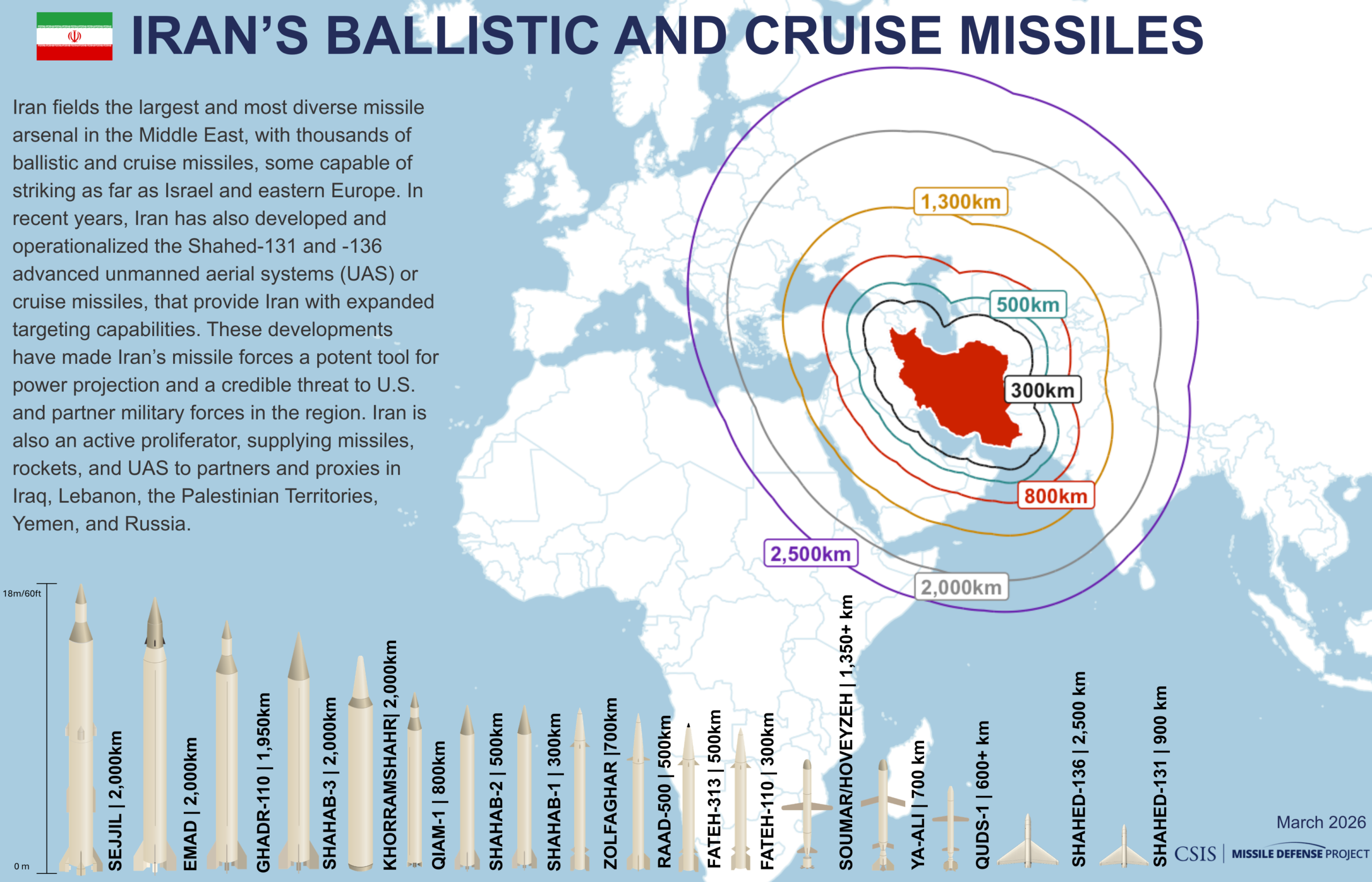
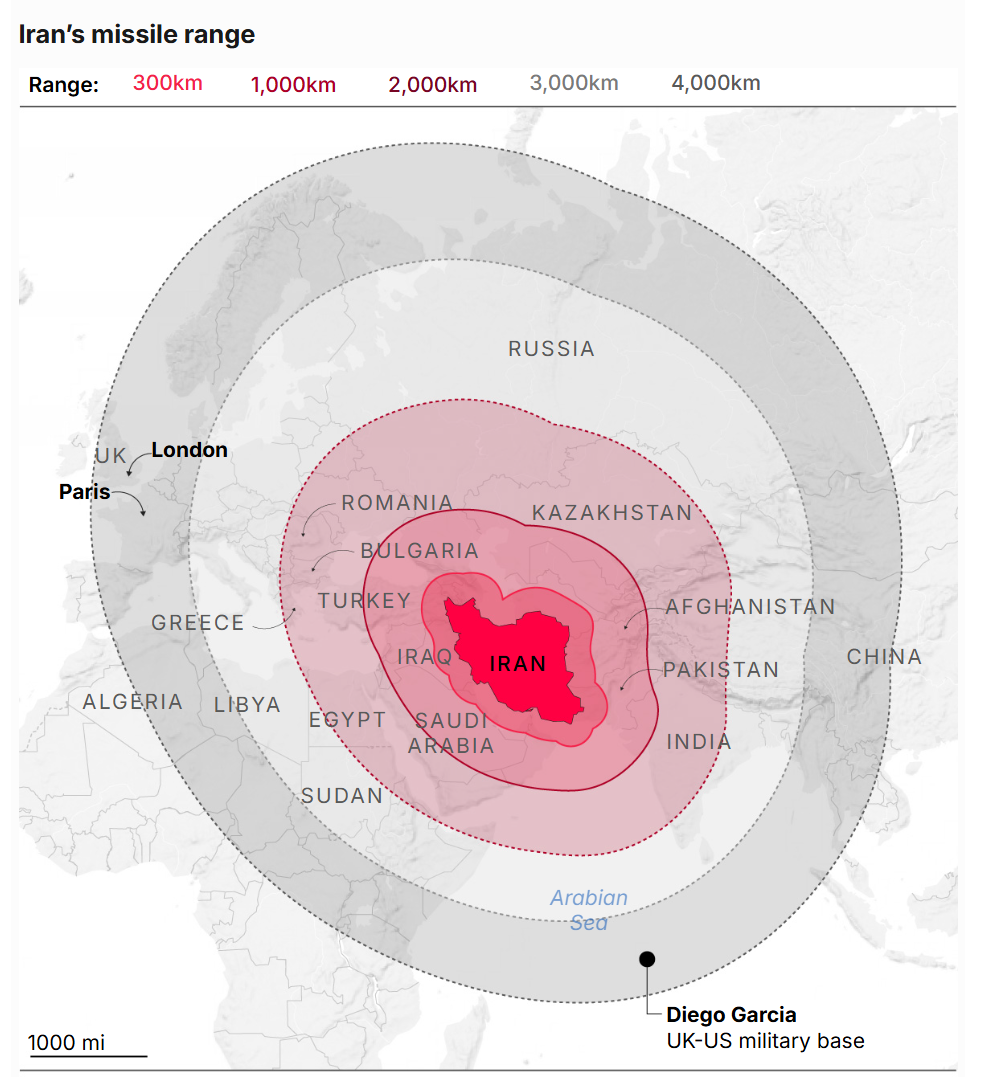
Yesterday, the peaceful Islamic Republic lobbed a warhead 4,000 km (2,500 miles) from Iran to Diego Garcia (WSJ).
Let’s compare to “In Trump’s Case for War, a Series of False or Unproven Claims” (New York Times, last month; note that a “False Claim” might be construed by some people as “Lie”):
American and European government officials, international weapons monitoring groups and reports from American intelligence agencies give a far different picture of the urgency of the Iran threat than the one the White House has presented in recent days.
… in his State of the Union address on Tuesday, Mr. Trump made a new claim, saying Iran was “working to build missiles that will soon reach the United States of America.”
The following day, Mr. Rubio repeated the president’s assertion about Iran’s work on intercontinental ballistic missiles, although he used different language about how quickly Iran could be capable of hitting the United States. While Mr. Trump said it would be “soon,” Mr. Rubio said it would be “one day.”
A report by the Defense Intelligence Agency last year concluded that Iran did not have ballistic missiles capable of hitting the United States, and that it might take as long as a decade for it to have up to 60 intercontinental ballistic missiles.
… 16 years later, there is still no evidence that Iran has made its long-range missile program a top priority.
Instead, Iran has put far greater focus on building up its arsenal of short- and medium-range missiles, believing it could be the most effective deterrent against Israeli or American efforts to overthrow the government in Tehran.
“Trump Iranian missile claim unsupported by U.S. intelligence, say sources” (Reuters, last month):
The New York Times first reported that U.S. intelligence agencies believe Iran is probably years away from having missiles that can hit the United States.
Without providing evidence, Trump said that Tehran was beginning to rebuild the nuclear program that he claimed had been “obliterated” by U.S. airstrikes last June on three major sites involved with uranium enrichment.
In an interview with India Today TV released on Wednesday, Iranian Foreign Minister Abbas Araghchi denied that Iran was expanding its missile capabilities. “We are not developing long range missiles. We have limited range to below 2000 kilometers intentionally,” he said. “We don’t want it to be a global threat. We only have (them) to defend ourselves. Our missiles build deterrence.”
Now that the Iranians actually do have missiles capable of reaching Paris and London, how long before (1) the French surrender, and (2) the Islamic Republic of the UK merges with the Islamic Republic of Iran to form the United Islamic Republic of Britain and Iran?
The map from a few days ago:
The map from today (Daily Mail):
I still can’t figure out why the U.S. hasn’t targeted Iran’s oil production and electric power plants. So long as Iran is exporting oil it can build new missile factories whenever it wants to and so long as Iran has electric power it can plug those new missile factories into the grid for 24×7 operation. If there isn’t a realistic possibility of a friendly government in Iran how can it make sense to leave the current government in control of a functional export economy?
Phil, from your lips to my ears.
https://x.com/sentdefender/status/2035504529794277839
Thank you, Donald, for recognizing that one shouldn’t leave an enemy nation with everything that it needs to build more weapons!
(I am somewhat confused by the conditions. We say that Iran has 48 hours to reopen the Strait of Hormuz. How do we know if Iran has complied with our demand? There weren’t any “closed for Ramadan” signs on the Strait whose removal we can consider evidence of compliance.)
Phil, great question but let not your confusion about the conditions trouble you! All is good and BIG things are happening! Stay tuned! Thank your for your attention to this matter.
US hasn’t been able to close down Iran’s airspace. Bomb any power plants & they’re just going to keep bombing the living daylights out of Tel Aviv & Kuwait. Closing the enemy’s airspace was the cornerstone of US’s tactics for 40 years & now those days are over.
@lion, and what has Iranian air-force accomplished? And where is it? All firepower that Iran can deliver via 2000 ballistic missiles, which have 1/2 ton warheads, assuming they will convert them from useless cluster bombs to single high explosive warhead, is less then what allied airforce could deliver in one bombing raid in WW2, such as Dresden bombing. 90% of those warheads are being intercepted. Israel is united to live through this.
In cases when Iranian warheads fall God protects Israel. Few hours ago such warheads fell in a densely populated town, in area with apartment buildings whose inhabitants are members of ultra-orthodox Jewish community. They did not go to the shelters. 75 wounded, mostly lightly wounded, 12 in critical condition, no lethal cases yet. A couple of building lost their exterior walls, this could be even with many ore casualties, but it was not.
lion: I don’t know what you mean by “close down Iran’s airspace”, but it seems that the U.S. has air superiority because otherwise we wouldn’t be operating slow fat targets such as A-10s and Apache helicopters. That Iran can still launch some rockets doesn’t mean they control their airspace.
Intentionally attacking power plants can constitute a war crime if the attack is directed against civilian infrastructure or causes disproportionate harm to the civilian population relative to the anticipated military advantage.
Iran is only allowing its own oil exports to cross Hormuz. If that supply gets cut, or reduced, the price of oil is going to be dramatically higher (actually I believe Iran was exporting 4% of the world oil before the war and is now exporting 20%; with the blessing of the USA).
Anon: most of Iran’s missiles have been launched at civilian targets. The only way to stop the missiles is to stop their production. So there isn’t a “disproportionate harm” in disabling Iran’s production inputs.
Iran already has (or rather had of US and Israels bombardments) missiles that can hit continental or iselandic or any kind of United States. https://www.space.com/space-exploration/launches-spacecraft/iran-launches-military-satellite-sending-nations-largest-ever-payload-to-orbit-reports
Iran puts satellites into orbit using their own space rockets. First space rocket that put Sputnik, first man-made satellite, in 1957, was first Soviet ICBM.
No Iranian missile ever reached Diego Garcia. Allegedly, two were fired but none reached it. A US warship allegedly fired a missile at one, but most likely it was not intercepted. The only source for this info are “US officials”, which is not really a neutral party (remember Iraq and WMDs).
Bombing Iran’s power plants would be a humanitarian catastrophe. Civilians would be disproportionately affected, and most of these people are already oppressed by the regime. This would lead to retaliation and Iran has the means to cause a lot of damage to Gulf oil & gas, plus desalination plants. In the worst case scenario they could make the Gulf countries uninhabitable in the short term, huge shocks to the world economy and basically lead to the loss of the little remaining soft power that US still has internationally. It would also not solve the Iranian menace (see the Taliban).
And why? Just so that Donald Trump distracts US voters from his links to Epstein? So that bibi escapes arrest for a little longer?
Jarle, Alhamdulillah! I’m a bit under the weather right now, but even now my previously sharp mind tells me you are a learned individual because you see so clearly how America has already been defeated. Please remain updated on the latest happenings in this glorious defeat by tuning into the Islamic State’s TV and web broadcasts (“all the news that’s fit for Allah”). Allahu Akbar!
Thank you, Mojtaba, for commenting. Alhamdulillah that you’re now well enough to use the electric power and Internet connection that the U.S. has so wisely decided not to attack in Iran!
Jarle: The doomsday scenario that you describe doesn’t sound like doom for the U.S., the world’s largest oil producer. Suppose that an alien spaceship appeared over the Persian Gulf and hoovered up all of the oil and gas, thus reducing world supply by about 20 percent. Why would that be bad for the U.S.? Imagine that all of the car factories within the Islamic nations (European Union) were shut down and only U.S. and Asian car factories continued production. Why would that be bad for the U.S.?
Jarle, All-around sad situation in the Middle East. Hard to imagine what would the Mullahs do had Trump let them get nuclear weapons. We all should unite even if we do not especially like each other. Like different ethnic, religious, military and political factions united in the USSR during WWII to fight Hitler. If they did not your people would exterminate them and suck up all their resources, until US nuked you / them all.
US soft power was based on lots of megatons of WWII and post-WWII actions, and bribery of very special continent of Europe. Now when others, such as Mojtaba Khamenei and his stolen Iranian oil wealth, bribe Europe, they get a pass even when soft American Obama’s and Biden’s administrations sanction them.
@philg Let’s assume all the Gulf’s oil and gas indeed just disappears. Why would that be bad for the US? It would be good for US revenue from selling oil, even if much of that would be US people paying maybe 2-3x more for gas and other stuff (just 20% less oil does not imply a 20% price drop, since many people would be willing to suffer a lot more just to get oil). However, the US is not an autarky. Its billionaires surrendered most of the US’s industrial capability to the much more efficient Chinese and other nations in Asia, so the US does not manufacture most of what it needs. Asia and China are strongly dependent on Gulf oil&gas. This would lead to greatly increased prices in the US, of about everything. Remember that even that domestic oil and gas is used for transporting and rising prices will lead to inflation overall. The problem here is not 20% of oil, it is its sudden demise. So this would lead to persistent inflation, possibly stagflation in the US. (And maybe other countries as well.) And how about stocks? You may have noticed that stocks are not doing so well (S&P down 5% YTD, NASDAQ nearly 7%). Many Americans will not be happy to see their retirement funds plummet. Maybe in the long run it would be good? Yes, but in the long run we’re all dead.
@Jarle, you seem to worry more about Gulf Arab states then they worry about themselves. I am sure it is because your are (morally) uber European and not because you hate Israel and Semites in general. https://www.arabianbusiness.com/abnews/uaes-gargash-warns-against-permanent-state-of-threat-amid-iran-escalation
Senior diplomatic advisor to the President of the United Arab Emirates:
“As we confront the brutal Iranian aggression and discover our steadfast strength in resilience and endurance, our thinking does not stop at a ceasefire, but rather turns toward solutions that ensure lasting security in the Arabian Gulf, curbing the nuclear threat, missiles, drones, and the bullying of the straits
Jarle, you may be living in an alternate universe, but for the rest of us here on planet earth your comment that the U.S. doesn’t “manufacture most of what it needs” is ungrounded: the U.S. manufactures 67% of what is consumed in the U.S. The U.S. economy is also the most productive as measured by GDP per capita if you strip out those countries that are heavily driven by finance (e.g. Monaco, Liechtenstein, Luxembourg, Bermuda, Singapore, Ireland, Switzerland etc.). Also, you mention investors concerned about their retirement funds “plummeting.” You will be glad to know that the S&P 500 has “plummeted” up by 14.8% over the past year and NASDAQ has similarly “plummeted” up by 21.7% over the past year. The 5% decline in the S&P 500 since the beginning of Trump’s defeat by Mojtaba Khamenei three weeks ago is within normal market volatility.
@Jarle, Three weeks into this Iran war, and you are already painting a bleak picture for the U.S. and the world. I don’t recall you posting on this blog during COVIDFear, when the global economy was shut down far more severely and for much longer, was your outlook then even bleaker than it is now?
Also, Israel has faced continues threats and attacks from its Arab neighbors since 1949, yet it is still standing as one of the most stable and successful countries in the Middle East, how come?
Also, with Iran’s proxies in Lebanon and Yemen, if and when Iran acquires nuclear weapons, its influence would be far greater than it is today. For example, when Saddam invaded Kuwait in 1990, the world was able to respond militarily. That kind of response would be far more complicated, or even impossible, if a similar scenario involved a nuclear-armed Iran.
In addition, while Saddam was a ruthless dictator, Iran’s Ayatollahs utilize religious to mobilize support, which has far-reaching impact and is far more dangerous. In contrast, Saddam largely suppressed religious extremism; for example, Christians, were able to live in Iraq with no fear for their freedom.
Jarle: I don’t believe that there would be a 2-3X increase in oil prices if the Persian Gulf were removed as a supplier. The world has an almost infinite amount of oil at 2X the January 2026 price. If prices go up, production in marginal fields goes up until the price stabilizes. I asked ChatGPT “What oil sources would become practical to extract at $150/barrel?”
At $150/barrel, you don’t suddenly “discover” new oil—but a lot of previously uneconomic or marginal resources become worth developing at scale. The main shift is that higher-cost, energy-intensive, or technically difficult extraction methods become viable.
Oil Sands (Tar Sands) Expansion … Canada (Alberta), Venezuela (Orinoco Belt) … Already viable at ~$60–90, but $150 unlocks massive expansion
Extra-Heavy Oil & Bitumen (Global) … Found in: Venezuela, Russia, Middle East … At lower prices it’s marginal; at $150 it becomes mainstream supply, not niche.
Tight Oil / Shale (Maximal Extraction) … You’d see a surge in U.S. production, plus expansion into less productive geology globally.
Deepwater & Ultra-Deepwater … These projects take 5–10 years, but $150 would trigger a wave of new investment.
Kerogen (Oil Shale — NOT shale oil) … Solid rock containing kerogen (not liquid oil) … Example: Green River Formation (Colorado, Utah, Wyoming) … This is the big one: … Enormous resource (trillions of barrels) … At ~$150+, some methods become viable
(And remember that my hypothetical is just a hypothetical. Even without a Strait of Hormuz, a lot of Middle Eastern oil can still be extracted and pipelined out to the Red Sea. See https://en.wikipedia.org/wiki/East%E2%80%93West_Crude_Oil_Pipeline for an example.)
Suddenly none of the Republicans are talking about deficit and GOVT spending. Spending another $600 b on a war that has nothing to do with us not a big deal anymore
Wish it were true. Unfortunately they do talk about it and about “unclear” goals. Being a politician means you suck at logic and pattern recognition.
Spending $600 billion on making new Iran an ally or even not a threat will pay many $trillions in dividends.
Anon #1: If it doesn’t make financial sense to eliminate Iran’s military capabilities then I don’t think it makes financial sense for the U.S. to have a military at all. We could cut back to National Guard to prevent an invasion from Mexico/Canada and, in the event that a Democrat is elected president and reopens the border, cut out the National Guard as well (why defend against an invasion if the border is open and anyone who wants to invade can walk across?).
@phil with that logic when are we bombing China, Russia and north Korea
Anon: the countries you mentioned aren’t similar to Iran. North Koreans don’t expect to go to Jannah and have continuous sex with 72 virgins if they die in a counterattack. Iranian leaders say that they welcome and seek martyrdom. So it would make sense for them to nuke The Great Satan even if they expected The Great Satan to violate international law by striking back (it’s not a violation of international law if Muslims target and kill civilians, but if the U.S. kills civilians unintentionally that is a violation).
Anon #2, if you’re looking for someone who doesn’t “suck” at logic and pattern recognition, I’m your gal! My voters in the Commonwealth of Massachusetts keep electing me by huge margins (over 60% in 2018). In particular, they really love the logic behind my fraudulent background as a Cherokee (and I must say Harvard liked it even more than the good voters of MA because it earned me tenure there–I “aint” to smart as granny Pow used to say). My cookbook (Pow Wow Chow) also helps families cook the authentic food I grew up on, which is special! I repeatedly say and do anything to get elected and the voters love me for it. Seems like I’ve got the pattern recognition all figured out too!
I find it fascinating that liberal media outlets and some commentators here have already declared that the U.S. has lost this war just three weeks into it. If true, then Israel must have “lost” its many wars with neighboring Arab dating back to the 1949, nearly 80 years ago. But yet the land of Israel, is not totally occupied by Arabs and Palestinians!
George: among progressives, the dream is still alive! (dream = eliminating the multiethnic, multiracial, multireligious democracy of Israel and replacing it with a 100% Arab, 100% Islamic Hamas-style or Iran-style theocracy)
I also find it fascinating that many in the liberal media, along with some commentators here, overlook a key point: very much most of the damage to Iran’s facilities do not get report by the news media because we don’t have reports on the ground in Iran and restrictions imposed by Iran.
Meanwhile, the few strikes Iran manages against Israel or neighboring countries are shown repeatedly, creating a one-sided narrative driven by dramatic and sensational visuals. In effect, you are being wrongly convinced that the U.S. has lost the war.
Phil, your suggestion related to the Iran’s electrical power plants was very helpful. Next, we need to assemble a ranked priority target list for them. Could you use your AI skillset to help us with this?
“I still can’t figure out why the U.S. hasn’t targeted Iran’s oil production and electric power plants.”
Shocking that you don’t know targeting civilian infrastructure is a war crime – not that you would care if you did know that but…