I’ve been trying to help our HOA (right there you can stop reading if you want to know the definition of a thankless effort) deal with our bulk cable TV contract and establish a bulk fiber Internet contract. I hit Consumer Reports for their survey of providers. For pure cable TV, here’s something remarkable: all of the companies are rated 1/5 for “value”. If we can all agree, which we apparently do, that cable/satellite TV is a terrible value, why do roughly 70 million of us subscribe?
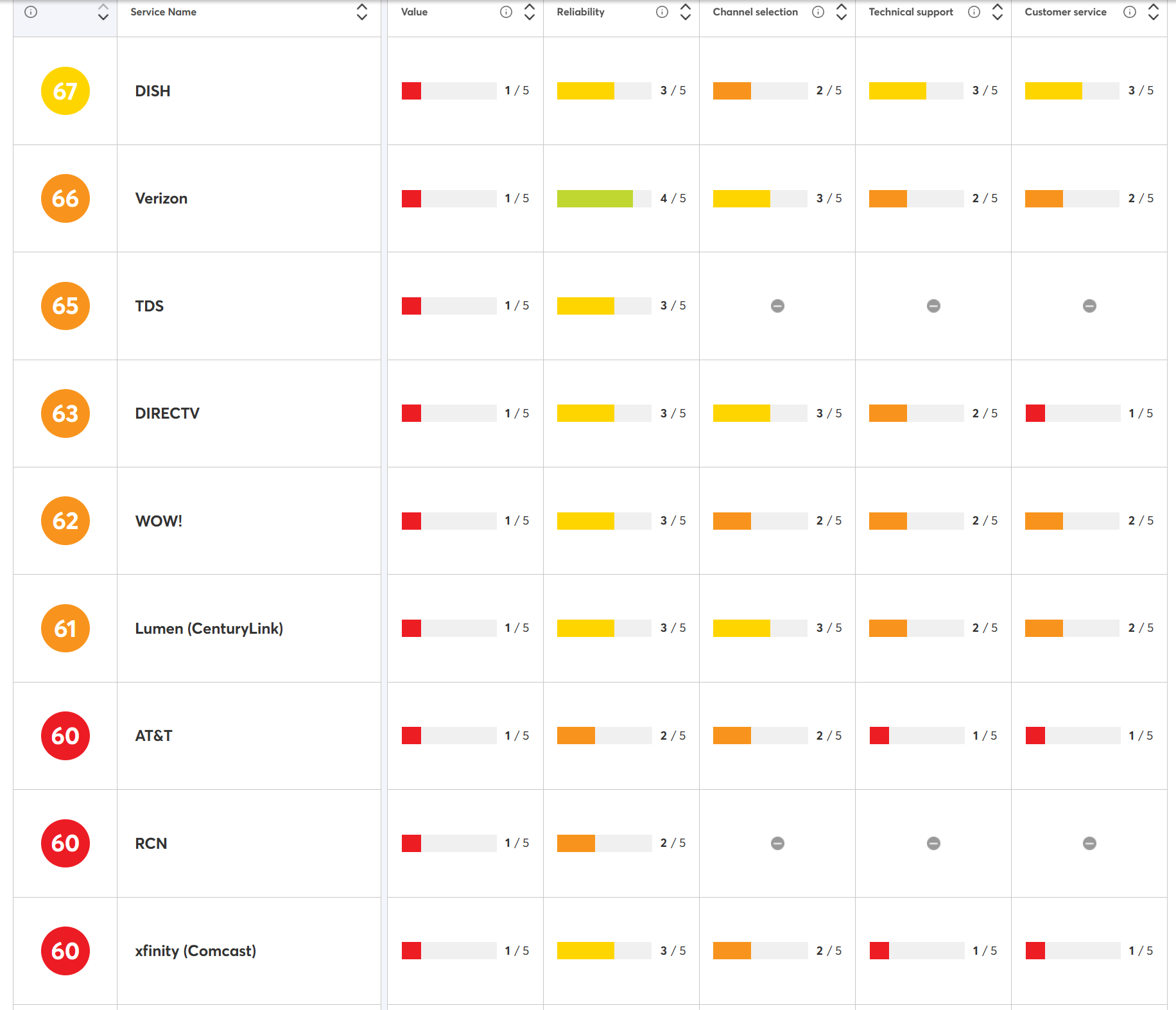
(Bulk is much cheaper than retail, incidentally. We pay about $55/house per month for a decent slate of channels, 20 hours of DVR, up to three cable boxes per household, and Xfinity’s famously awesome customer service (rated 1/5).)
Conversation with Xfinity rep…
- them: we are offering our Hybrid fiber-coaxial network in your neighborhood
- me: if I’m using AOL dialup aren’t I on a “hybrid fiber” network? The computer that answers my 56K modem’s phone call is connected via fiber, right?
Readers: Anyone have experience with TV from FiberNow, Blue Stream, or Hotwire?
Note that the 1/5 value rating for cable TV isn’t because they surveyed 73,000 sourpusses. The same people rated their Internet providers at 4/5 or 5/5 for “value”:
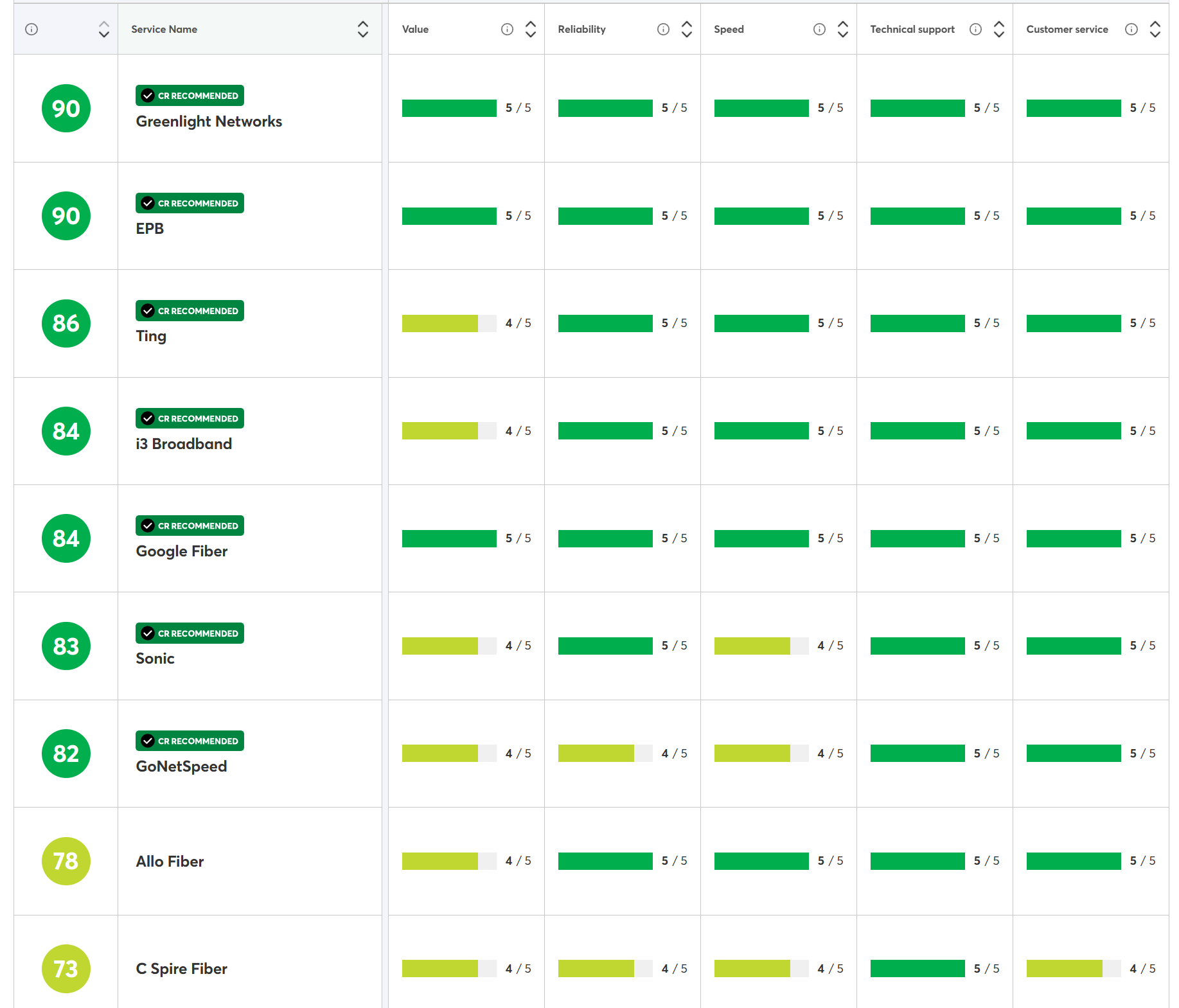
How did Elon’s company do?

I’m not sure why Starlink was perceived to be mediocre in value. The only people who would buy it are those who can’t get fiber or good cable modem service, right? The alternative is LTE or smoke signals?
Live sports in the highest picture quality are probably still only on satellite & cable. Starlink is still 1 of those Elon products which is only accessible for single family homes, an ever dwindling segment of the population.
4/5 explains 1/5. Internet service goes over same cables and fiber as TV service, and cable companies bundle it at “discount”. While satellite is fast enough bandwidth – wise, latency of satellite kills important applications as remote connections for work purposes.
Starlink has 20ms latency usually, quite comparable with cable.
It is funny how everyone hates Comcast, and yet they keep paying.
Because in some places before Starlink this was the only option available.
Roger: As SK points out, in Cambridge, Maskachusetts and here in our neighborhood Xfinity is the only option. But there are a ton of people who do have access to fiber and yet continue to pay for coax. That’s the mystery from my point of view!
Phil, you are mistaken. In Cambridge and many other locations nationwide there is now 5G wireless internet from T-Mobile (and others, including Verizon, though quality is lower). The price is roughly half what Comcast charges ($60/month for unlimited service) and the speed is typically 700-800Mbps download in urban areas (lower in rural areas distant from antennas as you would expect). Latency also relatively low. I’ve been using it for the past few months and have now turned off the Comcast because this service is nearly as fast and half the price.
That’s a good point. I’d forgotten that Xfinity’s coax service has been stagnating for so many years that mobile data was able to surpass it (an amazing achievement when you think about all of the infrastructure that Comcast maintains, apparently to no productive end).
You may or may not be aware, but Comcast has been losing high-speed subscribers every quarter since the middle of 2022 and the losses have been accelerating (and same for Charter, although losses began a little later). High-speed internet was their only “product” remaining after video losses began over 10 years ago (these are now shrinking at a scary >10% per year for the past 3 years for the reasons you and others have discussed). Besides T-Mobile and the other wireless providers, Comcast’s high speed business is being crushed by fiber overbuilds (building out on top of Comcast’s footprint), which had been relatively subdued for many years until it exploded during the past few years. Fiber is obviously a way better product in all respects, so Comcast loses large market immediately in the overbuild regions. Interestingly, T-Mobile is also buying and/or building out fiber in many locations, as are AT&T and Verizon (late to game after they made a strategic error many years ago to cease their Fios fiber builds). Comcast and Charter’s businesses are in big trouble (reflected in their stock prices).
T-Mobile in Cambridge: Comcast had 100% market share in our corner of Jupiter (see https://en.wikipedia.org/wiki/Abacoa,_Florida ). Supposedly there are about 6,000 houses, condos, and apartments here. Everything was built roughly 1997-2016. Comcast proceeded to lose nearly all of the neighborhoods to Hotwire (fiber Internet bundled with cable TV that’s maybe not quite as good as Xfinity TV?) and some of the multi-unit buildings to AT&T Fiber. They just stood by and watched as 6,000 customers were taken away.
Not sure on all the details in your neighborhood, but I’m guessing all utilities are underground and run through conduits, so relatively easy to rewire (vs. overhead lines or a mixture of the two), and it sounds like this has already happened all around you? If so, seems like your best option is to have someone come in and run fiber, and say goodbye to Comcast. Then, let people individually choose their streaming video (via fiber), or not, if they so choose–skip a video contract that many people don’t want and let them go to YoutubeTV (or other) if they want the full lineup of channels that is cheaper than Comcast’s offering and also interestingly offers a better interface (e.g. better DVR for favorite shows etc.).
We are getting some bids from companies that will lay down new fiber, including Xfinity (they finally acknowledge that they need to do something to compete).
All utilities are indeed underground, but not in conduit. The Comcast coax is directly buried. The big copper wire bundles from AT&T 25 years ago. The AT&T fiber that is on one street. Hotwire says that they will use conduit for everything because they’ve had too many incidents where landscapers cut fibers. Xfinity might be going in that direction as well when they do a fiber rebuild.
Grok sez:
“5G home internet typically delivers download speeds of 100–300 Mbps on average, with peaks up to 1,000 Mbps in optimal conditions from providers like Verizon’s 5G Home Ultimate plan. Real-world tested averages are lower: Verizon at ~71–96 Mbps, T-Mobile at ~69–196 Mbps, and AT&T Internet Air at ~68–80 Mbps, varying by location, congestion, signal strength, and time of day.”
Chat basically concur.
That’s a far cry from the claimed 800
Ivan, a bit of help for you on the physics 101 of radio waves: their strength (and hence download speed for 5G internet) is defined by an equation with the inverse square of the distance from the antenna. See a junior high school mathematics book if you also aren’t familiar with how exponents work.
See the table below from Grok that shows download speeds (based on users from Reddit) from T-Mobile 5G internet based on distance from the antenna. You may also be interested to know that in a typical city T-Mobile has hundreds if not thousands of antennas, so some blocks might be within sight of multiple antennas.
Distance from Tower/Antenna
Typical Download Speed Range (Mbps)
Notes / Examples from Real Users
Adjacent / 0–0.1 miles (very close, near line-of-sight)
500–900+ (peaks over 1 Gbps possible)
Highest potential; reports of 770–850+ Mbps right next to or within ~1/8–1/4 mile on strong n41 signal. Minimal signal loss.
0.1–0.5 miles
300–700+
Strong signal; common 400–600 Mbps with good placement. Half-mile shifts can triple speeds in some tests.
0.5–1.5 miles
150–500
Solid mid-range; many users report 200–450 Mbps averages. Still good for most households if signal is clear.
1.5–3 miles
50–300
Noticeable drop-off; 100–250 Mbps common, but can dip lower with obstructions or congestion.
3–5+ miles
10–150 (often 20–100)
Edge of usable range; reports of 12–50 Mbps or less, sometimes unreliable. May fall back to LTE (slower). External antennas help here.
Physics 101: I would love to see a test here in our neighborhood. When I walk Mindy the Crippler there are places where it is difficult to sustain a voice call or download a web page on any of the mobile networks! I don’t think it would work well at our house because the cell signal is weak indoors and the T-Mobile hardware doesn’t natively support an external antenna, right? There are definitely spots in my old Harvard Square place that had strong signals (wood frame instead of concrete block).
T-Mobile 5G Internet in New York City (Brooklyn) just now:
Download: 934 Mbps.
Upload: 179 Mbps
Brooklynite: We’re honored to have you commenting here! That is an impressive speed. Is your antenna by a window? Trying to receive a signal through a brick wall or a wooden wall?
Phil, T-Mobile 5G isn’t available in many places yet, but they are adding new areas all the time. Their website has a finder that can tell you if is available for you (it is extremely granular-right down to individual city blocks). I checked a random street in your development and it says it is not available there yet, but feel free to try your actual address just for interest.
The T-Mobile box (which contains the antenna and everything else–there is no separate antenna–and is approximately the size of a text book) sits on a window sill. Have tried other locations (as they suggest to maximize the signal), but it is relatively indifferent to location, which, along with the download speed, suggests to me that the T-Mobile antenna(s) are very close by.
Missed your question on the antenna: yes, you can also add an external antenna to the T-Mobile box to enhance reception.
In my vibrant “urban” paradise, blessed with AT&T’s glorious 5G, I’m witnessing a blistering 4.2 Mbps down and a majestic 1 Mbps up—while sitting just one mile from the tower. My neighbor on T-Mobile is getting similar speeds, most likely because TM antennas share the same tower.
You may find it exciting to graduate past Physics 101 and finally grasp the miracles of electromagnetic wave propagation.
Physics 101: I visited the T-Mobile page and for here in Abacoa/Jupiter was offered AWAY Unlimited Plan for $160/month. This includes a “portable 5G Wi_Fi Gateway device”. Also “Home Internet Backup” at $20/month.
When I typed in the Cambridge, Maskachusetts address I was offered “Rely Home Internet” at $50/month for unlimited and a couple of higher-speed options at $60/month and $70/month.
Could it be that they have more microcells in higher-density cities and that’s why they’re offering lower prices than in suburban Jupiter? I typed in our old Lincoln, MA address and got the same high-priced offers as in Jupiter.
Relative to your questions on the T-Mobile plans:
1) I believe the AWAY plan is as you noted (portable, which means you can take it with you and use it anywhere). This plan also appears to have a data cap.
2) The Rely Home Internet is their lower speed option (hence cheaper).
3) I have their highest speed option/unlimited option at $60/month; the $70/month All-in plan includes some other items (mesh extender, hulu, Paramount+ and some other items that were of no interest to me).
I believe the dedicated home internet plans will only work at your home address, but I have not tested this by taking the box to another location (posts online suggest T-Mobile doesn’t like this and may in fact turn it off if you persist).
You have hit on what is going on in your question. T-Mobile obviously has regular 5-G cell service everywhere around the U.S., but they only offer the 5-G home internet in certain locations, in which I believe they have sufficiently densified the antenna network to handle the extra load without degrading either the regular cell service or the home internet service. I am told that both services use the same cell towers/antennas, but as you likely know you almost never achieve anywhere near the same speeds on a regular cell phone as on the home internet box, even if you are connected to the same tower/antenna. This is because of box design, but also more importantly how they prioritize bandwidth to devices (they let the home box have more bandwidth/speed vs. cell phones).
Guessing the fact that they only offer the AWAY plan in Jupiter and Lincoln indicates their networks in those locations aren’t sufficiently densified, so they dis-incentivize customers by pricing the AWAY product much higher and having a data cap.
What is this “bulk” deal? Your HOA makes your purchase cable TV?
I pay for only option available – Xfinity internet, but it would be insane to order TV from them – I’m using streaming only.
SM: Yes. Each household pays about $60/month indirectly through its HOA fees for cable TV into every house plus up to 3 cable boxes. That was the deal that our HOA board negotiated in 2021 (we bought a house in April 2022 because I like to make all of my investments in the dumbest way imaginable; the only saving grace is that we had locked in a 3.125% mortgage in Feb 2022; the Wall Street Journal and the NYT assure me that the value of our house is down 50% because it is in Florida; Zillow says that the value has gone up roughly even with Bidenflation). For some reason, the HOA board decided not to negotiate for a package price on Internet, which 92% of the houses ended up purchasing from Xfinity at retail rates (I think 1 out of 136 houses has Starlink and one street in our neighborhood is on AT&T fiber so maybe that is most of the 8% who don’t buy Comcast Internet).
Every house needs some sort of cable TV subscription, I think, in order to receive local stations. There aren’t any antennae on houses.
The bulk deal is a way for cable company to sell a lot of unwanted TV garbage. A bulk TV agreement for an HOA can end up locking residents into paying for a large bundle of channels and services, many of which they may not need or want, limiting flexibility and choice for typically 5 years.
Recently we’ve experienced multiple multi-hour outages with Comcast/Xfinity starting in December of the last year through February of this year. Fortunately, we have AT&T fiber in our community too. I ended up paying $55 in addition to the Xfinity bulk fee of about 100 (internet+TV) in order to be able to connect to my remote client. I would have bought Starlink if I did not have at&t fiber available.
Our contract expires next year and I’ll be pushing our HOA NOT to have any Soviet collective farm style bulk contract or at least limit it to internet only. In fact younger generation prefers having the internet only option as they mainly do streaming. Some of the older folks are pretty set on keeping the old TV setup, which can make moving forward a bit tougher.
Why doesn’t your HOA switch over to a (non-woke) book of the month club? TV is for chumps, fricking opiate of the masses.
“Every house needs some sort of cable TV subscription, I think, in order to receive local stations. There aren’t any antennae on houses.”
Have you tried hooking up an indoor antenna to one of your TV’s?
I haven’t paid for cable since 2001 and I get all the local stations. Antenna currently is in the attic, but used to be on the wall behind the TV.
HD Homerun setup can convert the OTA signal to network feed any device anywhere. Also can record and remove commercials. I’m in the mountains of western NC right now and can watch my local stations back in AL on my phone or TV for “free” (just add internet).
Sam: It’s unclear where the antennae would go. The houses in the neighborhood typically have flat screen TVs so there wouldn’t be an obvious way to stick an antenna on top of the TV as in the good old days.