Friends have been asking how the LaGuardia airplane-fire truck crash could have happened.
Before reviewing any audio, my first guess was “Might be a controller error. Clear plane to land and someone else clears fire truck across runway.” That shouldn’t happen in general. Even if there are multiple Tower frequencies, there is typically one controller who is solely responsible for a given runway. Based on news reports thus far, it looks like my first guess was partially correct, but it was the same person who cleared a plane to land and a fire truck to cross. Here’s the airport diagram:
The crash apparently occurred at the intersection of Runway 4 and taxiway Delta (D), marked with a red oval below. The plane was moving in the direction of the red arrow.
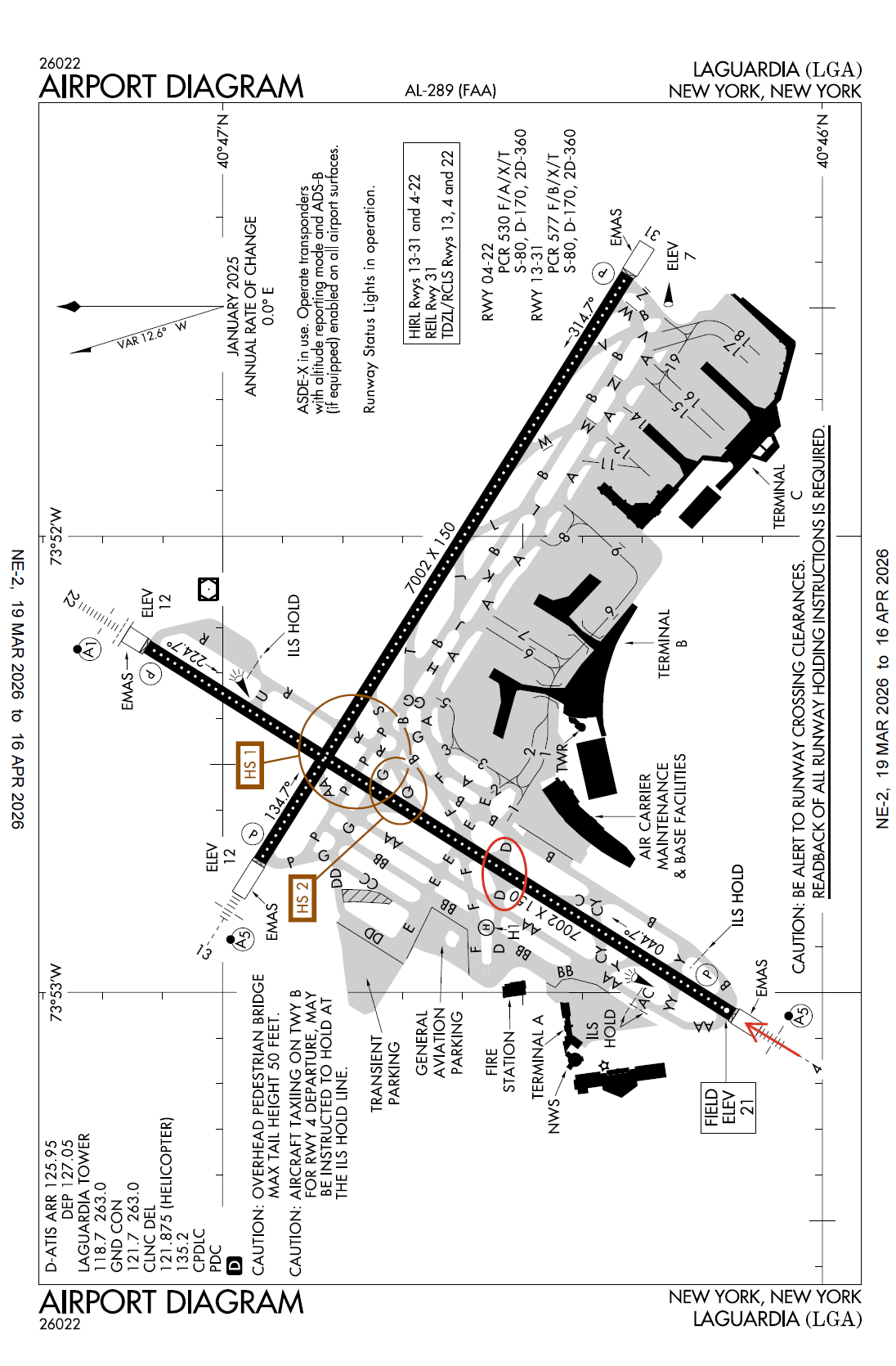
Note that a jet doesn’t try to land right at the beginning of the runway, but rather 1000′ down the runway (out of 7002′ total here). Because of inertia due to weight and the slow-ish spool-up time of a big jet engine, it’s tough to adjust approach angle/position near the ground in the event the wind changes. If the airplane is going to come up a little short, therefore, the 1000′ marker target enables the short landing to still happen on the runway surface. The airplane would have been rolling/braking for perhaps only 1500-2000′ before the crash.
ABC has a timeline:
Based on an air traffic control recording, the truck had requested permission and had been cleared by the air traffic controller to cross Runway 4 at taxiway Delta. Shortly after, the air traffic controller tells the vehicle to stop several times right before the collision.
“Stop, Truck 1. Stop,” the transmission says. The controller can then be heard frantically diverting an incoming aircraft from landing.
Michael McCormick is the former vice president of the FAA and was once in charge of all of the airspace in the Tri-State.
He wants to know how many people were in the control tower, because initially it sounds like one person could have been doing the work of two people.
“What we’ve heard from that control tape, is it’s the same voice that is clearing the aircraft to land and clearing the vehicles across the runway and a normal tower scenario it would be ground control working the surface traffic and tower control just working arrivals and departures,” McCormick said.
Michael McCormick sounds much more qualified than I, but I think that he is incorrect regarding what’s conventional for Tower vs. Ground responsibility. In my experience, any vehicle or aircraft that wants to cross an active runway usually deals with Tower, i.e., the same person on the same frequency. This is substantially safer than two people issuing instructions on two frequencies because it gives pilots the chance to hear that a vehicle has been cleared across the runway that they were expecting to use and also concentrates control into one brain rather than requiring coordination among multiple brains.
It’s super sad to reflect on the deaths and injuries caused by what seems to be human error, especially since there was no need for the humans in the fire truck to be on their own. An AI in the fire truck could have been monitoring both Tower and Ground frequencies and also looking around at vehicles and aircraft on the field. The AI could easily have said “Don’t move! There’s a plane landing!” to the truck driver who’d been cleared across.
Has anything like this happened to me, you might ask? Yes. I won’t rat out the airport and controller, but I was holding short of a runway at a towered general aviation airport with a fair amount of flight school traffic. Tower cleared me for takeoff. I looked left and noticed a piston-powered airplane on short final and decided not to move into the runway. At a normal taxi speed, I think that the landing aircraft might have gone past by the time I was in the middle of the runway, but it was surely a controller mistake (at the point that I was cleared for takeoff nobody could have had any idea how long it would take for the landing airplane to clear the runway).
(For what it’s worth, our AI overlord (ChatGPT) says “Runway = Tower’s jurisdiction … No one—aircraft or vehicle—may enter or cross a runway without: … Explicit clearance from Tower” and that only rarely might a Ground controller relay a Tower controller’s clearance to cross a runway.)
Don’t take this post as a criticism of LaGuardia ATC. In my experience, New York controllers in all positions are some of the best in the U.S. I’ve talked to LaGuardia Tower while flying a helicopter around the East River and while flying a CRJ into and out of LGA. One really can’t get better humans and, therefore, improved safety will come only from improved systems, such as AI assistance in ground vehicles and, maybe, an AI assistant in the Tower.
One big question: why didn’t the fire truck personnel notice the CRJ’s insanely bright landing lights or get warned by the runway status lights that are supposed to prevent runway incursions even when a human makes a mistake? Pilots are trained to look both ways when entering a taxiway or runway so presumably the airport fire truck drivers are too. According to the FAA, there should have been a “stop” indication to the fire truck that the runway was in use (another easy thing for an AI to warn out: “STOP! Look at the red lights!”):

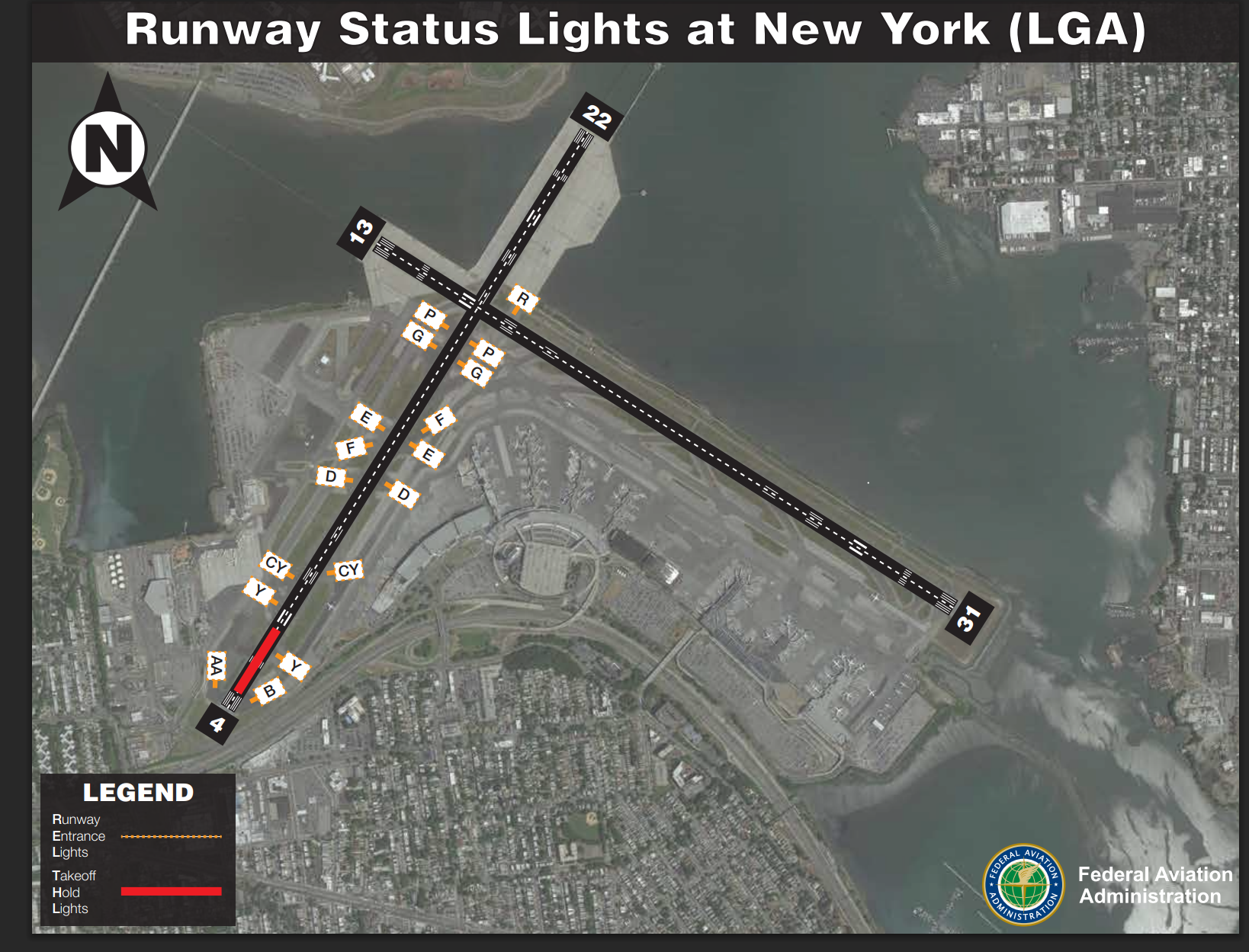
It will certainly be worth investigating whether this failsafe system was operating correctly at the time of the accident and also what kind of training fire truck drivers receive. For pilots in a two-pilot crew, the captain (left seat) is supposed to look and say “clear left” while the first officer (right seat) is supposed to look and say “clear right” before making a turn.
Related:
- My visual approach, and Asiana’s (my own landing in a CRJ at LGA)
Runway incursion videos in the last few years were as common as “how to retire early”. The runways are a free for all. The last big one was KSAT on Jan 27.
I read about the crash on the Times. Then I see that there are comments so I think to myself what can people have to say about a plane crash where it looks like ATC told the truck to stop? Times readers did not disappoint: Congress and government shutdown, lack of TSA staffing, Trump’s fault, DOGE…
Wall Street Journal comments were same. Years ago, they would have diverged vs. NYT, but the WSJ content and readers have converged so it’s effectively a “new” NYT. Sad.
@mitch “…it looks like ATC told the truck to stop”
Phil quoted ABC’s timeline:
“Based on an air traffic control recording, the truck had requested permission and had been cleared by the air traffic controller to cross Runway 4 at taxiway Delta. Shortly after, the air traffic controller tells the vehicle to stop several times right before the collision.”
So ATC cleared the truck and then frantically yelled for it to stop at the last minute when the collision was imminent. It seems clear that their is ATC error in this timeline, conflated perhaps with the truck operator lack of situational awareness.
–>How is it not valid to point to the possible impact DOGE etc had on ATC staffing and morale? Multiple crashes in the Trump/DOGE era, and so little for a decade prior.
https://x.com/airmainengineer/status/2036116651167384018
Thanks, Steve. Painful to watch.
I have not heard any further details about this incident, but at my home airport, KHIO a busy GA airport:
A) Ground control always gives runway crossing instructions. When taxing, I have never been switched to tower to cross a runway.
B) Ground and Tower are frequently the same person and often very busy.
C) Even when Ground and Tower are the same person, they still use different frequencies so somebody monitoring only Tower or only Ground will not hear conflicting instructions.
E.G. The scenario were an overloaded controller gives somebody permission to cross the runway at the same time they give permission to somebody else without either party hearing the conflicting instruction could totally happen.
I don’t have any background in aviation or airport design, but I have a question: why not build tunnels under runways, where needed, to allow trucks and other vehicles to pass? It don’t think this is an impossible task, and the cost could be peanuts compared to the operational efficiency and safety benefits.
“ why not build tunnels under runways, where needed, to allow trucks and other vehicles to pass?”
Tunnels here would be holes planes could fall into if they happened to drift off the runway.
Ground vehicle / plane collisions like this seem rare anyway.
My local airport did this. It cost an absurd $1 billion, for 2000 ft 6-lane tunnel.
Tunnels might make clearing snow harder and might collect water. (Seems like tunnels might cause more problems than they solve.)
> How is it not valid to point to the possible impact DOGE etc had on ATC staffing and morale?
Because that might implode Phil’s view that Daddy Trump is better than Biden