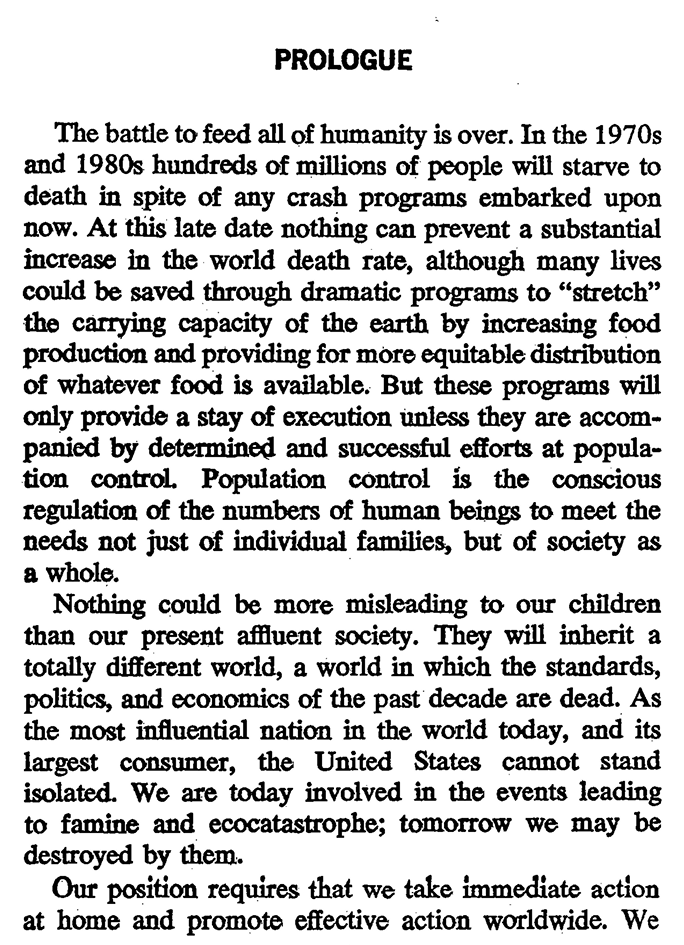
We took the kids to see Hoppers, the latest Pixar movie. It has some spiritual similarities to The Population Bomb (1968), whose author recently died. Stanford University prof. and Ivy League graduate Paul R. Ehrlich was famously wrong about human population growth leading to famine within his lifetime, but Hoppers shows that his philosophy remains alive.
The movie opens with a noble Japanese-American girl visiting with her grandmother at a single-family house with immediate access to an unspoiled natural area (i.e., something that is impossible for the average person who lives in a heavily populated country). It is access to nature, we’re told, that enables a human to be calm (urban “teens” who can’t access nature, thus, are guaranteed to be violent).
Population pressure and growth, as Prof. Ehrlich described, drive the plot of the movie. The humans are working to take away all of the animals’ habitat, something that they might not have done if the U.S. had stopped growing after reaching 150 million circa 1950.
Was Ehrlich actually wrong? He did say that we might “stretch” and increase food production by trashing the Earth and that is kind of what we’ve done here in the U.S., e.g., heavily fertilizing the Midwest and dumping runoff into the Gulf of America, thus creating dead zones:
The Dead Zone develops, somewhat ironically, as a result of the nutrients that fuel the high productivity in the Gulf’s surface waters. As dead plant material falls from the surface through the water column deeper into the Gulf, bacteria consume it using oxygen. This lack of oxygen creates the Dead Zone in bottom waters on the Texas-Louisiana shelf throughout warm summer months. This occurs when there are fewer storms and strong winds to mix the warm, oxygenated surface waters and the cooler, deeper waters. At other times during the year, winds, weather fronts and storms in the area mix the water, replenishing the oxygen used by the bacteria in the deeper water.
Nutrients, such as nitrogen and phosphorous, are essential for an abundant food supply, but crops take up on average just 40% of the nitrogen that is applied each season. The excess can run off into waterways, leading to a high nutrient load in the Mississippi River. Many efforts are underway throughout the Corn Belt to improve fertilizer efficiency and increase adoption of practices like cover crops and buffer strips that protect water quality.
See Book that explores the biggest issue of our age for a discussion of the tension between those who think we need six Earths total for the current batch of humans and those who think we can innovate enough to use just one Earth.
How was the movie? The boys (10 and 12) didn’t love it. Maybe because they don’t identify as either female or Black, the only two kinds of humans who are smart enough to be scientists and engineers. There is, of course, one white male character and he occupies the environment-destroying villain role. The movie involves mobile robots that are created by the intelligent female scientists. Said robots have no apparent solar cells and yet never run out of power. Speaking of miracles, the population in the unnamed U.S. city (Pacific Northwest?) is booming, which is why the humans want to take all of the animals’ habitat. The humans come in a rainbow of skin colors, consistent with U.S. population growth being entirely driven by immigration. And yet… nobody in the movie speaks with a foreign accent.
> We took the kids to see Hoppers, the latest Pixar movie.
Why? As an object lesson in the stupidity of Hollywood? I probably would have taken my kids to the beach and showed them what nature has survived. Fake-ass e-waste robot beavas made with grrl powa are not going to save the world, for real, yo.
OAG: Decisions regarding movies, like most decisions in our household, are made under a One Woman, One Vote system.
Jesus Christ, would you listen to yourself man? Ta.
You should try to avoid entertainment that seeks to demean and feminize your boys & then everything will be ok -hakol sababah:
From reading this blog and the contents published by its author, Steps 5 and 6 do not seem to be conducive any longer to achieving the desired goals.
From the excellent summary of the causes of divorce by Goode, Greenspun, Dankowski, Martin-Berkowicz, and Tonnu: “Lawyers in every jurisdiction offering no-fault divorce told us that the commitment [Step 5] aspect of marriage was meaningless: “Marriage lasts until one spouse figures out that he or she can be better off by getting rid of the other spouse.””
If only it were this simple…
Good post. Thanks for your comments and link to the old blog post. I wonder if our current technology will write a new chapter in history on this subject? In olden days when exponential and unsustainable population growth occurred, there was not nearly as much technology. So in theory, we could go through an extra stage of the technology failing underneath us before we do the “make the majority work with their own hands” stage like the nations of old did. Could buy enough time?
IMO Ehrlich’s thinking was warped by the common academic disease of being unable to think beyond the first-order logic and by his 20th century libtard assumptions of egalitarianism and sexual libertinism.
Malthus’ Law suffers from two difficulties – population doesn’t always grow exponentially and food supply doesn’t always grow linearly. Medieval populations controlled growth through varying the age of marriage and through monasticism. The protestant reformation and decline of monasticism even in catholic countries led to the “Western European Marriage Pattern,” which is relying on marital age of women to regulate population growth.
The Haber-Bosch process also allowed the food supply to grow exponentially, even with a dramatic drop in agricultural labor, so long as energy prices are cheap. At the same time, governments abolished marriage in substance, that of a pubic office regulating births and legitimate sexual intercourse, and allowed unrestricted sexual activity. This creates the population bomb. The attempt to control it in a way that fit Ehrlich’s worldview fails, because birth control fails 1 in 10 times even when used perfectly. It is useless altogether in the third world and among the lower orders.
Ehrlich thought (first order logic disease) that this could only resolve by famine. Instead, we have Hubbert’s Law of peak oil. Like Malthus, this proved incomplete but not wrong. After we hit peak conventional oil in the 70s, we started developing shale. So it should really be “Peak EROI” not “peak oil.” (Energy return on investment for those who don’t know.) To keep oil at prices that will support Haber-Bosch, we have to divert an ever-increasing amount of capital to energy that would have gone to infrastructure or maintenance. At the same time, you need easy money available for shale projects. Downstream effect of this combination is fewer resources available to young couples. Contra the academics, people are pretty good at regulating births to available resources without any guidance from Harvard or pharmaceutical products. Superior Medieval administration worked with natural instincts, famines in the past only happened due to black swans. (Side note: Hubbert’s law can be used for other resources like fisheries, which are also being exhausted)
The actual consequence of the population bomb is the now population shortage of new births, creating an inverted population pyramid with a vast swarm of elderly and fewer and fewer working age adults. Ehrlich exasperated this problem by getting the governments of the world to try any and every policy, along with propaganda, to suppress the birth rate much further than it otherwise would have. While the concerns he raised were not baseless as people think today, he was another example of super incompetent academia causing massive disasters in the real world.