As 18-year-olds and their parents manage their grief over the stack of rejections received from elite colleges, here’s a Wall Street Journal article for those who were rejected by Duke (95 percent rejection rate): “He Had a Full Ride at Duke—Until America Cut Him Off”.
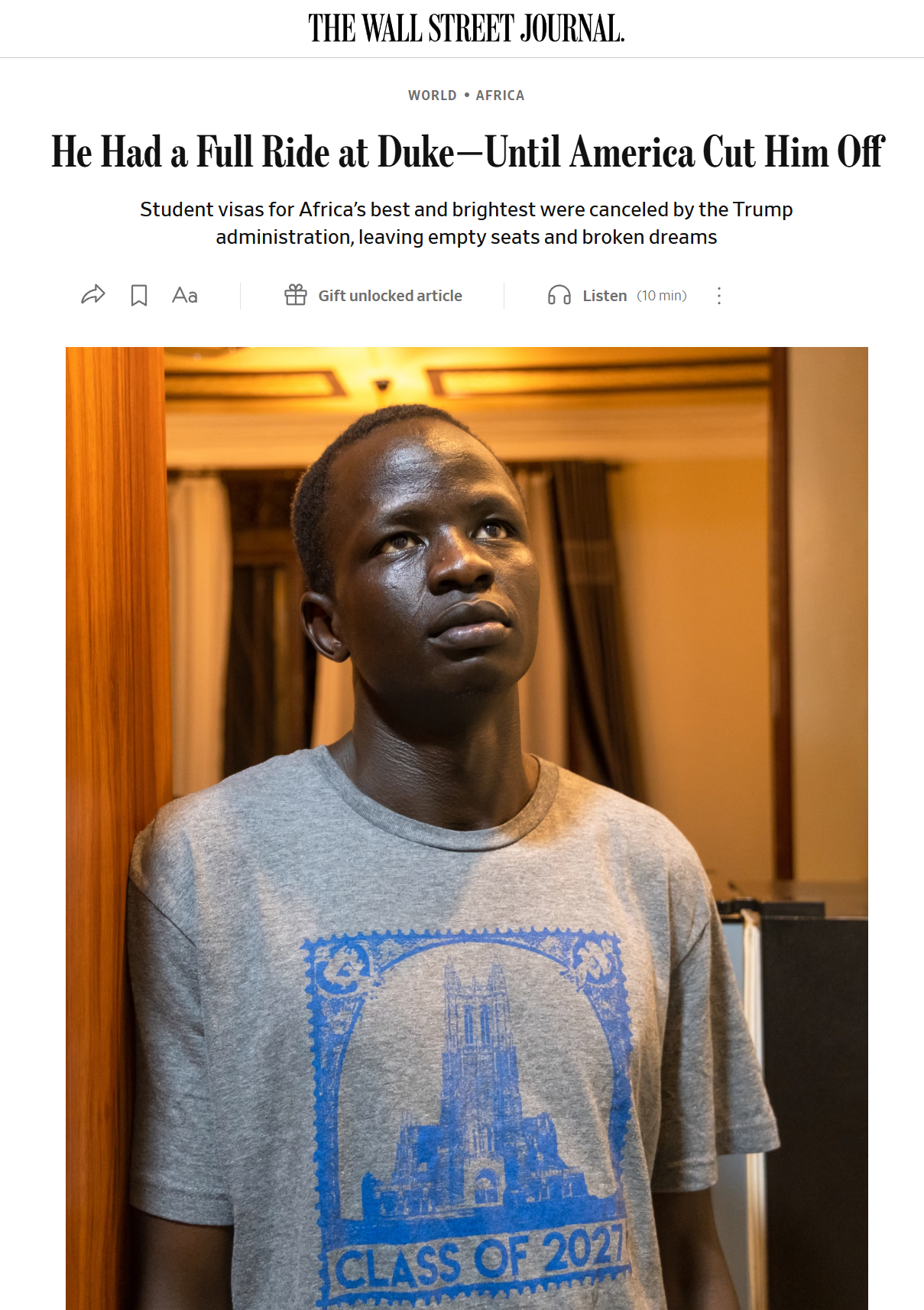
(This article could also be inspiring to Americans graduating next month from Duke with crushing student loan debt. They can sleep easier knowing that some of the money they borrowed and must pay back (unless Kamala Harris is defrosted and elected?) was used to give “a full ride” to a migrant.)
The villain of the article is Donald Trump, of course, referenced 6 times. Here’s a peculiar Trump reference. The South Sudanese are so smart that they thrive at Duke, but they aren’t smart enough to realize that any migrant is an enricher. They refused to accept a migrant on the grounds that he was Congolese rather than South Sudanese:
Trump’s displeasure with South Sudan began when it refused to accept a man being deported by the U.S. The man was Congolese, South Sudanese officials said, but the administration didn’t want to take no for an answer.
South Sudan has a GDP per capita of less than $400. We’re informed that migrants are an economic boon to any nation. Why doesn’t South Sudan want to become richer by accepting migrants from Congo?
A separate question: if migrants enrich the U.S. as a whole, why are migrants at Duke being funded by American students paying tuition at Duke? Shouldn’t full tuition for migrants be paid with federal tax dollars on the grounds that every migrant makes the U.S. better off?
If migrants enrich the country they migrate to, doesn’t that mean they impoverish the country they migrate from? Is it moral for the USA to benefit from the brain-drain of top talent from Sudan / Congo, at the expense of Sudan / Congo?
You have to really wonder what the WSJ’s business strategy is since the old man handed the News Corp. off to his lads. The WSJ used to be America’s preeminent business publication, stock market tables, stock markets tips, this company acquiring that company, the kind of thing that would appeal to a bank VP in Des Moines or an insurance broker in Topeka. The news section was a bit liberal and the editorial pages were Reagan and Bush Republican with Peggy Noonan reminiscing about the good old days with Ron chopping wood on the the ranch or Babs Bush whipping up some killer gin and tonics at Kennebunkport after a hard game of croquet. But now-a-days the front of the paper is about the same as the NYT replete with a Trump-deranged comments section and the editorial pages seem to be random opinions with the geezers regurgitating the same old stuff. The NYT has a lock on the left and those who love hearing Peggy Noonan reminisce say about how her Great Aunt Mary from County Clare misplaced her rosary beads right before Midnight Mass are dying out. And if you really want news you can get it better on X or some podcast. So who is the WSJ’s target audience?
Aren’t plenty of finbros “liberal”? The majority of the ones I went to school with in the withering Ivy League were “liberal”, many Catholic too.
(“liberal” == “institutional racism is OK, as long as you aren’t racist to their face.” Also, see hypocrite.)
“This is the kind of talent we’re shutting out,” Mano said.
IDK, there are certain advantages of *being* shut out:
https://www.science.org/content/article/duke-university-settle-case-alleging-researchers-used-fraudulent-data-win-millions
https://indyweek.com/news/duke-light-rail-gotriangle-durham/
North Carolina, “The Cracker State”
If possible, it would be interesting to run an experiment: take today’s progressive and liberal writers and leaders and send them back in time to the Great Depression or World War II. I wonder how their writing and leadership would change. If they believe that things are going to shit today under Trump or in the current global climate, how would they view and describe those far more extreme periods?