Manhattan real estate prices… in Cambridge

I live in a four-unit condo near Harvard Yard (see the epic tale of my purchase back in 1996). The ground floor unit recently went on the market for $429,000. Very shortly five bids materialized, all over the asking price. The accepted bid was for $480,000.

What was bought? The broker, from perhaps Cambridge’s largest real estate firm, listed the apartment as 1363 square feet in the MLS (realtor.com entry for 5 Irving Terrace). The city lists 5-7 Irving Terrace, Unit 2A as having 713 square feet and being worth $349,300 (property database). What is actually inside the unit are two rooms: one bedroom plus a combined kitchen/living room. If you hired someone to refinish the floors they might find 500 square feet. How did the realtor manage to find 1363 square feet for this small one-bedroom? An old version of the condo docs had this apartment combined with another. They were later (20+ years ago) split into two separate condos. Folks who showed up expecting 1363 square feet and found a small one-bedroom were apparently not discouraged, though, based on the number of bids.

If we take the city’s 713 square footage, the place sold for $673 per square foot, but in terms of usable interior space I think the total square footage is closer to that of a 500 sf place in a modern building, which gets us to $1000/sf, i.e., what people pay for an apartment in Manhattan. The apartment includes a driveway parking spot, which is a plus, but the kitchen and bathroom would need $30-50,000 of work to bring them into the modern era.

This supports my theory that the suburbs will be abandoned by the wealthy (May 2013 posting) due to the horrific traffic congestion in our metropolitan areas. Rush hour getting out of Cambridge through Alewife now extends until about 8 pm, but you can buy your way out of sitting in traffic if you’re willing to spend $480,000 on a one-bedroom apartment (plus kitchen/bath renovation costs and, very possibly, your share of a new roof (see below)).

Separately, in case you are ever tempted to trust a realtor…. the broker selling the unit had previously been managing the place for the owner as a rental. He thus became aware of an issue with leaks from the 125-year-old slate roof that might cost more than $30,000 to repair and thus result in an assessment to the new owner. The condo’s master insurance carrier had sent a letter refusing to pay for water damage because of “age-related deterioration” of the roof. I asked the realtor if he’d shared the letter, which he’d had in his possession, with the buyer. “No. That’s not my responsibility. It is up to her home inspector to discover any problems.”

[Finally, what do readers know about old slate roofs? At the end of almost every winter there is some ceiling damage from ice and snow melting through the slate/flashing/whatever. There is occasional additional damage from random events, such as a slate being kicked out of place or falling off. We hire a roofer who goes up there, charges us some money, pronounces the leaks fixed, and then departs. We repeat the cycle the next year. An experienced slate roofer (not our regular contractor) told me that the nails on our roof are copper and that they corrode after about 85 years, resulting in the slates being very easy to dislodge. This is why the life of a slate roof is not infinite. He said that the only real fix was to remove the slates, install ice and water shield material, and then reinstall the slates over the ice and water shield with new nails that will last another 85 years. Have any of the readers done this?]

Full post, including comments

How to measure the microwave heating of milk in a plastic cup?

Here’s one for the chemistry, chemical engineering, and mechanical engineering graduate students out there…

What’s a good way to measure the uniformity of heating of milk in a plastic cup in a microwave oven?

Explanation: I have watched a new mother pour milk into a plastic cup with measurements on the side to determine the quantity, then pour that cold milk into a ceramic coffee mug to be heated in the microwave for 30 seconds, then pour the warm milk into a plastic sippy cup to be served to a toddler (3 items to wash). I have observed day care workers perform the same task by heating the milk in the plastic server cup (1 item to wash).

When I have inquired of mothers dirtying either 2 or 3 dishes in serving a cup of milk what their reasoning was, the answer was “It is bad to microwave food or drink in plastic.” Why? “Hot or warm liquid will pull dangerous chemicals out of the plastic.” What about the fact that they were going to then take the warm liquid and immediately dump it into the plastic? If the temperature was a problem, wouldn’t the warm milk hitting the sippy cup leach out whatever dangerous chemicals were in there just about as badly as if the milk had become warm in the microwave? Blank stare in response.

An acquaintance who works for Harvard University managing engineers building scientific experiments opined that the mothers were likely right. “The milk right up against the cup might get super hot while it is in the microwave while the milk in the center remains cold.” I pointed out that this didn’t make a lot of sense given the relatively long wavelengths of microwave cooking energy compared to the size of a sippy cup (Wikipedia says standard frequencies for microwave ovens are .9 to 2.45 GHz, resulting in wavelengths of about 5-12 inches). And wouldn’t convection and conduction within the liquid also make the heating pretty uniform? Hot spots seemed more likely when microwaving solid foods. We put some milk into a sippy cup and tried an on-the-spot experiment. Using sophisticated temperature probes (i.e., our fingers) we couldn’t discern any differences between the edge and center temperatures.

How would one construct an experiment to do this in an actual microwave oven and measure the edge and center temperatures continuously as the milk is heated? (we stuck our fingers in only once the milk was done) There are plenty of infrared temperature probes, I think, that don’t require contact with the item being measured, but I don’t know how well they would operate if stuffed into an operating microwave oven.

Full post, including comments

Silicon Valley “other-shoring” jobs to Boston?

A friend told me about his new job: setting up an office for a Silicon Valley hardware/software company here in the Boston area. “I need to hire about 10 engineers,” he said. Why would they want to fragment their workforce by adding an office 3000 miles away? “Everything costs about 30 percent less here in Cambridge, including salaries.”

Readers: Is this a trend? Should we coin the term “other shoring” for hiring cheap workers in Boston?

Full post, including comments

Sheryl Sandberg, Jane Austen, and the Queen of Versailles

Sheryl Sandberg’s Lean In, which I reviewed back in May, continues to be on the New York Times bestseller list. At least one of my friends in business says that the book has been an inspiration to her and that she has applied for some bigger jobs as a consequence of reading the first half of the book (one of the things people learn at top B-schools, apparently, is that business best-sellers need not be finished!).

Separately, I watched The Queen of Versailles where the protagonist talks about her days as an engineer at IBM. One day she asked her manager why he had a clock counting down. The manager said that it was showing him the days, hours, minutes, and seconds until he could retire. Why did he care? “Because that is the moment when I can start living,” was what the guy said. As a result of this conversation, the Queen of Versailles quit her engineering job and took up fashion modeling in Manhattan. Then she devoted herself to being the wife of a rich guy and mother to seven children.

Sandberg’s advice is apparently inspiring, but even someone as successful as Sandberg cannot figure out a way to put more hours into a day or more days into a year. For most people, a bigger career means fewer children. As the Queen of Versailles found, even some of the better jobs in our society, e.g., engineering manager at IBM, are not very satisfying. According to various studies (see Forbes, for example), only a minority of American workers are at least “somewhat satisfied” with their jobs. Even for those who are satisfied, if you asked them, at age 70, “Would you rather have had thirty percent more career success and one fewer child?” I wonder how many would say “Cut me back to 1 kid from 2 and make my final title two rungs up higher in the bureaucracy.”

One of the original English-language authors who provided advice and inspiration to young women is Jane Austen. She been in the news this summer due to a controversy over Austen replacing Charles Darwin on an English banknote (example story). She more quietly inspires individuals (implicitly; explicitly). Austen spends a lot of ink describing women who marry for money, e.g., in Mansfield Park:

First page: About thirty years ago Miss Maria Ward, of Huntingdon, with only seven thousand pounds, had the good luck to captivate Sir Thomas Bertram, of Mansfield Park, in the county of Northampton, and to be thereby raised to the rank of a baronet’s lady, with all the comforts and consequences of an handsome house and large income. All Huntingdon exclaimed on the greatness of the match, and her uncle, the lawyer, himself, allowed her to be at least three thousand pounds short of any equitable claim to it. She had two sisters to be benefited by her elevation; and such of their acquaintance as thought Miss Ward and Miss Frances quite as handsome as Miss Maria, did not scruple to predict their marrying with almost equal advantage. But there certainly are not so many men of large fortune in the world as there are pretty women to deserve them.

[Regarding Maria’s proposed loveless marriage to the rich blockhead Rushworth, Mary Crawford says] “Oh yes I know it is. I was merely joking. She has done no more than what every young woman would do; and I have no doubt of her being extremely happy.”

[Upon the father returning from the Caribbean and giving his daughter the opportunity to escape the loveless marriage… ] He had expected a very different son-in-law; and beginning to feel grave on Maria’s account, tried to understand her feelings. Little observation there was necessary to tell him that indifference was the most favourable state they could be in. Her behaviour to Mr. Rushworth was careless and cold. She could not, did not like him. Sir Thomas resolved to speak seriously to her. Advantageous as would be the alliance, and long standing and public as was the engagement, her happiness must not be sacrificed to it. Mr. Rushworth had, perhaps, been accepted on too short an acquaintance, and, on knowing him better, she was repenting.

With solemn kindness Sir Thomas addressed her: told her his fears, inquired into her wishes, entreated her to be open and sincere, and assured her that every inconvenience should be braved, and the connexion entirely given up, if she felt herself unhappy in the prospect of it. He would act for her and release her. Maria had a moment’s struggle as she listened, and only a moment’s: when her father ceased, she was able to give her answer immediately, decidedly, and with no apparent agitation. She thanked him for his great attention, his paternal kindness, but he was quite mistaken in supposing she had the smallest desire of breaking through her engagement, or was sensible of any change of opinion or inclination since her forming it. She had the highest esteem for Mr. Rushworth’s character and disposition, and could not have a doubt of her happiness with him.

[Later in the book, Mary Crawford points out..] “I mean to be too rich to lament or to feel anything of the sort. A large income is the best recipe for happiness I ever heard of.”

Austen’s world is alive and well at Harvard College today. I remember one undergraduate saying “I used to think that I wanted to be an investment banker, but then I realized that I could just marry an investment banker.”

A woman friend of mine observed that the modern world is in some ways friendlier to women seeking their fortune through romance or marriage. “A woman used to have to stay married, possibly to someone that she had never loved, in order to retain access to the money, the house, and the title,” she pointed out, “but now she can get most of that from a quick marriage and a divorce.”

A couple of recent New York City tabloid articles (News; Post) reinforce my friend’s point. It seems that Liza Ghorbani, a New York Times reporter, was having an affair with a married British man. Ghorbani is the mother of a healthy 8-month-old baby, apparently a result of the affair. In Austen’s day she would be trying to hide the facts both of the affair and the child. Today, however, there is apparently insufficient social stigma to discourage the filing of a public $3 million child support lawsuit.

[Note that if the New York Times pays her $100,000 per year (source), a decent salary for a journalist, Ghorbani’s compensation from working would be at most $65,000 after federal, state, and city income taxes. The $3 million that she stands to collect, tax-free, as a result of having a child, therefore, would equal approximately 46 years of after-tax income. For a reporter on the Bureau of Labor Statistics median pay of $36,000 per year, the $3 million would be closer to 100 years of after-tax income.]

In case there are young people reading this blog, my personal experience supports a position somewhere in between the Queen of Versailles’s perspective and Sheryl Sandberg’s (Austen, like Shakespeare, wrote about a lot of different characters and therefore I would hesitate to ascribe a position to Austen herself). I worked 80 hours per week on some computer-aided engineering software back in the 1980s. It was all written in Common Lisp and very little of my original code, if any, is in use today. I remember that customers were happy with the system, but the memories of being thanked by those customers are vague. I am an inventor on three patents, but nobody ever had the money or energy to chase after infringers and two out of three cover technologies that are now irrelevant. In the 1990s I co-developed a popular free and open source toolkit for building Internet applications. I was proud at the time of the roughly 10,000 sites worldwide that adopted the software but today it is usually considered “legacy code” and companies, such as Zipcar, are investing money and effort to replace it with newer software. I have taught a lot of students, e.g., at MIT, and they have gone on to have good careers, e.g., at Google. But the 300+ students taken together do not call me as often as I call my parents and from this I infer that an adult child would be more of a comfort in old age than a career’s worth of students. [Note to self: spend the next few weeks calling/emailing my former teachers!] The textbooks that I’ve written, and made available for free via the Web, and the photo.net online community that Rajeev Surati, Jin Choi, and I nurtured continue to be useful to others and, therefore, continue to provide me with some career satisfaction. So while on the one hand I am glad that I “Leaned In” to finish those textbooks and keep the photo.net server refreshed with new content and software and may sometimes smile when receiving an email from a grateful reader, I experienced a lot more joy last Tuesday afternoon taking my almost-four-year-old daughter to her first feature-length movie (“Planes”; lacking an adult vocabulary, after the movie was over, Greta referred to the aircraft carrier as “the airport in the middle of the water”).

Sandberg doesn’t talk a lot about money, but there is a financial subtext in her book. The bigger jobs pay more and the parents about whom Sandberg is writing use some of that money to hire household and child care help, typically for just one or two children. The happiness researchers have found that money beyond an upper middle-class level of income does not yield too much additional happiness (Forbes has a recent article describing a challenge to this finding, thus providing more evidence that John Ioannidis is the only correct researcher). My personal experience is that my overall mood has not been strongly correlated with my income or wealth, despite wide swings over the past 30 years (from an engineering grad student stipend of about $32,000/year in today’s dollars up to a maximum of about $300,000/year). I have gotten a lot more happiness from spending time with a child than from reflecting on the fact that my income was higher in Year X than it had been the previous year. Thus I would say that it is not rational to take on a bigger job in order to make more money if that means that one will end up with fewer children.

This idea of giving more priority to children than to career, at least for a portion of their working lives, seems to be prevalent among my friends. I spent yesterday with a woman at the very top of American credentialism. She has an MD and a PhD in engineering. She has been the author of textbooks for medical students. For the moment, however, she has done the opposite of what Sandberg recommended. She has scaled back her career so that she can work part-time from home and spend more time with her husband and three children (youngest is almost 4 years old). Even though the youngest child was being a little difficult at the time (a crisis developed over the question of which chair she would occupy at dinner), my friend answered without hesitation that she was much happier with that third child than she would be with additional career advancement. Her husband is a work-from-home entrepreneur and could have been advancing the products that he is designing on the day that I visited. There were three other adults who could have watched the four total children. But he spent the whole day playing with the kids instead.

The older people that I’ve met are more in agreement with the Queen of Versailles than they are with Sandberg. I recently spent a couple

Full post, including comments

Fuller Craft Museum

If you’re headed to the Cape, don’t forget to stop in the Fuller Craft Museum in Brockton (quick stop off Route 24). They have some great exhibitions right now, including a large collection of glass art from MIT. According to Wikipedia, the museum’s architecture and gardens inspired the Louisiana modern art museum in Denmark.

Reasonably good for kids (we went with a 4-year-old and she was losing interest after about 45 minutes).

Full post, including comments

Cost to renovate Longfellow Bridge compared to its construction cost

The Longfellow Bridge here in Cambridge, built in 1906, is going to be partially shut down for the next three years. The project is forecast to cost about $260 million, though previous construction cost forecasts in Massachusetts have been optimistic (e.g., the Big Dig was originally planned at $2.8 billion but ended up costing close to $15 billion). The project has already generated some controversy due to the fact that Governor Deval Patrick imposed a rule that excluded non-union workers from contributing (Boston Globe editorial).

I was interested to know how the cost of renovating the bridge compared to the cost of its construction but none of the news articles on the subject of the bridge project mentioned the original cost. Nor does Wikipedia. I found a “Cambridge Bridge Commission Report” on archive.org that on pages 53 and 54 summarizes the cost. The “total paid for new bridge” was about $2.5 million. In today’s dollars that’s approximately $65 million. In other words, assuming that this project comes in within its budget, renovating the bridge will cost roughly 4X what it cost to build.

If you’d like to play with the figures, I hired Cristian Blendea of Bucharest, Romania (via Guru.com) to prepare an Excel spreadsheet with all of the numbers from the book: Longfellow-Bridge-Construction-Cost

[When the project is all done, the current four lanes for cars (two in each direction) will be reduced to three (just one lane from Boston to Cambridge), so if examined in terms of cost per lane of travel, it was $16.25 million to construct and will be $86.67 million to renovate, a 5X increase in cost.]

Full post, including comments

Civil Forfeiture in New Yorker magazine

The latest New Yorker magazine includes an article on civil forfeiture. Back in 1995 I took a class at Harvard Law School called “Advanced Criminal Procedure.” An example civil forfeiture case that I can remember involved a man who drove his wife’s car to a shady part of town looking for a prostitute. The police didn’t have enough evidence for a successful criminal prosecution but they took the wife’s car via civil forfeiture, arguing that the car was involved in prostitution. The wife appealed, pointing out that she certainly did not authorize the use of her car for such a purpose, but lost. The appeals court ruled that the government had the right to take her car.

Now that adult children are moving in with parents in increasing numbers, the case of the elderly Philadelphia couple whose 31-year-old son made three $20 marijuana deals from the front porch should be cautionary. I would rate this as another argument in favor of renting rather than owning a home (see previous posting on the subject). An owned house is a irresistible target for a variety of predators, including the government (gradual via property tax) and the police (sudden via civil forfeiture). Insurance cannot protect against these kinds of risks.

If Mary and Leon Adams had purchased a basket of stocks in 1966 instead of the house they would be a lot better off today. A jealous neighbor cannot plant a marijuana seed in a Vanguard portfolio and then call 911. A wastrel child cannot deal drugs while standing on top of a record in a Fidelity Investments relational database management system.

Full post, including comments

Friends of Acadia National Park Charity Auction

I spent a couple of days on Mount Desert Island (“MDI” to the Rockefellers) and was invited to join the swells of Bar Harbor and Northeast Harbor at the Friends of Acadia annual benefit auction.

About 500 people attended the event, held in a tent on the lawn of the Asticou Inn. Many of the waitstaff seemed to be speaking with Eastern European accents. Our table included the owner of one of the island’s larger hotels and we asked him why, in a time of supposedly high unemployment, there weren’t Americans who wanted to spend the summer on MDI. “I offer pretty high wages and housing, but Americans still aren’t interested,” he noted. “I had a single mom working for me for a few months but then she figured out that she could collect more from public assistance if she quit. Americans can usually obtain a comfortable material lifestyle by moving in with their parents or collecting Welfare. Why would they want to be on their feet serving two meals per day?”

Men wore salmon- and orange-colored pants with navy blazers and boat shoes without socks. Nobody seemed to have a problem bidding over $40,000 for a Willys Jeepster (photo below) or a week’s vacation in Antigua. Out of 500 people attending I noticed just one black person and no Asians.

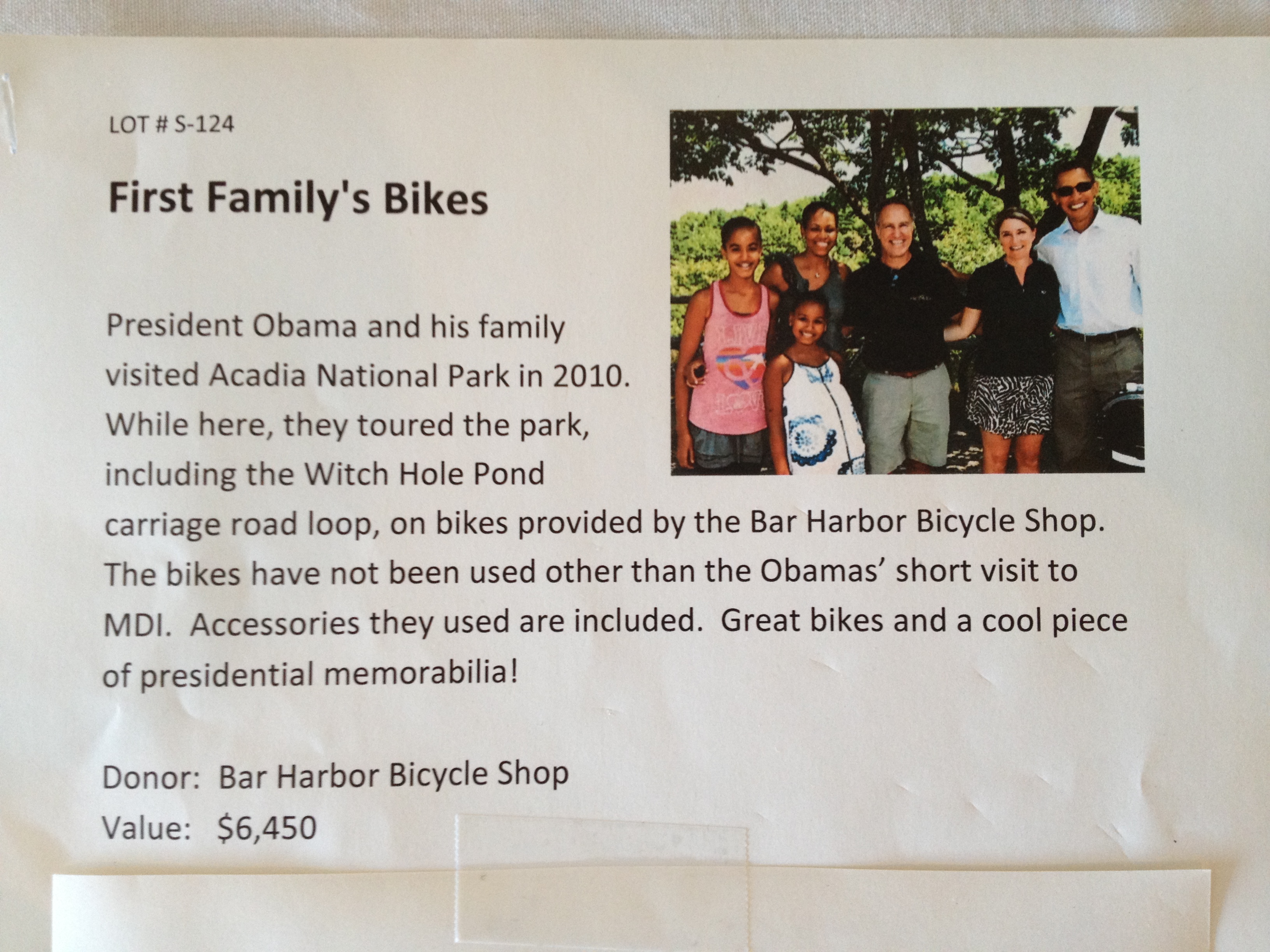
The least obvious auction item was a set of four bicycles that the Obama family had rented during a brief visit to the national park in 2010. They sold for $7000. Asked why someone would pay that much for bikes that the Obama family had touched, a woman at our table said “Probably they are going to re-sell them at a profit to liberals in Cambridge.” Upon returning home I asked a Cambridge neighbor how much she thought the four bikes might have sold for. She estimated their auction value as $50,000.

[My best MDI moment was reading a Mo Yan novel while looking out at a moored yacht and think “Mo Yar” would be a good name for a sailboat maker (see Philadelphia Story for definition of “yar”).]


Full post, including comments

A varied weekend of flying

I spent a long weekend making two trips in the Cirrus SR20. The flights included an instrument approach down to 500′ overcast at the untowered airport in Bar Harbor, Maine, operations at a busy towered airport (Hanscom), and short-field operations on the 2500′ runway at Block Island, Rhode Island. It included running into someone we knew at an airport (California instructor Jeff Moss training a new jet owner from Texas).

My host in Maine is an accomplished pilot who owns and operates a single-engine turboprop. He has a college-age daughter who would be any parent’s treasure. Despite the fact that my friend has ample funds with which to have purchased this child an airline ticket or even a jet charter, he sent her back to Hanscom Field with me in the Cirrus. How often does one have an opportunity to find out how one’s friends truly evaluate one’s level of skill and responsibility? It reminded me of being a 200-hour pilot working on my instrument rating in Alaska. My instructor had more than 5000 hours of flying time… on skis. In addition he had been an FAA employee for decades, supervising air taxi operations. When he asked me to give his wife a ride to a nearby airport I felt much more proud than when I had passed my Private checkride.

It is definitely simpler to stay home and/or drive a Honda Accord everywhere that one needs to go. But I’m happy that I have challenged myself and invested enough time with flight training that friends will trust me with their children.

Full post, including comments

Federal government spends more money debating backup cameras for cars than it would have cost to install them?

The federal government has been planning since the reign of King Bush II to require that automakers include a backup camera as standard equipment (to cut down on the roughly 17,000 people per year who are injured in “backover” accidents). I’m helping a friend who is shopping for a new car (she needs to move her two kids and maybe some extra children a few miles within a city so naturally her first choice is a pavement-melting SUV) and decided to check to see if all new 2014 cars would have backup cameras. This April 15, 2013 story says that the Obama Administration is still debating the rule.

Given the pace at which technology becomes cheaper and government workers become more expensive I’m wondering if now we are actually spending more as a society on arguing about these cameras than they would have cost to install. It seems that perhaps 30 percent of new cars won’t have the cameras in 2014.

If the camera and screen add $50 to the cost of making a car and the 2012 sales rate of 14.5 million is sustained, that is $217.5 million that would be spent on the backup cameras for those vehicles that lack them. The U.S. Department of Transportation budget was $79 billion in 2011 (Wikipedia) but it is tough to know how much of that was spent on making rules for backup cameras. Given that members of Congress are engaged in this debate and also journalists and members of the public, and that the debate has been ongoing for at least 10 years (George W. Bush signed the law (text of H.R. 1216, the Cameron Gulbransen Kids Transportation Safety Act of 2007) requiring cameras back in 2008, but presumably the law came out of a previous debate), it doesn’t seem inconceivable that $217.5 million has been spent arguing. Let’s not forget travel expenses for advocates of the law who flew to Washington, D.C. to try to get audiences with bureaucrats and members of Congress.

What do folks think? Will Americans spend more arguing about this hardware than the Chinese will charge us to build a year’s worth of the devices?

[Note that this is not an argument against the spirit of the 2007/2008 law. The automobile market is already so heavily regulated and, in some cases subsidized with federal tax dollars, that there is not really an obvious argument to be made against any additional regulation. As a parent I certainly don’t want any of my kids to be backed over because a car maker saw an opportunity to sell a $2000 option package and a consumer didn’t have the $2000 to spend on the package that included the camera. I think the cameras will pay for themselves over time, even if no lives were saved, because drivers won’t back over/into as much stuff (economic analyses of the law that I’ve seen concentrate on the cost of each life actually saved, but ignore the costs of property damage and injuries). I would, however, say that this does show a weakness in the American political system. Congress could write “There shall be a backup camera in every car starting in 2011, covering at least whatever a driver can’t see with the mirrors, and the screen will be at least 3″ diagonally.” Instead the law will say “This authorizes bureaucrats to engage in an endless debate, during every minute of which they draw fat salary and pension benefits at taxpayer expense, about the best way to regulate each and every detail of backup cameras. If they can’t conclude their debate by 2010 then they can pay themselves for an additional five or ten years to continue studying the issue and talking to their pals in the auto industry.”]

Full post, including comments