In addition to remembering those who died in previous wars, let’s consider our arsenal for the next ones.
The F-35 was used in combat by the US for the first time in September (Reuters story on attacking a ground target in Afghanistan; maybe a drone could have done this?). Wikipedia says that taxpayers began funding this program in 1992 and that the plane first flew in 2000 (prototype) and 2006 (production version). So it was 26 years from the start of development to the first military use, longer than the interval between World War I and World War II.
Comparison: The B-29, the most technologically advanced plane that we had in World War II, was requested by the Air Corps in December 1939, first flew in 1942, and was used in combat in June 1944 (5.5 years after the start of the program).
Should we be happy with Donald Trump for not starting any new wars? Or unhappy with him for not disentangling us from places where we apparently can’t win (or even define “win”)? See “Who Is Winning the War in Afghanistan? Depends on Which One” (nytimes, August 18), for example.
We went to the New England Air Museum today, home of a beautifully restored B-29, and met two former B-29 crew members. One is 92 and one is 94. Both were navigators, which meant a lot of radar work (identifying islands and cities both for navigating and bombing through clouds). Every B-29 crew member endured missions 12-15 hours in length and horrific weather encounters (see “Plowing through the weather in a B-29”).
It is a great museum in general, but it was wonderful to be there on Veterans Day and have a Huey crew chief from Vietnam show us around the Huey, two B-29 crew members show us the B-29, etc.
Sad to think that the World War II veterans will be gone soon.
[disabling the system] would not have been a simple matter of pushing a button. Instead, pilots said, Captain Suneja could have braced his feet on the dashboard and yanked the yoke, or control wheel, back with all his strength. Or he could have undertaken a four-step process to shut off power to electric motors in the aircraft’s tail that were wrongly causing the plane’s nose to pitch downward.
Can we consider this the first mass killing by software?
[Background: an airplane wing will suffer an aerodynamic stall, in which the airflow over the top of the wing is no longer smooth, and lose Bernoulli effect lift, if the angle between the relative wind and the wing is too large. This is what limits an airplane’s ability to hover. To generate sufficient lift, the wing has to be within about 12 degrees of level and the wing needs to keep moving. It isn’t possible to fly super slowly at a 45-degree nose-up angle and still have enough lift to remain at the same altitude. The helicopter works by spinning a conventional airfoil so that, even if the fuselage isn’t moving, the wing is still moving rapidly and generating lift.]
What are some alternatives to Boeing’s design, you might ask? The Airbus philosophy, as embodied in the A320 and subsequent airliners, is to turn everything over to the computer(s). Despite holding the stick all the way back, Captain Sully was not able to stall the A320 that landed in the Hudson River. If the fancy computers on an Airbus aren’t getting what they think is good or consistent data from the various sensors, they hand over the machine to the pilot who can look out the window or at the attitude indicators in the cockpit and do something sensible (or panic like a student pilot, as with Air France 447).
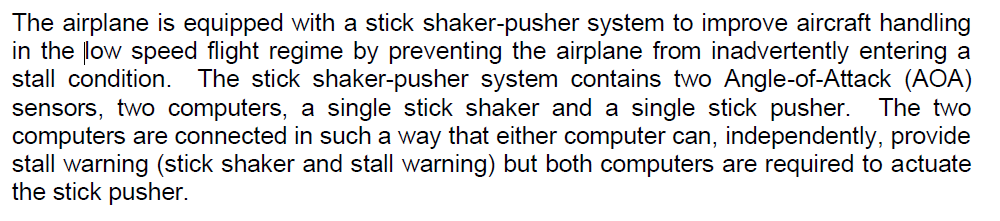
Stepping down the food chain, we have the Pilatus PC-12, a Swiss-designed 11-seat turboprop. The plane starts out with a standard light aircraft flight control system. The pilots’ yokes are connected directly to control surfaces via pushrods and cables. On top of this Pilatus has layered a stick shaker to warn pilots that the airplane is nearing a stall and a stick pusher that yanks the yoke forward. The airplane has a great safety record despite being operated into some challenging short runways and being flown, in some cases, by inexperienced pilots.
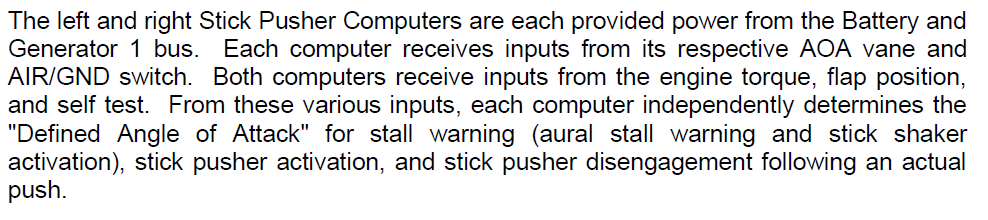
Instead of Boeing’s single AOA sensor and software to run the trim, the PC-12 has two AOA sensors and two computers. If both sides agree that it is time to go nose-down, then and only then will the stick pusher be engaged. If somehow both sensors and both computers are defective and push inappropriately, a “pusher interrupt” button is always right there on each yoke. From the AFM (“owner’s manual”):
A friend who is a Silicon Valley engineer texted me incredulously “Wouldn’t they do fusion from zillions of sensors?” My response on the FAA certification process:
It is like ISO 9000. Boeing had binders of paperwork and bureaucratic approval for their design, but the design itself may never be scrutinized.
Almost certainly if the B737 had the same system design as the PC-12 all 189 folks aboard Lion Air 610 would have arrived safely at their destination. The worst that would have happened is the pilots being briefly annoyed by a shaking stick and having to hit a checklist.
I’m not sure if this crash can fairly be attributed to a software problem, since the software presumably did function as designed. It seems that we can attribute the crash to a poor system design, but ultimately the plane was crashed into the water by software.
Related:
Wikipedia has a good article on the various aircraft flight control system alternatives
Central American migrants in a caravan that has stopped in Mexico City demanded buses Thursday to take them to the U.S. border, saying it is too cold and dangerous to continue walking and hitchhiking. About 200 migrants, representing the roughly 5,000 staying in a stadium in the south of Mexico’s capital, marched to the United Nations office in Mexico City to make the demand for transportation.
What is the practical obstacle to giving them plane tickets to Toronto?
Ms. Alvarado and her relatives left their home on the outskirts of Comayagua, a city in central Honduras, on Oct. 12. They came from a family of farm laborers who worked for abysmal wages in coffee plantations. Generations of residents from Comayagua had made the trek to the United States to find better-paying work, and the possibility was always forefront in the minds of those who remained behind.
Ms. Alvarado, one of the few in her family who had managed to escape the coffee fields, had been working as an assistant in a government social development program, but barely getting by on a salary of $200 a month.
(So the woman who gets a monthly paycheck from the Honduran government will have to claim in her asylum hearing (2-3 years from now?) that she is being persecuted by the Honduran government?)
Do-gooders should considering seeting up a shoe distribution center on the southern border of Mexico, rather than thoughts and prayers on Facebook:
They, like most members of the caravan, were ill-prepared for walking. Ms. Jiménez was wearing pink plastic sandals. Ms. Banegas and her son wore flip-flops. Ms. Jiménez’s 3-year-old had to be carried by the adults for much of the way.
The mechanics of getting into the U.S.:
The group did not plan to apply for asylum. Rather, like many other families in the caravan, their plan was to cross between official border entries and turn themselves into the United States Border Patrol. Since they were women traveling with children, they hoped they would be released quickly from detention and allowed to remain in the United States pending the outcome of their deportation cases. It’s a practice that has been widely used for years, but one that Mr. Trump is seeking to end.
Ms. Banegas said she picked Elmer, who left school three years ago to work in the coffee fields, to travel with her to the United States because he was her oldest minor child.
With him, “I might have a better chance of getting in,” she said.
The women had heard that the Trump administration policy of family separation had ended. Other migrants from their hometown had successfully crossed into the United States since then and had been released with their children.
I’m still confused by the policy of limiting refugee/asylee status to those who are fit enough to make an overland trek to the U.S. If we are humanitarians, given that Honduras has an awesome airport with a 9,500′ runway (MHLM), why aren’t we sending a daily Airbus A380 to pick up the elderly and disabled in 900-person groups? If we are not humanitarians, why do we accept any low-skill refugees/asylees?
Circling back to the top of this post… even if we take Canada out of this, why buses? Why wouldn’t the U.N. charter an Airbus A350 (after the A380, the world’s quietest airliner so that caravan members can relax!) to bring caravan members to the U.S. destination of their choice? If the U.S. objects to the daily arrivals, the U.N. can simply cite that the U.S. signed up to the 1967 refugee protocol.
“Deployed Inside the United States: The Military Waits for the Migrant Caravan” (nytimes, 11/10/2018), on the suffering of U.S. troops: “The tents sleep 20 soldiers and have no electricity or air-conditioning. Phone charging is relegated to a few generators that power the spotlights around the living area. … Unlike in Iraq and Afghanistan, however, the troops do not receive extra combat pay. … Come Thanksgiving, they most likely will still be here.” (this is why new veterans have higher rates of disability than Vietnam combat vets?)
The Son Also Rises finds that personal success is highly correlated with extended family success.
The perpetrator of the recent Thousand Oaks shooting was plainly someone with a disordered personality and also not a very successful person. The media seems to blame his actions on PTSD from his time in the U.S. Marine Corps. Certainly a high percentage of Americans who serve in the modern military become disabled due to PTSD, but is that enough to explain a shooting rampage?
I’m wondering about this guy’s family background. Were his biological parents, aunts, and uncles simply mild-mannered accountants? Does he have siblings? What are they like?
Readers: What have you heard? Would someone who looked at this guy’s relatives have had any inkling that he was likely to do something crazy and violent?
After a six-month investigation, prosecutors said Thursday that they would not pursue criminal charges against Eric T. Schneiderman, the former New York State attorney general who resigned in May after four women accused him of assaulting them.
“I believe the women who shared their experiences with our investigation team,” Ms. Singas wrote, “however legal impediments, including statutes of limitations, preclude criminal prosecution.”
The women, who had been romantically involved with him, accused him of choking, hitting and slapping them, sometimes during sex and often after drinking. All of them said the violence was not consensual.
Harvey hasn’t been accused of being violent, right? He is accused of trading roles in movies for ordinary non-violent sexual favors?
This former New York politician was inflicting non-consensual violence on women, possibly every night year after year (since the women continued their romantic relationship with him despite the violent attacks). Why isn’t that more worthy of prosecution than Harvey’s casting bathrobe operation?
[Separately, the Times also says
In the immediate wake of the allegations, Mr. Schneiderman at first denied assaulting or abusing anyone, saying he had “engaged in role-playing” with the women. But in a statement issued Thursday morning, he apologized both to them and to the people of New York. He also said that he had spent time in “a rehab facility” and was “committed to a lifelong path of recovery and making amends to those I have harmed.”
What kind of “rehab” would be effective for changing someone’s sexual proclivities? We ridicule anyone who says that they are going to “rehab” people out of homosexual desires, right? Why would it be more effective to rehab this guy out of whatever he was enjoying in bed for the last 5-10 years?]
The woman, with whom Mr. Rubin had been having an extramarital relationship, said he coerced her into performing oral sex in a hotel room in 2013
Mr. Rubin said in a statement after the publication of this article. “Specifically, I never coerced a woman to have sex in a hotel room. These false allegations are part of a smear campaign by my ex-wife to disparage me during a divorce and custody battle.”
[See this chapter on California family law for how Rubin’s defense in the family court is likely to go; Rie Rubin sued Andy in 2017 and her LinkedIn profile, with no conventional employment since 2009, suggests that she’ll be able to devote full-time effort to maximizing her child support profits. See this chapter on Nevada family law, with its default 50/50 shared parenting and capped-at-$13,000-per-year child support, for how Rubin could have saved his children the trauma of being the subject of custody litigation, himself a huge amount of time and energy that he’d have been able to devote to parenting rather than lawsuit defense, and his personal reputation (since Rie Rubin wouldn’t have had any financial incentive to disclose her defendant’s alleged sex habits) if he’d flown into KPAO from Vegas every day (see “Facebook uses a Malibu-flying engineering manager to promote careers in engineering”). The difference between Nevada and California child support guidelines? Sufficient for Rubin to have purchased a factory-new pressurized airplane and hired a professional two-pilot crew… every year of the marriage and for every year until the cash-yielding child turns 18. (e.g., Rubin could have bought a $2 million jet-powered short-field-capable Piper Meridian every year on January 1 and donated it to charity on Dec 31, times 20 years, for less the difference between what he will likely pay his plaintiff under CA versus NV law)]
On the chance that Google employees will cut back on having sex in each other’s hotel rooms, have a “work-in” rather than a “walk-out,” and manage to streamline their defenses of the various family court lawsuits, I wonder if it would be helpful to put together a wishlist of stuff that we humble users want them to work on. Here’s mine:
Make Google Docs as good as spotting spelling errors as Microsoft Word was in 1985. Example: “acquishing” not flagged as misspelled (Millennial attempt at “acquiescing”).
Fix Google Contacts. Example: I recently tried to add a phone number for a pilot working on his instrument rating. We had exchanged mobile numbers via email. Google’s Huge-Brained AI (TM) suggested that my own cell phone number should be added as his cell phone number. This despite the fact that I have a Google Voice account and use that number for two-factor auth, etc.
We in the temperate zones of Planet Earth have been waging war on folks at the Equator for the past few hundred years. We dig up dinosaur blood and coal, set it on fire, and fill with atmosphere with CO2. Who suffers most from the resulting warming? Folks who live at sea level near the Equator, where it was already too damn hot.
Suppose that, 25 years from now, the Chinese develop an awesome solar-powered CO2-extraction machine. Barack Obama dusts off his Nobel Peace Prize to get all of the correct-thinking countries to buy and run these machines until CO2 is reduced to a level that is optimum for the U.S. and similarly-situated nations.
What stops Malaysia, Indonesia, Vietnam, Ecuador, Venezuela, Saudi Arabia, Nigeria, et al. from deciding to buy and run carbon sequestration machines until the Earth gets kicked back into its “going back towards an Ice Age” phase?
It is not as though these folks really owe us temperate-zone-dwellers anything, right?
The Uber driver who picked me up recently in “North Bethesda” (Rockville!) happened to be an immigrant from Venezuela. His parents and siblings remain in Venezuela’s “second city”, as he phrased it, of Maracaibo. They are short of food and medicine, both of which he ships to them monthly. “Sometimes it gets through. Sometimes it gets stolen by the army or police.”
I asked him what, in an ideal world, the U.S. government would do to help his family and their fellow Venezuelans. He wanted to see a U.S. military invasion that would remove the current government.
On the one hand, our most recent invasions-followed-by-nation-building efforts haven’t worked out so well. On the other hand, we invaded the Dominican Republic in 1965 and managed to get back out (Wikipedia).
We claim to be humanitarians, which is why we provide free housing, health care, food, and smartphones to low-income immigrants and their children. But, in theory, we could help all 32 million people in Venezuela to a much greater extent at a much lower cost than what we’re providing to tens of millions of welfare-dependent immigrants (at least one million in New York City alone, according to the nytimes).
If we don’t care about helping the vulnerable then obviously there is no need for us to bother. But then why do we spend $1.2 trillion on welfare? If we do care about helping the vulnerable, why don’t we set Venezuela back on its feet? How much resistance would current members of the Venezuelan military and police put up if we said “Staring Monday you’ll all be getting paychecks in dollars”? Are these folks truly fanatically devoted to their current way of doing things?
And probably we wouldn’t be successful in meeting expectations. Foreign Policy says “Venezuela was considered rich in the early 1960s: It produced more than 10 percent of the world’s crude and had a per capita GDP many times bigger than that of its neighbors Brazil and Colombia — and not far behind that of the United States.” The author is a brilliant “geoeconomics” expert, but apparently economists aren’t interested in long division because the article doesn’t include the word “population.” The population of Venezuela was 7.6 million in 1960 and dividing oil revenue by 7.6 million resulted in “per capita rich”. The same oil reserves divided by 32 million, of course, yield a disappointingly smaller number.
So of course we probably don’t want to invade Venezuela. But if we don’t, why do we say that our government acts in a humanitarian manner? Who needs help right now more than Venezuelans?
And if we don’t want to use our military for this, why do we need such a huge military? What other country would our new Congress want to invade?