Democrat-run media says car prices will go up 25% due to Trump’s new tariffs. My prediction: average transaction price goes up 3% and if we hold the car model and trim level constant, up 5%. What’s the basis of my prediction? Americans spend every penny they can earn, borrow, win in family court, inherit, or steal. There simply isn’t any way for people to spend more on cars. (Prices did go up during coronapanic, but interest rates were low and the government was handing out $trillions in free money.)
Readers: who wants to take the other side of this?
(I’m personally in favor of free trade (zero tariffs) based on standard Econ 101 arguments. I believe that the classical Econ belief is that the U.S. is best off with zero tariffs even if other countries erect tariff barriers to our exports. In other words, we would be better off exporting nothing if it came to that so long as we could get cheap imports. However, if other countries blink first in the trade war that Donald Trump has started we might be better off than we were a few months ago.)
What happened to out family so far? The imported bicycles that we wanted to purchase have gone down by nearly 17 percent compared to a week ago:
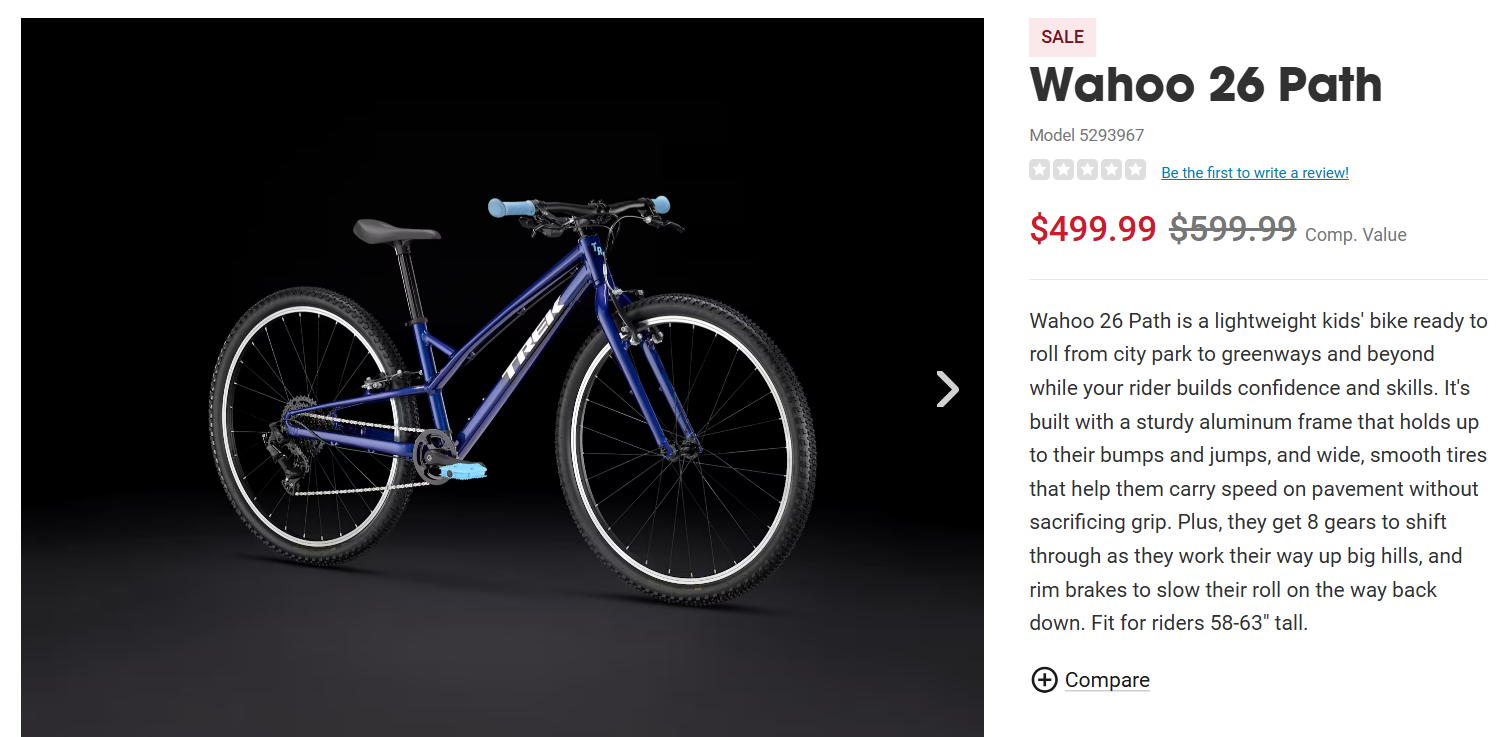
REI (expanding in Florida, while closing stores in Portland, Oregon and Cambridge, Maskachusetts) and some independent bike shops all wanted to sell us XS adult bikes, which have enormous 700C wheels and weigh about 7 lbs. more than this Trek 26″ bike. Supposedly the kids won’t outgrow the XS adult bike as fast. My position is that road bike nerds will pay $thousands to shave 7 lbs. off a road bike so we should be happy to buy these with the expectation of reselling them in 2 years.
Loosely related…
And from today at Sun ‘n Fun, a Nash Metropolitan (it actually made economic sense to build cars in England back then!):

Since you believe in efficient market hypothesis: How are your ETFs reacting to the tariffs?
Stock index values don’t predict car prices. For one thing, most American car owners have debt, not a massive stock portfolio. A falling stock price means an expectation that elites won’t have as much money in the future to bid up stocks.
(I guess an ETF decline does predict some car prices: G-Wagens and Ferraris should be cheaper.)
The efficient market hypothesis simply means that stock prices incorporate all available information – like what else could stock prices possibly be?. So Phil’s ETFs are most likely reacting badly to the new information since as Phil points out, Econ 101 says that tariffs are economically destructive and the fact that the Donald is imposing them is new information. Other than that, hard to see what the point is here.
JDC: Stock prices not only don’t predict car prices, they don’t predict the health of an economy. Stock prices reflect what investors have available to them to bid. So if the government hands out free dollars, stocks will go up. If rich people get richer, stocks will go up. There is some correlation between the economy’s overall growth rate and the stock market (see https://blogs.cfainstitute.org/investor/2023/03/17/myth-busting-the-economy-drives-the-stock-market/ for some charts), but the correlation has varied tremendously over time.
By asking about the etfs I wasn’t responding specifically to the query about car prices, but more generally to Lukas (computer)’s “inverse retard indicator”
On this side of the border, everyone with a US market etf (pretty much everyone with retirement savings) is super pissed about the tariffs. Is that not true in America as well?
Markets go up and down, but this is the first time I remember a collapse being triggered by a single head of state.
JoeCanuck: You’re probably right that it would have been smarter to wage one trade war at a time. Even the tough/smart/capable Germans couldn’t win a two-front war. On the third hand, Trump won’t be able to do anything at all after the mid-term elections when the Democrats inevitably retake Congress so I guess he feels some urgency to get everything done right now.
The government is now getting a wave of easy money from panic sellers & is probably going to get the rate cut of its dreams. Suspect the lion day job & many other tiny startups will downsize because contract manufacturers in Asia are no longer economical. Top tier companies have enough capital to eat the cost.
The trade deficit was becoming a security problem, with the military depending on China for more & more parts. Then there was that invasion of Taiwan, the impact of Chinese lockdowns on supply chains. Eventually, US was going to run out of money to fund the trade deficit so it’s hard to see any easy way out.
The trade deficit and sovereign debt are two distinct things. Germany runs a large trade surplus and still has debt. There will always be countries that produce things cheaper than the US can (and the US is near full employment, so who’s gonna make it?). The alternative is autarky, which the Soviet Union tried and resulted in poor quality goods, and shortages.
I used to believe in economics, until I took Econ 101. There I learned:
– the more a product is produced, the more it’s price goes down, until it goes back up again (I asked prof for example of a price going back up, he just scowled at me)
– inflation is necessary (otherwise people would just save their money and never spend it with out the fear it will be worth less in future)
– nations can borrow their way to prosperity, while never repaying the debt, if the economy just grows exponentially forever
– free trade is always good (even if it kills jobs in rich nations, it will create jobs in poor nations)
– economic models rely on perfectly rational and flexible actions by people (workers lose jobs making steel? They will all just become computer programmers!)
The liberal media, “elite” economists, and many nations are quick to condemn Trump for imposing tariffs and causing disruption. Yet, few are asking why those same countries already have tariffs in place against the United States.
Cars are already overpriced. Strip away the luxury features, excessive safety add-ons, and oversized builds, and prices would drop significantly. It’s hard for me to understand why anyone with no saving and is on month-to-month income would spend >$50K (new) on a or >$20K (used) on a car. Unless your car is a business necessity or you spend over, let’s pick a number, 3 hours a day driving, you really don’t need all the extras to justify the high price.
Readers: who wants to take the other side of this? Pavel.
Toucan Sam, I think philg is mostly correct on this. In Canada, I am seeing the return of zero percent financing for 2024 GM EVs and cash back offers. The dealers cannot sell 2024 stock. The tariffs also do not apply to parts and cars that fall under the CUSMA origin documentation. This is where it can get really tricky, for example if the PCBs for an electronic module are made and populated in China, but the final assembly, testing and firmware upload is in Mexico or Canada, does the module fall under CUSMA or is it subject to tariffs? This can apply to any sub assembly, I bet that the manufactures are very busy making sure that the documentation shows that all the parts fall under CUSMA origin regulations. My prediction is that vehicles under $100k, that have final assembly in US, Canada or Mexico will have not have much price change, nobody has any cash. European exotics like Porsche, Ferrari, Lamborghini and the more expensive BMW, Audi and Mercedes are going to go up significantly because those buyers have the cash.
The more important question is if to pull The Big Short on Tesla stock? Elmo seems to want zero tariffs now, my guess that his advisors gave him the numbers and the Tesla earnings call later this month will be a complete disaster.
Pavel: I would like to know who reads the Wikipedia page on the Lamborghini Urus, finds out that it is the same car as the Volkswagen Touareg ($50,000 in pre-Biden dollars), and then says “Of course, I will be happy to pay $300,000 for this Volkswagen with a few extra options.”
One aspect not addressed is retail vs wholesale. On a high-profit, high-margin vehicle like a luxury pavement-melting SUV, if the tariff applies to wholesale cost, then the retail price increase would be much less than 25%.
Here’s a positive for U.S. consumers: https://www.engadget.com/transportation/jaguar-land-rover-pauses-us-shipments-while-it-figures-out-a-plan-for-trumps-tariffs-172512506.html
UK-based Jaguar Land Rover says it’s pausing shipments to the US after President Donald Trump imposed a 25 percent tariff on passenger vehicles and other auto imports. The pause will be in effect this month, the Associated Press reports. While the full impact of the tariffs remains to be seen, analysts have said the move could ultimately drive up the cost of new and even used cars.
“The USA is an important market for JLR’s luxury brands,” Jaguar Land Rover said in a statement to AP. “As we work to address the new trading terms with our business partners, we are taking some short-term actions including a shipment pause in April, as we develop our mid- to longer-term plans.”
(If even one American can be saved from owning a Land Rover or Jaguar (near the bottom of the Consumer Reports reliability rankings) that will free up a lot of time for productive activities (as opposed to repeat trips to the dealer service department).)
David D: auto dealers have very tiny margins (like most retailers) on the order of ~5% or less, so assuming the dealer passes on the entire amount of the increase in wholesale price, the retail price increase would be very close to the actual amount of the tariff. Could the dealer take a modest hit to profitability and not pass on the entire amount? Sure, but very unlikely to sell units at a huge implied loss unless operating as a socialist/marxist.
Anon: you’re right. Rather than “wholesale”, I should have said the actual manufacturer’s cost to produce the vehicle, before the manufacturer’s profit is added on. That is the value when it enters the country so it seems like the tariff should be applied to that cost, not the dealer cost or MSRP. I just don’t know–I have not seen any official details regarding what point the tariff is imposed along the chain of mark-ups.
David D: the tariff will be added to the price at which the manufacturer sells the car to the dealer (not the cost to manufacture), so the argument I posited is unchanged. Note also that the manufacturer’s selling price has nothing to do with the MSRP listed on the car (this is a somewhat made-up number with little relevance to actual transactions).
“This amusing scene managed to omit the U.S. Senate, but it was on June 13, 1930, that the Senate passed the Smoot-Hawley Tariff—one of the most catastrophic acts in congressional history.”
https://www.senate.gov/artandhistory/history/minute/Senate_Passes_Smoot_Hawley_Tariff.htm
Prices are going to rise significantly. Other countries are not going to “blink first”—they have no incentive to do so (China has already come to that conclusion). Perhaps smaller nations that lack the ability to retaliate will “blink”—a great way to run foreign trade, by the way. Vietnam comes to mind.
In this new scenario, power matters. China and the EU have power. I think it’s going to resemble the Godfather scene when the Nevada senator tells Michael Corleone, “I intend to squeeze you,” and Michael calmly responds, “You can have my answer now, if you like. My final offer is this: nothing.”
In this very new world order, mafia movies are instructive, much better than wishful thinking.
Anon, surely you are aware that it was the U.S. that “blinked” first years ago and allowed others to tariff and otherwise exclude our products and also steal companies’ IP for permission to operate in their countries. About time we wised up and stopped being suckers.
This is a good summary of what is going on, in my opinion.
Sam is almost as sanctimonious as Obamascam!
I knew Sam had earned a PhD in EDS, but looks like he’s now finished one in TDS.
Cars will initially be much cheaper.
10%-25%, then more expensive over the course of 12-24 months.
Liberation Day has set off a deflationary Minsky moment. All private credit risks are now bad and counterparty risk has gone asymptotic.
Credit markets are seizing up. Commercial Credit will be much more expensive.
Inventories will be liquidated.
Next event will be the Fed and congressional reaction (“helicopter money”, bail out of member banks), which will have a less than salutory effect on the purchasing power of the already bidenized bucks in your bank account.
Best case: 2008+2020.
CDS markets are freezing up? Has been a long while since I look at them. At my own folly I am staying in the markets, despite all the warnings and hunches. I would think that there are CDS winners who will be invest directly into US market. And I hope that all large players, except militant communist in China, will find common ground and resolve to freer markets then before. Those who finance militant communists in China need to separate from their profits to reflect.
Heros, credit markets seizing up? You must be living in an alternative universe. The 10-Year treasury yield has *declined* from 4.8% in January to 4.2% today. And, while spreads on high yield bonds have risen, they are *way* below recent peaks in 2016, 2020, 2022. Same story with CDS. And no where near levels in 2008.
That’s a lot of predicted drama from someone that functions like the European VAT! Why don’t the Europeans enjoy this level of drama?
Hi @philg
You certainly can advance the view that exports and imports at 27%-ish of GDP are inconsequential, but once you take out the 46% of GDP represented by healthcare, government, and education, trade is now about half of private GDP and appears somewhat more significant.
Comparing the tariffs to VAT is silly. VAT tax occurs at the time of intermediate sale.
In contrast, tariffs are paid, in full, by importer when goods are imported. Then collected stochastically from their customers when goods are sold, if ever. Whether profitably or not. That difference in timing and probability of collection is meaningful. It represents a significant chunk of capital and risk that needs to be funded, either by owners or creditors.
Hi @Anon!
I think the issue with your response, which you may be able to spot, is you’ve just told me what the 10-year market did between January and April. Thank you, but I’m not sure it’s relevant to a discussion about forward prices. Also, please add “so far” and “yet” to your final sentence, which I’m sure you’ll agree in no way diminishes it’s truth-value.
Heros, thanks much. I’ll gladly take the other side of your argument:
You argue that “All private credit risks are now bad.” The U.S. private credit market size is ~$1.25 trillion (depending on which securities you include) as of early 2025. Perhaps Phil can arrange a check-back in a couple months to see if this has now defaulted (evaporated)?
Hi Anon!
I think you’ll note I wrote, carefully, “Commercial Credit will be much more expensive.”
I’m not seeing a prediction of “default”. Could you point that out?
Is there some reason you need to argue in bad faith or is reading comprehension poor? I know there are Harvard grads on this blog due to hosts unfortunate days at HMC. Are you one?
If so, I’ll happy to use smaller words and shorter sentences.
Heros, thanks so much!
Perhaps you are having a Biden senior moment?
You wrote: “All private credit risks are now bad and counterparty risk has gone asymptotic.” Neither of which is true.
You then argued (or tried to argue) that this would happen in the future. I took the other side of that. I think you will find that almost everyone at Harvard will differ with you (with the exception of Claudine Gay, perhaps?).
Please feel free to use smaller words and shorter sentences if you think it will help you!
Hi Anon!
Let me try a gentler approach with you.
Here’s an accessible link to the Bloomberg Junk Bond ETF. https://finance.yahoo.com/quote/JNK/
It’s down 4.2% in the past four trading sessions since Liberation Day. Down every single day.
Is there something going on in corporate credit markets that’s causing that decline?
Is there some underlying reason yields are going up on corporate credit which is, wait for it – becoming more expensive than it used to be?
If so, what?
Or is it just random noise?
Heros, thanks so much for the link to the junk bond ETF. The ETF makes my point perfectly.
Just so you know, I’m not begin snarky, but when people discuss fixed income/credit markets and they say (as you did) that “all credit risks are now bad” it means the credit has or will default (headed to way below par or ultimately zero).
If as you say the junk bonds in the ETF were “bad” the ETF would would certainly not be down 4.2%…it would be down perhaps 50% of more (some bonds in the ETF might have some recovery value in bankruptcy as the junk bond holders would take ownership of the assets and hope to get paid in bankruptcy proceedings, which is a long, perhaps multi-year process to get paid).
Ok – If I could rewrite my original comment would rewrite the word “bad” as “mispriced and opaque”.
On your other comments, meh, you’re a summer child of ZIRP and unicorns.
Lots of people thought Bear Stearns and Lehman were solvent, until theyweren’t. Market prices are always wrong at inflection points.
Enjoy. I’m done teaching you stuff today. Maybe you learned something, likely you didn’t.
Heros, you obviously have a point of view that (I think) differs vs. mine…and that’s what makes markets! Without spending any boring time discussing my background and thinking, you may be amused to know that I am definitely not a “summer child of ZIRP or unicorns”!
Might I suggest you put down a trade or two (if I’m understanding your thinking, it sounds like you would short the ETF, and perhaps some other things?) that you believe will pay off going forward and reference a benchmark, so we can measure the alpha? Phil can track them I’m sure (I gather he’s rather good at math!) and then maybe do a follow-up post in 6-12 months?
Anon: I’m good enough at tracking investments that I have been able to establish that all of my ideas have been worse than buying the S&P 500! (maybe shorting Snowflake (SNOW) is an exception to the rule that I’m always wrong)
Many idiots are about to get a much-needed lesson in geography and economics. Many residents of “aspirational suburbs” in the U.S. are going to learn that their little houses with fake stone, fake columns, three-car garages, and a lovely lawnmower tractor for Sunday mowing —whose sound calls the faithful to the megachurch— depend on an international order their beloved “deal maker” has just broken.
Anon: I would kill for a three-car garage (sadly, ours is a two-car garage, which means a 0-1-car garage in practice). But I can’t figure out why the average owner of the house that you describe would be dramatically affected by a shift from imports to domestic production or by somewhat higher prices for certain imports. Maybe the Corvette Z06 gets purchased instead of the Porsche 911 for that third garage bay, but the homeowner will still get to Publix before closing.
First, apologies, my previous post was quite harsh—I regret the wording I used. That said, I’d like to try to explain how I see the future (though my predictive abilities are probably on par with Quasimodo’s: https://www.youtube.com/watch?v=rmhVw6q-KOA).
First, I think the damage is already done. Regardless of what course the administration takes now, the rest of the world’s view of America has shifted for the worse—and that perception may last for quite some time.
That said, this country still has a lot going for it: brilliant people (I bring the average down a bit), excellent universities (not all activity at Columbia University revolves around the liberation of Palestine), and generally solid institutions. The long-term could still be okay.
Much of what we consider “wealth” is based on credit—on trust. Your future earnings as a court expert, for example, depend on how your employers perceive you. That kind of trust is surprisingly easy to destroy. On a larger scale, that’s exactly what this administration has done.
Sure, your neighbor can choose a Corvette over a Porsche (a solid choice, in my opinion), but if the economy tanks—as I believe it will, and the markets are already pointing that way—a humble Fiat might have been the wiser option.
Also, my condolences on the parking situation. I’m comparatively rich—I actually have a parking space in Manhattan.
I don’t grasp why the rest of the world’s view of the U.S. is of critical relevance. The U.S. is one of the world’s least trade-dependent economies (see https://en.wikipedia.org/wiki/List_of_countries_by_trade-to-GDP_ratio ). As a thought experiment, suppose that all U.S. trade ceased. No exports and no imports. Why is it obvious that this would be a disaster? We wouldn’t have out-of-season fruits. A lot of stuff would become more expensive so we’d buy less of it, e.g., we’d have less furniture per room. We would likely shift construction from foreign-baked clay roof tiles to U.S. made roofing materials that are more durable (e.g., metal). (There are U.S.-made clay roof tiles, but they are very expensive for comparable or better quality. There are U.S.-made concrete roofing tiles that are cheap.)
If we didn’t carve out a few years of exception for Taiwan/TSMC (Trump’s tariffs don’t apply to semiconductors right now, in any case) we’d have a few years of disruption on the chip front. We’d have to stop building tunnels because we are terrible at it compared to the Germans (even with their machines, we bankrupt ourselves trying to build tunnels so maybe that would be just as well; see https://www.nytimes.com/2017/12/28/nyregion/new-york-subway-construction-costs.html and remember to adjust for Bidenflation: “In New York, “underground construction employs approximately four times the number of personnel as in similar jobs in Asia, Australia, or Europe,” according to an internal report by Arup, a consulting firm that worked on the Second Avenue subway and many similar projects around the world.”)
Anon, what don’t you get about what is going on? The “lesson” that the broad U.S. population is now learning is that there has *not* been free trade (from a U.S. perspective) over the past 50-60 years with almost every country. And to top it off, we also pay nearly the *entire* defense bill (both blood and treasure) for all our ostensible “friends and allies.” Trump is correct that many of our allies have been the worst actors as they’ve subsidized their socialist economies and woke ideologies on our backs (e.g. most countries in Europe). It’s about time we woke up and stopped being suckers!!
If all trade were to cease, we would be poorer. We wouldn’t be selling goods and services to other nations (and I hope you’re not suggesting that’s a good thing). At the same time, we wouldn’t be buying goods and services from other countries—products we currently purchase because we believe they offer superior quality, better prices, or both.
This approach didn’t work for the USSR, and it won’t work for us. Our economy, as we know it, is built on competition. Eliminating foreign competition will have serious medium- and long-term consequences: American products will become inferior in both quality and price.
But here’s a more important question: do you really believe the biggest problems facing this country are trade-related? If not, why embark on this “experiment”, which, in my opinion (and the opinion of the markets, which have already lost trillions)—is doomed to fail? Fix the “Second Avenue subway” problems and leave trade alone.
Anon: I agree that we would be poorer without trade, But for most of U.S. history trade was a small percentage of GDP (5 percent or less). See https://data.worldbank.org/indicator/NE.IMP.GNFS.ZS?locations=US and https://data.worldbank.org/indicator/NE.EXP.GNFS.ZS?locations=US for data back to 1970. People didn’t declare an economic disaster because trade was only 5 percent of our economy. We stole so much from the Native Americans that we can be extremely prosperous without trade (I guess we do need Taiwan because our average IQ is lower and getting yet lower every year.)
I wouldn’t say that trade per se is our #1 economic problem. I would say that it is the lack of incentive to work for people of below-average ability/skill, which has resulted in a low rate of employment. See https://obamawhitehouse.archives.gov/sites/default/files/page/files/20160620_cea_primeage_male_lfp.pdf from the Obama years.
According to Wikipedia, U.S. exports amounted to $3.2 trillion and imports to $4.1 trillion. So let’s call that roughly 10% of GDP each — that’s significant. Also, the importance of some things far exceeds their price tags. I couldn’t live without electricity, yet my electric bill is well under 1% of my expenses.
https://en.wikipedia.org/wiki/Economy_of_the_United_States
I’m in total agreement with you in what concerns lack of incentives to work.
This is the car that the lucky (years waiting list) East Germans drove in the 70s thanks to autarky. It did have advantages, it doubled in value after filling the tank or changing the oil.
https://en.wikipedia.org/wiki/Trabant
Anon, check US auto manufacturing regulations and CAFE standards. If world starts manufacturing flying carpets then yes, US will be left behind. So far Tesla’s plants in China resulted in copycat BYD competitor. Makes sense to manufacture in US if enterprenurship is in US. I am not particularly gang-ho on Trump’s tariffs policy except for strategic materiel, but Trump is so much better then his political competition that it makes sense to accommodate Trump on trade.
Stock Market Tanking: Why is everyone, especially so-called expert economists, so alarmed? Trump made it clear he was planning to impose tariffs, and he even announced the exact day they would take effect days ahead. Any wise investor or financial advisor should have already positioned their money accordingly. And let’s be real, this isn’t the first time the market has taken a hit due to government or one man action. And aren’t we constantly told by financial advisors to invest for the “long term”? So why the panic now?
Global Backlash Over Tariffs: Again, Trump has been openly talking about tariffs for a long time. So why is anyone surprised? Historically, diplomacy and trade policies have often worked against U.S. interests. Take China, for example, try starting a business there without giving up a good portion of it to the Chinese government or unpacking your technology or changing the way it works. As for Europe, they expect us to act as the world’s police force, yet they resist contributing their share. They impose regulations that we’re expected to follow, even when those policies don’t serve us. Mexico? Why can’t they enforce their own southern border and stop illegal migrants before they reach our border?
I could go on and on. But here’s one more thing to consider: If Trump was a “smooth talker” as Obama or Clinton, everyone would be backing him.
George, I think your summary perfectly captures what perhaps half the U.S. is thinking! Feels like the tide of public opinion has begun to swing toward’s Trump’s America first thinking. I think many people weren’t really aware of what has been going on for the past 50 years, but now they are. Check out similar commentary by Thomas Petterfy today
Thanks, George. I want to quibble with one point. I don’t think it is fair to blame Mexico for anything. We’re the ones who established a cradle-to-grave welfare state in which people can choose to refrain from work their entire lives AND also who established a procedure by which anyone who spins a compelling tale can be granted asylum. It isn’t the Mexicans’ fault if people all over the world are attracted to this beacon of four generations of handouts. The U.S. could have reduced the flow to a trickle at any point by eliminating asylum (simple as saying “it was a good idea in the 1950s, before the Great Society welfare state expansion, and the Boeing 747 but it no longer makes sense given (1) our world-leading welfare state, and (2) a globalized economy of more than 8 billion people, any of whom can travel cheaply via airliner”).
@Philip, the U.S. immigration and asylum system is definitely broken and has been for decades. As I pointed out in my post today [1] and in many similar comments I shared on your blog. And yes, our open-access welfare system and no-human-is-illegal certainly is the icing on the cake for illegal migrants.
My issue with Mexico is that they CAN do something about illegal migrants, but choose not to. For example, they are well aware of the routes and stops illegal migrants take through various cities in Mexico. If they conducted even occasional random raids in those hotspots, it would significantly disrupt the flow. We have been discussing this issue with them for years, yet diplomatic talks have done nothing. Of course, we cannot send our law enforcers to Mexico to crack down on the traffickers, and we cannot sue the traffickers in Mexico. However, thanks to our democratic laws, the Mexican government CAN sue American gun manufacturers in U.S. courts [2] for making guns that end up in Mexico.
[1] https://philip.greenspun.com/blog/2025/04/08/how-is-honor-system-immigration-supposed-to-work/#comment-394342
[2] https://abcnews.go.com/Politics/supreme-court-shoot-mexicos-10b-lawsuit-us-gun/story?id=119446426
We could have paid Mexico to defend our border, but we didn’t offer to do so as far as I know (I have made the suggestion here in this blog multiple times! The Mexicans should also be paid to do any wall-building that we want, though maybe the Egyptians would be an even better choice given their success in walling off Gaza.)
I think the Mexicans are perfectly justified in thinking that Americans are the stupidest humans on the planet.
Phil, I agree with your assertion that there are many “stupid” people in U.S. (Biden was elected and was declared sharp as a tack by these people for nearly four years…until he wasn’t…then, these same people backed Kackling Kamala), but please give the rest of us a little respect! You may differ, but based on the recent election, it now appears the “stupid” people are in the slight minority.
Circling back to the stock market tanking.
Let’s not forget, there was another man-made economic disaster — just about five years back — triggered by COVIDFear. Thanks to Dr. Fauci and the likes, practically the entire world came to a halt, economic activity froze, and countless businesses were destroyed. And when people started asking questions about the origins of that COVIDFear, no one dared to question China. Even suggesting that the virus may have originated in Wuhan got you slammed as a racist and insensitive.
In fact, during COVIDFear, governments around the world doubled down on “more lockdowns, more lockdowns” regardless the impact on the economy.
George, you’re on target again. The China virus should fairly be attributed to China, but we now know (thank you DOGE and Musk/Twitter files) that Fauci actually funded (via. NGO) and supervised the development and was fully aware of this all along. And, knowing this, he thenconcocted a scam to make him appear as the “savior” of the world, which then killed millions more (either then or going forward, related to all the collateral effects). Musk is correct that this guy should be prosecuted (at a minimum).
Anon, how dare you impugn my protege Tony Fauci! While I did critical medical research on thousands of Jewish children, Fauci took my ideas to a whole new level and conducted critical medical research on the entire world! May god bless is soul!