Financially struggling liberal arts colleges are probably already extending offers of admission to today’s 18-year-olds. If we leave aside the top 30 schools, would a young person be taking a huge risk by investing four years of his/her/zir/their life at a liberal arts college? Gone are the days when an American worker will spend an entire career at one company. Imagine the graduate of such a school applying for a job at age 50, exactly the age at which employers are believed to discriminate against older workers. It will be 2058. The school that was financially weak in 2026 will have shut down in 2035 and won’t be putting our PR about how great the school is. The hiring manager will therefore likely never have heard of the degree-granting institution on the resume. By contrast, University of ***pick your favorite state*** will always be there so long as there is someone to tax in that state. The hiring manager will have heard of University of AnyState if for no other reason than that university’s sports teams will be on television.
“What’s Lost When Liberal Arts Schools Close” (New York Times, October 2025):
The demise of Wells College has become a familiar story. In the 19th century, pioneers and religious seekers built a constellation of private colleges across the Northeast, South and Midwest. Now these schools are steadily blinking out. The Council of Independent Colleges, a national trade association, had 658 members at the beginning of the fall 2023 semester. Over the next two years, it lost 18 colleges to closure and three to merger, adding to the dozens that had already closed over the previous decade.
Many liberal arts schools closed because they couldn’t recover from the pandemic. Others couldn’t keep up with the arms race for expensive amenities that students have come to expect. And all were early victims of a problem that is about to wash over the entirety of American higher education: not enough applicants.
The year before the 2008 financial crisis, there were 4.3 million babies born in the United States, the highest number in history. Last year, there were only 3.6 million. The birthrate decline that began in 2008 lit an 18-year fuse on a college freshman slump that starts next year. Many highly selective schools are getting more applicants by the year, meaning that the enrollment crisis will continue to burn through mostly small colleges for decades to come.
From a Texas A&M report, which mostly shows that forecasters aren’t very good at forecasting (huge change from 2017 to 2023!):
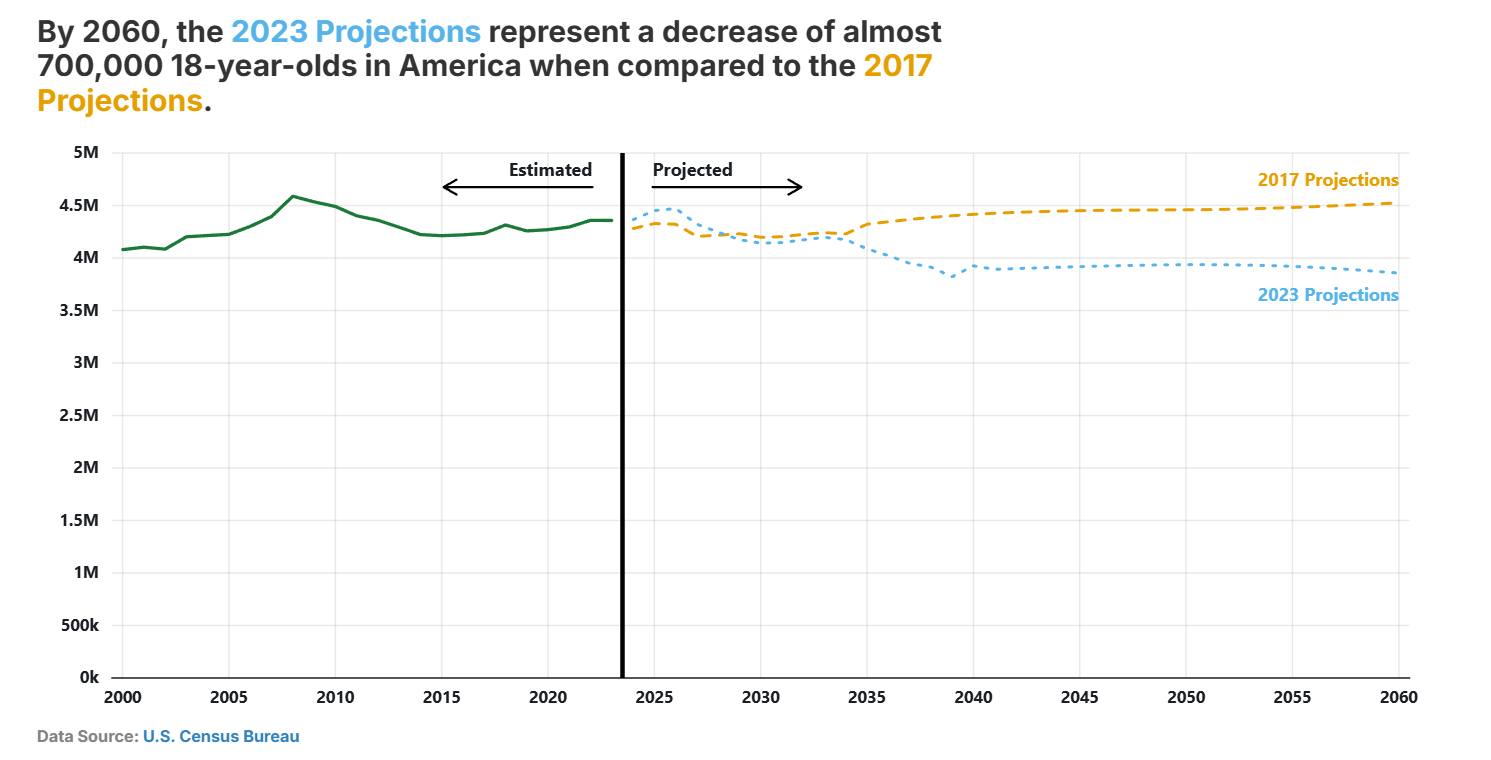
(I’m not sure how this number can be forecast by anyone, no matter how intelligent. If the president of the U.S. can by executive order either open or close the border then there is no way to predict the number of immigrants and, therefore, no way to predict the number of children of immigrants.)
The Federal Reserve Bank of Philadelphia put out a moderately gloomy analysis:
Still doubt the population size would make a huge difference unless you’re a polyamorous billionaire trying to justify his lifestyle. It was quite difficult to find a lot of information 40 years ago without formal education. Not so today.
From the Federal Reserve paper:
> We then show that modern machine learning techniques, combined with richer data, are
far more effective at predicting college closures than linear probability models, and considerably more effective than existing accountability metrics.
“Give me an ‘A’! (‘A’) Give me an “I”! (‘I’) What’s that spell? (‘AI’) Yay — quit team quit!” (I grew up reading the Federal Reserve Bank of Kansas City publication Economic Review, instead of comic books, which shaped my sense of humor.)
When I chose a college 40 years ago, I unfortunately made the decision based far more on what other people thought of the university than how good of a fit it would have been for me. AI probably would have just made it worse. I hope they are opening trade schools for plumbers and electricians on the empty campuses.
Why top 30? US has 50 states, and at least 50 state universities’ campuses will remain standing. Also when colleges merge you can update your resume to new college name. Out of many contracts and a couple of full time positions, I was asked about my college 3 times. or at about 20% of all my jobs: first one, another that had many interviews including HR interview, apparently the firm liked hiring from my college (my biggest mistake) and the third where owners wanted to get complex job done relatively cheaply, combined development and quantitative modeling work in one.
50 state universities will survive because all 50 states have taxpayers who can be taxed.
Liberal arts colleges are in rough financial shape. Maybe the top 30 are guaranteed to survive, but I don’t think it is a safe bet for the rest. The typical liberal arts college is already being destroyed by competition from state-owned universities. Do we really think that they can also survive pressure from ChatGPT and friends?
The women’s liberal arts college I attended closed and merged with the other undergrad programs at the university, supposedly due to financial issues. Thankfully, the university still remains strong both financially and reputation-wise (especially its regional reputation). My cousin’s school, Hampshire, appears not to be doing as well: https://www.highereddive.com/news/hampshire-college-faces-closure-risk-refinance-debt/809808/
Vegan Cheese Lover, that is so inspirational to hear! Do they also maintain a wonderful Transvestitism sports program for “women” or whatever they use for their pronouns?
That’s rough for Hampshire. They used to have some good mathematics teachers. US News ranks them #156 in the nation out of about 400 in their database of liberal arts schools. So it’s an above-average institution within the liberal arts category and, apparently, going under.
@philg
I think I mentioned here years ago that US News rankings may be unreliable, at least for some things.
About 15 years ago a hospital I was working at received recognition from US News for excellence in Neurology. The hospital admin sent out a self -congratulatory email. Not only was the hospital not great at neurology, but they had no neurologist and required that we transfer all stroke patients to a different hospital that had neurologists available.
So, yeah, maybe the school is great, maybe it isn’t.
Imagine the graduate of such a school applying for a job at age 50, exactly the age at which employers are believed to discriminate against older workers
Discrimination against white men apparently begins by age 22, not to mention the awokening of curricula, which drives men toward more practical careers. But this means that liberal arts colleges are passing 60% female enrollment en route to becoming women’s schools again. Does anyone really want to attend these places?
At least with a state school, you can get discounted tuition and a STEM degree.
Then there is AI… AI won’t necessarily eliminate the value of a degree, but it will increase the risk premium on an expensive and useless degree.
@philg:
> Where are the 8K computer monitors and televisions?
New Dell 6K 52″ monitor U5226KW: https://www.dell.com/en-us/shop/dell-ultrasharp-52-thunderbolt-hub-monitor-u5226kw/apd/210-bthw/monitors-monitor-accessories
Anon: Thanks for that. I think the PPI is a bit lower than https://www.samsung.com/us/computing/monitors/gaming/57-odyssey-neo-g9-dual-4k-uhd-quantum-mini-led-240hz-1ms-hdr-1000-curved-gaming-monitor-ls57cg952nnxza/ (dual 4K) but it doesn’t take over the entire desk so maybe it is a better solution.