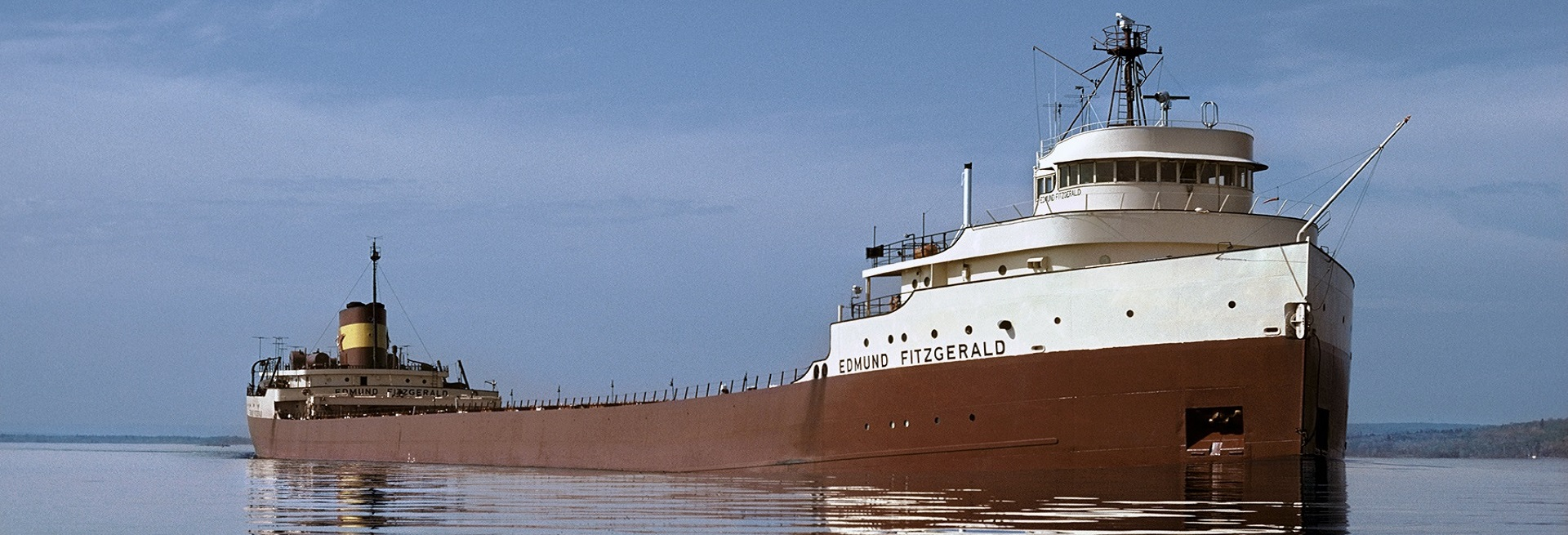
It’s Friday the 13th, a notorious day for bad luck. Speaking of bad luck, let’s look at the 29 men who died on the Edmund Fitzgerald on November 10, 1975. They’re the subject of an interesting new book: Gales of November by John Bacon. Not exactly a spoiler: everyone dies, just as Gordon Lightfoot explained in his enduring hit song (from the book I learned that Lightfoot was an experienced recreational Great Lakes sailor).
Some things that I didn’t know:
- it was the last trip of what was going to be the retirement year for the captain and many of his long-time partners amongst the crew
- the captain was considered the best on the Great Lakes and had 45 years of experience
- the weather was a 50-year event, perhaps, and not merely an ordinary “gale of November”
Perspective on the suffering of Jeffrey Epstein’s victims
Since almost everything in the news these days must be referenced to the Epstein Files…
The sinking was preventable, as we’ll see below, and quite a few mistakes were made.
Columbia offered some of the families the victims’ last paycheck ($568.25 for a deckhand) and $750 for the victim’s lost personal effects, an amount determined by their labor contract, but other families didn’t receive even those checks. When Columbia offered nothing else, the families had little recourse but to file wrongful death lawsuits, for which Columbia paid whatever the families’ individual attorneys could negotiate. Some families received about $35,000, or a little more than a year’s wages for a deckhand making overtime, and others marginally more.
The typical woman who alleged that she suffered by receiving cash, Gulfstream rides, free rent in Manhattan, luxury vacations, etc., in exchange for sex 10, 20, or 30 years earlier, was paid about $3.5 million from Epstein’s estate, a JP Morgan settlement fund, and a Deutsche Bank settlement fund. That’s 100X what an Edmund Fitzgerald crewmember’s survivors were paid. Thus, we can conclude that having sex on Jeffrey Epstein’s island was 100X worse than riding through 30-50′ waves for hours and ultimately being drowned in 42-degree water.
The bargain all the crewmen on the Fitzgerald had signed up for was a hard one, but straightforward: The work will be taxing, and you will miss most of your family’s best moments, but you will retire relatively young, with a good pension and nothing to do but hunt, fish, and play cards, pool, and golf. Best of all, you’ll have plenty of time and energy to spend with your grandchildren. The Fitzgerald’s twenty-nine crewmen and their families had all paid their deposits up front, but never got to enjoy the sweet side of the deal.
The Special Hazards of the Great Lakes
The Great Lakes can be more treacherous than the oceans. One reason is the distinct structure and frequency of the Great Lakes’ freshwater waves. In the oceans, salt weighs down the water, squashing the waves and spreading them out, so they typically form larger but smoother swells, similar to a roller coaster. On the Great Lakes there’s no salt to hold down the waves, so they rise more sharply and travel closer together, like jagged mountains of water coming at you in rapid succession. These waves don’t roll; they peak, crest, then crash down on whatever is unlucky enough to lie below them.
That’s another reason why Great Lakes waves are so steep and ragged and travel so fast. On the ocean the waves are usually about ten to sixteen seconds apart, so even a large container ship can fit between them. On Lake Superior the waves run four to eight seconds apart, which means that a seven-hundred-foot lake freighter can be riding atop two waves at once.
That problem produces more problems. On the Great Lakes a ship that long can impale its bow in one wave, which can lift it up thirty feet or more, while the ship’s stern can be simultaneously stuck in the wave coming right behind it, raising the ship’s back end in the air another thirty feet. That leaves its midsection, which could be loaded with 58 million pounds of iron ore—the equivalent of 4,200 adult elephants—suspended between the two waves, with nothing supporting it. That creates a phenomenon naval architects call “sagging,” in which the unsupported middle of the ship sags toward the water below it, exerting a tremendous strain on the hull.
After sagging between two waves, just seconds later the ship might face another threat: riding over the peak of a single colossal wave. This creates a condition known as “hogging,” the opposite of sagging, where the vessel drapes over the wave’s crest, with both the bow and stern drooping downward, again placing immense pressure on the center of the ship’s hull.
[Michigan Tech’s Guy] Meadows’s research shows that Lake Superior’s biggest storms occur every thirty years or so, but even in milder storms the waves on the Great Lakes can be alarming. In a pretty unremarkable 2020 storm, for example, two of their buoys anchored off Lake Superior’s southern shore, far from the path of Superior’s biggest waves, measured waves reaching 28.5 feet, almost as high as a three-story building.
If the biggest waves within a few minutes are at 30′, according to Guy Meadows, and they stay there for 24 hours, a ship should experience at least one 60′ wave (1 in 10,000).
Another bad feature of the Great Lakes is that it is easier for freshwater to freeze above the waterline on a ship than it is for saltwater to freeze, thus adding weight to a ship that is already in peril. A typical modern iron boat’s cargo of taconite also creates a hazard:
Because it’s two-thirds clay, a porous material, it can absorb up to 7 percent of its weight in water, and four times that can get trapped between the pellets when it’s piled high.
(i.e., the cargo hold can hold a lot of water weight that isn’t possible to pump out; separately, if you thought that math professors were useless, the book notes that U. Minnesota math prof Edward W. Davis is the person who figured out how to work with taconite, a low-grade iron ore)
Overloading as a Factor
Prior to the wreck of the Fitz, Great Lakes captains prided themselves on moving maximum tonnage per trip and per season. Everyone loaded up the ships to the painted Plimsoll line at which point the freeboard is the minimum required for safety. The Fitz was operated with far less freeboard than her original designers had intended:
Given how such incredibly small margins on the Plimsoll line could produce such prodigious gains, especially when multiplied by forty to fifty round trips each shipping season, the executives at Columbia Transportation must have been thrilled when the American Bureau of Shipping (ABS), working with the Coast Guard, reduced everyone’s required freeboard in 1969, and again in 1971, and again in 1973. For the Fitzgerald, that meant the original requirement of 14 feet, 9.25 inches of freeboard when sailing in November had been reduced to 11 feet, 6 inches—a total drop of 39.25 inches, or more than a yard, in just a few years.
Captains would then use various techniques to add a few inches of cargo beyond even this reduced freeboard, described in a chapter titled “Cheating the Plimsoll Line”.
The Edmund Fitzgerald was loaded to the absolute maximum, and a little beyond, on what was supposed to be her last voyage of the season:
The loading speed was all the more impressive because the dockworkers had filled the Fitzgerald’s belly with 26,112 long tons of taconite—far from the staggering amounts the new thousand—footers were carrying, but a fitting finale to McSorley’s celebrated career. The load that day was almost 4,000 long tons more than the 22,509 the Fitzgerald needed to set the Great Lakes record on its very first run just seventeen years earlier, a testament to the extra 39.25 inches the Coast Guard had allowed the Fitzgerald to sink in the water since 1973—plus the crew’s ability to cheat a few more inches on the Plimsoll line. This was such a common practice it would have been more remarkable if the crew had not cheated on the Plimsoll Line. Even the crew’s families knew about it. “They were overweight because they wanted to break their own record,” says Blaine Wilhelm’s daughter, Heidi Brabon. “So they cheated.” But what was unusual, according to former Fitzgerald deckhand Terry Sullivan, was that she was carrying a full load so late in the season, when even the USCG rules start scaling back the limits. While the Fitzgerald might not have been cheating by much, on the grand scale, when you combine those extra inches, plus the 39.25 inches the Coast Guard had already granted the Fitzgerald two years earlier, and the fact that all ships were supposed to scale back their loads for the rougher fall weather, any reasonable analysis can draw only one conclusion: The Fitzgerald had loaded thousands of tons more than what her architects had designed her to carry.
Primitive weather forecasts and distributions of forecasts
One of the blessings of the semiconductor revolution kicked off by William Shockley and carried forward by Jack Kilby is that computers have gotten vastly more powerful, thus enabling weather forecasts to become more reliable even without any advances in our understanding of meteorology. The National Weather Service was consistently late and consistently underestimating the strength of the storm that would sink the Fitz.
That afternoon [Sunday, November 9, 1975] the National Weather Service had posted a “gale warning,” a level of caution the NWS had created after the 1913 Storm of the Century showed it needed intermediary warnings, not just hurricane alerts. A gale warning predicts winds blowing thirty-nine to fifty-four miles per hour. But the NWS projected the wind would barely reach the gale range, which meant about forty miles per hour.
By 7 p.m. the National Weather Service noticed the storm system that started out of California had reached Iowa, and was gaining speed. It issued a gale warning for all of Lake Superior, correcting its earlier prediction that the storm would slip just below the big lake. Now, the NWS meteorologists said, the storm would cut diagonally across Lake Superior, producing waves from five to ten feet. That might not sound like much, but because the Fitzgerald had only 11.5 feet of freeboard, ten-foot waves wouldn’t give the ship much margin for error.
Late Sunday night the National Weather Service revised its forecast again, now predicting that waves Monday morning would reach ten to fifteen feet high. At 2 a.m. the NWS escalated its gale warning to a storm warning, reserved for winds expected to reach fifty-five to seventy-three miles per hour—strong enough to tear off roofs, uproot large trees, and knock over people attempting to walk outside. But the reality on the water was already starting to outpace the NWS’s forecasts. Winds on Lake Superior had already surged past fifty-eight miles per hour, and were still accelerating. The storm was gaining power like a boulder thundering down a steep hill.
[at 4 pm on Monday, November 10] Captain Cooper, now running an hour behind the Fitzgerald, later reported waves “up to twenty-five feet” when the Anderson neared Caribou Island. Since the Fitzgerald was now about twenty-five miles and an hour and forty minutes beyond the coordinates whence the Anderson had made that report—that much closer to the safety of Whitefish Bay, but also the storm’s epicenter—the waves the Fitzgerald was now experiencing were probably worse than the twenty-five-footers the Anderson had reported. Because the Fitzgerald had only 11.5 feet of freeboard, and probably less by the hour due to its compounding problems, those waves would be more than enough to wash green water—entire waves, not just the spray—over the Fitzgerald’s deck.
The Fitz sank at about 7:10 pm.
Get-there-itis
Some captains put in at Thunder Bay after realizing that the storm was worse than forecast. Captain McSorley certainly could have done this. He was about to retire so what could the company have done to him if he’d showed up a day or two late? Get-there-itis is a huge hazard in aviation and reading this book is a good reminder that a tragedy can often be trivially averted by waiting a day. “If you’re rich enough to own a plane, you’re rich enough to set your own schedule,” is what I often say to friends who ask for my advice regarding a trip through iffy weather.
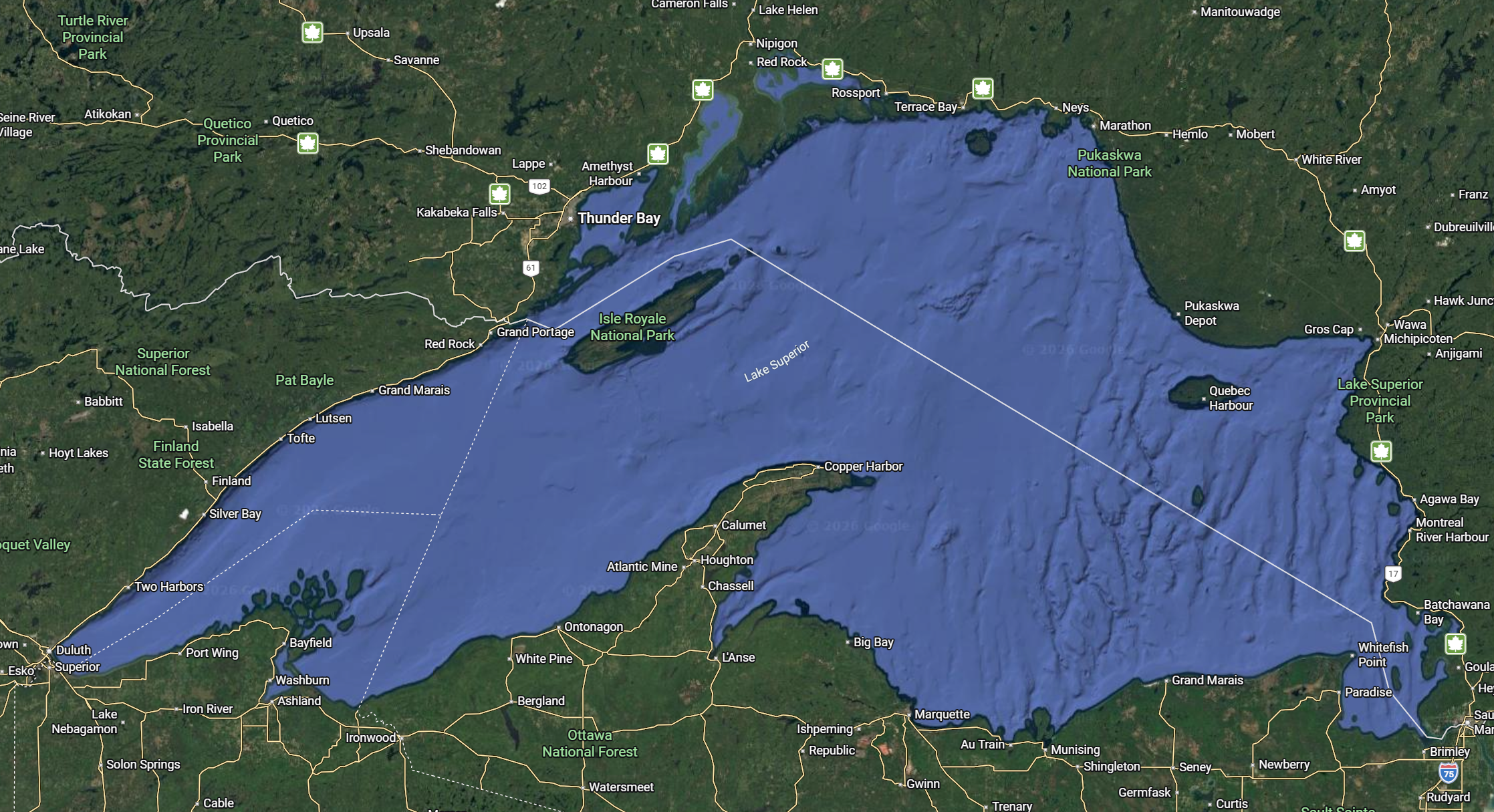
Here’s an illustration from the book:
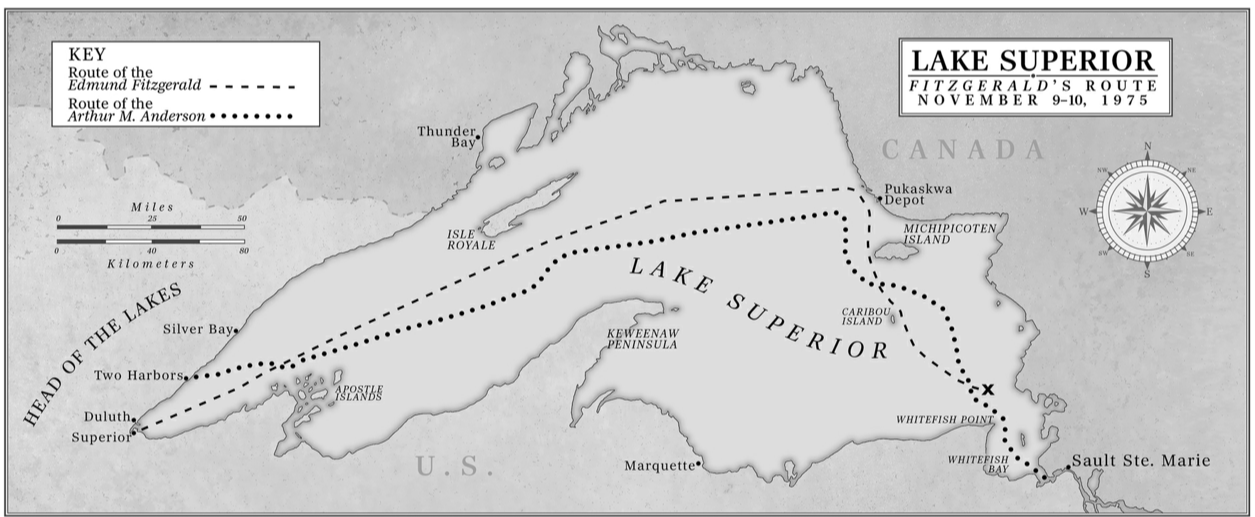
(Note that these routes are from the pre-GPS days so they’re not very precise.)
Bad Luck
Out of an abundance of caution, Captain McSorley took a longer more sheltered more northerly route. Had he taken the usual minimum distance route across Lake Superior he would have beaten the worst of the storm.
Heroes
According to the author, the Coast Guard was useless. They couldn’t even understand that the Edmund Fitzgerald was in serious trouble, much less begin to do something about it.
At one point McSorley managed to contact the Coast Guard station in Sault Ste. Marie, called Group Soo, only to reach Petty Officer Philip Branch, a rookie watchman who repeatedly failed to grasp the urgency of McSorley’s situation. He did not pass on McSorley’s concerns, offer any help, or alert anyone else at the station.
[shortly after the sinking, when Fitz had disappeared from from the Arthur M. Anderson’s radar and from visual sight] Captain [Jessie “Bernie”] Cooper called the Coast Guard station in Sault Ste. Marie, Group Soo, on channel 16, a wavelength reserved for ships in distress. USCG Petty Officer Philip Branch, the same Coast Guard agent who had largely dismissed Captain McSorley’s worries when he had radioed earlier, interrupted Cooper’s concerns to tell him to call back on Channel 12 so they could keep Channel 16 open for ships in distress. Unless Petty Officer Branch was listening to Captain McSorley himself on Channel 16, it is hard to imagine which ship on the Great Lakes might have had more distress to report than the Anderson, whose captain was trying to alert anyone who could help that he couldn’t locate one of the largest ships on the Great Lakes. Cooper must have been mystified by Branch’s instructions, but he did as directed—only to get no response on Channel 12.
During one of the many investigations that followed the Fitzgerald’s sinking, Branch had his chance to explain his responses to McSorley’s and Cooper’s calls about the Fitzgerald’s increasingly dire situation. “I considered it serious,” he testified, “but at the time it was not urgent.” Branch’s answer defies explanation. He received no censure for his actions on November 10.
Due to some maintenance and preparation failures, the Coast Guard had no boats available to go and search for the Fitzgerald or any survivors of a sinking.
The Anderson slogged along, rocking back and forth and smashing down with each colossal wave, but she continued to make steady progress toward Whitefish Bay. After a full day spent fighting the worst storm of their lives, the Anderson’s captain and crew never did experience the great relief of seeing the Whitefish Point lighthouse welcoming them to safe harbor. Still, they did manage to coax their ship across the threshold of Whitefish Bay in fifty-five-mile-per-hour winds at 8:59 p.m.
Captain Charles “Chuck” Milradt, the commanding officer of Group Soo, asked Captain Cooper the question he’d hoped not to hear.
Soo Control: Roger, well, again . . . do you think you could come about and go back and take a look in the area?
Cooper: I’ll go back and take a look, but God, I’m afraid I’m going to take a hell of a beating out there on it . . . I’ll turn around and give it a whirl, but God, I don’t know. I’ll give it a try.
Soo Control: . . . That would be good, if you could turn around and head out that way . . .
Cooper: Soo Control, do you realize what the conditions are like out there?
Soo Control: [no answer]
Cooper [again]: Soo Control, you do realize what the conditions are out there?
Milradt didn’t answer Cooper’s question, but we can: He had no idea. But then, how could he? No matter how outlandish the conditions were at Group Soo, land is land, water is water, and waves are waves. Cooper had already been out on the water, fighting the biggest waves he would ever face, while Milradt and company were safely on land. Even with waves crashing over their buildings on shore, they hadn’t seen what Cooper had seen, or experienced the fear he had felt for his men and himself. Now they were asking Cooper and his crew, in a 767-foot-long ship still weighed down with twenty thousand tons of taconite, to do what the Coast Guard, which was equipped with boats specifically designed for rescues and crews highly trained to execute them, would not be doing: go back out to look for a ship that couldn’t be found.
“I was reluctant to go, really I was,” Cooper confessed years later in a video interview. When Commander Milradt had told Cooper, “ ’There’s a ship on the bottom out there,’ I felt like saying, ’That could be two if I go back.’ But, I finally decided I’d go out.” Before Captain Cooper had even laid anchor he turned the Anderson around and plowed back out toward the Shipwreck Coast, the most dangerous stretch of the Great Lakes, during the storm of the century, to look for a ship he knew could not be found.
“The William Clay Ford was already at anchor,” Barthuli says, “and they still pulled up and went out. That’s even more noble. They’re heroes, in my book.” John Tanner knew the Ford skipper, Don Erickson, a native of Ontonagon, in Michigan’s Upper Peninsula. As a teenager Erickson lied about his age to enlist in the Navy, and emerged a decorated World War II veteran. He was the kind of guy Tanner fully expected to take his ship back out—and he did.
How did the ship actually sink?
Although the wreck was discovered shortly after the sinking by a Lockheed P-3 Orion detecting magnetic anomalies and then a Coast Guard ship looking at sonar images, to this day there isn’t a definitive explanation for the accident. The Fitz had lost her radars and the storm blinded the officers with snow and, therefore, it is quite possible that a navigation error caused her to bounce off rocks at Six Fathom Shoal. Captain McSorley mentioned a list in one of his final radio transmissions.
What’s changed?
Ships today aren’t any stronger, but weather forecasts are more frequent and more reliable. Commercial ship captains are also discouraged from taking chances and, consequently, there hasn’t been a sinking of a commercial vessel in the 50 years since the Edmund Fitzgerald went down.
The life of a sailor is completely different as a result of no-fault divorce laws. Prior to the 1970s, sailors stayed on the ship all season:
Short of a child’s wedding or a family funeral, the crews back then usually received no holidays, no vacations, no weekends. That was what they signed up for, that was what they did, and they did it every day for forty-two weeks a year. But everyone onboard agreed it was still better than working for the factories they served or the farms many had left as soon as they were old enough. On every ship some crewmen couldn’t wait for the season to start, while others couldn’t wait for it to end. Former chief engineer John Hayes liked his work, but he still fell squarely in the latter category. “Every spring I said goodbye to my wife and kids,” says Hayes, whose best friend Tom Bentsen served on the Fitzgerald as an oiler. “I didn’t teach any of my kids how to ride a bike. You miss a lot.”
This fell apart with no-fault (“unilateral”) divorce. The wife who stayed at home could go to the local family court and say “I’d like a divorce and 75 percent of my husband’s salary going forward because I’ve really been enjoying having sex with two of my neighbors while he’s away from April through December and I want to keep having sex with them during the off-season as well.” Today’s crews may work a 28/28 or 60 on/30 off schedule.
There’s a new lock due to come online in 2030. Congress authorized the lock in 1986 and ground was officially broken in 2009, though the heavy construction work didn’t start until 2020. So if it continues on schedule it will be either a 10-year, 21-year, or 44-year project and will cost about $2.6 billion in 2025 dollars. How did our primitive forebears do by comparison?
In 1853 construction started on the new lock at the Soo, which replaced guillotine-style gates with Da Vinci’s miter locks. Construction of the State Lock still required 1,700 men working twelve-hour days for twenty dollars a month through snowstorms, subzero winters, and even a cholera epidemic—but they finished the ambitious project in just two years, opening on June 18, 1855. [Cost: $1 million or about $40 million in today’s dollars]
The MacArthur Lock was finished in 1943 after four years of construction at a cost of $19 million ($400 million today). The Poe Lock was completed in 1968 after seven years of construction at a cost of $26 million ($260 million today). The new lock will cost 10X what the Poe Lock cost, adjusted for inflation, and will be… exactly the same size. Keep that in mind any time you hear that we can comfortably grow U.S. population because we can always build more infrastructure to accommodate migrants and their descendants.
More: Read Gales of November.
Related:
On the 50th anniversary, I read the investigative report and plotted the timeline on a spreadsheet since these narratives didn’t seem clear to me. The Coast Guard PCO didn’t have any real capacity to direct a rescue. He was just on the nearest radio station. Instead, he had to report it to a centralized rescue center in Cleveland. Last radio contact with Fitzgerald was around 7:10 PM. Five minutes later, Anderson lost Fitzgerald on radar. Neither of these, of course, is a definitive finding. A few minutes later, the snow clears to the point that the captain of Anderson expects a visual on Fitzgerald’s lights, but the lookouts can’t see it. He orders all hands on deck. The crews begin tinkering with the radar, radio, charts, etc to see if they can find Fitzgerald. At 8:15, Anderson reports to the Coast Guard that Fitzgerald is missing, almost an hour later. Of course, this is not enough for the Coast Guard to report it to the rescue center. Ten minutes later Anderson reports they are sure Fitzgerald is doomed. At 8:40, the local Coast Guard station reports it to the rescue center. So fear of spreading false alarms played a huge role in the delay.
At 9:05, Anderson is asked to go back out to Quarterback the S&R effort.
At 9:15, the Canadian Coast Guard is alerted of the situation.
At 9:25, a cutter 50 miles away is ordered underway, but delayed for urgent maintenance.
At 9:30, the aircrews at Traverse City are briefed and ordered to prepare for takeoff. (30 minutes to airborne)
At 10:06, a HU-16 takes off.
At 10:53, the HU-16 arrives on scene, 3.5 hours after peril was known.
While it was theoretically possible the crew was alive on some sort of life boat, the Coast Guard wasn’t equipped to respond anywhere near in time.
Phil, little secret I wanted to share with you (please feel free to share it). The author’s contention that the lack of salt (fresh water) in the Great Lakes exacerbates the waves is balderdash. Even my drug-addled brain told me it didn’t pass even my smell test. Adding 3% salt to water will have de minimis impact on the wave dimensions. As per Grok:
Wave size in Great Lakes storms is controlled almost entirely by wind, fetch, and depth, not by the lack of salt itself, so the “no‑salt” factor changes storm wave dimensions only very slightly compared with the ocean.
What salt does (and doesn’t) change
Seawater is only about 2–3% denser than freshwater, so the extra “weight” from salt makes ocean waves very slightly slower and more “rounded,” but the effect on wave height for a given wind is minor.
Core wave‑generation formulas depend on wind speed, duration, and fetch; salinity does not appear explicitly, so there is no large, direct “fresh vs salt” height penalty built into the physics.
Why Great Lakes waves often feel rougher
The Great Lakes are much smaller than oceans, so fetch is limited and storms tend to produce steep, short‑period wind waves rather than long, smooth swells; this makes them feel more abrupt and “choppy” even if absolute height is similar.
Waves in the Great Lakes are more confined by coastlines, so they reflect off shores and interact, which can amplify local steepness and make seas feel more chaotic than open‑ocean storm swells of comparable height.
Thank you, Hunter, for taking time away from your sporting girls to analyze this!
@HB: And thank you Hunter for the A.I. slop. Keep it lazy, bro.
I spent last summer on Lake Michigan. An small-ocean-sized fresh-water lake does capture the imagination. Too bad you don’t have any. I’ve always wanted to float on the Dead Sea, but I’m not going anywhere near that place in the near future.
Hunter can have a big freshwater lake if he and his stable of paid females and blow dealers move to Florida! https://en.wikipedia.org/wiki/Lake_Okeechobee (730 square miles, “the second-largest natural freshwater lake contained entirely within the contiguous 48 states, after Lake Michigan”). I agree that Superior is bigger, but sharing with Justin Trudeau’s Canada isn’t fun for everyone.
“That’s 100X what an Edmund Fitzgerald crewmember’s survivors were paid. Thus, we can conclude that having sex on Jeffrey Epstein’s island was 100X worse than riding through 30-50′ waves for hours and ultimately being drowned in 42-degree water.”
You have to adjust for inflation though. Basically the same.
Phil, this is a good review – perhaps it is your attention to technical details that this piece made more of an impression on me than the WSJ review of a while ago. My question is: do you really think it is worth reading general nonfiction anymore? So the guy who wrote this book is a “writer” who has written according to Amazon 14 books on all sorts of subjects including sports, business, heath. This would suggest that he has no real expertise in anything – he puts his books together by doing “research” from the public domain- like what you would have done to put a paper together in a HS or a college history course but more intensively & he is probably a better writer. Maybe he also interviewed some people, though no one on the Edmund Fitzgerald, & those interviews are likely in the public domain. It is a 400+ page book so say it took 6 hrs to read. And if you were taking notes or underlining a little bit longer. You could have asked an LLM about the Edmund Fitzgerald and after some back and forth that might take an hour it would spit out say 10 pages – might be an interesting experiment to do that and compare it to the book? Someone above has pointed out an apparent inaccuracy in the book and if there is one there are probably more – given that the author does not seem to be an expert on anything relevant to maritime shipping on the Great Lakes or nautical engineering. What do you think reading the book accomplishes that an LLM doesn’t? There is an entertainment value. But anything else? It is a serious question – i have been wondering about this for myself.