I hope that everyone who celebrates is having a meaningful National Supply Chain Integrity Month.
I recently listened to The Box: How the Shipping Container Made the World Smaller and the World Economy Bigger by Marc Levinson, against whom I was somewhat prejudiced because he has worked as an editor for The Economist, a magazine written and edited by experts who never met a human.
It’s a suprisingly interesting book on an uninteresting subject. The author is an economist so he is expecially weak on the engineering challenges of building ever-larger container ships and cranes. Nonetheless, we do learn about some of the engineering that went into designing the containers themselves, e.g., the corner connectors and figuring out how to support the weight of additional containers piled on top.
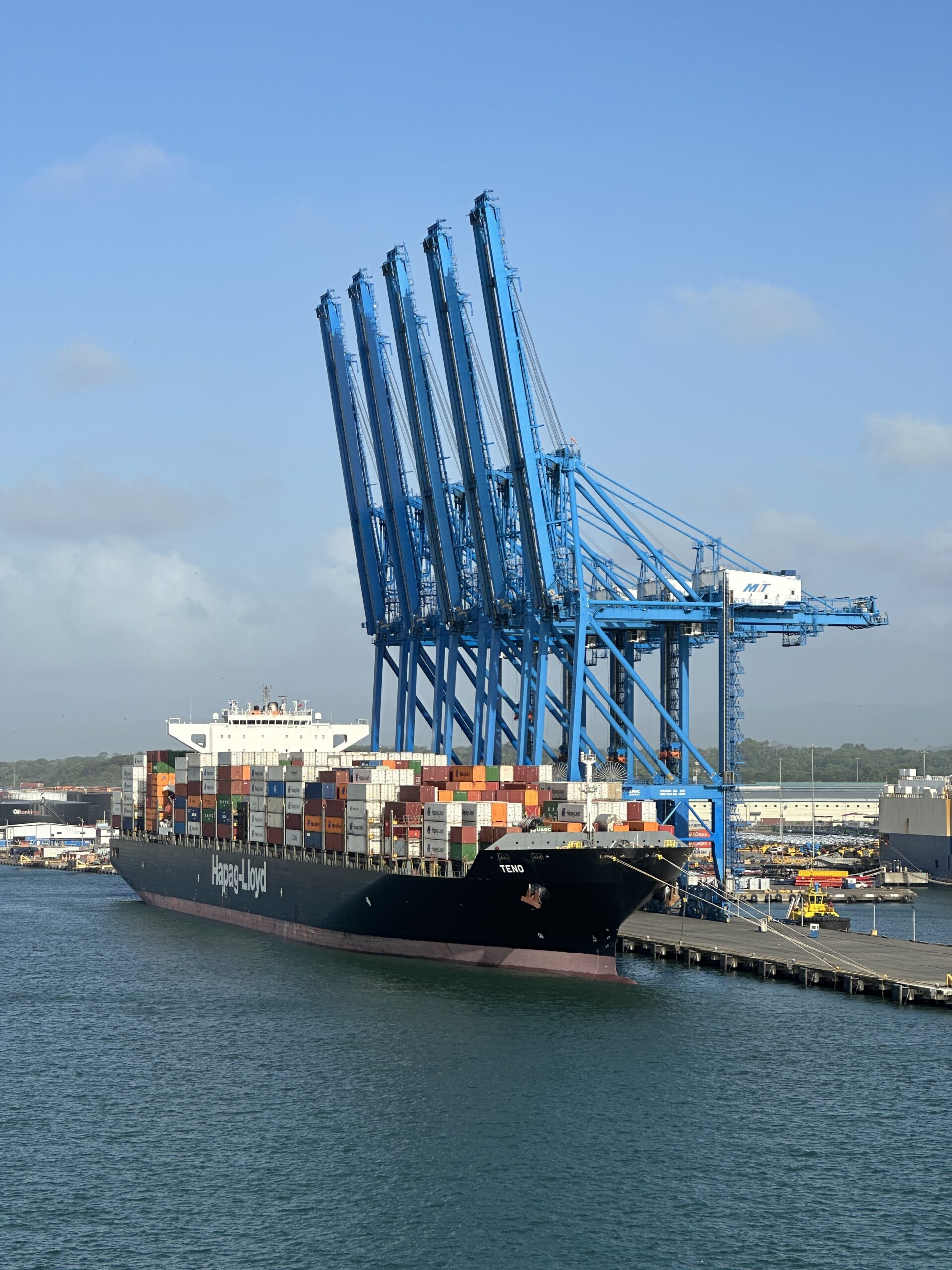
Like AI today, container shipping was perceived in its early days (1960s) as potentially saving a huge amount of human labor, especially dockside. Breakbulk shipping required large crews of longshoremen working for days to pack items into cargo holds, thus giving the mariners a relaxed week in port. Because longshoremen were usually unionized and had the power to shut down ports completely, they were able to negotiate the transfer of a massive share of the expected profits from container shipping to their members, either for not working at all or for working part-time. Non-unionized workers in the breakbulk shipping industry were completely out of luck. Future workers were also out of luck. As members of longshoremen unions died, the benefits of the union contract flowed only to those who were still alive and/or working. Crane operators in Los Angeles can make over $300,000 per year, but there aren’t many of them.
Practical advice for young people: Get a union job now and in a union that can shut down something important to the rest of the economy and/or the public. If containerization is any guide, unionized schoolteachers will be able to keep their wages even if Optimus can teach better. It would be ideal if one could think of a union that can shut down all AI data centers, but I am not sure there is one. Maybe the people who handle cooling? Even then, however, the data centers theoretically have the right to hire replacement workers during a strike. (School districts have this right too and it would be trivial to hire some adults to take over teaching/daycare responsibilities, but they don’t do it because, I guess, the union and the people who run the city are part of the same political party.)
Container shipping caused a massive shift in employment. Docks and their associated jobs in Manhattan and Brooklyn disappeared. So did factories that had been close to the docks in order to faciliate shipping to Europe. The replacement was Port Elizabeth in New Jersey, set up in 1963 to handle containers for Malcom McLean‘s Sea-Land. The factories moved to Upstate New York, Pennsylvania, Connecticut because with container shipping they just needed to be able to put a box on a railroad car headed for Port Elizabeth.
The advent of container shipping did not highlight the merits of technocratic government or credentialed experts. Governments, armed with expert advice and forecasts, were investing huge quantities of tax dollars in wharves for breakbulk ships just as the container boom was becoming established. Experts predicted minimal savings and disruption from containerization, perhaps partly due to government regulations that stifled the growth of the industry. Until President Gerald Ford kicked off the deregulation trend in the U.S., rates for shipping via rail and truck were set by a central planning agency (the ICC). International shipping rates over water were similarly regulated by a combination of bilateral agreements, cartels among shipping lines, etc. The rate to ship a load of refrigerators, for example, might not be different whether they were in a container or not. It wasn’t until the 1980s that the full benefits of containerization began to be experienced by shippers and consumers. In other words, government intervention in the market delayed the benefits of the technology by 15-20 years.
As with AI, which has made receptionists at NVIDIA richer than 99% of the people who live in Michigan (Detroit was once the richest city in the US and maybe the world!), the benefits of container shipping haven’t been equally distributed. A privately-owned non-union (at the time) port in Felixstowe took away thousands of jobs from unionized government-owned ports in other parts of the UK. Intelligent and efficient countries got dramatically richer, e.g., Singapore and the Netherlands, while countries that couldn’t get organized were left much farther behind than in the breakbulk days, where everyone was inefficient. It’s almost free to ship cargo among the world’s leading container ports and expensive/slow to ship cargo to places that aren’t regularly visited by big ships. The cycle tends to be a virtuous one. Because Panama has a busy container port that’s also the logical place to put factories that divide up and repackage pharmaceuticals for re-export to other Latin American countries. Being a landlocked country was already bad, but the penalty increased with containerization. (Our family experienced this with roofing tile. We got $30,000 of clay tiles from Spain, including container shipping and a truck ride up from Miami. It was going to cost $16,000 for tiles from Ohio…. just for the shipping.)
Consider Haiti, one of the world’s most violent and dysfunctional societies (which is why the U.S. is eager to import as many people from this society as possible?). It also has a violent and dysfunctional container port. UNICEF:
Armed groups breached the city’s main port a week ago, severing one of the capital’s last remaining lifelines for food and supplies as the country edges closer to collapse. Currently, over 260 humanitarian-owned containers are controlled by armed groups at the port.
Even if the rest of Haiti weren’t violent and dysfunctional, no factory could be set up profitably given the violent and dysfunctional nature of the port.
Moving over to the most functional country in Sub-Saharan Africa… “South African ports still rank among worst in the world” (BusinessTech 2025):
State-owned Transnet Port Terminals is pouring investment into cranes and new equipment after years of corruption and mismanagement that eroded the quality of its operations. The Container Port Performance Index from 2020 to 2024 took note of the upgrades and measures, including better weather forecasting at two local facilities. … Still, Cape Town was 400th in the survey, with Coega and Durban the penultimate and last of the 403 ports ranked.
The countries with high-ranked container ports are likely to be more advantageous spots for factories, at least the parts of those countries connected by good rail links to the efficient ports. Note that even today it can cost more to ship a container a few hundred miles by rail than thousands of miles by ship.
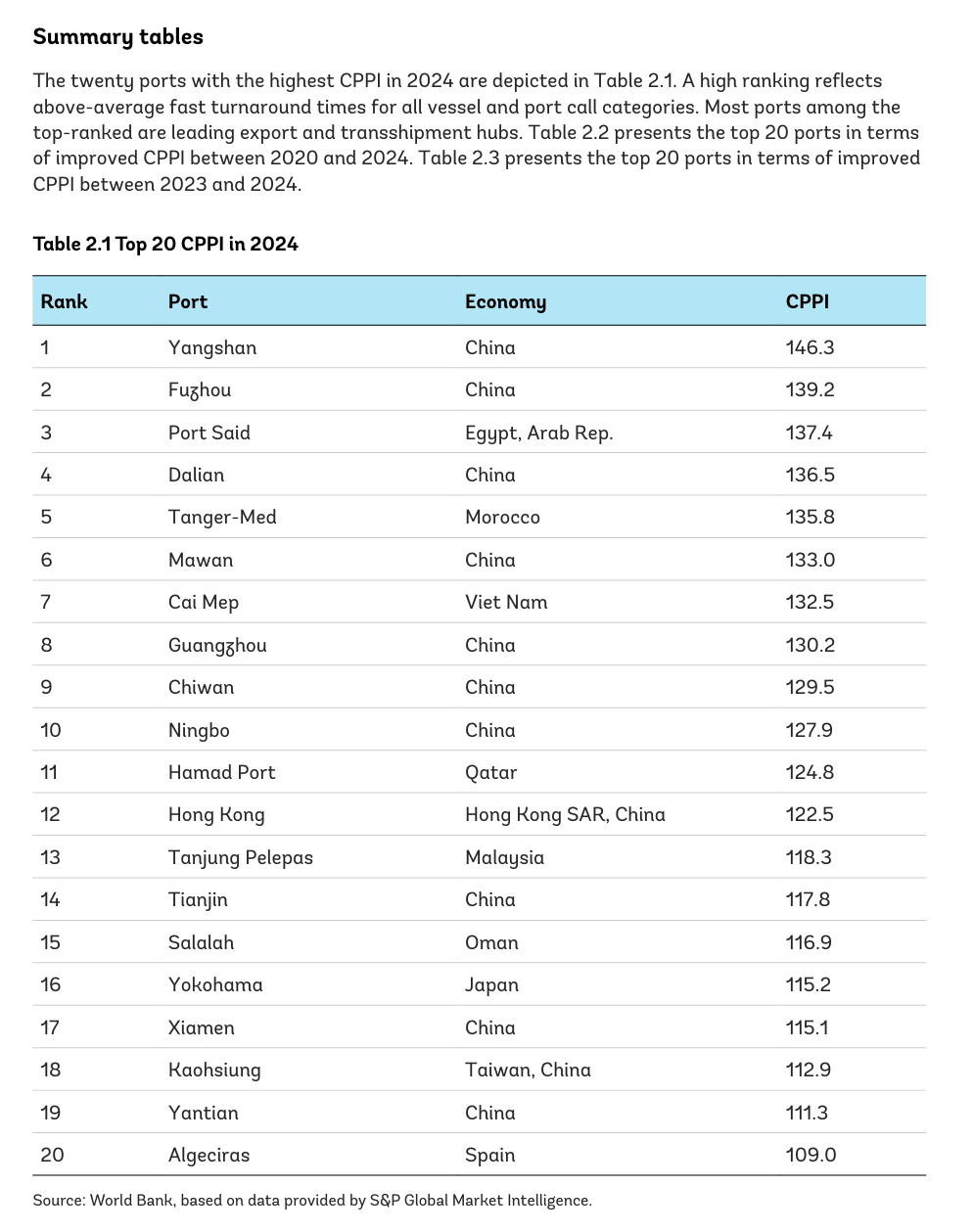
Also interesting from the above-cited report, what happens when you compare the best that Americans can do, considering all union and cultural factors, to our brothers, sisters, and binary-resisters in Asia?
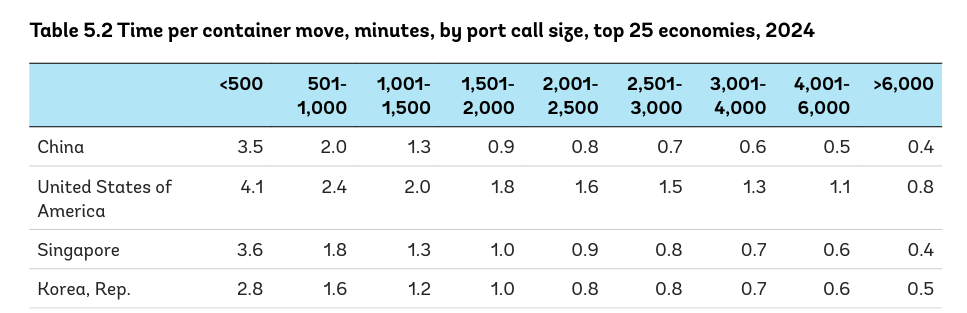
(Note that some of this inferior performance might be robot vs. human. American unions have had a lot of success in obstructing the installation of automation at our ports.)
So… if the AI revolution turns out to have dramatic economic effects, as predicted, the benefits will be radically unequal. Maybe Californians won’t complain so much about inequality if it turns out that nearly all of the wealth of the U.S. ends up in California as a result of the AI economy? Will they be eager for federal tax policy that plucks wealth from California AI Achievers and pays it out to Left-Behind Mainers and Michiganders?
Can we predict the people and places that the AI boom will enrich the most? I hope that SE Florida will be fine, even if money is earned elsewhere in the U.S., thanks to the spectacular mismanagement and consequent high taxes of a lot of other parts of the U.S. (Maybe Jensen Huang will eventually retire and bring his personal $trillions to tax-free Florida?) California is an obvious candidate for a place where a lot of individuals will keep getting richer, but mostly the rich AI nerds will leave the other 40 million Californians in the dust.
Maybe the answer is that AI is most useful to the smartest humans and, therefore, the big winners from AI will be the smartest humans and places where smart humans cluster. This was the core point of the book The Bell Curve, improperly characterized as a book about IQ as a function of race. In fact, the main point is that, unlike in medieval times, the modern industrial economy delivers enormous rewards to the smartest people. A potato-picking peasant in 1500 who happened to have an IQ of 130 wasn’t going to earn a lot more than his counterpart with an IQ of 100. If AI accelerates the trend identified by The Bell Curve then maybe Korea, China, Japan, Singapore, and Taiwan will be the ultimate winners. (Average IQ in the U.S. started to fall shortly after our post-1965 opening of our borders to immigrants from countries with lower-than-100 IQs.)
Containerization was invented by an American. The first purpose-built container ships were built in U.S. shipyards. All of the early leaders in container shipping were American companies. One of the biggest early adopters of container shipping was the U.S. military (to support our ultimately futile efforts in South Vietnam). Today, however, the U.S. is insignificant in building and operating container ships. Merely because the world’s current AI leaders are in the U.S. we shouldn’t be complacent!
Readers: Who wants to make some predictions?
Fresh on X today, from the Financial Times, about how AI makes the cognitive elite more elite (i.e., another reason why the majority of Americans will eventually vote for everything that Bernie Sanders, Elizabeth Warren, and AOC propose):
(Photos from Panama, 2023)

“Practical advice for young people: Get a union job now”
Hahaha! My union has been very good to me. I’m a 44-year old big city Firewhiner (oops, I mean Firefighter) with 24 years of “service.” I deserve to get paid! I’ve got bills! Alimony & child support to three ex-wives, payments on my Escalade, Harley, and speed boat. I’m juggling three girlfriends, and have some serious gambling debts.
I now make close to $200K per year but deserve more! Not bad for a high school grad who was washing cars before I got on with the FD. I did, however, earn my A.S. degree in “Fire Science” on the City’s dime. And that silly degree got me promoted three times to Sr. Deputy Assistant Deputy Big-Cheese Battalion Chief Indian Chief. I still have lots of free time to work out and watch porn while on the job.
Last year I “worked” tons of OT to spike my pension and next year I turn 45 y/o and will retire and start collecting my $100K lifetime pension with built-in annual COLA. In 20 years, I’ll be 65 (the retirement age for most of you stiffs), the 3% COLA will have nearly doubled my pension to $200K per year! My life expectancy is 88, so my pension will double again to almost $400K per year by the time I die. It gets better; my lovely 20-year old Filipina mail-order bride will collect my pension long after I die. Her life expectancy is 90. She’ll collect my growing pension for another 25 years after my death! Twenty-five years on the job will trigger almost 70 years of growing monthly pension checks! Now get back to work and pay those taxes! Oh, by the way, F.U. Pay Me!
NYT, 04/17/26 – N.Y.C. Doormen and Building Owners Reach an Agreement to Avert a Strike
“The deal would provide pay raises and maintain free health insurance for about 34,000 apartment building workers … The union got most of what it sought in the negotiations, including wage increases that would boost salaries by $4.50 … the owners had also agreed to continue covering all of the costs of providing health care to the workers and their families … and to increase pension benefits by 15 percent.
… the proposed raises would increase the typical employee’s pay from about $62,000 a year to more than $71,000 by 2030. …
I recall reading that there also were serious amounts of pilfering going on pre-containerization, a good reason to switch. But it seems like modern criminals now have adapted to the container.
Also, regarding NY salaries:
Upper East Side doorman: $75000
Author With One New York ‘Times’ Best Seller: $49,000
https://nymag.com/intelligencer/article/new-york-salaries-jobs.html
“Practical advice for young people: Get a union job now and in a union that can shut down something important to the rest of the economy and/or the public.”
Excellent advice, as you already discussed in your blog.
https://philip.greenspun.com/blog/2010/01/22/air-traffic-controllers-in-spain/
There can never be deflation so the fed inflates the assets of the rich to offset wage deflation. It’s going to be quite a fight to keep inflation averages above 3%.
Europeans and East Asians are the only two groups with reasonably high iqs to navigate the AI disruption (south Asians and MENA have some outperforming clans/castes but the median person is unimpressive).
I wouldn’t give up on the US/Europeans though. The permissive social mores enable any sufficiently motivated high iq person to use any combination of ivf, sperm/egg donors, genetic screening of embryos, surrogacy to make smarter babies. Over 10% of babies in Denmark were conceived through ivf and Down syndrome has virtually disappeared. China on the other hand has an outright ban on surrogacy which is why Chinese couples often give birth in the US (birthright helps too).
This fertility pattern seems to date back to the Middle Ages: more European women stayed single than Asian women but the ones who did procreate had more children than their Asian counterparts.
One wildcard card to watch for: Kazakhstan. The only country with an above replacement tfr outside of sub Saharan Africa (excepting Israel). Reasonable iq levels, checks on extreme Islamism, and a sizeable Russian minority. Unfortunately its landlocked….
The Economist used to be a pretty good magazine if like me you are into graphs of say date production in Mali or coffee in Ghana, but about ten years ago it was acquired by the wealthy Agnelli family in Italy though their investment vehicle Exor. It like the FT, which also used to be pretty good, now peddles the same dogmatic anti-Trump & anti-American nonsense that one needn’t venture offshore for if that is your taste. Presumably the Agnelli family recognized that there was a bigger market for people interested in reading about the evils of Donald Trump than for those interested in reading about Mali date production. The FT used to be the best publication to keep up on international business and like the Economist was free market & liberal in the British sense. About ten years ago I noticed that the FT’s reporting on America seemed to have no relationship to what I could see was going on in America and I had to assume that their reporting elsewhere was similarly biased. It is too bad since both were once worthwhile publications without analog in the US.
> The Economist used to be a pretty good magazine
I agree, something chased me off reading it years ago–lack of access to the print version maybe? What I am I supposed to read for a different perspective, The Guardian?
I also stopped reading Economic Review from the Reserve Bank of KC after they stopped sending me print copies. When I made the effort, the articles taught me a lot about economics and economic research.
I listen to Marketwatch on NPR. It isn’t blatantly partisan. Just today I learned that Florida’s orange industry is down 95% percent from historical levels, with groves being replaced with housing developments. (I wonder if scurvy rates will be going up.) I was thinking more and more of my oranges were labeled “Product of Mexico/Brazil” over the years, who are having troubles of their own with orange production.
I once decided that I wanted a simple life and that job of a state trooper involved to match boring writing (stupid me, I could retire on a large pension by now) and applied for an union job at a shipping business. I passed the interview, 100% on test but was totally ignored by a morbidly obese paper pusher union leader, who did not like me, not sure why, maybe he was reserving the place for relatives or expected a bribe.
A local capitalist in the nearby medium – scale manufacturing business asked if I agree for the rate he offered and when I could start.
However I shortly rejoined the laptop class and that unionized shipping business did not last; it went bust in a couple years. The manufacturing business is still there.
Looks like the video game industry is unionizing.
Lear to code?
https://cwa-union.org/news/releases/video-game-workers-launch-industry-wide-union-communications-workers-america#:~:text=NATIONWIDE%20%E2%80%93%20Today%2C%20in%20a%20historic,launch%20this%20powerful%20new%20organization.
I guess AI will be the picket line crossing scabs. Heck, I might even join the picket line in solidarity. “AI go vibe code yourself, beotch.” my sign might read.
Speaking of unions, when will men and women “unionize”? Oh wait, they already do when they take their vows, joining in unity. But with today’s divorce laws, that “union” is one sided.
> that “union” is one sided.
Like any seemingly futile enterprise such as beating the house odds at gambling, winning (for some definition of “winning”) at marriage as a guy involves gaming the system.
Nobody will ever win the battle of the sexes. There’s too much fraternizing with the enemy….