Summer is here for most of those who escaped the New England lockdowns during coronapanic. Average Nashville high temp for May is 79 degrees (unlike Maskachusetts, Tennessee has no state income tax and no estate (death) tax; state tax competitiveness index).
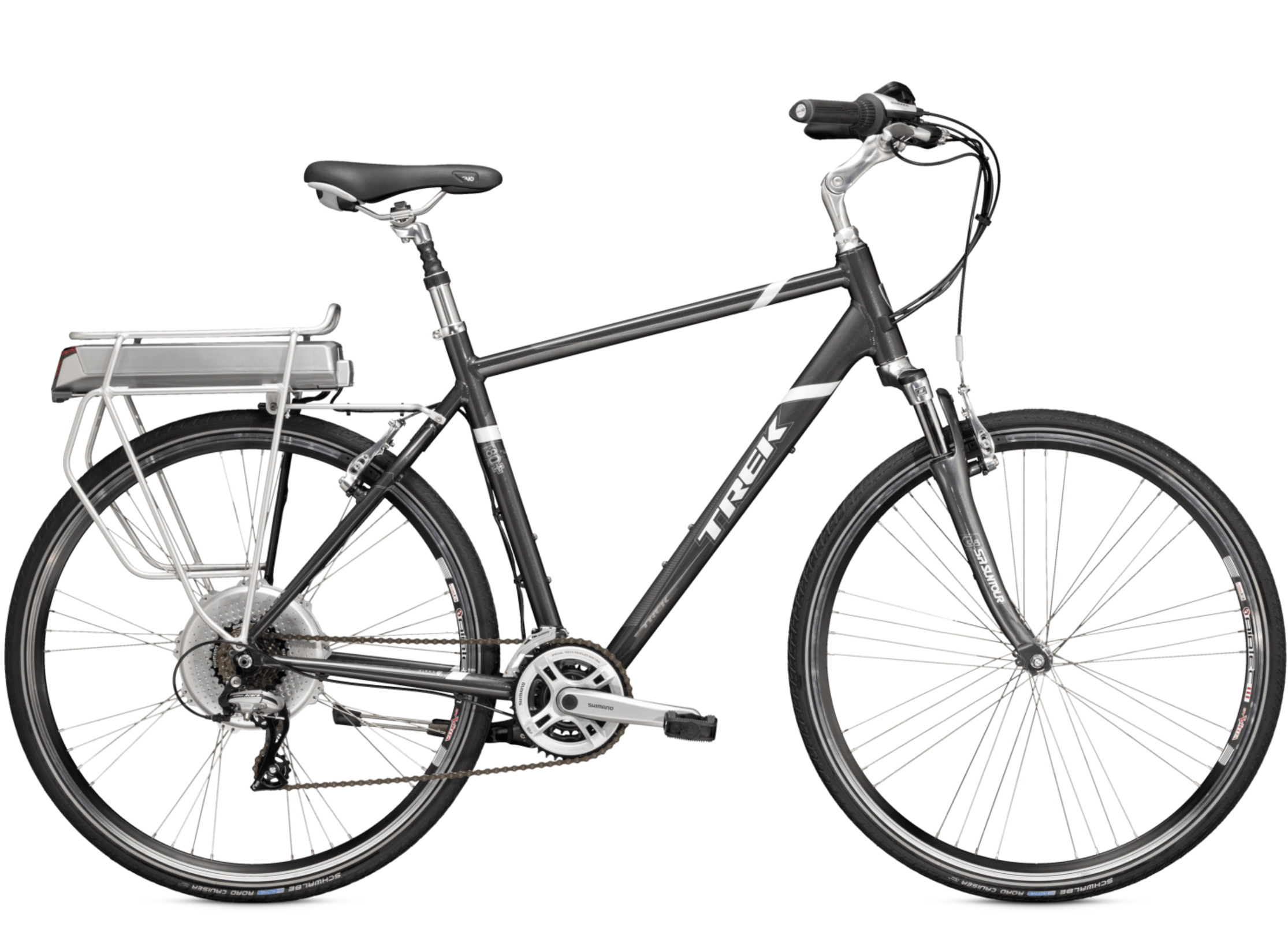
Many moons ago, I wrote about a 2013 Trek e-bike that weighed 52 lbs.: Trek T80+ Electric Bike Review. The ungainly unbalanced rear hub motor beast has a 250W motor and a 250 Wh battery. I bought it as an experiment and figured that if I loved e-biking I would treat myself to a fancier mid-drive one when the Trek died. Here we are 11 years after the closeout purchase and the Trek has not died. It’s on its second chain and has needed a new rear tire, but otherwise just works. The range is more than adequate for running errands around Jupiter and bike theft is a minimal issue (if the Florida police do catch a bike thief do they say “Where did you think you were, San Francisco?”; I sometimes use the built-in wheel lock if leaving the bike for an hour or two). The ancient Trek has the “torque sensor” that is advertised as a selling feature in 2026 by e-bike vendors, though the company (BionX, in the Islamic Republic of Canada) that made the electric gear went belly-up in 2018.
I’d love to buy a new e-bike if I could find the same comfortable geometry and the same motor/battery power at 33 lbs. Is that possible? (TL;DR: nobody has ever managed to make mid-drive light; mid-drive was the Holy Grail 10+ years ago, but it might be an emperor with no clothes except for climbing steep hills (certainly the old Trek’s hub motor was fine for climbing hills in Eastern MA)) For reference, let’s have a look at the upright riding position of the ancient Trek:
How much progress has there been in this industry? The closest Trek current bike that I can find to the T80+ is the Verve+, starting at $2,000. The versions that are the most popular would weigh about 65 lbs. in a larger frame size.
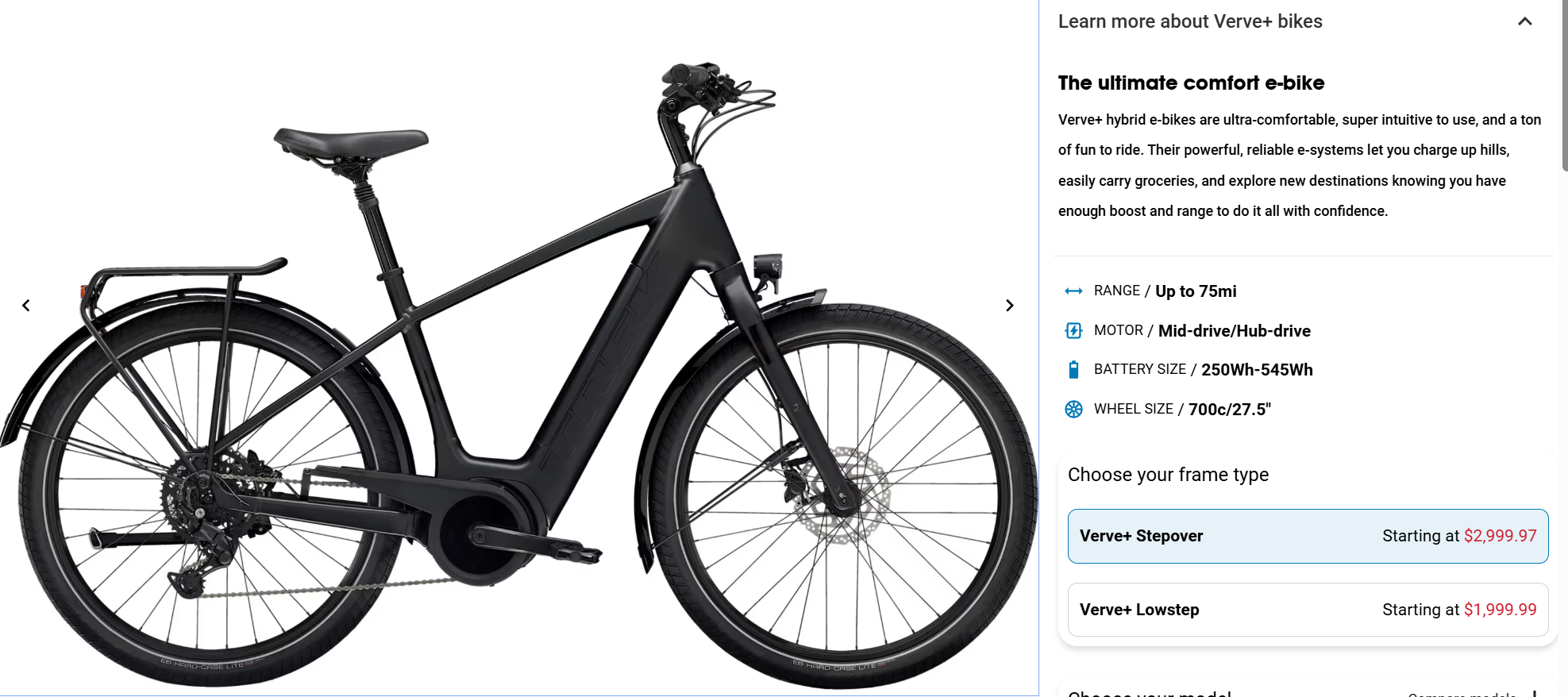
The cheapest lightest version of this bike has the same motor/battery specs as my “survivor”. It is spec’d at about 42 lbs., but that’s for the M size and mine is an XL so let’s say that it would be 44 lbs. in L or XL. That’s not a negligible reduction, but the T80+ was literally thrown together and it is way off my 33 lb. spec.
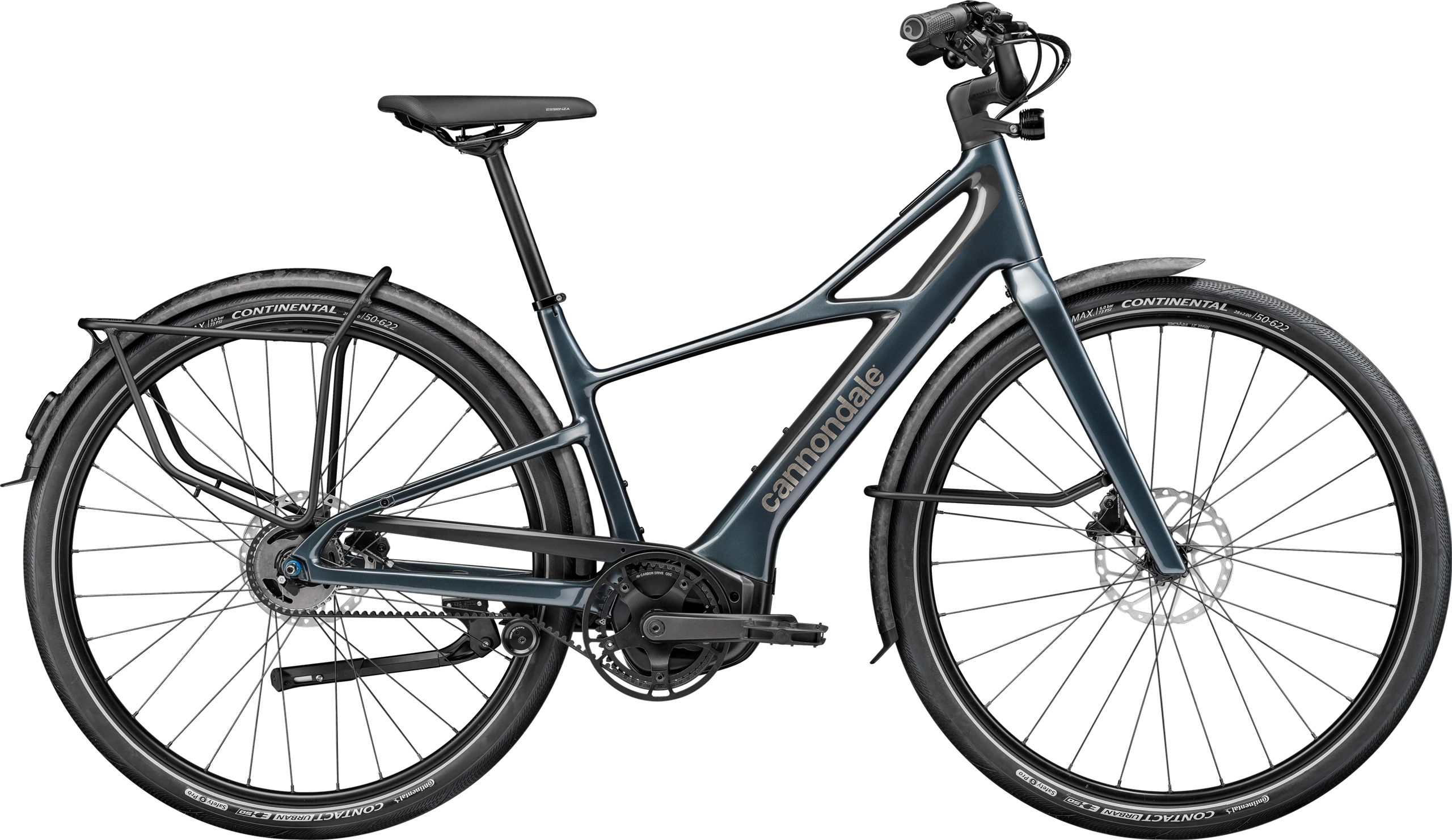
What if we spent $6,749 on a Cannondale FlyingV (plus a $15 E-bike Battery Recycling fee?!?). The web page includes the word “weight” in numerous places to crow about how light the bike is due to its carbon fiber construction. The one spec they left out, though… the weight. It’s got 600 watts of motor power for people who want to kill themselves at 28 mph and 400 Wh of battery. An independent review says it weighs 40 lbs and it doesn’t have the suspension seatpost of the old Trek T80+. The review makes it sound uncomfortable as well: “The riding position aboard the FlyingV is balanced, fairly upright but with a sporty edge. The stance suits the bike’s character to a tee. If you want to fly, you’ll need to be at least a little fit and flexible – this isn’t your living room sofa on two wheels.”
Maybe the answer is a comfortable upright bike has to be super heavy? Giant’s $700-900 “city” bikes weigh 25-30 lbs., a fair amount more than a $1,000 non-electric road bike at 20 lbs. (examples). When road bikes are electrified they don’t get that much heavier. Here’s a road bike with the same 250W/250Wh spec as the old T80+. The Ride1Up weighs 28 lbs., presumably in a medium size, and costs $2200 (almost the same as the $2100 2013 price of the T80+, which is $3000 today if adjusted for the inflation that the government tells us does not exist). The same company makes a more upright city-style bike that costs $1400 and porks out to 40 lbs. with a 360 Wh battery. What if you spend $7000 on a carbon fiber hybrid from Specialized, the Turbo Vado SL 2 6.0 EQ Carbon? It weighs… 40.5 lbs. and has 520 Wh of power.
How are consumers getting these monster bikes onto roof racks or even into the backs of their monster SUVs when it is time to take the bike in for service? It seems as though the bikes that are actually selling in quantity weigh 50 lbs. or more. A review of what Bicycling says is the sweet spot e-bike, the Aventon Level 3, doesn’t even mention weight. Nor is the weight found on the page that sells the bike. Gemini says the beast weighs 67 lbs. and “The [733 Wh] battery is removable, allowing you to reduce the total weight to roughly 58 lbs for easier transport.”
Did everyone get rid of their roof racks and replace them with hitch racks, some of which can hold bikes up to 80 lbs.? Save the planet by attaching it to a Tesla Y’s receiver hitch, but leave half the e-biking family at home because it says “designed to support vertical loads of up to 160 pounds”? The two-bike hitch racks empty can weigh over 50 lbs.; the four-bike ones weigh over 70 lbs.!); maybe better to buy a cheaper one from Torklift that can handle more weight (the same company sells a Toyota Sienna receiver hitch that can handle 700 lbs. of tongue weight, which might translate to 350 lbs. of e-bikes). If you search for “bent receiver hitch with bike rack” the Google returns stories from people who bent the hitch or, worse, the frame of their vehicle, by loading up bikes.
Circling back to my original question… why no 33 lb. comfy hybrid e-bikes given all of the progress that has been made in materials? ChatGPT says a 250 Wh battery weighs only 3-4 lbs. ChatGPT says that the killer is the motor: “A 250W mid-drive (bottom bracket) motor system typically adds ~6–10 lbs (2.7–4.5 kg) compared to a normal bottom bracket. … Ultra-light e-bikes (like Fiido Air) avoid mid-drives. They use small rear hub motors instead. That saves ~5–8 lbs immediately.” (apparently the feel and balance of the mid-drive is worth the extra weight for most consumers, but the “sweet spot” is “Lightweight hub motor + torque sensor”) ChatGPT says that 67 percent of e-bikes globally are sold with hub motors, not the mid-drives that I thought were going to dominate the industry. In Europe and for premium bikes, though, mid-drives are dominant. The mid-drives up wearing out the drivetrain, though, so the super heavy bike has to get loaded into the car for the trip to the bike shop more frequently… (see above)
ChatGPT says that Fazua, a Bavarian company founded in 2013 and now owned by Porsche, is the leader in making a lightweight mid-drive system. Their completed city bikes, however, weigh at least 40 lbs. Internet reviews of Fazua’s reliability are mixed, to say the least, compared to the standard Bosch. ChatGPT: “In general, Hub motors are more reliable than mid-drives”. So maybe the answer is that I can have a better balanced bike if the battery is moved to the downtube, but the architecture of the motor in the rear wheel needs to be retained in order to avoid what ChatGPT claims is a 5-8 lb. weight hit and a lifetime of additional maintenance.
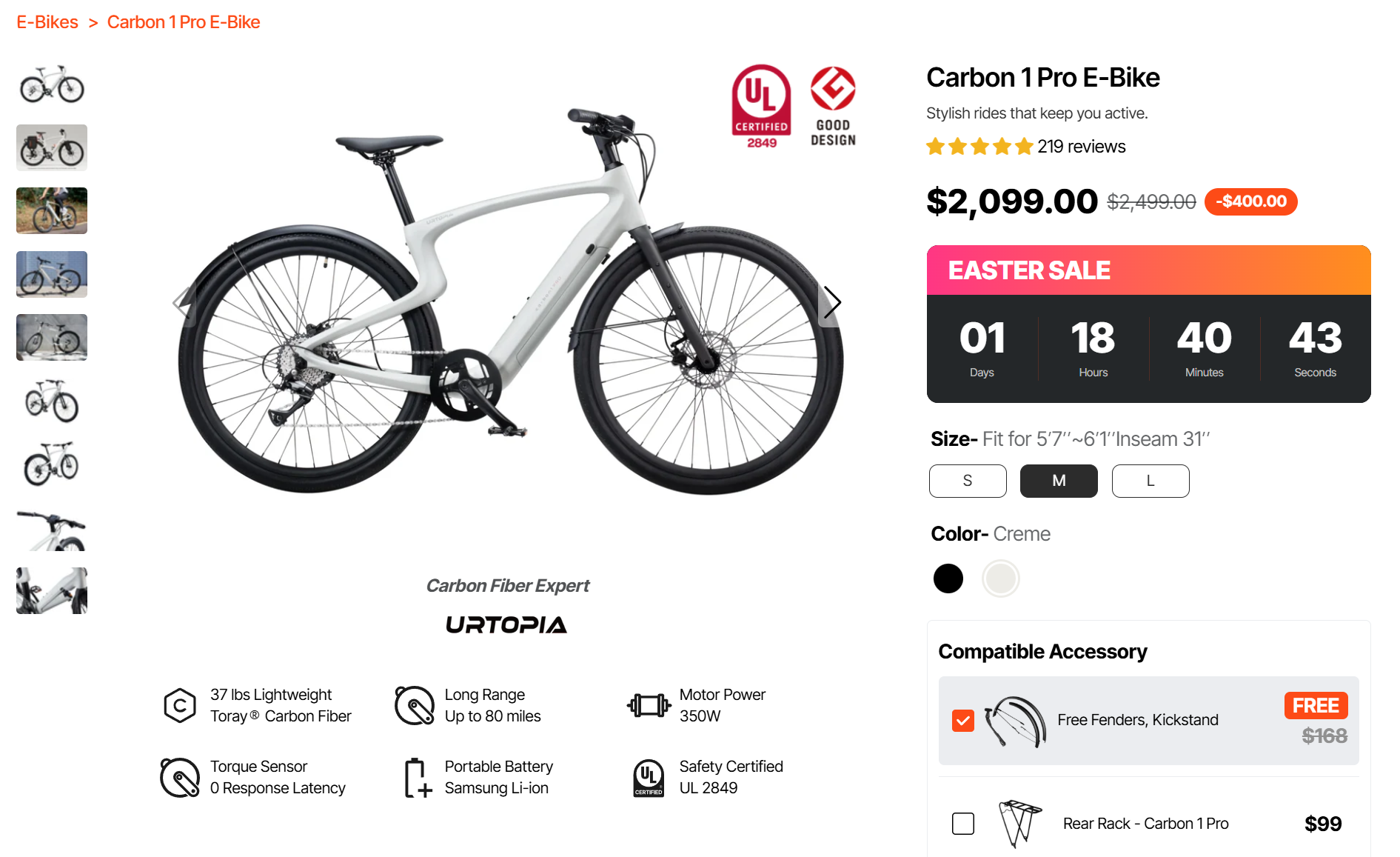
Let’s close with a bike that isn’t exactly “name-brand” (Giant, Trek, et al.), but that does seem to have the architecture that ChatGPT recommends… Urtopia Carbon 1 Pro (about $2100 as of a couple months ago). It seems to have a similar geometry to the $6,749 (plus $15 recycling/virtue fee) Cannondale, above. It lacks the suspension seat post of the old Trek, but maybe the flexible carbon frame absorbs shock reasonably well. Instead of cutting the promised-by-ChatGPT 5-8 lbs. by switching to a hub motor, the practical weight savings is only 3 lbs. (37 lbs. vs. 40). This one might be worth a test-ride (the company has dealers).
> Summer is here for most of those who escaped the New England lockdowns during coronapanic.
Does anyone else see the analogy of Zionism in Phil’s comments? Florida is the promised land and Mask. is Egypt or Babylon. I say this neutrally, and I’m not trying to be mean. But I’ve lived in both areas, and, like nothing is perfect (and these days everywhere is looking equally grim).
A friend and I rented e-bikes for the first time last week in Cocoa Beach. $30 ea. for two hours. One had a mediaul width tire, the other a fatter tire. Not high-end bikes, but seemed perfectly fine. The governor was set at 22 MPH, which was fast. Not allowed to ride on the hard-packed sand. Had a lot of fun, but was a bit tired after 90 mins.
It really does seem like people are going deep into mythological construction nowadays. My opinion is that we are in deep doo-doo. I sometimes pretend I’m Yoda on the swap planet (back to Florida, did anyone notice that part of the Everglades was on fire?), waiting for my chance to take up the fight for the Republic.
My friend is a Realtor up north of Phil. She describes her area as “a charming Southern small town”. I mean, it really is just slightly less urbanized Eastern Central Florida, not Shangri-La.
Why do we even need e-bikes? People are so lazy they can’t choose the right gear and use human-power — even when the are in a position to use a bike in our car-centric country. We need to get back to reality, and ask the real questions. Assuming our discussion here is meant to be productive, which excludes most of the Internet discourse these days.
So I was on the homestretch of my bike ride, noodling along as I approached the driveway. Check my rear view mirror — just because — okay, no cars overtaking. Set up to turn left, some movement registers in the corner of my eye and I reflexively hit the brakes. A kid on an electric minibike just misses me, passing on my left. Swift, silent, and a close call.
Back in the day some of our neighborhood boys had (illegal) minibikes at that age — 8 or 10. They had Briggs lawnmower engines, could be heard blocks away.
What’s with riding scooters/motos against oncoming traffic? I was nearly run off the road on Squantum drive by some knucklehead — answers to the description ‘bushy-haired stranger’ — driving a battery-operated moto on the wrong side. Was Cool Breeze baked to the gills?
All good until somebody’s noggin’ gets splashed, said the ER Nurse.
Also not clear why anyone would need an e-bike unless you are a Hispanic deliveryman risking his life to bring an order of Thai curry chicken to the hard working guys and gals manning the trading floors in NYC who keep our country humming. As for Nashville, I visited there last year to meet up with a school friend from Texas. It is physically attractive but like most North American cities not all that interesting, though I bet it would be a nice place to live and bring up a family. What it has to offer is country music, if that is you thing & the Country Music Hall of Fame is well worth your time especially if you are familiar with the genre as well as the bars and honkey tonks on lower Broadway. We were there to see Dwight Yoakam, country rock- think Willie, Waylon, The Byrds, Grateful Dead mixed together, and he puts on a great show & had curated an exhibit at the Country Music Hall of Fame explaining country rock. Sat next to a couple from eastern Kentucky, JD Vance country, an hour and a half, two hour drive to Nashville and then the same home. Really nice people but morbidly obese, probably late 30s/early 40s with all sorts of serious health problems. Hard to imagine they would ever reach 60. The typical food in Nashville is what your average 9 year old would find appealing so there are lots of morbidly obese people around. Went to the breakfast spot where Taylor Swift supposedly chows down when she is in Nashville, Pancake Patty’s or something similarly cute. It is pancakes alright, if that is what you like to eat. Anyway, I thought the couple of days I spent there were worthwhile & on balance I think it is an appealing city.
jdc: e-bikes are awesome for running errands in Florida. Because you’re always going at least 12-15 mph, even if not super fit, you always have a breeze. The e-bike turns into a substitute for a car, not a substitute for a bike (most people don’t want to bike for more than about 20 minutes each direction and the e-bike stretches the range for a 20-minute ride). Remember that these are bikes where you pedal about as forcefully as you would on a non-boosted bike. So you get the same amount of exercise per minute. And, in fact, that’s what research has shown. People with e-bikes get just as much exercise as people with regular bikes. The difference is that the e-bikers go farther.
> We were there to see Dwight Yoakam, country rock- think Willie, Waylon, The Byrds, Grateful Dead
Dwight is the man, amazing musician, and funny as hell. He acts too, Sling Blade, e.g. Never saw him in concert. I especially like the album Blame the Vain. She’ll Remember starts with an “emo” intro:
She came in and she told me
She said: “I’m leaving you.”
I said: “Oh, you are?”
Well let me tell you something:
If you leave, I suggest you stay gone
And I mean stay gone forever, you hear me?
Ever!”
I’m too lazy to ride an e-bike, I prefer to hitch hike.
There are affordable 31 lb e-bikes with comfortable geometry, e.g. https://www.mokwheel.com/products/flint-pro
To go much lighter than that, you need to cut weight somewhere, and there are comfort tradeoffs.
Cannondale’s SuperSix EVO Neo is 25lbs, and is sold used for a reasonable price ($1200 here: https://upway.co/products/cannondale-supersix-evo-neo-3-ugc29). Many similar examples from Orbea etc.
However, with all due respect, if you are struggling to lift 40lbs to chest height, free weights will be a much better use of your time than optimizing away the last 10lbs of bike weight.
Thanks, John. The current struggle isn’t to lift 40 lbs to chest height, but 52 lbs. to the top of the minivan and then another 6” to the top of the Yakima rack. Unless you open a side door and step in there it is full arm extension for a person 6’ tall.
The Yakima bike mount itself is rated to only 45 lbs. And if you put three heavy bikes up there I think you get over the Honda cross rail weight limit of 165 lbs. (bikes plus racks)
I’d install a hitch and would use more robust hitch bike mounts. Odissey is capable of towing small boats or cargo containers, adding a hitch to it can be useful.
As noted above, the hitch racks that hold four bikes weigh 70 lbs. before a bike is installed. Due to the moment arm, the individual bikes on the rack can’t be heavy even with the highest-capacity trailer hitches. You also have the issue of where to store the hitch rack when it isn’t being used. The roof racks store themselves on a part of the car that isn’t otherwise used.
Hitch racks are very robust.
I had 3 bikes on them, combination steel/aluminum and at the beginning all steel. With no issues. The rack itself is easily stored in the garage, I added wall hooks for items like this. Just hang it parallel to the wall, takes no space. I think it can hold at least 5 bikes, also I did not need that many. It is easy to stow in the minivan itself, or in a Grand Cherokee in my case. It takes under 5 minutes to attach/detach to/from the hitch.
I just finished reading The Brompton: Engineering for Change
Brompton thinks a lot about weight – interesting book about building a company that builds things… in London.
I’ve never ridden one, but might be interesting to check out their electric offerings.
The British have been remarkably innovative in folding bikes, starting with Alex Moulton in 1962. Brompton is essentially Moulton’s idea made cheaper for mass production. Looks like their $8000 e-bike is below 30 lbs and still has a 345 Wh battery. That’s pretty impressive considering that it must also fold. Not good for Massachusetts potholes I am sure, but perhaps fine in Florida for someone who doesn’t want to deal with a bike rack. As someone with long-ish legs I am skeptical of these British one-size bikes.
RE: it still takes you 20 minutes but you can go further.
This is the perfect metaphor for AI. It’s still going to take you 20 minutes to get the task done but you’ll get a lot more done in that 20 minutes than you would without the AI.
Except with AI, your path looks more like Brownian motion:
https://en.wikipedia.org/wiki/Brownian_motion