June is National Safety Month (also, for maximum safety from Mpox (not to be confused with “monkeypox”), Go to the Bathhouse Month). Should we protect ourselves via outdoor masking as part of our celebration?
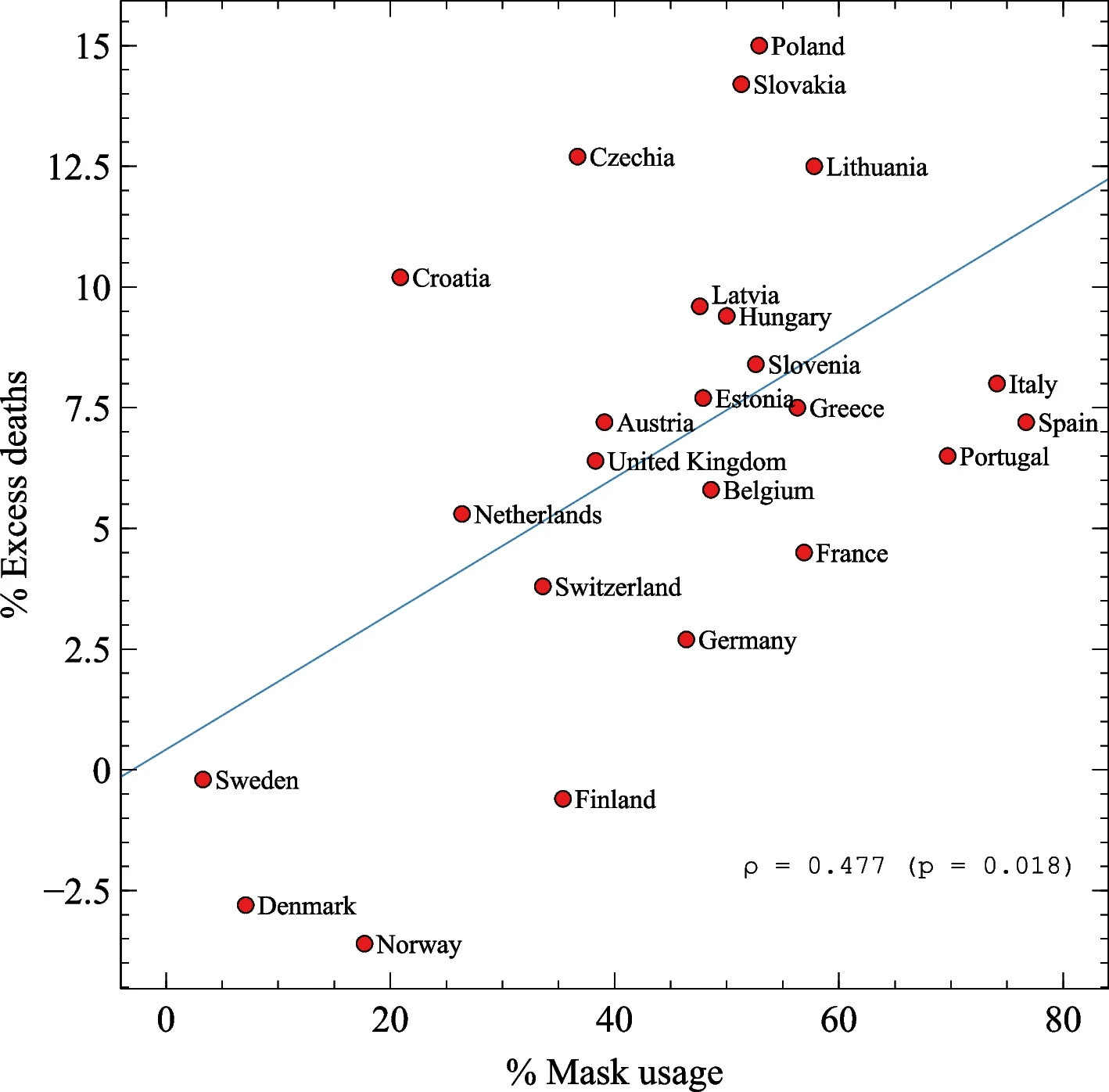
Let’s check “Does mask usage correlate with excess mortality? Findings from 24 European countries”, by a couple of Ph.D. haters in Brazil. The good news is that there is a correlation between the percentage of people wearing masks and the percentage of people dying in 2020-2021. In fact, the correlation is reasonably strong at 0.5, about the same as for education level/income and neighborhood income/school tests scores. The bad news for Massachusetts Scientists who’ve been fully masked indoors and out for the past 6+ years is that the correlation is positive (the higher the mask usage, the higher the rate of actual deaths vs. expected (“excess deaths”)):
Was masking a cause, or effect?
Great Question!
I find it hard to understand how two countries, at a time of a great pandemic (not world-ending, but we know there were some excess deaths directly attributable to the virus), ended up with measurably negative excess deaths. Zero excess deaths like Sweden and Finland makes sense if the people of that country are less affected in some way. To have actual fewer deaths like Denmark and Norway really confuses me. Anyone want to comment on how that is even possible?
NTBB: That is a great question. If it were just one or two out of the four I would say it was a statistical anomaly occasioned by their relatively small populations (the U.S. has more undocumented migrants than all four of the countries you mention put together have in total population).
Here are some ideas: Frail elderly people, even though they didn’t don the saliva-soaked Face Vestments of Fauci, tended to mix less with other humans and, therefore, were less likely to pick up the old reliable killers, such as flu. Remote work became popular, even in places where it wasn’t illegal to work in person, and that cuts exposure to car accidents (this didn’t happen in the US because we compensated for the lack of traffic by driving faster and more incompetently, but ChatGPT found stats showing significant reductions in the countries you ask about). Staying home a lot might be a good way to shift deaths. You sit on the couch watching TV and eating chips. You have zero stress. You’re not going to die of a heart attack even as you build up some obesity and end up dying younger at some future date.
Also, remember that the Swedes said that the typical person felled by SARS-CoV-2 was on track to live only 6 additional months. The chart above looks at a 24-month period. So, as you point out, COVID-19 did kill some people, but those deaths mostly occurred in 2020 and wouldn’t have been “excess” deaths for anyone killed who was on track to die before the end of 2021.
How about social distancing? I don’t recall one person in Sweden wearing a mask. And looks like they did well. I was there post-covid, between 21-24.
The Swedes tend to be physically distant generally. There’s a culture to not even sit in front of a person, if sitting diagonally is possible. They don’t speak much in non-social contexts like trains. Not top-tier health care + social distancing + culture + average climate (like humidity), maybe more, or as important as mask. Didn’t read your links, maybe they go into these.
Personally, I eschew unnecessarily wearing random shit, and fortunately I was in India at home, with my family, and in Sweden during Corona.