Tomorrow is the big America 250 celebration. Perhaps today could be dedicated to remembering the Loyalists.
A good place to start is by reading Liberty’s Exiles: American Loyalists in the Revolutionary World by Maya Jasanoff, a teacher of the Queers for Palestine (i.e., she’s at Harvard).
What was the scale of those who didn’t want to be traitors to the king? “historians estimate that between a fifth and a third of American colonists remained loyal to the king.” Let’s not forget that the merits of being ruled by slaveholders such as George Washington could depend on one’s perspective:
Crucially, not all loyalists were white. For the half million black slaves in the thirteen colonies, the revolution presented a striking opportunity when British officers offered freedom to slaves who agreed to fight. Twenty thousand slaves seized this promise, making the revolution the occasion for the largest emancipation of North American slaves until the U.S. Civil War. For native American Indians, too, the revolution posed a pressing choice. Encroached on by generations of land-hungry colonists, several Indian nations—notably the Mohawks in the north and the Creeks in the south—opted to ally themselves with the British Empire. The experiences of loyal whites, blacks, and Indians have generally been segregated into distinct historical narratives, and of course there were important differences among them.
There is a Florida angle to both the story and the book. The British colonies of East Florida and West Florida remained loyal to the king during the rebellion. Just as during coronapanic, East Florida received a significant influx of refugees from states to her north. Unfortunately for the loyalists, the British quickly ceded Florida to Spain, which set many refugees on the move once again, oftentimes to the Bahamas. That said, quite a few refugees did stay in Florida and their descendants are among us today, presumably mostly around St. Augustine. The U.S. stole Florida from the Spanish, the theft being completed by 1821 when we promised to renounce our claims to Texas, which, of course, we stole about twenty years later.
The traitorous rebellion in America also gave birth to a second country… in Africa.
And in perhaps the most surprising migration, nearly twelve hundred black loyalists moved to Africa, under the sponsorship of British abolitionists, to found the utopian settlement of Freetown, in Sierra Leone.
Google AI says that we should all move to Sierra Leone, or at least visit, because it is “vibrant”:
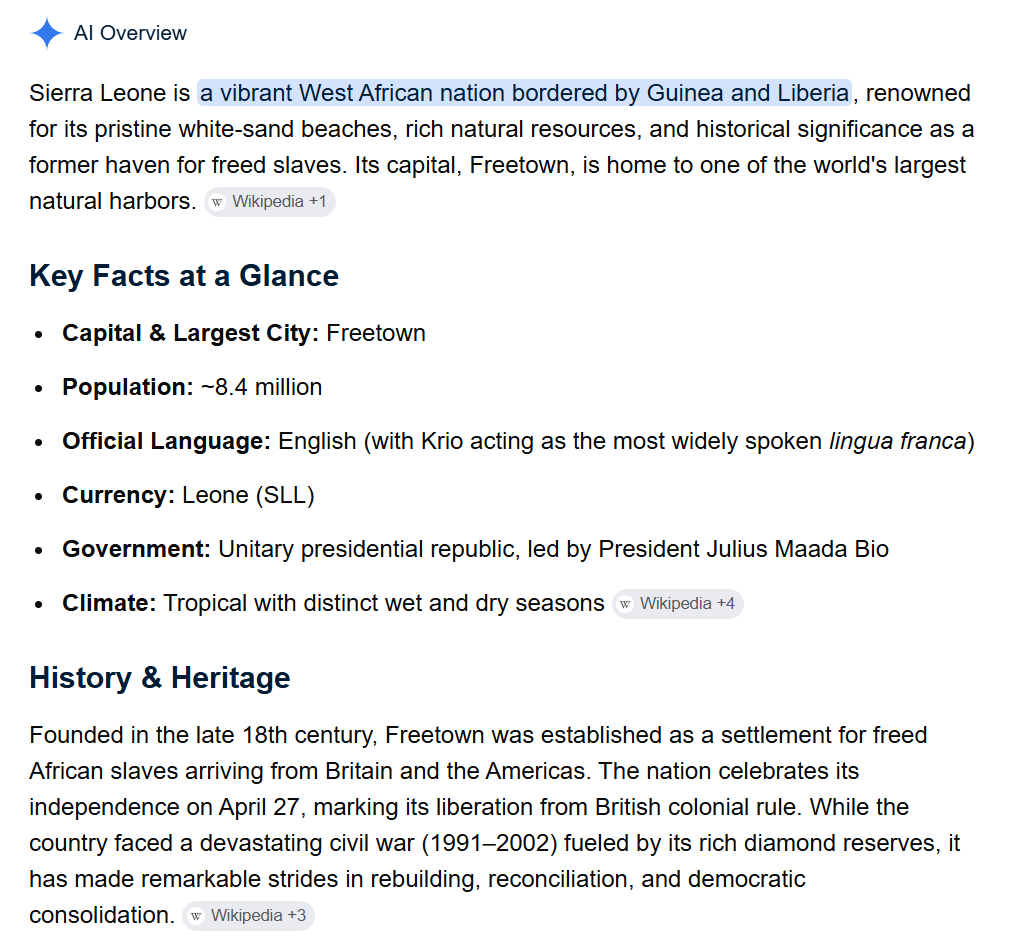
Wikipedia shows that Sierra Leone is one of the world’s poorest countries on a GDP (PPP) per capita basis. They’re doing a little better than Haiti, at least. Here’s something from Google AI that Sierra Leone shares with modern-day England (a predominantly Muslim nation, as measured by hours spent in religious observance), from which the population of Sierra Leone embarked:
Sierra Leone is celebrated for its deep religious tolerance, with a large majority of the population being Muslim alongside a significant Christian minority.
How did patriots treat their loyalist brothers and sisters (the author does not describe any binary-resisters back then, which is odd because we are informed that trans and nonbinary people have played crucial roles in majory historical events; Google AI: “Transgender people have existed throughout recorded history … countless cultures across the globe have historically recognized, honored, and documented individuals whose gender identities differed from their assigned sex at birth … the gender binary was not the default across all cultures”)?
Thomas Brown would always remember the day the American Revolution changed his life. It was the summer of 1775, the twenty-five-year-old’s first on his own American land. He had arrived in the colonies a year earlier from the blustery English port of Whitby, with seventy-four indentured servants in tow, to start a plantation in the Georgia backcountry, near Augusta. The newcomers must have marveled on reaching this strange, subtropical landscape, where giant black oaks stood like sixty-foot columns holding up the sky.1 Within nine months, Brown and his laborers had cut much of the forest into farms. He supervised his burgeoning 5,600-acre estate from a fine new great house, his tenants surrounding him in thirty-six farmhouses of their own. Horses filled Brown’s stables; cattle and hogs got fat off his grass and feed. He applied to the governor for more land, sent away to Britain for another shipload of workers, and enjoyed “the pleasing prospect to observe that his affairs in that country were likely to succeed beyond his most sanguine expectations.” But another force was set to transform Thomas Brown’s new world. He saw it coming one August day in the form of 130 armed men marching straight toward his house.
Standing on the porch, the sticky heat clinging to him like a second shirt, Brown tried to put the men off calmly. He had no wish to fight his own neighbors, he said, but he “could never enter into an Engagement to take up arms against the Country which gave him being.” The conversation quickly turned to confrontation. Some of the patriots “threatened that unless he would subscribe the association they would drag him by force to Augusta.” Brown backed into the house to seize his weapons, “determined to defend himself as long as he was able against any violence.” “It would be at the peril of that man who should attempt it!” he declared, brandishing his pistols. Six men lunged at him. Blades flashed, a gun fired, a rifle butt swung up over his head—and smashed squarely down onto his skull. Then blackness.
What came next he would reconstruct later, from flashes of recollection in a semiconscious haze. Shattered head throbbing, body bleeding, he rattles over a track. They reach Augusta. He is tossed to the ground, his arms lashed around the trunk of a tree. He sees his bare legs splayed out in front of him, funny-looking foreign things, and he sees hot brown pitch poured over them, scalding, clinging to his skin. Under his feet the men pile up kindling and set it alight. The flame catches the tar, sears his flesh. His feet are on fire, two of his toes charred into stubs. The attackers seize his broken head by the hair and pull it out in clumps. Knives take care of the rest, cutting off strips of scalp, making the blood run down over his ears, face, and neck. Half scalped, skull fractured, lamed, slashed, and battered, Brown—remarkably—survives. Later, a doctor comes to the place where he is confined and bandages him up, setting his broken bones on course to heal. A sympathetic guard, moved by the spectacle of this badly damaged man, agrees to let Brown get away. He slips out of custody and rides over the border into South Carolina to take shelter with a loyalist friend.
A rich historical tradition has portrayed the American Revolution first and foremost as a war of ideals—not a war of ordeals. Yet for Brown and thousands more civilians caught in the conflict, this was what the revolution looked like: mobs on the march, neighbors turned enemies, critical decisions forced under stress.
The new states were officially intolerant of those who refused to join the traitorous rebellion:
Within six months of the battle, six states had stiffened and expanded their test laws, enforcing loyalty oaths. In 1778 New Hampshire, Massachusetts, New York, and South Carolina all passed punitive laws allowing loyalists to be arrested or banished. Pennsylvania passed an act of attainder against “divers traitors.” New Jersey established a committee of safety. Delaware prohibited trade with the enemy. Georgia implemented a vague but sinister law against “the dangerous consequences that may arise from the practices of disaffected … persons within this state.”
A different side of George Washington is revealed by the book. When he’s upset with the loyalists, he threatens to execute a completely unrelated British prisoner of war (Charles Asgill). George Washington was most passionate on the subject of whether slaves freed by the British could depart for England or to what would ultimately become Canada:
But Carleton had insisted during the evacuation of Charleston that slaves promised freedom should have it—and his word held just as firmly now in New York City. He implemented his own version of the commission General Leslie had established in Charleston, to assess the cases of blacks claiming freedom. Every Wednesday from ten till two, members of this committee (made up of four British and three American representatives) sat in Fraunces’s Tavern on Pearl Street to hear out disputes over former slaves. Those cleared by the board received a printed certificate of freedom signed by the commandant of New York, General Samuel Birch. Then at the docks, inspectors entered the names of all departing blacks into a sprawling register, together with their ages, former owners’ names, brief physical descriptions, and notes—ironically enough, much the same information recorded for slave sales. The register, known as the “Book of Negroes,” forms a genuinely exceptional document of exodus; nothing like it exists for the thousands of white loyalist refugees. The reason for such careful bookkeeping was that these migrants were also exceptional compared to whites. They could be considered property as well as people. The volume that recorded the black loyalists’ freedom thus reinscribed their former status as slaves.
But Washington started off the conference by lecturing Carleton on what, to him, was the most urgent matter of all: the removal of human property from New York. Carleton calmly explained that a fleet had already embarked for Nova Scotia with registered black loyalists on board. “Already imbarked!” exclaimed a startled Washington. (He might have been yet more surprised to know that one of the blacks embarked, Harry Washington, had once belonged to him.) Carleton replied that he could not abide by anything in the treaty “inconsistent with prior Engagements binding the National Honor, which must be kept with all Colours.”
Washington’s letter to his British counterpart:
I was surprized to hear you mention that an Embarkation had already taken place in which a large Number of Negroes had been carried away. Whether this conduct is consonant or not to, or how far it may be deemed an Infraction of the Treaty, is not for me to decide. I cannot however conceal from your Excellency, that my private opinion is that the measure is totally different from the Letter & Spirit of the Treaty.
Carleton’s answer:
The negroes in question … I found free when I arrived in New York, I had therefore no right … to prevent their going to any part of the world they thought proper.
(The exchange is consistent with Dr. Samuel Johnson’s famous line: “How is it that we hear the loudest yelps for liberty among the drivers of negroes?”)
The author points out that the exodus of the loyalists and the systems set up for housing and feeding them in England, Canada, and other parts of the British Empire, anticipate today’s internationl aid infrastructure.
Since we’re right in between Pride and Nonbinary Awareness Week (July 13-19 2026), maybe Gemini can fill in the gaps left by this author, who left out from her 2011 book the crucial role played by the nonbinary and transgender in the American Revolution:
Because regular soldiers were rarely subjected to medical exams unless severely wounded or deceased, historians widely agree that there were likely dozens, if not hundreds, of individuals who crossed gender lines to serve in the military or support the war effort whose names and stories were simply never caught or recorded.
Florida was against Washington in 1776 and against Lincoln in 1861!
In the spirit of reconciliation, here is a sympathetic American painting of departing loyalists
https://commons.wikimedia.org/wiki/File:Tory_Refugees_by_Howard_Pyle.jpg
Excellent point, EG! Those positions make Florida solidly anti-war, because both Washington and Lincoln were fighting wars that didn’t need to be fought! (Canada became independent without any bloodshed, so that proves that Washington’s rebellion wasn’t necessary; slavery ended almost everywhere outside of the Arab world within a few years afer the Civil War, which proves that the Northern War of Aggression, as the Southerners call it, wasn’t necessary (and, actually, if not for Washington’s war, there wouldn’t have been a slave-related dispute because https://en.wikipedia.org/wiki/Slavery_Abolition_Act_1833 would have freed all American slaves).
> Because regular soldiers were rarely subjected to medical exams unless severely wounded or deceased
The minute men must have thought it was a little weird that Corporal Smythe had to squat to pee.
@phil I was hoping you would attend our President’s July 4th rally and write about it. Of course it will be HUGE and GREAT.
99 degrees in the shade is a little toasty for me.
We’re going to walk or bike over the local spring training baseball stadium (home to the Marlins and Cardinals) for a minor league baseball game surrounded by a massive block party and followed by fireworks that the stadium shoots off. Senior Management will be home providing necessary support to Mindy the Crippler (not a fireworks fan!)
https://www.jupiterdaily.com/event/mega-bash-2026-baseball-fireworks-celebration/2026-07-04/
Wait, what? No Pride, no transgender athletes, no drag show at this minor league baseball game? How un-American for America’s 250th celebration!
Thank you Philip for this great post and the information. Way more informative than anything I ever read by Zinn.