American and European peasants are often told by their respective elites that immigration is necessary because a shrinking and/or aging population inevitably leads to an economic crisis.
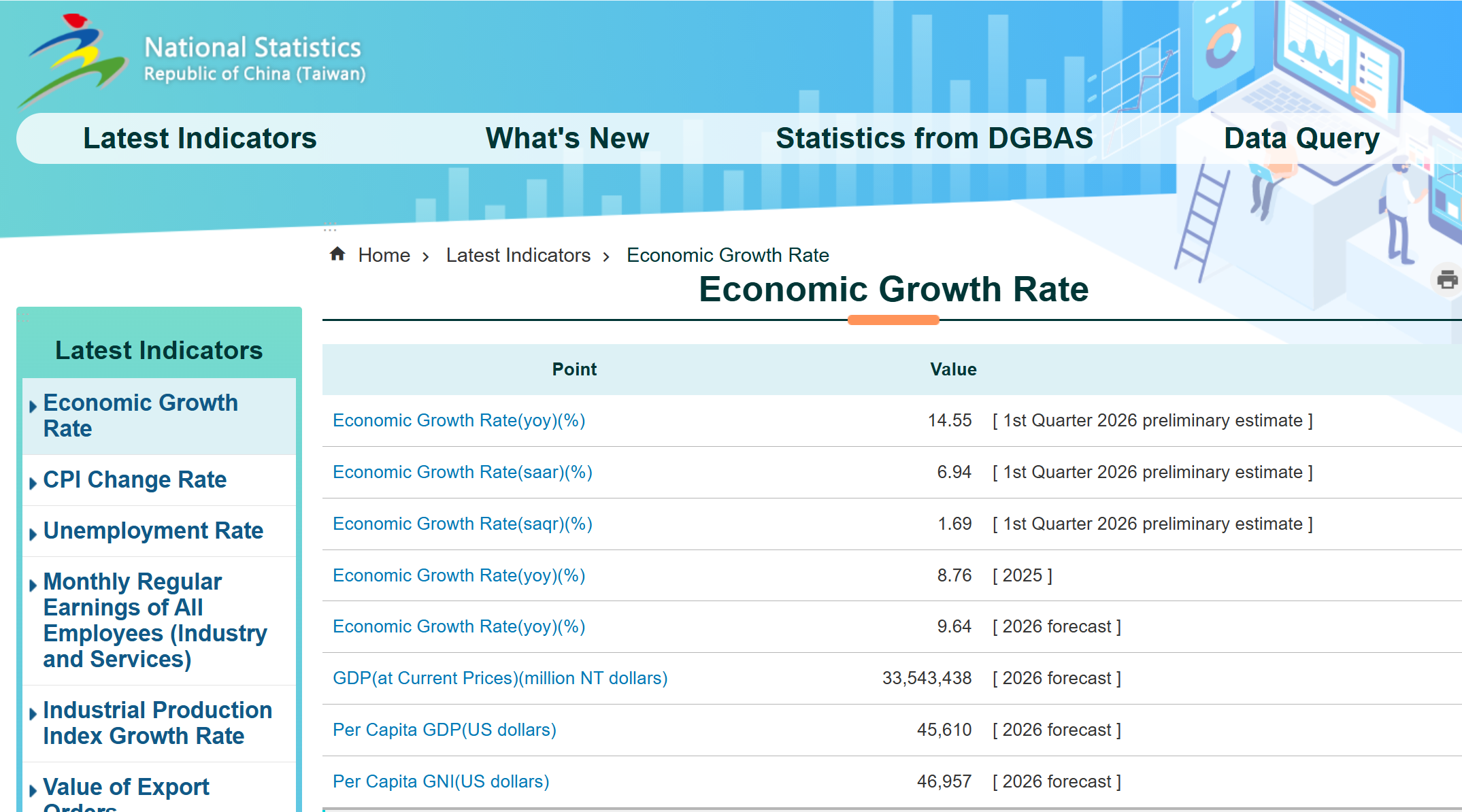
Let’s look at Taiwan. The working-age population peaked in 2015. In real terms (adjusted for inflation), the economy has grown by more than 50 percent since then. What about right now? It’s growing at a rate of over 10 percent per year.
What does Google AI say about South Korea in two separate queries?
South Korea is experiencing an unprecedented demographic crisis, driven by having the world’s lowest fertility rate.
South Korea’s real GDP grew by an impressive 1.8% in the first quarter of 2026, representing a 3.8% year-over-year increase.
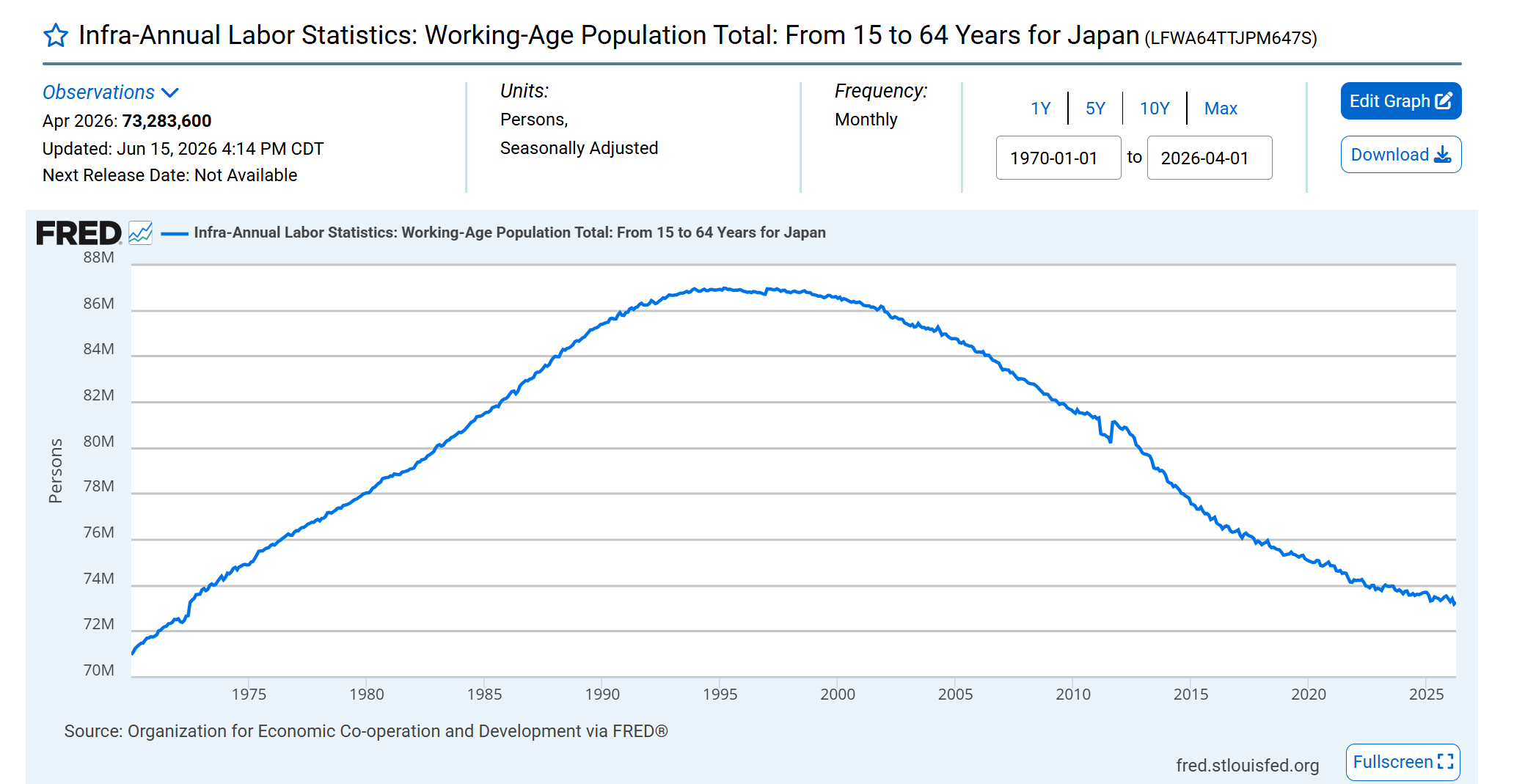
Japan’s labor force has been shrinking since the mid-1990s:
During what we’re told is a demographic catastrophe, Japan’s real GDP has been growing steadily:
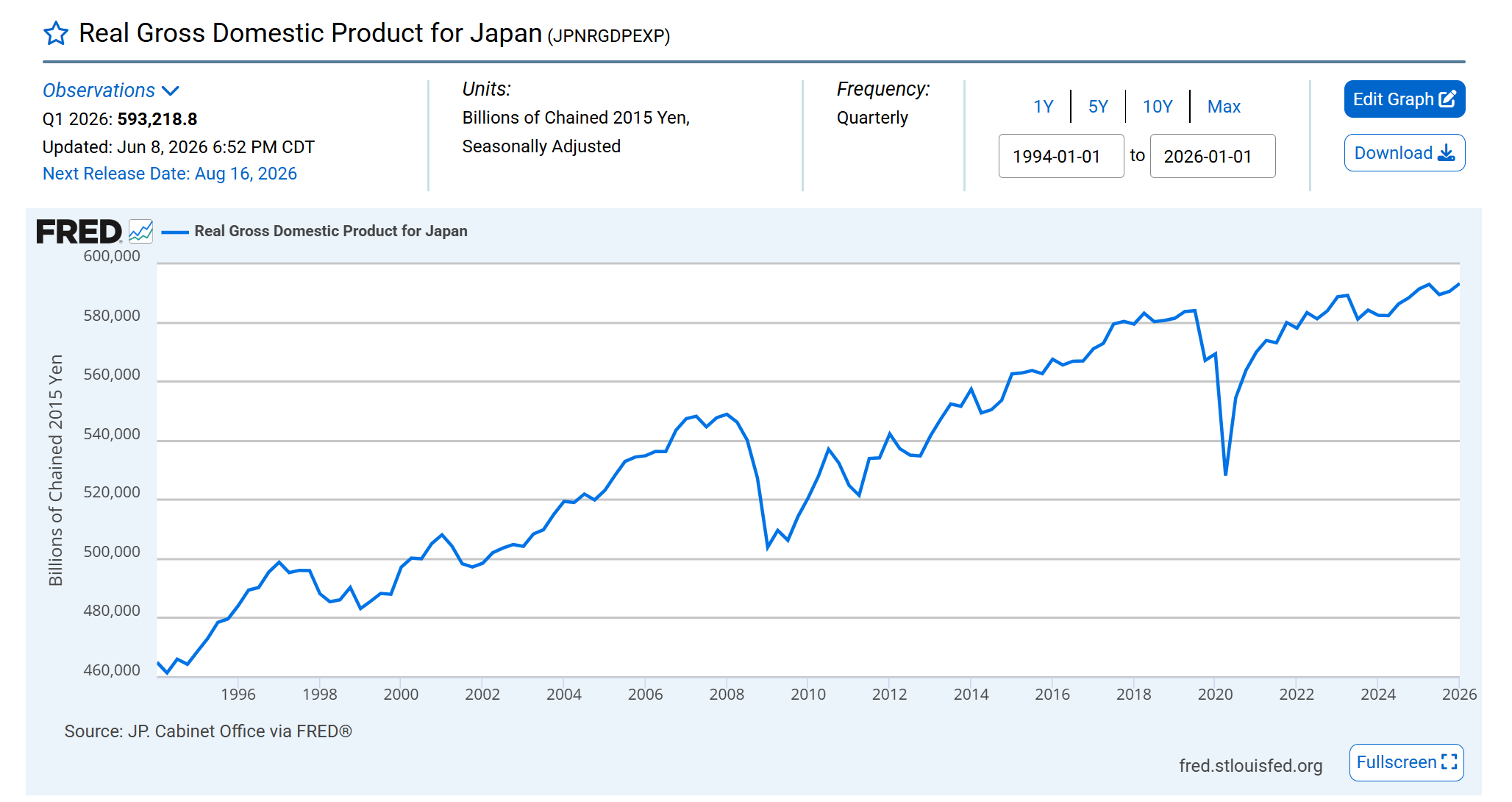
(Of course, this means that the real GDP per worker is growing quite robustly.)
How does the religious belief that population shrinkage is an economic catastrophe remain unchallenged given the above examples?
The powers that be don’t want to be cared for in the rest home by soulless A.I. robots, so they make shit up in order to get a fresh supply of babies? They don’t want Somalians to abuse their elders, or not abuse them by being absent? [Laughing is triggering the neuralgia again, so ta for now.]
They were famously maxed out, years ago. US still has a ways to go before it’s as packed as Japan in the 80’s.
Only Wall St and politicians care about GDP. Actual citizens care about their net income and it’s buying power for housing, living, and leisure.
Maybe low-IQ citizens don’t care about GDP, but anyone with an IQ above that of Joe Biden cares about it. Over the long-term, GDP is the *single best* predictor of the net income for a country’s citizens.
@Economics 101: In the last 10 years, Canadastan boosted its GDP by bringing in millions of “low-productivity” newcomers, so hooray! Yet their inflation-adjusted GDP-per capita-fell ~10% in absolute terms, and almost 50% relative to USA. Are its citizens happier about higher GDP?
Anon, simple answer to your excellent question on Canadastan: no. Canadastan is a shithole because of policies such as the one you reference. Allow me to modify my prior post by inserting per-capita GDP in place of GDP. Thank you for your attention to this matter.
Related #economics #inflation
> Grocery Order From Target That Cost $64 In 2020 Is Now $158 In 2026
https://theeconomiccollapseblog.com/a-28-item-grocery-order-from-target-that-cost-64-50-in-2020-is-now-158-30-in-2026/
From TFA > Not one member of Congress has looked at a grocery receipt in decades.
That’s why AoC ran for Congress, IIRC, so she/her/them could do the same. An then, of course, the food stamp privileged who elect them have never looked at a receipt. “Oh, SNAP!” Leaving OAG to cough up the difference.
Having been shown several houses this year, one would never know foreclosures are up. Vinyl siding starter homes for $550K. Maybe some serious near-bubble-burst propping up going on?
Thete is no right on set bascket of goods price in Target. Making US weaker or electing Politburo to look after prices will make goods scarcer and thus more expensive. Beyond fighting regular fraud or already illegals schemes direct positive role of government in economy is limited. Society at large affects economy. US military strength affects economy inderectly. Governments main positive contribution to economy is to keep it free and to protect it from hostile foreign government schemes.
“There are four kinds of countries in the world: developed, undeveloped, Japan and Argentina” –
Simon Kuznets (Dr., PhD, Nobel Prize etc., etc.).
Economic science cannot predict Japan. Or Argentina. Or East Asia. Or anything else.
But these are just special corner cases. Do not worry and trust the experts!
So, if Japan’s labor force is shrinking, but their real GDP is increasing, then their GDP per capita is increasing even more so. Impressive.
No matter. The US needs millions more low-skill, immigrants to save SS!
> How does the religious belief that population shrinkage is an economic catastrophe remain unchallenged given the above examples?
Here’s a yogic way of analyzing that I find very useful. A said statement X in context C, if and only if, A could have said statement not(X) without getting persecuted in context C.
In other words, if the opposite of X cannot be said comfortably in a context then it’s not just X that’s being said, a propaganda is being propagated as well.
I don’t follow what politicians say, but my guess is that they will lose power or not gain more power if they said or accepted that lesser population leads to more GDP. The context here being of capitalism and remaining in power.
A country’s GDP is tied to its culture, values, and work ethic. If someone claims those factors play no role, that’s plain stupid.
Taiwan, South Korea, and Japan continue to be known for strong work ethics, discipline, and a culture that emphasizes education, productivity, and personal responsibility. Unlike other developed nations, Taiwan, South Korea, and Japan are not polluted (yet?) with woke ideologies such as DEI, LGBTQ and no-human-is-illegal believes.
It’s simple. Japan has such impressive GDP per capita growth because Japan is full of Japanese. While the U.S. is full of…errr…aahh…ummm…never mind.