Rotorcraft and vertical lift technology will be the featured highlights at the new EAA Vertical Lift Center to be unveiled during EAA AirVenture Oshkosh 2026. The 73rd Experimental Aircraft Association fly-in convention is July 20-26 at Wittman Regional Airport.
As announced at EAA AirVenture Oshkosh 2025, this area will feature an emphasis on helicopters and VTOL aircraft as part of a partnership with the Robinson Helicopter Company and Vertical Aviation International (VAI), a membership organization dedicated to supporting the vertical lift industry. The dedicated space within AirVenture’s Aviation Gateway Park will display aircraft as well as promote rotorcraft education, industry recruitment, and innovative technology in the vertical lift industry.
“The future of flight is vertical, and EAA AirVenture in Oshkosh is an ideal stage to sponsor and showcase the innovation happening across our industry, from traditional rotorcraft to the next generation of piloted, remotely piloted and unmanned systems,” said David Smith, President and CEO of Robinson Helicopter and sponsor of the inaugural Vertical Lift Center at AirVenture 2026. “As the demand for skilled engineers, A&P mechanics, and test pilots reaches an all-time high, Robinson is committed to supporting education and careers across vertical lift. We encourage everyone to visit the Vertical Lift Center to discover how these advancements are shaping the next era of flight and how they can become a part of it.”
Robinson, under new MIT-educated leadership, seems to be making dramatic project in autonomous aircraft. Who’s going even faster, though? The hurry-up-and-deliver crew at Amazon Prime Air (Wokipedia seems to be understating the scale of this enterprise):
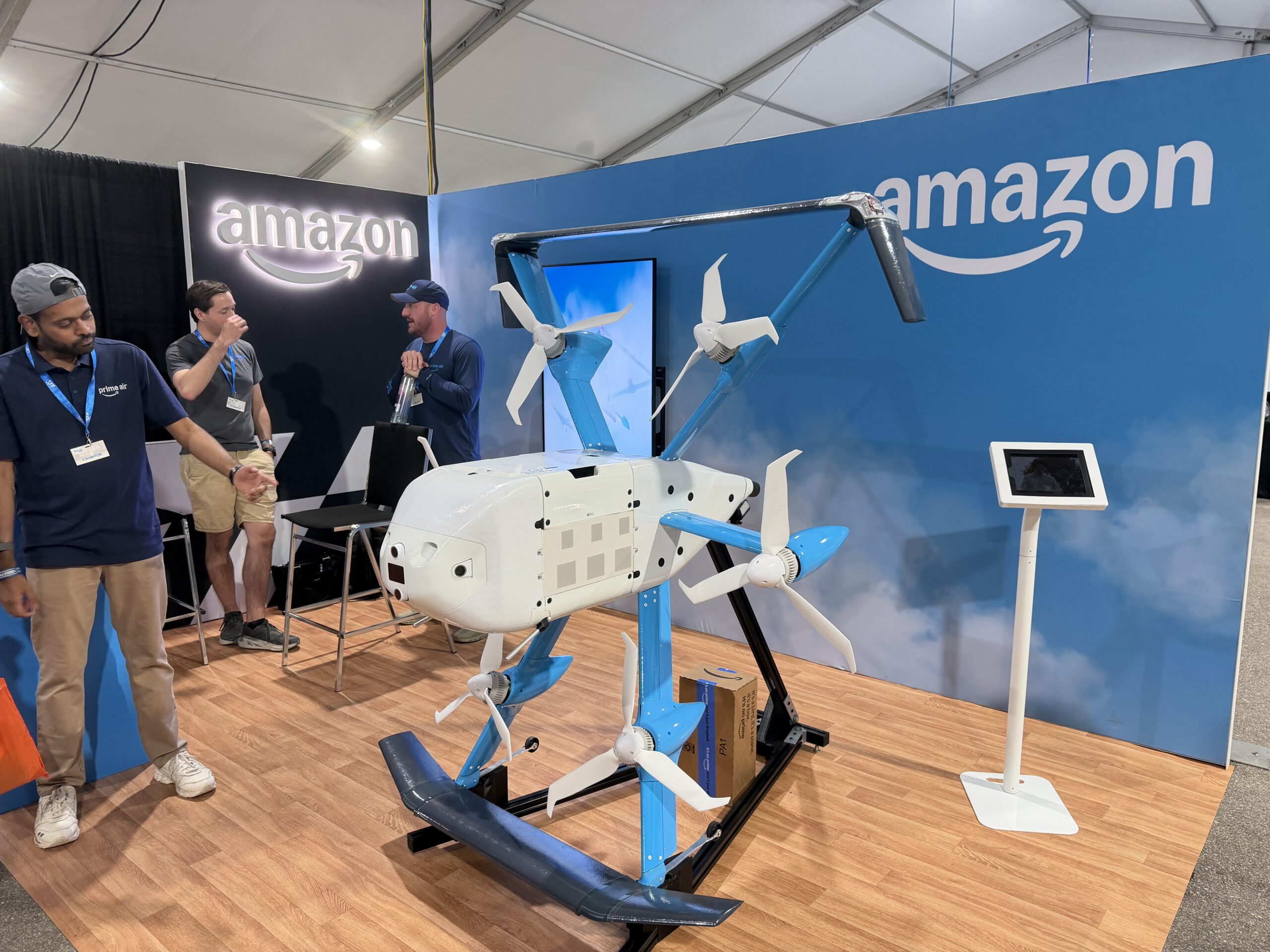
All of the FAA regulatory hurdles that are impossible to surmount Amazon seems to have surmounted, e.g., operating Beyond Visual Line of Sight (BVLOS, for which Amazon got approval in 2024). The company is building its own airframes, its own engines, its own software, and then is operating its own Part 135 cargo airline. This is a throwback to the old days of Boeing, before President FDR broke it up into airframes (Boeing), engines (Pratt), and airline (United). (Bill Boeing quit at this point and became a developer of racially segregated suburban real estate.) The FAA seems to be trying to encourage a whole industry in this area, but among the vendors at Oshkosh, Amazon appeared to be way out in front. The guys in the booth said more than 1,000 drones were currently in operation and that the assembly line is capable of producing mroe than 1,000 additional drones per year.
Could a human pilot do what the Amazon drone does? It would be unfair to ask a human to drop a Blackhawk into a driveway surrounded by trees, but suppose that we gave a Robinson R44 pilot the same amount of open space relative to machine size. Could the R44 pilot go straight down, avoiding obstacles and vortex ring state, push a package out the side, and lift back up? Theoretically, yes, but to do it 50 times per day every day would require a remarkably high level of proficiency, not to mention a ton of power! (Helicopters are most efficient when taking off and landing like airplanes, ironically.)
What’s the planned scale for Amazon? April 2026 article:
Jassy said Prime Air service will be able to serve communities with 30 million customers by the end of the year, with a much wider catalog of goods to choose from, and is expected to annually deliver 500 million packages by the end of the decade in under 30 minutes. The ability to scale up drone deliveries is possible now because of more than 85 same-day fulfillment centers that carry Amazon’s top 90,000 products and serve as launch pads for the autonomous delivery vehicles.
Does anyone need this? Consumers in China already experience something similar, though delivery is mostly by scooter. I was surprised during a 2019 visit to Shanghai at the lack of any stores like CVS and also at the absence of supermarkets. It turned out that everyone was getting everything delivered in about the same amount of time that it would have taken them to walk to CVS and back.
Amazon has competition in this area, of course. Zipline is one and they’ve supposedly done a couple of million deliveries, but the product that they brought to Oshkosh didn’t seem as finished as Amazon’s. Wing, part of Alphabet/Google, has a similar system to Zipline’s in that the main drone stays up in the sky while a sub-drone is lowered by cable. The Amazon solution seems cleaner and a better fit for suburban American life. The “longline” idea does seem to open up the possibility of deliveries to tighter spaces, e.g., within the Mamdani Caliphate or San Francisco, but how can it work to deliver high-value packages autonomously in those places given the number of package thieves?
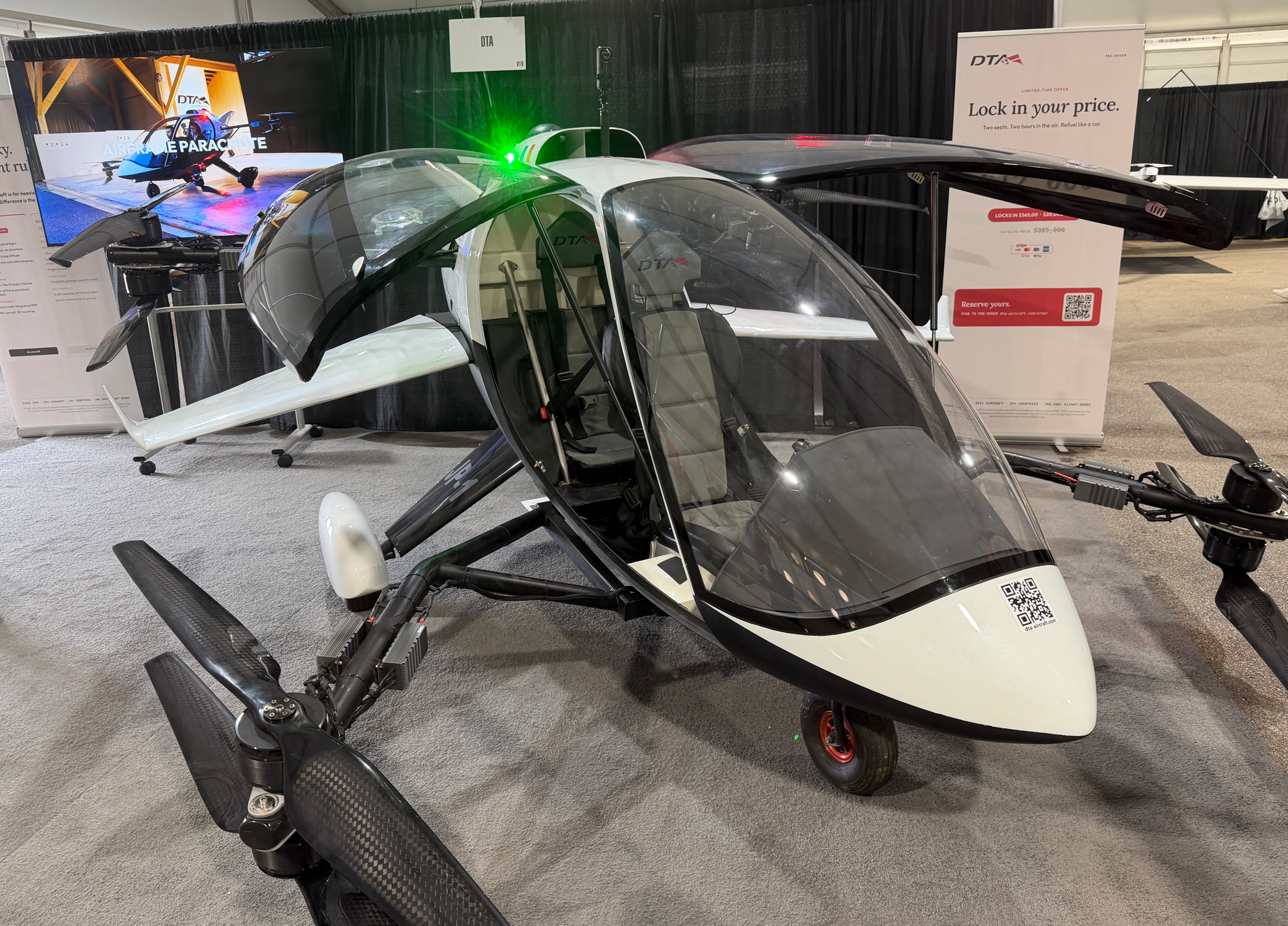
The barriers to entry for creating human-occupied eVTOL “super drones” seem to be remarkably low right now. Some truly tiny companies, e.g., with only 10 engineers, were exhibiting. Below is a sampling of some of the human lifters.
Here’s a hybrid from France (reclaiming the country’s early leadership in aviation!) with two hours of flight time:
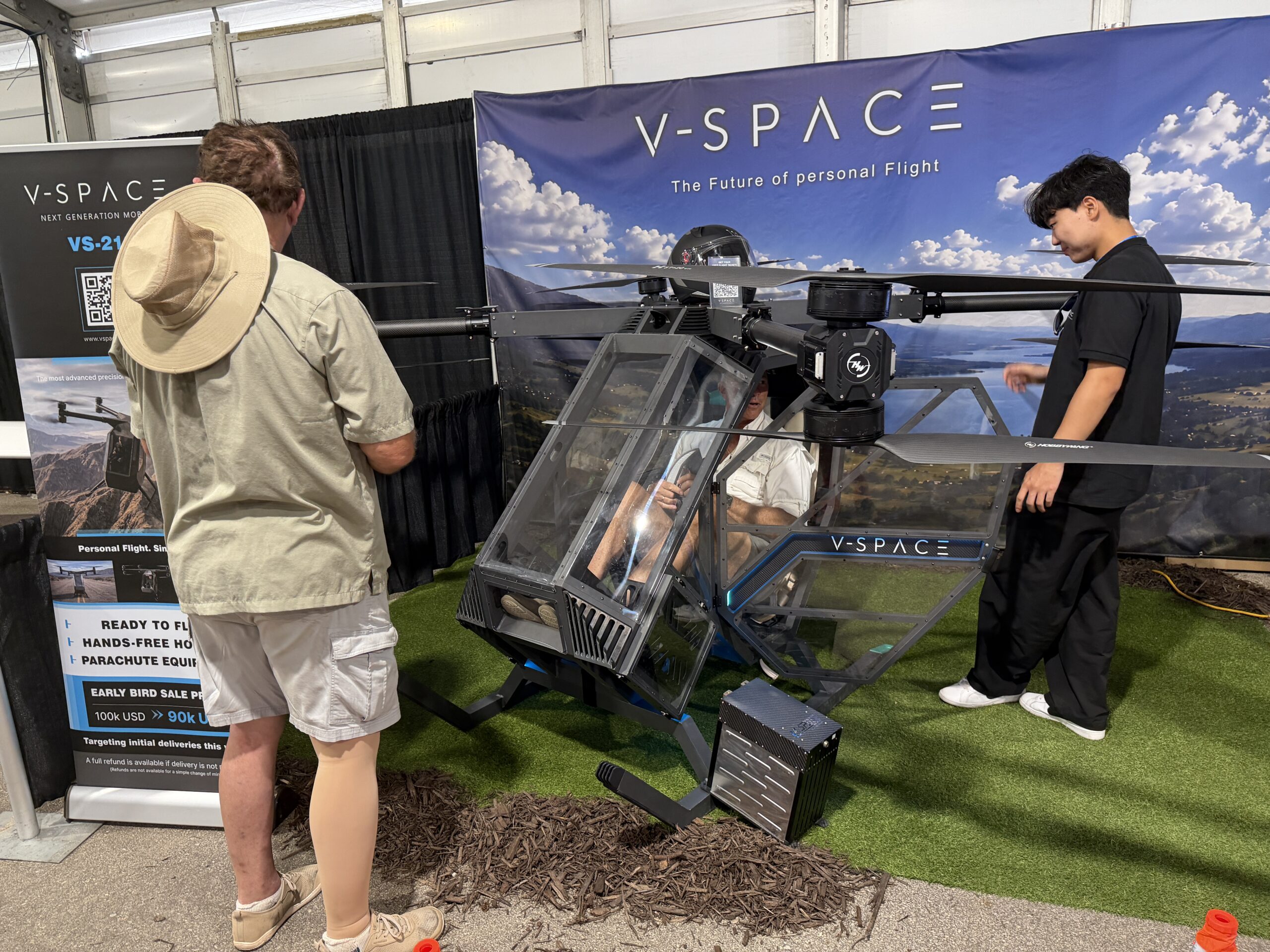
Here’s one from Korea, apparently sized for Koreans:
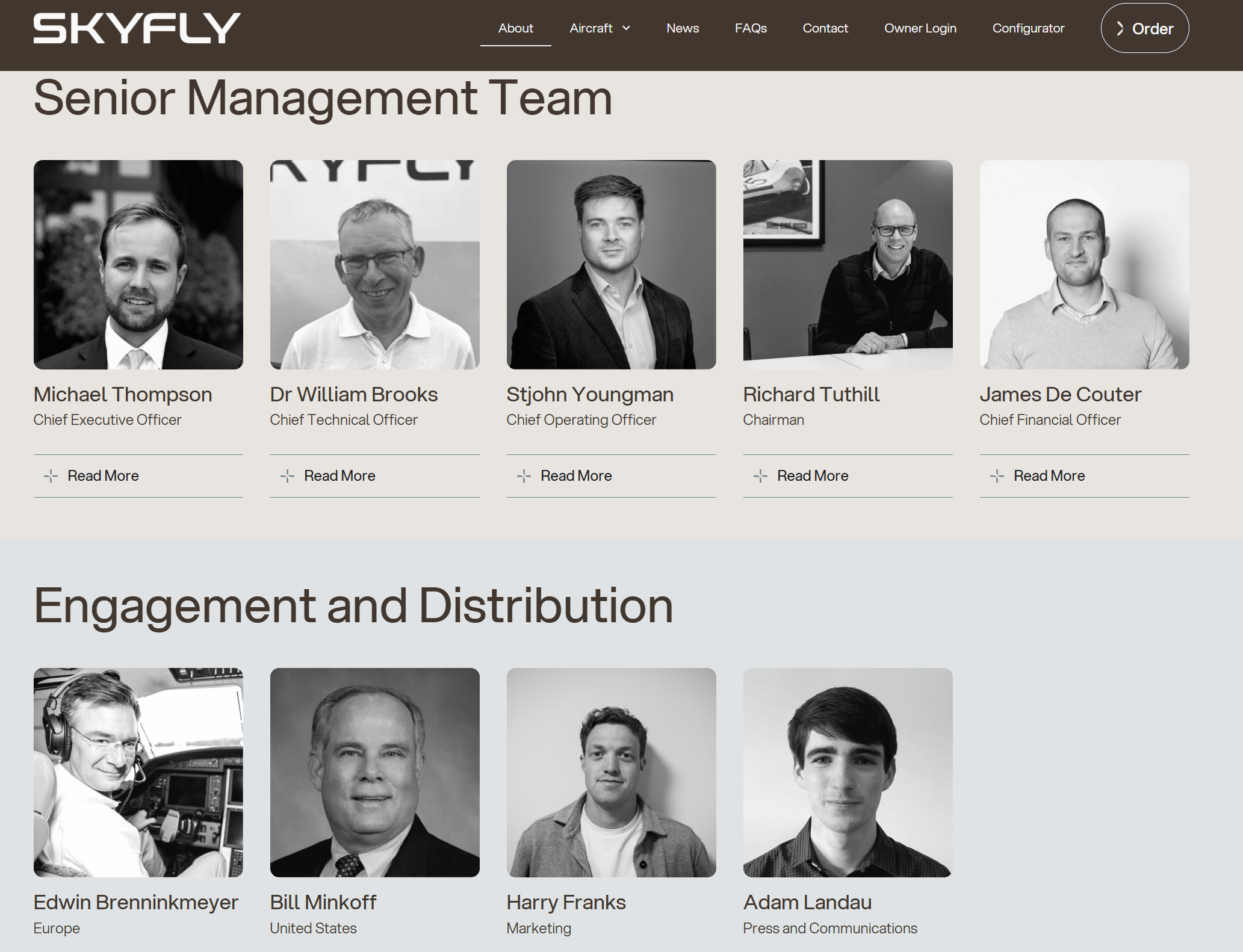
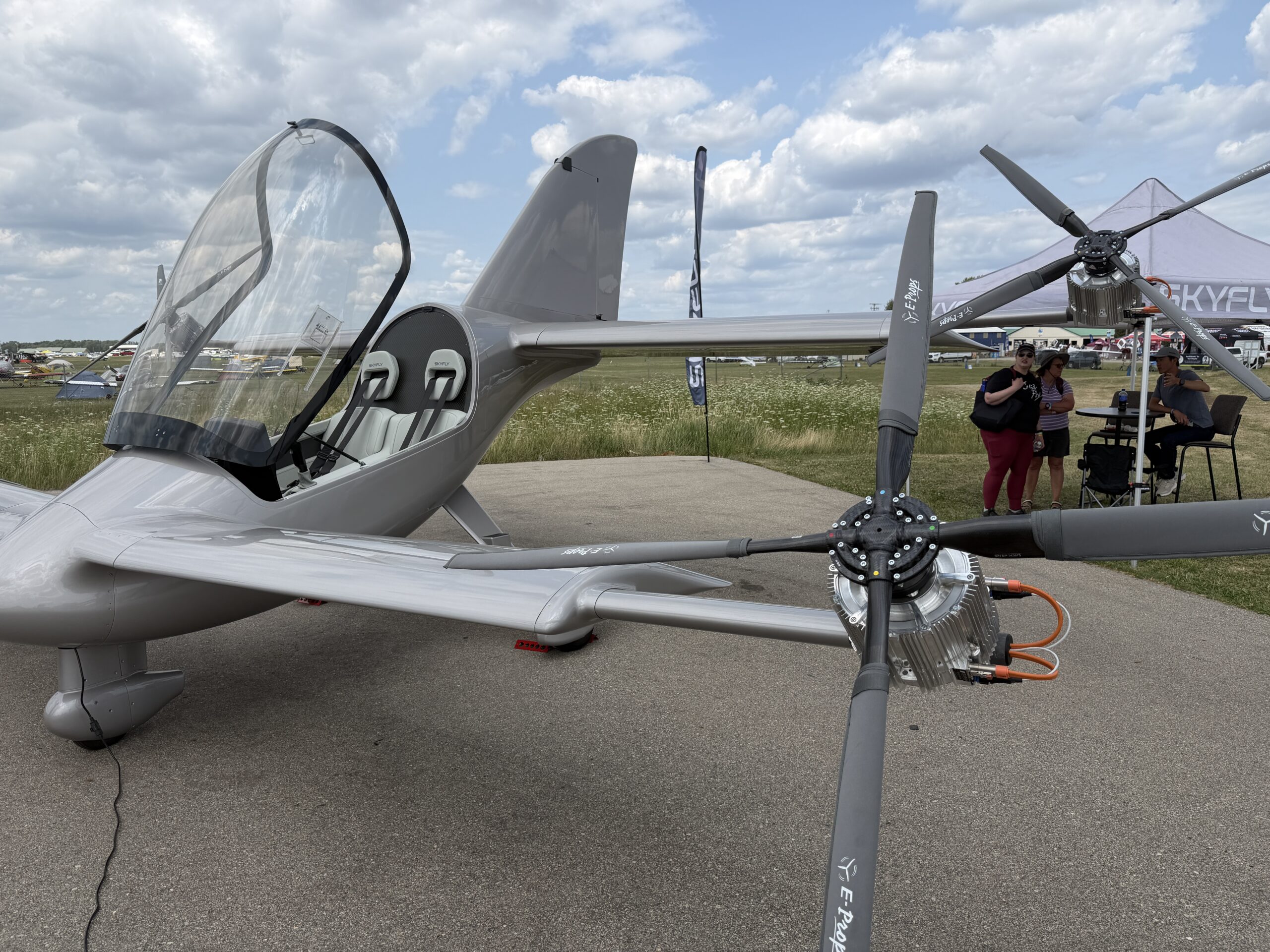
We’re informed that everything good that happens in Britain is thanks to non-British immigrants, but the team at Skyfly has a distinctly pale appearance:
Their product had an encouraging finished look (the potential customer in the red pants, however, like she might be a better fit for a Cirrus SR22):
Jump Aero was exhibiting in a separate tent. This company, founded by a co-founder of Terrafugia (a flying car), offers a practical use case for human-occupied eVTOL: deliver a paramedic to the scene of an accident.
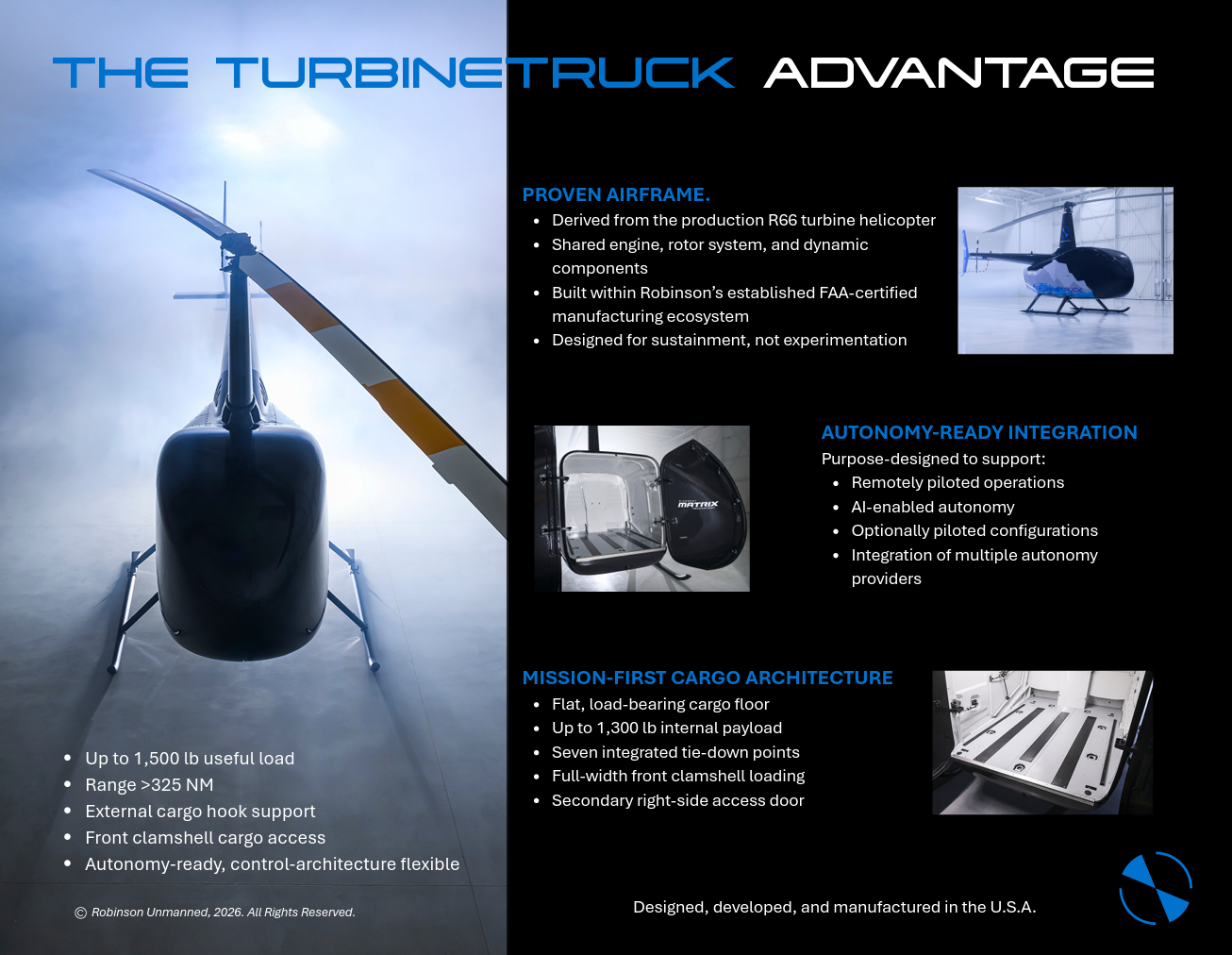
What about Robinson, the sponsor of all of the above? If we ever decide that we want to win a war, rather than almost immediately surrendering, Robinson is there with an autonomous R66 that can deliver ammo to a beleagured hilltop.
> Could the R44 pilot go straight down, avoiding obstacles and vortex ring state, push a package out the side, and lift back up?
So vortex ring state isn’t an issue for the drones? (Pardon my ignorance, I don’t know a hippie collective from a helicopter collective. In my defense the Wikipedia article states at the top “This article may be too technical for most readers to understand.”)
OAG: A drone that has a single down-pointing rotor could definitely get into VRS, though probably the perfect skill level of the robot pilot would prevent it (simply don’t descend more than X feet per minute (X=300 in a Robinson)). If the multiple rotors of a familiar drone are all at slightly different angles, though, VRS seems intuitively unlikely to develop because there’s no single direction that the drone could go in which it would be heading into all of the rotors’ downwash.
Thanks! I suppose this could be taken as support for your argument:
> Though vortex ring state (VRS) contributed to a deadly V-22 accident, flight testing found it to be less susceptible to VRS than conventional helicopters.
https://en.wikipedia.org/wiki/Bell%E2%80%93Boeing_V-22_Osprey
It might make an interesting aero engineering student project to demonstrate the principles at hand.
@OAG
> So vortex ring state isn’t an issue for the drones?
Interesting insight. Not sure this video helps one understand the difference in the VRS modes (they kind of look like phase-state diagrams of matter) between single and multiple rotors, but it does show it is an issue with multiple rotors too. The was part of an academic paper on the subject. (What happens when a motor fails is another interesting issue, structurally and controllability-wise, and somewhat of an active research area, IIRC.)
Remember when Bezos embarked on this journey in 2013, 7 years after most of the hobbyists had been building quad copters from scratch & 15 years after the roswell flier. They wouldn’t hire anyone but recent ivy league PhD’s on quad copters. The timeline for top tier companies is how long it takes someone to finish a PhD on what was done in a garage. Expect zipline to get acquired by amazon. Never understood their upside down docking port.
Let’s not forget the New Englad Favorite for eVTOL coming out of Vermont with https://www.jobyaviation.com/
JJ: Are you thinking of Beta, based in Burlington, Vermont? They do have a rainbow flag hanging at the center of their main hangar so they probably have much in common with the California-based Joby. Incredibly, JOBY has a market cap of $7 billion despite not being sufficiently advanced to fly an aircraft at Oshkosh. BETA is worth $4.4 billion. Their machine is less ambitious (mostly an electric airplane), but it seems to work well.
Both companies are down from what they were worth just after their IPO. That’s in nominal dollars. Adjusted for Bidenflation, the two companies are down at least 50%. Compared to the S&P 500, both can be considered disasters.
Airbus and Boeing are each worth $170-180 billion. So these electric aircraft companies whose products aren’t certified are somehow worth a non-negligible percentage of the value of companies that can make near-infinite revenue even if they never build or sell any additional aircraft (just sell parts for the existing fleet).