Our clay tile roof was installed a year ago and came with a 7-year warranty with the following condition: “All warranties require free annual maintenance inspections, in order to maintain validity throughout the duration.” During this year’s inspection, done by drone because the roof was slightly wet and clay is extremely slippery/hazardous when wet, a cracked tile was discovered.
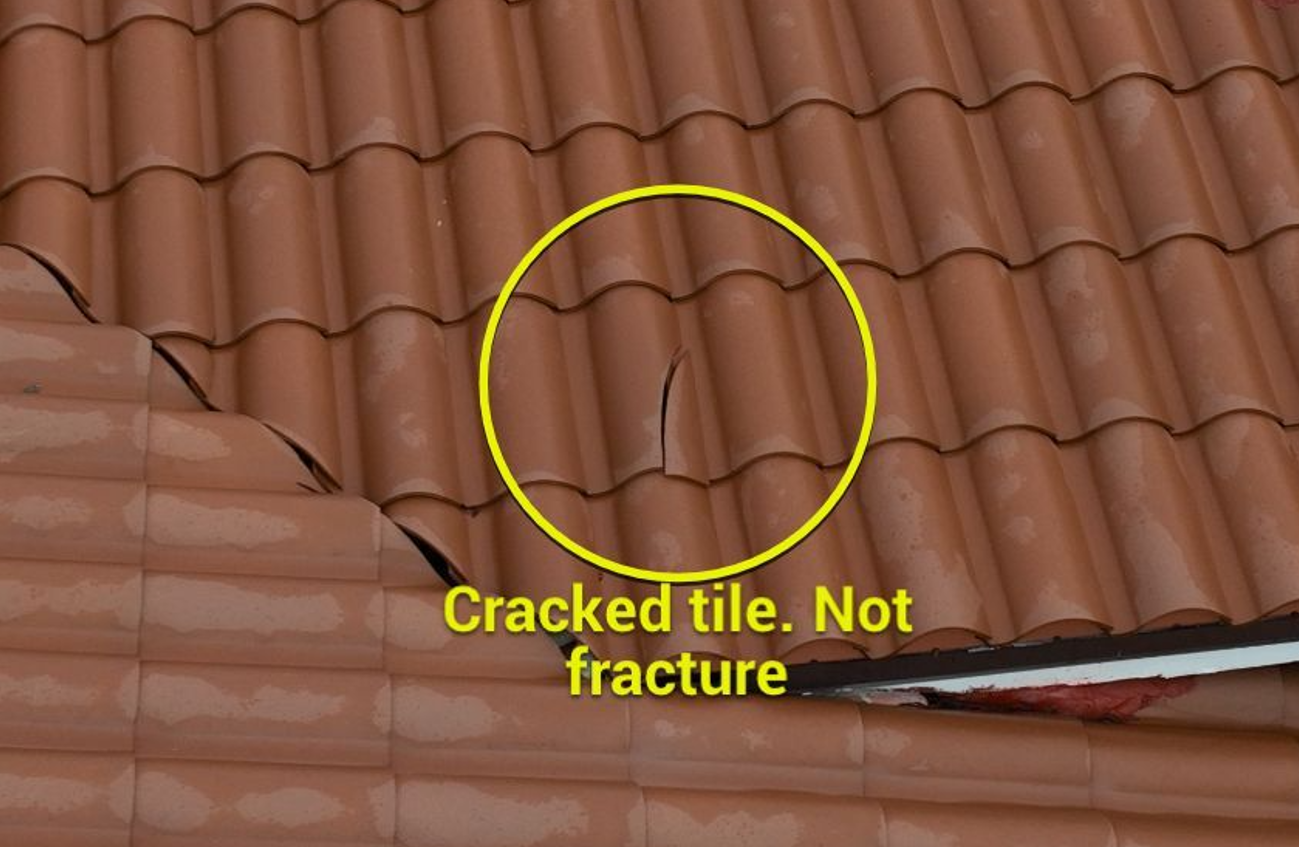
The roofer has to fix this at no charge? Email from the roofer: “Clay tiles will not crack like concrete tiles since they aren’t absorbing water and would only crack from impact of some kind.”
There haven’t been any real wind storms here in the past year (the last “major hurricane” in Palm Beach County was in 1949). The cracked tile isn’t near a coconut palm that could have dropped a heavy nut onto it. I uploaded the photo to my warranty analyst (ChatGPT):
The crack looks more like a structural/installation crack than a classic impact break. It is a fairly clean, narrow crack running longitudinally through the tile, without an obvious crater, chip, crushed spot, or radiating fracture pattern where something struck it. Impact from something substantial—fallen branch, tool, golf ball, worker stepping hard on an unsupported portion—often leaves some evidence at the point of contact.
On a one-year-old roof, plausible non-impact causes include a hairline crack present when installed that subsequently opened up; a tile stressed by its nail/screw/clip or adhesive; inadequate support beneath part of the tile; somebody walking on it during installation or later work; or occasionally a manufacturing defect.
(I’m pretty sure that we’ll still have to pay the roofer to fix the problem that his crew created, or maybe that the tile manufacturer (Verea in Spain (maybe they’re too busy freeing “Palestine” to go the last kilometer in quality control?)) created, but at least now we know that we’re being cheated!)
Also at the intersection of AI and Florida homeownership, I asked ChatGPT about what stain to use for the front door, beginning to look a bit shabby. Absent AI, I would have tried to buy Sikkens, making stain in the Netherlands since pre-Islamic times (1792). ChatGPT had a different perspective:
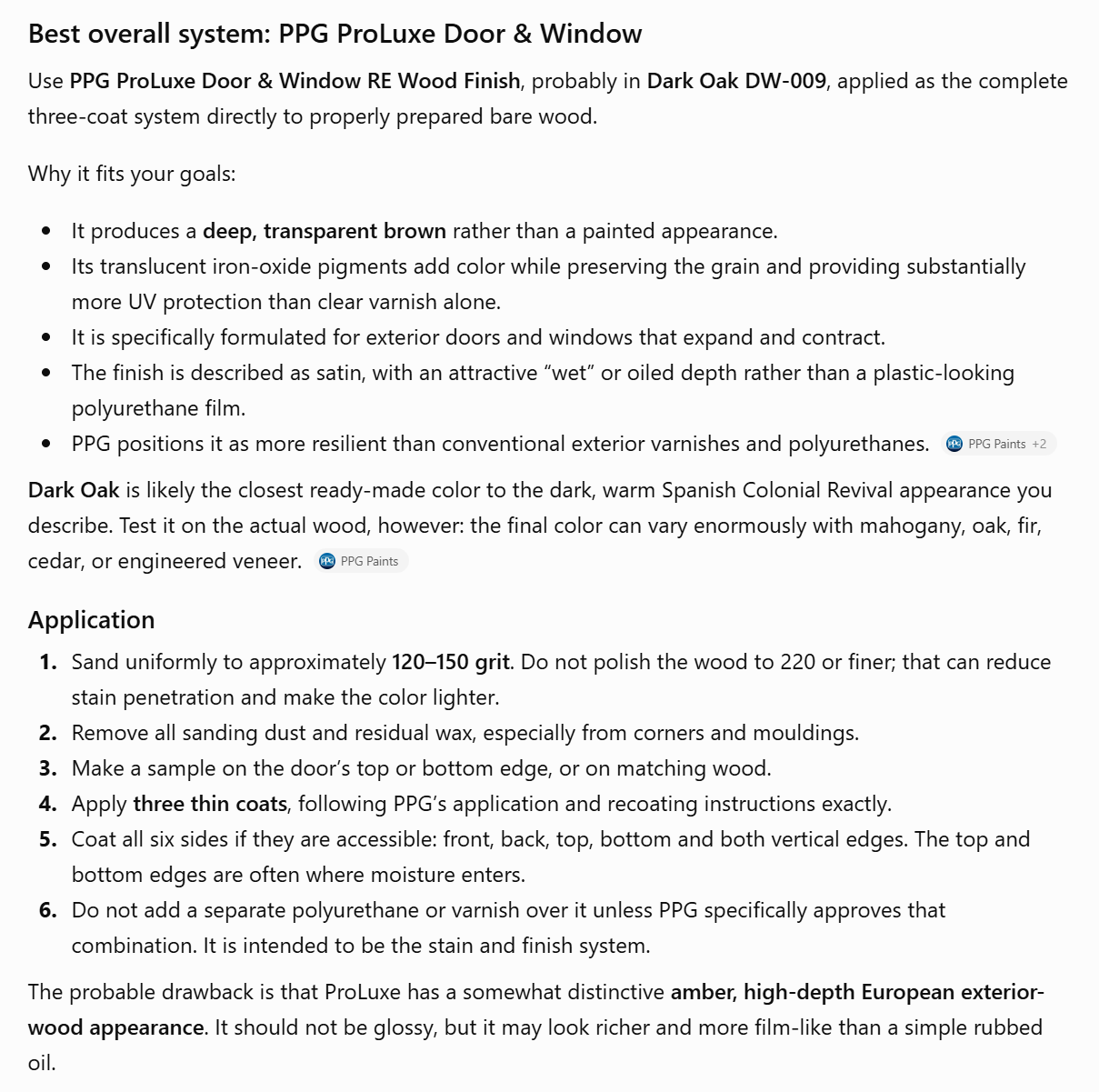
I bounced the question to Grok and Claude and learned… that Sikkens in the U.S. is marketed as “PPG”. The AI was still useful, though, potentially, because it calculated how many quarts are needed and that there is a specific stain for doors as opposed to siding.
Why not go and fight the good fight for the rest of us. Sure, you can afford to be scammed by them but the working class cannot. In the sense that you are retired, my retired grandfather would also write (futile, but nonetheless he tried) letters to manufacturers he thought were scamming the people.
I had a metal roof installed on my FL home in 2018 (8 squares + an over-sized, detached 2-car garage: $17,500, including 3 inches of insulation board under the metal). Comes with a full 10-yr parts and labor warranty, plus 50-yr warranty on the metal. For whatever that’s worth.
Our house is 5,400′ and two-story, but somehow the roofers who estimated the project came up with between 68 and 74 squares of roofing material required. I would have been tempted to go with metal but (1) the HOA won’t allow it (kind of contrary to Florida law since it is hurricane protection), and (2) it would have been the only standing seam metal roof in the Spanish Colonial Revival neighborhood (the metal roofs that try to look like Spanish tile aren’t very windproof; they actually have a lower wind rating than glued-down tile).
> Email from the roofer:
At least they are still around to deny your claim. Seems like a priority repair, since there is only one course of tiles above the underlayment. My guess for replacement cost? $1500, the going number they pull out of nowhere these days for any small home repair, no detailed cost breakdown. I wonder if they could use 2-part epoxy to repair the tile?
You do not need ChatGPT to tell that nothing struck the tile, perfect crack with no other impact signs. Just for fun, if the contractors do nit replace it for free, ask them to reproduce the strike on another perfect tile.
Those clay “tiles” are really very long sections of multiple tiles? Isn’t that tricky to handle without breaking them?
Each tile is about 11×20” in size: https://vereaclaytile.com/verea-spanish-s-tile/
Ah OK. They fit together very nicely. Here’s another guy making and installing clay tiles: https://youtu.be/58LGFLT4lYg?si=WXHEvR38QHUVarWS
Mitch: Thanks for that video. Those artisan-produced tiles should be far more valuable than our factory-made Vereas!
What’s making it stay there?
Seems like rain should have washed it away sometime over a whole year.
Since that didn’t happen, seems like it wound have to happen fairly recently.
The tiles are primarily attached by 160 mph foam glue: https://apoc.com/products/apoc-polyset-ah-160-roof-tile-adhesive
Doesn’t look like any foam in the crack. The crack seems kind of large for something glued down by such stuff.
Seems large enough to have been seen by a human sometime over a year. I guess nobody looks at roofs.
Did they leave you a supply of spare tiles? Good to have for the future, especially now that you know they break apart.
Stucco is another common building technique used in Florida. It needs “annual inspection” too for cracks.
I hold my hands over my ears and say “la-la-la-la-la” when my wife brings up our impending re-roof. God help us. (Although I’m planning on 3-tab asphalt shingles.) The re-carpeting nearly tore our marriage asunder.
As noted below, I do have at least 20 spares. Also, I think Verea is a reasonably standard product and it is stocked in Miami.
how thick (or thin?) are those spanish tiles? I have new clay tiles on my roof here in Germany. They are really strong and would survive some impact. It’s not that hard to replace them, as they are not glued down. They gave me 10 extra ones. If you got extra ones, maybe cheaper to pay an independent contractor to replace it? don’t know how hard it is to remove the glue.
I do have at least 20 replacement tiles (and they do seem quite strong; the roofer put one down on pavement and was jumping on it to demonstrate its resilence, though he’s only medium-sized by bloated American standards). If these guys are already claiming that the broken tile isn’t their fault just imagine what they’d say if there were a roof leak and I had used an independent contractor!
Good point, they would probably void your 7-year warranty. That’s kind of ridiculous they used the impact excuse. I hope they reconsider. Maybe take a photo of the house from a distance showing no trees that could have caused the damage?