The freshmen are arriving at elite universities this weekend. Four years from now, they’ll come out ready to do “community organizing” for Ayatollah Mamdani’s Senate campaign. Given that students don’t listen to professors, how is it possible that four years at a university is a reliable path toward becoming what Americans call a “socialist” (nothing like the Soviet Socialism in which every able-bodied adult had to work, of course!)? The Wall Street Journal carries a brilliant explanation of the mechanism, which does not require any student to learn anything from any professor, by a teacher at a liberal arts college in Pennsylvania, Kimberlee Josephson (not in quote style for readability):
When your first brush with adulthood involves endless consumption and no cost, it gives you the wrong idea of how the world works.
Universities operate as a closed economy: centrally administered, collectively resourced, carefully controlled by administrators who hope their plans aid retention efforts.
Over the past several decades, the college campus has morphed into a comprehensive residential and lifestyle provider. Beginning in the 1990s, when colleges started competing more aggressively for larger enrollment numbers, investing in student life became a way to recruit students. Expanded student unions, more-comfortable residence halls, larger recreation centers, campus programming offices and improved dining choices became the norm.
By the early 2000s, colleges faced an “amenities arms race.” Rec centers were revamped with climbing walls and lazy rivers; dorms gave way to apartment lofts with expansive lounges; campus coffee bars were established with national brands.
At elite institutions, students enter a nearly self-contained community. They ride campus buses without paying a fare. They enter expansive recreation centers without a membership card. They attend concerts, meet career coaches, reserve study rooms, download software, join student organizations, and participate in countless campus activities without ever reaching for a wallet.
If transportation is universally available without fares on campus, it may seem natural to ask why urban transportation doesn’t function similarly. If counseling services and mindfulness programs are readily available in college, paid time off for mental health may seem like a reasonable expectation in the workplace. If fitness centers, technology services, entertainment options and countless other amenities appear to operate without cost, comprehensive public provision elsewhere may seem practical.
A cohort raised on all-you-can-eat meal plans, campus shuttles and bundled student services may be evaluating public policy through the only economic model they have ever personally experienced.
Given these arrangements, is it any wonder that many graduates experience sticker shock on entering adult life? Grocery bills, utility payments, security deposits, transportation, internet service, gym memberships and countless other expenses suddenly become explicit rather than bundled. What many describe as an “affordability crisis” may partly reflect the shock of moving from a bundled institutional economy for which someone else usually pays to an unbundled market economy in which one has to earn his own keep.
… we should spend less time scrutinizing classroom lectures and more time examining the economic environment students inhabit every day. The most influential economics lesson many students receive may come from the institutional design of the university. Before blaming the professors, consider the campus.
A reasonable take-away, in other words, from four years at a high-end college or university is that government-run everything works great so long as chumps can be found to pay all of the bills (parents in the college case; “the rich” in the overall U.S. society case).
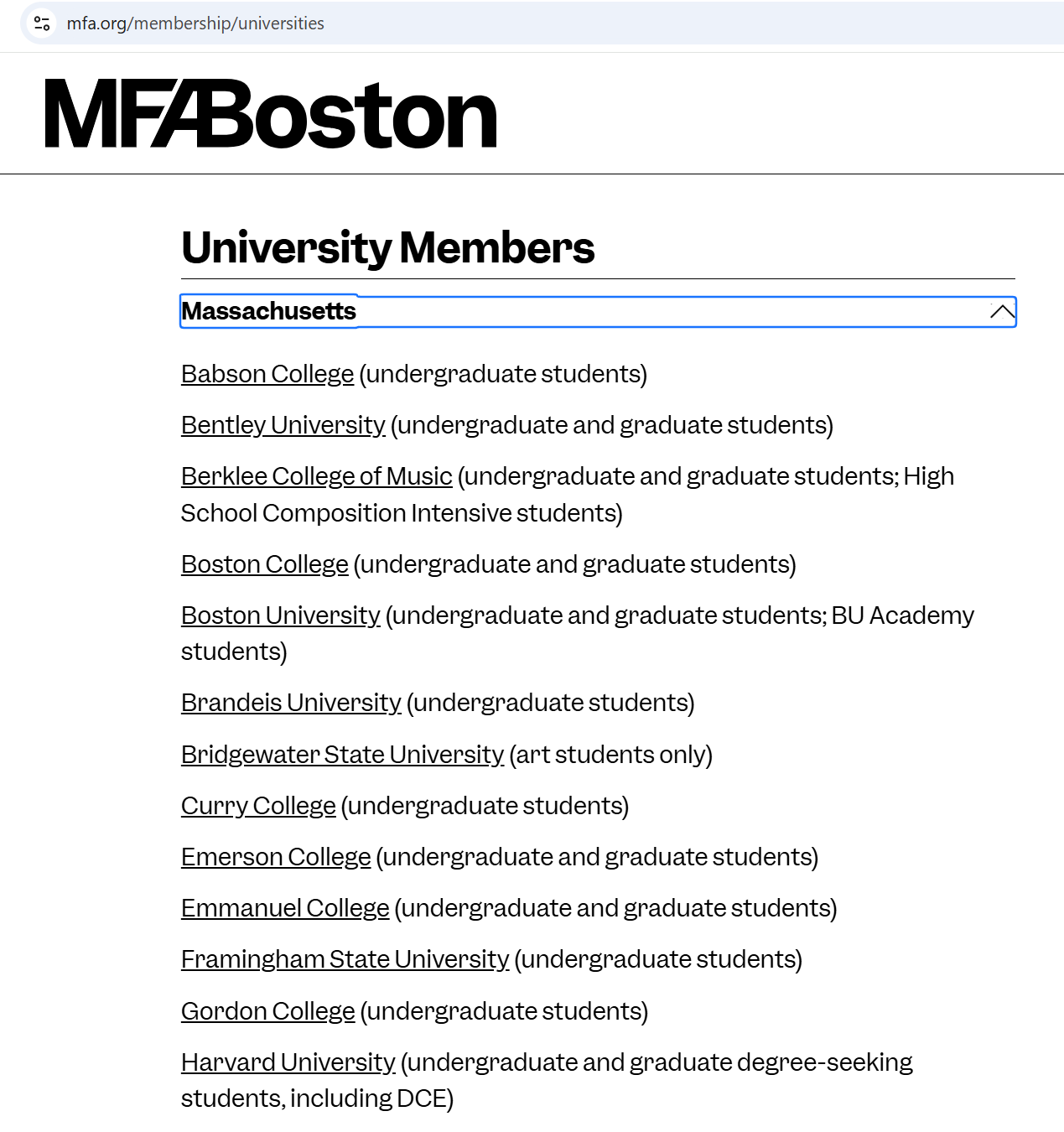
Note that students also get seemingly “free” stuff beyond their immediate campus. At the Museum of Fine Arts in Boston, for example, a long list of schools give the MFA money (from the students’ parents) so that when students show up they’re not confronted with the $30 price that most visitors see ($0 for SNAP/EBT card holders!). Don’t need to show ID to vote in Maskachusetts, of course, but everyone can agree that “presenting a valid ID on the day of their visit” is a reasonable demand for entering the museum at a $0 cost.
Fun fact for pilots: Prof. Josephson previously taught at Lycoming College! (The ultimate resume would include Lycoming College and Continental Florida University!)
The reality of commie housing, the kind where everyone works:
https://en.wikipedia.org/wiki/Khrushchevka#/media/File:%D0%98%D0%BD%D1%82%D0%B5%D1%80%D1%8C%D0%B5%D1%80_1-438.png
Next is where I lived as a freshman in the 1980s. Hasn’t really changed much, cinderblock walls, tiny rooms, fancier locks. Used to have one payphone per floor for calls home. A new lounge and kitchen, wow. Girls are mid, one would be kinda cute with beer goggles. I hope I don’t have nightmares tonight after seeing this.
Of course, the “left washing” isn’t new. I think the Ivy League back then was a pilot project for today’s universities. They used to call me Alex P. Keaton because of my conservative, Republican views — so I wasn’t swayed into being a commie or a male feminazi. (They also called me Keith Partridge, because of my hair parted in the middle — and rock-star looks, joking.) It wasn’t too difficult to get an A in a non-STEM class, I just had to fake caring about my fellow man, er person in a believable way.
Most of the girl students (the ones in the video do seem a little sweeter) were left-leaning feminists, so finding one who wasn’t batshit crazy was difficult. A lot of early LGBTASDF+ pride too. I don’t know if I really agree with the thesis that the new amenities in colleges are socialist training, probably moreso “keeping up with the Jones’ University”. It really was the social environment and the faculty that pushed the “Progressive” agenda. The last college library I was in had a whole display on Queer Pride in 2016, in Laramie, Wyoming of all places.
One of my “friends” in college stole my woman (a classmate), of the few candidates I could find for a wife. I’m not bitter or anything, stupid jerk. I couldn’t believe it when they recently told me they sent their two GenZ boys to that place, knowing what they do about it. I guess they want to doom them to be hedge fund managers just like dear old dad.
I was really stupid in college when it came to women. I should have kept my non-leftist ideas to myself and played the role of a leftist sympathizer and I would probably have gotten laid more. I think there were a lot of guys just pretending to be leftists to get laid. Another problem , I was probably lacking confidence and/or was too worried as coming across as a creep to girls, I really didn’t want to make anyone uncomfortable – so I wasn’t assertive about expressing my interest. I also missed a lot of signals women were giving me… that I look back on and face palm myself for not realizing – could have had more action had I been smarter. Still managed to get the hottest girl in the class in my junior year… after wising up… but missed out on a lot of earlier opportunities.
@OAGuy
I thought the Carman Room Tour was a cruise ship tour! Silly me!
But still, kids today find everything stressful, and the University of Michigan is doing something about it. Starting next fall, they won’t use letter grades to some freshmen [1].
“We believe that covering grades will help students start strong and curb the mental health crisis unfolding among college-aged individuals.”
Isn’t that another way of saying: “We believe the freshman dropout rate is too high, so let’s find a way to keep them around for another semester and collect more tuition?”
https://lsa.umich.edu/lsa/academics/lsa-first-semester-grade-covering-pilot-program.html
Phil, so great to see you highlighting the Greatness of the Soviet Union, which as you note was built by Socialism into the Greatest Economic Machine that has ever existed: just look the economic statistics from 1988 (GDP per capita) to show how hard all the “able-bodied adults” were working (lower #s are of course “better”):
Soviet Union: ~$2,700.
U.S.: ~$21,400.
And Soviet Supermarkets preceded Whole Foods by decades with the Great Abundance and Plethora of Gourmet Foods of all types to provide all that Abundance to the highly paid customers!
commie
Thank you, Uncle Joe, for winning the Great Patriotic War for which we like to take credit! Thanks also for your brave son (https://en.wikipedia.org/wiki/Alexander_Davydov_(soldier) ) and his 13-year-old mom for their roles in liberating Manchuria.
Yes, Uncle Joe is on target here! We in Cuba improved upon Uncle Joe’s Socialist model even further by eliminating Supermarkets entirely because we found they allowed people to eat, which in turn fueled obesity and hence diabetes. Better to be an “able-bodied hard worker” as Phil notes, than to be an overweight, diabetic deadweight on Socialism, right?
Joseph’s lil baby momma is ugly AF, yo. She like the white Claudine Gay (are both commies?)
@infidel
No grocery stores? Man, where imma get my 40 oz. beotch?
No ozempic needed in Cuba!
Uncle Joe, USSR was even better than that. $2,700 was a made – up number, generated by artificially set ruble (“rubble” would me more precise) to USD exchange rate of 0.6 ruble = $1.
So annual salary of 1,800 rubles was becoming $3,000. In reality, even during best years of USSR dollar was fetching 2/3 rubles. So real per-capita GDP in the USSR was around $1000.
And thank you and your successors in mid 1980th for fighting diabetes by limiting public access to “white death” – sugar – in government stores by requiring government coupons to buy sugar. But my dad’s friend who was making his own moonshine – samogon – was not as grateful as I.
Siberian girlie: Trusts Stalin, notorious prison escape artist
Stalin: Escapes
Perplexed, so many thanks for adding another layer of Greatness on top of the already Fantastically good (low) GDP per capita #s that all those “able-bodied” and hard-working Socialist adults were producing during the Great Socialist Years of the Soviet Union! Who knew the Rubble was so valuable.
The most luxurious apartment was the final one in 1999. It was the only one with actual drywall & a digital thermostat. The others were panels & cinderblock from the 1960’s. Drywall was quite luxurious. The taxpayers were paying interest on it & future lion was going to pay for most it. Never thought of that time as part of a bigger trend of campuses becoming amusement parks. It was a privilege to experience the last of the spartan accommodations of the 1960’s.
As a minor counterpoint / curiosity, the rooms at Stanford are awful. They are unbelievably small cinder block affairs with two people in a room that would be cramped for one person. Of course, the climate, campus and vast number of other beautiful buildings compensate to some degree.
Part of it is grade inflation and mob mentality: we gave you a favor, an undeserved grade and high GPA, now you are a member of credential mob and have to advance whatever we say.
It was different in the ’80s and or I wasn’t paying attention. Maybe being a commuter student at Merrimack College in N. Andover, MA, immunized me from wokeness. Then again, I didn’t recognize any leftism at the University of FL in the late ’90s for grad school.