“An Ancient Sumerian Solution to Our $40 Trillion Deficit” (yesterday):
The U.S. federal debt has hit $40 trillion. Add the debt owed by U.S. states, corporations and consumers and the figure rises to about $77 trillion in debt, set against an annual G.D.P. of about $32 trillion. The interest on all of it is compounding constantly.
Ancient societies had another method to deal with debt. It was called an amargi — a blanket declaration of public debt cancellation. All public debts written off. Disappeared. It sounds laughable, I know. But, really, that’s just because the idea has been buried so deeply in history you’ve probably never heard of it. In the ancient world, it presented a pragmatic solution to an intractable problem. And now, faced with impossible-to-repay debts that are weighing down our economy, is the time to look at the amargi and the lessons it offers about how to think about finance.
The amargi was a response to a persistent problem that was recognized in the ancient world: Debt compounded until it destabilized society.
Understatement Department:
People who were owed money were, predictably, not always happy about the amargi.
We invented it so we can de-invent it:
The reason the practice often worked in the first place was because the ancient world understood something about our monetary system we have mostly forgotten: Money is an invented social construct. It isn’t real, not in the way a tree or a stone is real. The system of money and credit is a thing humans made up. It’s a record-keeping device for distributing resources. And since money is a human creation, we can alter it when needed.
What would happen if the U.S. were to stiff all of the bondholders, most whom are domestic (breakdown)? Would the stock market collapse because of the evaporation of money people thought that they had saved? A lot of stocks would go to zero, presumably, because a bank or insurance company could go insolvent due to the evaporation of reserves. Maybe some stocks would go up because workers wouldn’t be quite as burdened with federal taxes and, therefore, would have more spending power? That seems unlikely because our fiscal deficits are so high that ceasing interest payments on federal debt still wouldn’t result in a balanced budget (i.e., we would need higher taxes to fund the government services that we demand in a world where the federal government doesn’t/can’t borrow, even after kissing $40 trillion in debt goodbye). This is kind of remarkable. Imagine a family that is so addicted to spending that even if it is magically freed from paying a mortgage, a car loan, or any of its past credit card bills that it still can’t fund the lifestyle to which it has become accustomed and feels entitled.
If this does happen, I guess I’ll be nominally poorer (stock market collapse), but I’ll have some bragging rights because I’ve been a hater of bonds as an investment ever since the Jimmy Carter era inflation (more properly attributed to Lyndon Johnson’s Great Society program, but Carter got the blame because hyperinflation took a while to build steam).
Here’s a misleading chart, by the way. It says “total public debt” is $40 trillion, but doesn’t count debt incurred by state and local governments (also “public”). Supposedly this is only about another $4 trillion, but that doesn’t include state and local obligations to retirees, such as pensions and health insurance (impossible even to guess at what those are because we don’t know how long humans will live).
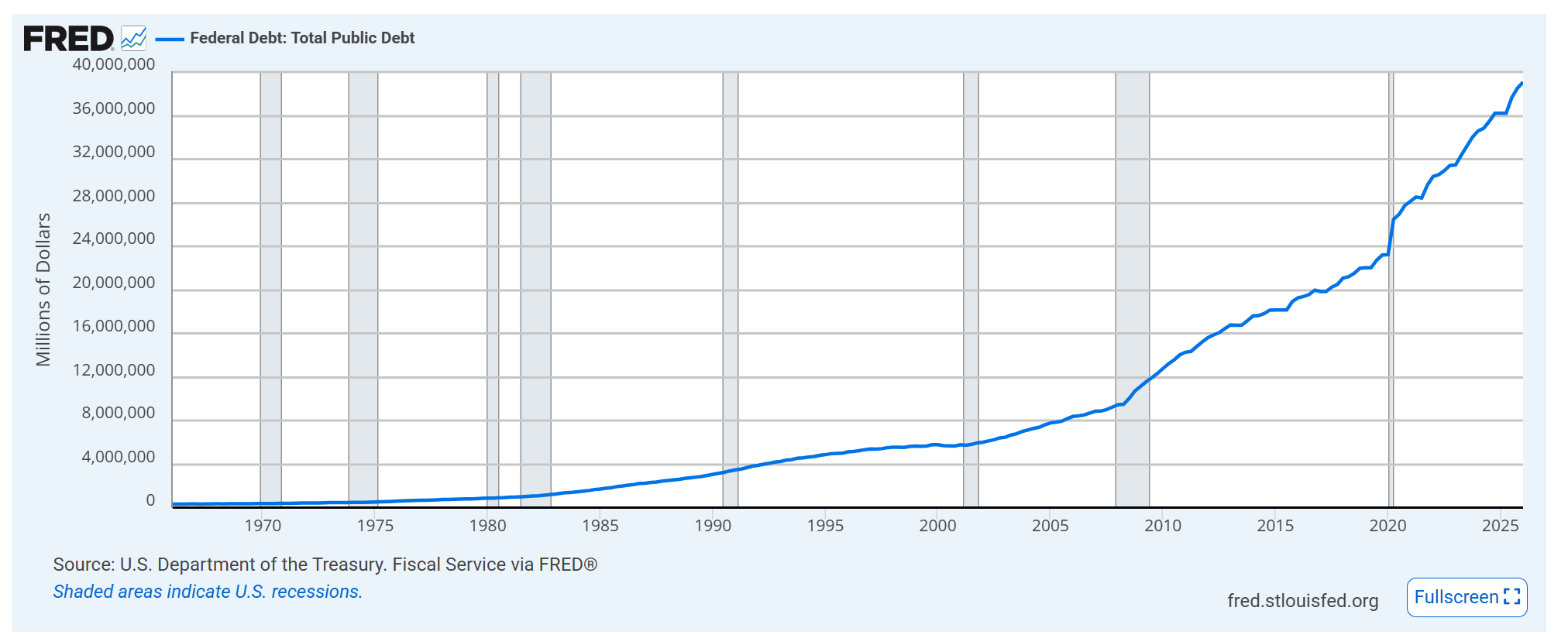
This strikes me as silly in two dimensions. First, unlike ancient societies where debt was defined in-terms of physical objects e.g., precious minerals, wheat, and other tangible goods. US Federal debt is a completely intangible asset that the government itself creates.
That is, if it so chose, the Government could instanstantly pay back all public debt by issuing or printing the money.
In this way fiat currency is a rather incredible innovation.
Second, this magic number, that debt exceeds GDP by > 100%, depending on what counts as public debt, etc… What’s magic about it other than 100% is a nice round number and symbolic? At the personal level, lots of people in this country are comfortable carrying personal debt greater than their annual income. Banks are comfortable issuing home mortgages equal to 3~5x the borrower’s income and that’s at much higher interest rates that the Federal government pays.
I’m not arguing that the high-level of US debt is a good idea, but I will argue that there is nothing inherently unsustainable about it and that if it ever does become problematic, the Fed won’t default on it, it will just print the money to pay it back.
Which makes me a supporter of Phil’s thesis, bonds are a terrible investment idea and I have no idea who buys long term bonds or what their investment thesis is. The natural hedge of inflation are assets and debt. If you are afraid that US public debt is too high and may be tip the country into an inflationary spiral, buy real property and borrow money to do it!
@Daniel, You are correct. As long as the U.S. maintains its leadership edge in innovation and continues to benefit from its abundant natural resources, the debt issue alone will not scare away investors or bond buyers.
What concerns me more is the growing movement toward socialism among progressives. If that trend continues and gains momentum, I worry that we will eventually lose our edge in innovation and, with it, our economic advantage. That’s when we will end up like some of the countries in Europe—like France!
“The validity of the public debt of the United States … shall not be questioned. ”
Fourteenth Amendment to the United States Constitution.
“This is not an ancient effing Sumeria”. Thomas Jefferson (attributed).
The government has been dissolving its debt for 30 years, through negative yields. The losses from bonds are now the accepted compromise for stability. Modern advice has adapted to never keep over 1 year of expenses in bonds. Quite a contrast to the Volcker years when bonds were treated as a source of passive income.
I’ve always figured if the federal government wanted out from under the debt the easiest thing they could do would be to print the money (more correctly, increase the money supply, printing should not really be necessary) and pay it all back in the newly created, and indistinguishable from the current, dollars. We would inflate our way out, not default our way out. Whether or not this would be more or less of a shock to the U.S. and world economy than default, I am not sure.
Not only this is modern practice, but we even have a word for it – “default”. Before public debt is wiped through the default, usually private debt is wiped out through hyperinflation.
For how well people feel after default and what happens to the country you can ask Russians, Greeks, Latin Americans and Africans.