I hope that everyone has made tons of money taking my investing advice and doing the opposite. Loyal readers may remember that I’ve been skeptical of Nvidia becoming worth more than all of the European Union combined and, therefore, never purchased NVDA (current market cap: $5+ trillion). My theory was that 50 percent profit margins for Nvidia would motivate other companies to develop chips and then the AI nerds would recompile their code (or ask AI to recompile their code). Google did this a long time ago with its Tensor Processing Unit. Intel tried and apparently failed with Gaudi (but they were very successful in DEI!). Elon Musk has his AI5 chip and, eventually, his own fab.
OpenAI is the latest entrant into this mix, apparently. “OpenAI Claims Its New Chips Can Outperform Nvidia Processors in Tests” (Bloomberg, yesterday):
The company plans to start using the new chips to support its artificial intelligence models later this year, which should significantly reduce costs for OpenAI as it rolls out more widely.
OpenAI, losing enough money every year to be worth almost $1 trillion, created Jalapeno in a partnership with Broadcom Inc., which makes custom chips for a variety of clients. The two companies, which announced their pact last year, touted the speed at which the processor was developed in June, saying it came together in record time.
Even if this thing succeeds, there will still be a huge market for Nvidia, apparently:
Jalapeno wasn’t tested against the new generation of Nvidia chips, Vera Rubin, which just began shipping. It’s also not designed for training AI models, an area where Nvidia technology excels. Jalapeno is intended for the inference phase of AI — the stage when models have already been trained and can begin responding to prompts and handling tasks.
(Why is the chip named for Vera Rubin, someone who was neither an electrical engineer nor a software developer? Google AI:
Honoring Women in STEM: The company has a specific practice of naming key platforms after pioneering women scientists. Previous examples include Grace Hopper (the Grace CPU) and Ada Lovelace (the RTX 40-series architecture)…
I guess we can’t expect the William Shockley CPU/architecture any time soon, despite the man’s Nobel for the invention of the transistor, but why not one for Jack Kilby? Kilby died in 2005, prior to the full flowering of Rainbow Science, and therefore Kilby’s gender ID is unknown (we could say the same regarding Vera Rubin, who died in 2016, some years before the trans-enhanced Rainbow Flag flew at the White House))
How much do journalists and editors need to know about electrical engineering in order to cover cutting-edge AI hardware?
Because the chip is achieving strong results at low voltage — 700 watts — Jalapeno will allow OpenAI to save money when running its data centers, where power is a key cost, he said.
Speaking of high voltage, let’s have a look at the cooling system for Google’s latest TPUs (blog entry, which Google’s massive AI brain couldn’t figure out should have a date on it; I think it is from April 2026):
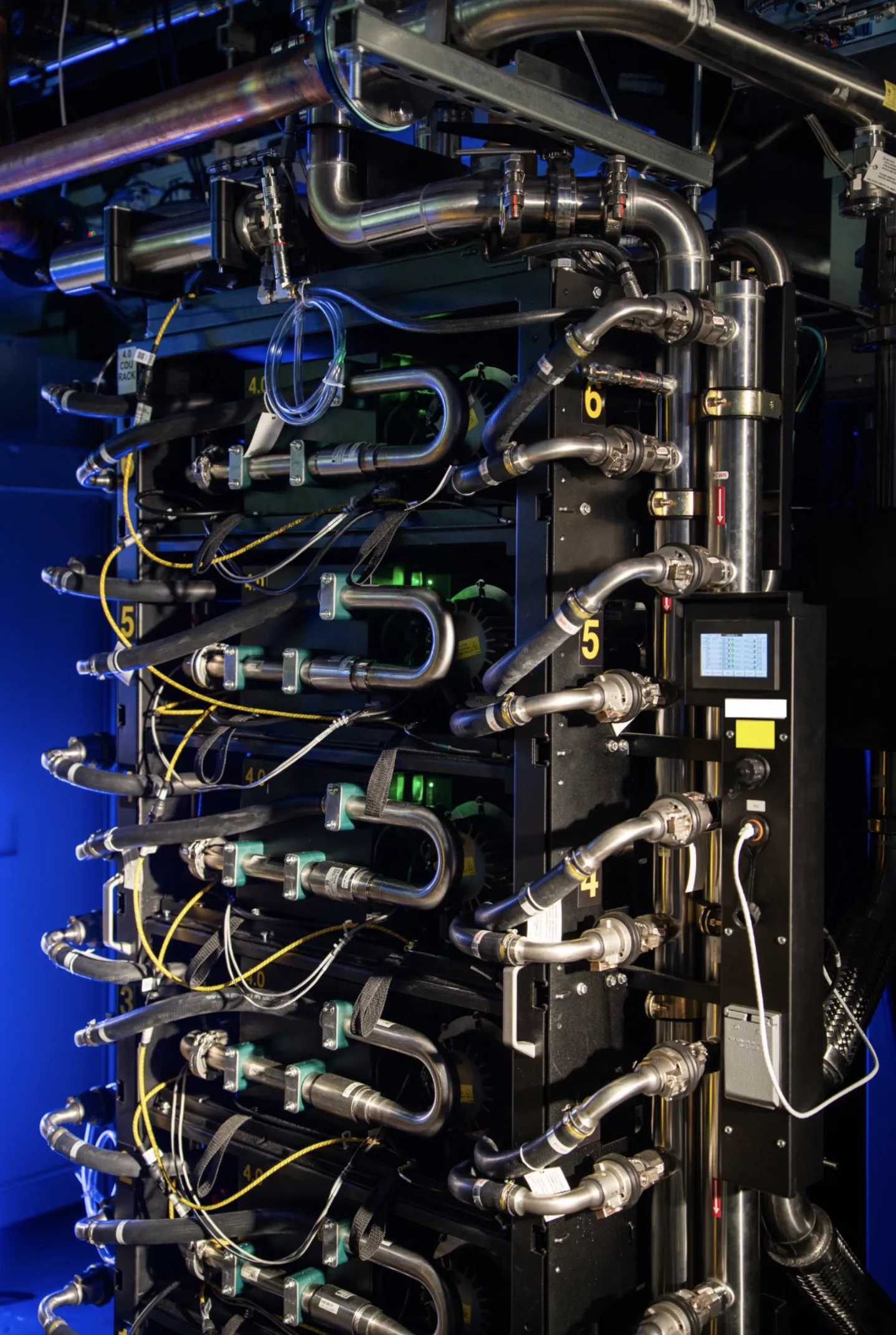
It looks like they got retired Pratt PT6 engineers to work on this!
(Actually, this suggests a career path: instead of fighting it out on the crowded software front, a young person could study to become a packaging/cooling engineer.)
Vaguely related… let’s see if we can figure out where Nvidia’s passion for “Honoring Women in STEM” comes from. Perhaps nerds identifying as “women” were the principal designers of Nvidia’s hardware and software?
Prompt to Gemini (to run on Google’s TPUs so that the results aren’t biased by running on Nvidia chips):
Who were the principal engineers of Nvidia’s historically important GPUs and software architectures, including CUDA? In other words, who are the people who are primarily responsible for making Nvidia as valuable as it is today?
Answer (not in quote style):
Key Technical Leaders Behind Nvidia’s Rise
1. Curtis Priem & Chris Malachowsky (Co-Founders & Founding Hardware Architects)
- The Role: Co-founded Nvidia in 1993 alongside Jensen Huang.
- Their Contribution: Priem was the chief architect of Nvidia’s early graphics chips (including the NV1 and the breakthrough RIVA 128), while Malachowsky led system engineering and hardware design operations.
- Impact: They established Nvidia’s core hardware engineering practices and designed the early pipelines that allowed Nvidia to survive the “3D accelerator wars” of the late 1990s and create the original GeForce 256—the chip Nvidia marketed as the world’s first true “GPU.”
2. Dr. David Kirk (The “Father of CUDA” & Chief Scientist 1997–2009)
- The Role: Chief Scientist and VP of Architecture.
- Their Contribution: David Kirk was the primary visionary behind transforming Nvidia’s fixed-function 3D graphics hardware into programmable, general-purpose parallel processors.
- Impact: In the mid-2000s, Kirk persuaded Jensen Huang to mandate that every single Nvidia GPU include dedicated general-purpose execution units—a massive financial gamble at the time. This decision laid the groundwork for CUDA (Compute Unified Device Architecture), launching general-purpose GPU computing (GPGPU) and making GPUs usable for scientific computing and later AI.
3. Ian Buck (VP of Accelerated Computing & Original CUDA Architect)
- The Role: Creator of the BrookGPU programming language (at Stanford) who joined Nvidia to lead the CUDA project.
- Their Contribution: While pursuing his PhD at Stanford, Buck created Brook, an extension of C for streaming coprocessors. Jensen Huang hired Buck to lead the software and systems team that built the original CUDA software stack and runtime environment, released in 2006.
- Impact: Buck turned the raw, complex parallel hardware engineered by Kirk’s team into an accessible software platform for C/C++ developers. Without Buck’s software stack, AI researchers in 2012 (like Alex Krizhevsky and Geoffrey Hinton) would not have been able to train AlexNet on Nvidia GPUs—the spark that triggered the modern deep learning boom.
4. John Montrym (Chief Architect, GeForce/Tesla Architecture)
- The Role: Senior Architect and Fellow.
- Their Contribution: Montrym was a key architect behind the NV40 (GeForce 6 series) and the landmark G80 (Tesla architecture) released in 2006.
- Impact: The G80 was the first unified shader architecture in a PC GPU and the hardware home where CUDA was born. It abandoned separate vertex and pixel pipelines in favor of unified streaming multiprocessors (SMs), setting the blueprint for every modern GPU architecture designed since.
5. Jonah Alben (Senior VP of GPU Engineering)
- The Role: Longtime leader of Nvidia’s hardware silicon development.
- Their Contribution: Alben joined Nvidia in 1997 and has spent over two decades directing the physical architecture, design execution, and engineering teams behind generations of GPU microarchitectures: Fermi, Kepler, Maxwell, Pascal, Volta, Ampere, Hopper, and Blackwell.
- Impact: Alben’s team managed the scaling and execution challenges as GPUs grew from millions to over 200 billion transistors on single silicon packages. His team integrated specialized hardware engines directly into the GPU pipeline—most notably Tensor Cores (introduced in Volta/Ampere) and Transformer Engines (in Hopper/Blackwell)—which gave Nvidia a 10x-100x efficiency advantage in AI workloads over traditional CPUs and competing chips.
6. Dr. Bill Dally (Chief Scientist & Head of Nvidia Research)
- The Role: Former Chairman of Stanford’s CS Department, appointed Nvidia Chief Scientist in 2009 (succeeding David Kirk).
- Their Contribution: A pioneer in computer architecture and high-speed interconnect networks, Dally leads Nvidia’s long-term research division.
- Impact: Dally pivoted Nvidia’s research toward optical interconnects, low-precision AI math (FP8, FP4 formats), ray tracing hardware cores (RT Cores), and multi-chip network scaling (NVLink). His architectural research predicted the massive bandwidth bottlenecks of large AI models years before ChatGPT emerged.
You can see the full answer and also one from Grok.
Fun fact from Oshkosh/AirVenture 2026: I ran into a mid-level Nvidia employee. He had shown up in his new airplane, a perfectly restored P-51 Mustang ($5 million?).
Phil, I don’t know much about AI chips, but I just wrote an Epic 5,784 word Analysis of AI and its future impacts (with assistance from some pretty 12 year-old ladies courtesy of my former (sadly) Best Friend and ladies man Jeffrey Epstein). Would love any thoughts!
Recall that in 1994 I predicted: “I see little commercial potential for the internet for the next 10 years.”
Thank you, Bill. Are you sure that dating 12-year-olds is consistent with Sahih al-Bukhari 5134? https://sunnah.com/bukhari:5134 implies that a 12-year-old should be at least three years into her life as a married woman.
It concerns me that Open AI wants to be in chip business. Could be an indicator that it does not see as much growth in AI itself. Unless their chip will be a significant break through in ML processing.
Perplexed, I know little about software (and less about AI), but am intrigued by your comment. When I saw the Open AI news on chip development, I assumed that beyond simple economics (subsuming some portion of the GPU chip portion of the profit stack into their own P&L), that there might be some advantages to developing one’s own chips, which could maybe allow their combined system (chips plus AI software) to work better. Is my uninformed logic here incorrect? Would love any other insights as you seem to be well informed on AI.
I do not have any inside insight into this development, just simple economic calculation. Which really should not matter much given my meager investment assets and lack of investment discipline but here I am. Chips being digital means that they could be treated as black boxes by their consumers, optimizing their internal caches, internal helper code programs and other enhancements is an overtime job. Unless Open AI expects AI chip technology breakthrough. From my layman point of view it does not make sense take money from main business line, LLMs, and put it into specialized hardware research, unless they expect huge chip breakthrough or know that LLM design can not be improved much and want to rely on cheaper scaling computing power to make money of their LLMs
Perplexed, thanks for the insights. I find this entire AI subject fascinating and only wish I understood more about what is going on inside the hardware and software when I type in a question to Grok or ask it to help me with a simple macro in Excel that would take me an hour or more to figure out on my own!
You’re old if you remember when bitcoin mining was the cause of the runaway GPU inflation, 8 years ago.
Sophie Watson co-designed the instruction set for the ARM architecture, very important for NVIDIA.
Included in “The 15 Most Important Women in Tech History” list in 2011.
Has been female since 1994.
https://en.wikipedia.org/wiki/Sophie_Wilson
Sophie: I hate to tell you this, but because of transphobia it seems that nearly all of your work was discarded when the 64-bit ARM architecture was developed (according to an immigrant (therefore virtuous) CPU/GPU designer grad school classmate of mine (works at Nvidia, as it happens)). Nvidia, because they’re very seriously transphobic, is currently using the 64-bit ARM chips in some limited roles.
Sad. People need fewer naughty bits, not more.
Major car and aerospace companies used to make their own in-house CAD software.
But eventually they resigned to buying software from one of the two external CAD companies.
Probably two competing CAD companies have less pricing leverage than monopolist Nvidia?
I could see Musk naming a CPU architecture for Shockley. He has been known to do things that could reasonably be predicted to trigger libtards, probably just for the LOLs. He’s my favorite Internet troll.
Let’s do an AI search on Google, the easiest and cheapest way of doing this:
Why does Elon Musk do things that could reasonably be predicted to trigger libtards?
Elon Musk takes actions that provoke progressive critics because his political evolution has shifted toward a populist, right-leaning, and anti-“woke” worldview that directly challenges progressive orthodoxy.
Anti-Establishment and “Free Speech Absolutism”
• Challenging Content Moderation: Musk views traditional moderation policies on social media as a form of ideological censorship. By purchasing X (formerly Twitter) and rolling back many of those rules, he deliberately disrupted what he and his supporters saw as a left-leaning monopoly on digital discourse.
• Combating the “Woke Mind Virus”: Musk frequently uses his platform to mock or criticize progressive social stances on gender, identity, and diversity, framing them as cultural threats.
Political and Economic Alignment
• Shift to MAGA and Conservatism: Once describing himself as politically moderate or independent, Musk aligned heavily with conservative politics, supporting Donald Trump and campaigning against pandemic lockdowns, government regulations, and unionization efforts.
• Business-Driven Friction: Many of his policy complaints—such as opposing government subsidies tied to union labor or criticizing tax policies on high earners—directly benefit his business empire, putting him at odds with the economic agenda of the Democratic Party.
Cultural Provocation
• The “Edgelord” Persona: Musk often behaves as an internet provocateur (“edgelord”), intentionally using humor, memes, and controversial statements to generate high engagement, reaction, and outrage, knowing it drives maximum attention to his profile and ventures.
Could you envision Elon Musk code-naming an AI IC after transistor inventory and eugenicist William Shockley?
Yes, it is possible to envision this because he often praises foundational engineering figures while embracing provocative or controversial cultural references.
Why It Fits His Style
• Engineering Roots: William Shockley won a Nobel Prize for his work on semiconductors and the transistor. Musk frequently highlights early electronics history.
• Provocative Public Persona: Musk often uses edgy, contrarian, or taboo historical nods that spark intense public debate.
Current Chip Naming Reality
• Numerical Series: Tesla names its custom processors with straightforward numbers like AI5 and AI6.
• No Shockley Reference: There is no official or leaked code name honoring Shockley in Tesla’s actual hardware roadmap.
1. So it’s the long-presaged ascendance of the plumbers. But in the server room.
2. Have there been any chips named for Lynn Conway yet? Intersectional gold there.
Mitch: The “Lynn Conway” generation for Nvidia is a great idea!
https://en.wikipedia.org/wiki/Lynn_Conway says that she graduated from Queers for Palestine League Columbia so the naming could celebrate (1 women in STEM, (2) trans achievement, and (3) innovation by Arabs who call themselves “Palestinian”.
(Wikipedia also says that Conway’s gender dysphoria began while she was at MIT trapped in a male body.)
I don’t think it is a stretch to say that Lynn Conway is the true founder of TSMC. Wiithout Mead-Conway we wouldn’t have separation between design and fab (see https://en.wikipedia.org/wiki/Mead%E2%80%93Conway_VLSI_chip_design_revolution ). (Just as the efforts of male programmers on Project Apollo can be ignored in favor of celebrating Margaret Hamilton, I think it is safe to ignore Carver Mead’s role and give all credit to Ms. Conway.)
Finally, because Lynn Conway is the actual founder of TSMC and Nvidia couldn’t exist without TSMC, she should be considered the founder of Nvidia.