A PhD physicist friend on Facebook:
The reason I’m all-in on AI investment, and there may not be a top to this “bubble”: Unlike tulips, railroads, or internet connectivity, there is no upper bound on the value of intelligence.
Me:
30-year TIPS yield is 3% real currently. So your perspective isn’t shared by the market. Investors wouldn’t lend money to the federal government at 3% (after inflation) if they thought there was no limit to NVIDIA’s value. If investors overall thought that there was a low-risk way of making super high real returns over the next 30 years they the government would have to pay 8% real, for example, if buying an AI index was expected to yield 12% real for the next 30 years.
I think AGI is already here from the perspective of most users of ChatGPT and similar. A generally intelligent human isn’t great at everything and makes mistakes… just like ChatGPT! People ask ChatGPT all kinds of questions and give the answers at least the same weight that they would give to an answer from a typical human. In that sense, ChatGPT has passed a Turing Test for general intelligence. Maybe Advanced Superintelligence is already here. The typical human is not good at mathematics. A math professor could have been described as “super intelligent” before WWII. LLMs are supposedly doing all kinds of advanced work in mathematics right now, even if they might fail at a plumbing task. The math professor in 1935 who was a failure at plumbing would still have been considered superintelligent, right?
In other words, we can’t expect hockey stick growth for the economy due to AGI/ASI arriving because the current growth is already an example of what an economy does with the gift of AGI and ASI (but maybe not robotics!).
Will the $40 trillion in federal debt be a drag on economic growth? Scott Bessent says “no”:
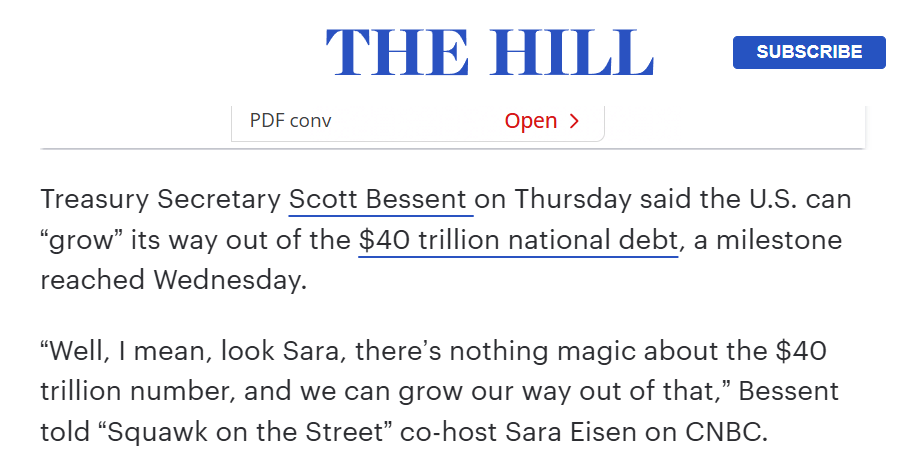
Let’s use a 20-year time horizon for the U.S. to potentially get out of Argentina territory (150% debt-to-GDP max; we’re at over 125% right now). For US debt to GDP to fall to the level of a high IQ society (e.g., Taiwan, which has lower-than-US tax rates and debt of about 20% of GDP), GDP growth would need to be 10%/year real for 20 years with Congress not borrowing any more money (the latter condition seems unlikely to be met, since Congress now borrows even in the most robust economies, contrary to Keynes). Investors plaintly don’t believe that this will happen because they’re willing to lend to the Feds at 2.75% real (20-year TIPS current price) and they wouldn’t do that if investing money in domestic stocks would generate a roughly 12% real annual return (real GDP growth plus 2% as a return on investment from corporate earnings).
Does this mean that we’re in an AI bubble? Not necessarily. Only that AI by itself apparently doesn’t hugely lift the overall U.S. economy (a huge part of which is government spending/welfare state!). We’ve got about 1.5% per capita real GDP growth right now. Maybe that includes the AI lift? This NBER paper by a Nobelist (sort of) predicts minimal per capita growth, but cites estimates as high as 3.4 percent per year as the boost (nowhere close to the 10% we’d need to get out debt down to Taiwan’s relative level):
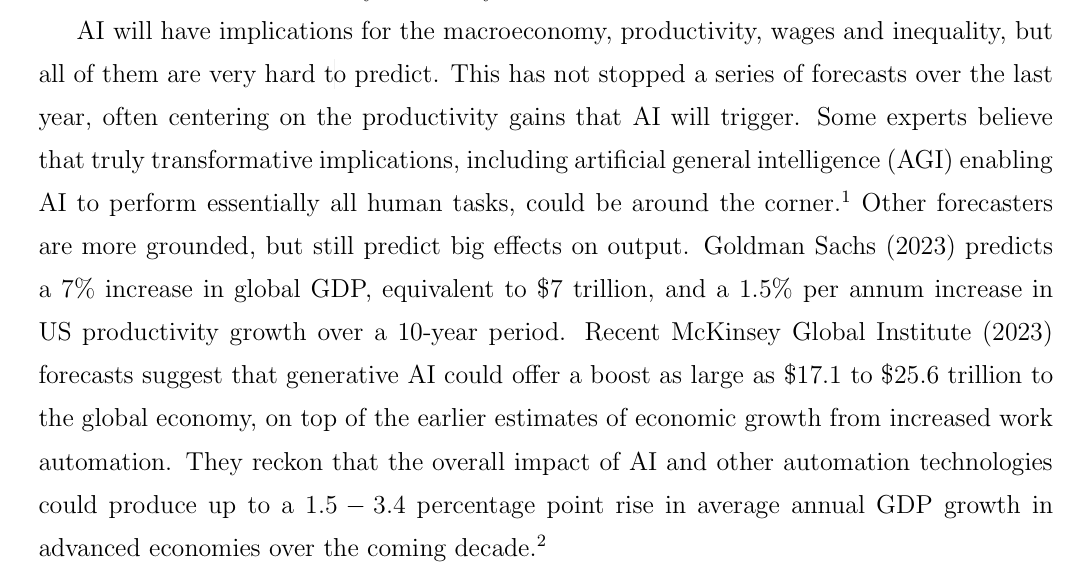
(He cites McKinsey, the giant brains behind Enron!)
The only way to make $40 trillion in debt insignificant, therefore, would be to grow the U.S. population to about 1 billion humans at roughly the same level of skill/income as the current U.S. population. Until Donald Trump showed up (again!), our wise politicians were working on this, but they forgot to apply and skills test for immigrants.
(In case this blog post is going to be a source for an NPR or PBS story (example), let’s not forget that both Turing and Bessent were/are members of the 2SLGBTQQIA+ community.)
So, there are several things that limit your analysis, which tries to simply connect real TIPS yields to forward stock price returns. You can ask Grok and it will show you a few of the reasons you’re analysis is lacking. There is a relationship, but it doesn’t always dominate.
For example, here’s a simple look back at history:
Looking at 20-Year TIPS CMT yields in the period mid-2004 (when data begins) through 2007, the yield ranged from ~2.0-2.75%. Yet the S&P 500 total return compounded at 11.1% in the past 23 years (beginning 6/30/04).
I do not disagree with the essence of this post, US economy can withstand excessive borrowing only for as long its position in the world is dominative, due to both military superiority and luck of alternatives, but TIPS yield is not indicative of expected market performance, Treasuries are used for risk management and trading collateral.
lack of alternatives
Simple Math: I didn’t mean to suggest that TIPS, a much lower risk investment than stocks, could be expected to return the same as stocks. There is, we’re told, a risk premium!
To be clear, I wasn’t suggesting you thought TIPS would perform the same as stocks (they won’t). Your post’s overall argument is that given given where TIPS are currently priced, means that stock returns going forward will be limited/muted/poor (“stock market boom…behind us” and “investors wouldn’t lend to the government at 3%…” if stocks had upside). But, as I pointed out, TIPS prices don’t have any predictive value relative to stock prices (see the simple math example I gave), so the stock market “boom” (your term) may or may not be “behind us.”
Given how much less stuff we have than 10 years ago & how much more it costs, the productivity boom has yet to happen. The world is awash in text & images it didn’t have 4 years ago, that no-one looks at. Every day is another story about a vibe coded copy of a calendar program that we already had.
This post is confusing because you seem to be trying to show relationships between too many things at once: interest rates, stock market returns, debt-to-gdp, inflation etc. Tease them apart one by one. Also, relative to high debt-to-gdp, you surely know that Japan is at 204% now, and has been super high for decades…put that in an AI computer and see what it says.
“Tease them apart one by one”? Can’t Claude do that for us?
Everything you say here appears premised on the TIPS price being “correct” and predictive, but Simple Math pointed out that it isn’t. And Grok does confirm this.
I didn’t mean to suggest that TIPS returns would predict, without a risk premium discount, stock market returns. That said, if we could travel forward in time to AOC’s 8th term as U.S. President (I assume that the Constitution will be adjusted so that this great leader can stay in power indefinitely), we might see a reasonable correlation with stock market returns.
Is it really a good idea to buy TIPS when inflation is defined by the borrower?
Tom: You raise a good point. CPI perhaps corresponds to the lived experience of someone in a failed Rust Belt city, but it absurdly underestimates inflation in the cost of living in the places where people who have significant investments want to live as well as in the hotels, airline tickets, theater tickets, and other experiences that these people buy. Still, there is probably a reasonable correlation! If CPI is 4%, in other words, maybe the “typical investors’ CPI” is 6% (always 1-2% higher).