Yesterday was supposedly when people from El Salvador, “temporarily” in the U.S. for 25.5 years, would begin to head home to the country that, for the past few years, has (1) had a lower murder rate than the U.S., and (2) is too dangerous for humans to occupy, especially Salvadorans such as Kilmar Abrego Garcia.
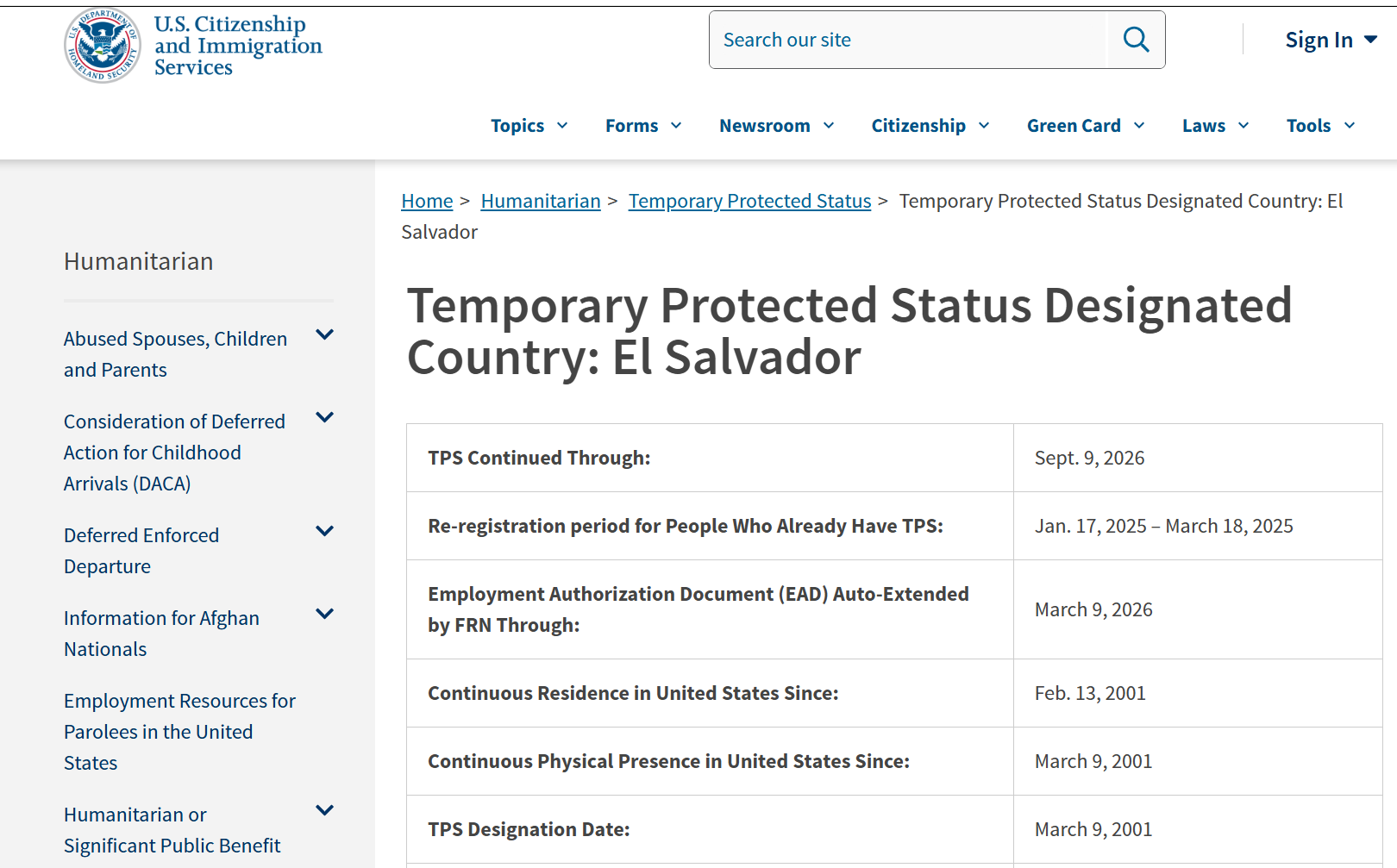
Have any Salvadorans gone home? Or is “temporary” some period of time longer than 25.5 years? Gemini says that people with “temporary” status are actually permanent from any practical perspective:
The termination of TPS [for Hondurans, nearly all of whom are still here] did not grant Immigration and Customs Enforcement (ICE) the right to summarily deport people. To be removed from the country, individuals who do not leave voluntarily must be issued a Notice to Appear (NTA) and go through the formal immigration court system.
With immigration courts already facing massive multi-million case backlogs, processing thousands of long-term residents with clean criminal histories and significant family equities in the U.S. takes years, effectively leaving them in a prolonged state of legal limbo within the United States.
So… a Salvadoran might be here on a “temporary” basis and at the same time, under the laws that our elected politicians were wise enough to create, it isn’t possible to deport him or her “summarily”.
Here’s a video from a few months back about what youngsters in El Salvador are up to:
Compare to what happens in Los Angeles:
Finally, let’s hope that DHS will use the new cover sheet for any further TPS reports.
Do you feel comfortable forcing someone who has lived in the USA for the past 25 years to move to a different country? I don’t. Let us have some basic “humanity” (defined as the quality of being kind, merciful, and sympathetic toward others). Once one loses the ability to treat others humanly, nothing is left.
Yes, Phil don’t you have the least bit of pity for the two upstanding immigrants who brutally raped me for two hours and then strangled and drowned me to death?
https://x.com/libsoftiktok/status/1803892245516685431
Yes, Phil. Ditto for me. My murderer only raped me and then crushed my head to kill me. Have a little “humanity” won’t you?
https://x.com/CollinRugg/status/1859274574220890420
Anon: I’m all about equity and hate inequality. If one Salvadoran not selected for some special skill has the right to live in the U.S. then all Salvadorans should have the right to live in the U.S. Suppose that a Salvadoran has lived here for 25 years. A Salvadoran who stayed in El Salvador should actually have a superior right to come and live in the U.S. because the Salvadoran who stayed in El Salvador never got the chance to enjoy any of the advantages of being a U.S. resident. This becomes particularly clear when you consider that the Salvadoran who has been here for 25 years might have enjoyed taxpayer-funded housing (immigration status doesn’t matter in Maskachusetts; see https://www.masslegalhelp.org/housing-apartments-shelter/public-subsidized-housing/immigration-status-and-affordable-housing ), taxpayer-funded health care, taxpayer-funded food, etc. (The Salvadoran on TPS who has several U.S.-born children at least gets everything at taxpayer expense for the kids.)
Fairness demands that the Salvadorans who never had any of this good stuff be given the first priority at coming here to live and get their share.
(If you say (hatefully) that Salvadorans currently in El Salvador AREN’T entitled to a U.S. taxpayer-funded lifestyle and permanent residence in the U.S. then the Salvadorans currently in the U.S. similarly aren’t entitled. Anything else would be massive government-created inequality, which I hope we can all agree is bad.)
Some of the great life discoveries happen when you are very young. For example, I was about six years old when I discovered that I disliked being in classrooms. I was not much older when I noticed that what we call “the world” is manifestly unjust. Only much latter I figured out that since “justice” can never be attained it is important to be human. That is all I have to say.
Yes, Phil anon is so totally correct here. There can never be “justice” for us, so have “sympathy” for those who brutally raped and murdered us. And, no need to worry about others like them who are here…have another helping of “humanity” as you reflect on our not-so-valuable legacies.
If “human” means that you don’t that there should be a distinction between the rights of an American citizen and the rights of a Salvadoran then, again, every Salvadoran should have the right to live in the U.S. It’s a basic human right.
A non-human, on the other hand, could take the position that the goal of a government should be to advance the interests of its citizens. Thus, the U.S. government should try to preserve opportunities for U.S. citizens and their children, e.g., to get a job or rent/buy housing.
@ anon, even though that you disliked classrooms, you can use Google or LLM to find out that human is a multifaceted noun with primarily definition stating that
“human /hyoo͞′mən/
noun
A member of the primate genus Homo, especially a member of the species Homo sapiens, distinguished from other apes by a large brain and the capacity for speech. “
@Anonymous, I honestly don’t understand the logic behind your position. You support open borders that would allow people to move freely into the United States, but at the same time, you object when one country invades and seeks to occupy or colonize another country.
Following that logic, wouldn’t Russia’s invasion and occupation of parts of Ukraine also be viewed simply as people moving across borders? And wouldn’t Israeli settlers taking Palestinian land similarly be viewed as nothing more than people relocating?
Yet folks like you and liberals strongly oppose Russia’s actions in Ukraine and oppose Israeli settlement and land claims in Palestinian territories. How do you support one but not the other?
What is the principle that makes one form of cross-border movement acceptable while the other is considered an invasion or land grab?