Anthropic’s Dario Amodei has called on the world’s leading artificial-intelligence labs to slow down development and asked Washington to grant an antitrust exemption so they can coordinate on safety without being treated as a cartel. OpenAI’s Sam Altman, SpaceXAI’s Elon Musk and Google’s Demis Hassabis were quick to support the slower pacing. But why do AI labs need an antitrust exemption?
When competitors agree on standards the rest of the industry is expected to meet, the law becomes suspicious.
In short, coordination is lawful when it creates value rather than excludes rivals or exploits consumers. If AI labs’ coordination is needed to create value and isn’t exclusionary or exploitative, they need not worry about antitrust liability.
So why demand an exemption? The labs appear to have in mind an agreement among competitors to restrict output and set a safety standard collectively rather than compete to produce the safest product. That is classic cartel conduct.
The labs’ apparent belief that competition will inevitably produce a race to the bottom is an awkward admission by OpenAI and Anthropic, both of which were founded to serve the public interest and premised on the idea that AI could be developed safely. Anthropic in particular espoused that safety would be its competitive advantage against rivals. If these companies genuinely believe slower development serves the public interest, nothing prevents them from slowing down unilaterally.
The strongest counterargument asserts that a coordinated slowdown solves a collective-action problem: A lab that slows down alone risks losing market share to rivals willing to cut corners. But this is precisely the problem OpenAI’s capped-profit structure and Anthropic’s public-benefit charter were supposed to solve by insulating their public-interest missions from competitive pressure.
The American frontier labs are purportedly concerned that Chinese models will close the performance gap and cut into what would be profits if they were profitable? Note that Anthropic says it is profitable, but Morningstar says that this is a scam:
The report, from the Financial Times citing multiple people with knowledge of the matter, said Anthropic told investors that it will profit on a measure called adjusted operating income.
According to the report, adjusted operating income excludes stock-based compensation, which is not unusual for technology companies. However, the report also quotes its gross margins – above 80% – exclude revenue shared with distribution partners, as well as the cost of training its models.
(Like saying “Our family is doing great financially so long as we exclude the burdens of mortgage, college tuition, taxes that we have to pay to support families that don’t work, and payments on our two pavement-melting SUVs.”)
Let’s suppose that the AI companies get their antitrust exemption and they cut way back on the training costs that would keep them from being profitable if such costs were included in their new improved accounting scam. How would Americans then be prevented from downloading and running models from Chinese companies that aren’t part of the cartel? Anyone who tries to do this and offer a chatbot or API on the public Internet will be shut down by the FBI? Peasants with Mac Minis and AMD AI Halo-based machines will be hunted down somehow?
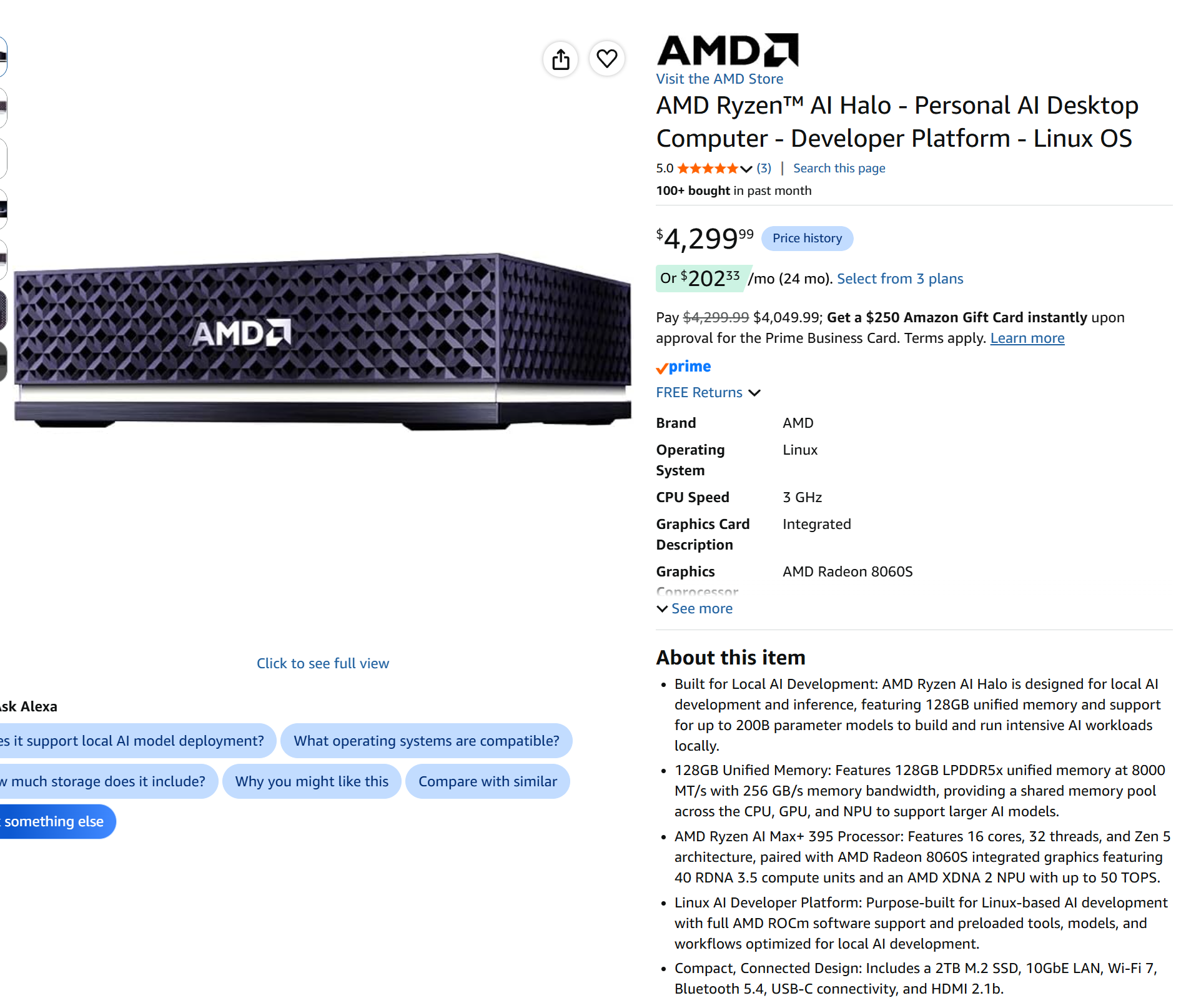
FDR made it illegal for Americans to own gold (Executive Order 6102), but the government didn’t do house-to-house searches. If typical desktop PCs adopt an architecture powerful enough to run AI models from countries where “AI slowdown collusion” isn’t happening, how will the government’s AI Safety Regulation Team (controlled by Effective Altruists who are friends with Sam Altman and Dario Amodei?) shut down home-based unsafe AI?
Circa 1980, I remember Ed Fredkin, one of the only professors at MIT who was smart enough to have skipped a PhD program (“poor as a professor, dumb as a Ph.D.” as the Chinese say), saying that he thought that AI could be achieved with VAX 11/780 computing power. Due to Moore’s Law, this would soon be available to everyone on the planet. “What if a teenager in Brazil figures out how to do AI? He can then have his AI trade stocks and become the richest person in the world and control entire nations,” Fredkin pointed out. He wanted computers to be licensed and controlled. Nvidia’s Rubin GPU is between 200 million and 500 million times faster than a VAX for “normal high-precision calculations”, according to ChatGPT, but closer to 200 billion times faster for “highly specialized low-precision matrix operations that dominate modern AI”. ChatGPT says that if we apply Moore’s Law to the Ryzen AI Halo product, it doesn’t reach Nvidia Rubin level until 2040ish (memory bandwidth, AI TOPS).
So… maybe a partnership between government and the current market leaders could suppress competition within the U.S. for the next 15 years or so, even if our brothers and sisters in China continue to deliver awesome free open-source models. Ownership of server-grade GPUs would have to be regulated, of course, but if the government could close schools and order peasants to stay home for Covid safety why not outlaw high-performance GPU ownership, except by responsible companies such as Anthropic and OpenAI, to keep all of society safe?
Phil, this is all very interesting, but for those of us not schooled in bits and bytes, can you first zoom out and answer the question: is AI on the cusp of wiping us out such that a slowdown is even required? Are those doomsayers telling us we need to slow down: 1) just modern-day Ed Fredkins, or 2) engaging in regulatory capture/preservation of their oligopolies?
NTP: “People of the same trade seldom meet together, even for merriment and diversion, but the conversation ends in a conspiracy against the public, or in some contrivance to raise prices.” (Adam Smith, 1776)
I’m not close enough to the industry to predict with confidence (and the people I know who are also don’t have confidence), but my feeling is that prowess in AI could give a country a huge military advantage if combined with some industrial capability for making drones and attack robots. A lot of stuff will have to be air-gapped, I think. Imagine AI on the Internet physically somewhere in Asia where scammers are currently operating. Can it get into your bank account? Not if your bank switches to requiring that significant withdrawals be made in person during business hours in a physical branch.
Thanks. So, am I understanding you correctly that *anything* including financial transactions, stock trading, verifying one’s identity (and millions of other things) might have to be done in person? That would seem to nearly destroy modern life as we know it…is that a fair read of your thoughts because it does then sound very concerning?
NTP: That’s kind of a worst-case scenario, but yes, the result would be a lot of inconvenience. On the other hand, maybe that’s not a bad thing. If AI eliminates a lot of soft air-conditioned office jobs, the fact that banks still need physical branches could provide useful employment. Nobody could day-trade anymore? That wouldn’t interfere with the headline function of the stock market (allow companies to raise money that they can then use to make productive investments, e.g., building data centers (none of which are illegal on stolen land)). Perhaps the threat of AI compromising the credit card payment systems would prevent the government from eliminating cash.
(I think we could still have small transactions handled conveniently, as they are now, e.g., restaurant bills. Every now and then some sort of big new AI-driven fraud would pop up, but it would get squashed reasonably quickly.)
Non-Tech Person: We are seeing some universities and schools ban/strictly limit electronic devices and force kids to take tests / do assignments in person and on paper. Certainly bucked the trend from when I was in college, which was for an ever-increasing amount of work to be done online. Perhaps with tech-averse elderly still in power, we may get to see this trend continue.
I heard a teacher the other day talk about some of the things some of the youth are saying now, such as how AI can solve all of their personal problems (e.g. find them a wife, find them a job, make them happy, give them fulfillment etc). The more AI is involved in people’s lives, the more thinking goes that way.
I mean, think about the internet itself now. Most young people use it to get dates/marriages (dating apps and websites), get employment (apply online, search for jobs), make them happy (consume entertainment, play games, connect with friends), and give them fulfillment (provide outlet for creative expression, provide platforms for freelancing/work/business/art etc.)
The question is: is that the future we want, and will it be as bad as we think it is now? It is nearly unthinkable to go back to “no internet”. We may very well enter a time where it will be nearly unthinkable to go back to “no AI”.
(I personally am hoping that AI goes the way of other tech buzzwords such as big data & blockchain: bubble popped, not relevant to normal people’s lives anymore, not shoved in everyone’s faces)
Phil, your worst-case outcome seems like way more than an “inconvenience.” It would be almost dystopian relative to today. Your commentary seems to suggest that, for example, purchasing a home would require taking a wheel barrow to the bank to gather cash for the purchase. Or, imagine the trillions of dollars that change hands every day electronically among businesses that would similarly need to be transacted by wheel barrows of cash. Do you believe that would “not be a bad thing?”
Dystopian: Unless AI can break the encryption of VPNs, the electronic transfers of cash that you’re talking about are already on a system that is mostly air-gapped. ACH and wire transfers supposedly live on their own network. There is some mechanism for submitting a request for an ACH or a wire via the web and maybe that would have to be eliminated in favor of in-person, but the money would still be transferred electronically.
Wire transfers predate the Internet/ARPAnet nd ACH predates the consumer Internet. They were set up nationwide in 1978, according to https://www.nacha.org/content/history-nacha-and-ach-network
So it would be like 1985 where you’d have to fill out a paper form and attach a voided check to get paychecks direct deposited.
Since Ryzen AI uses NPU, we need to apply Huang’s law, not Moore’s law.
The Girl from Ipanema would get rich a bit faster.
ChatGPT says that under Huang’s law, the peasants get Rubin-level performance in just 6.5 years or, by 2033. (I personally won’t buy anything more from AMD, though, because they refuse to name their products after female scientists selected at random, such as Vera Rubin. Separately I hope that Nvidia names a future generation of chips after Vera Rubin’s father, Pesach Kobchefski. How about the “Pesach GPU” with “Kosher for Pesach” interconnect and “Kobchefski socket”?)
Kobchefski is going to be tough to spell in several Asian languages. Maybe that will stop the Chinese from copying it, because nothing else has worked.
What a delightful refrain of the Cold War, now with giant evil electronic brains instead of H-bombs. Or maybe both? Or God forbid, what if they shut down Tick-Tock? Armageddon time folks. Artificial life sons of bitches are already keeping RAM and processors out of the hands of human users. Leaders should get worried when AI starts generating purchase requests for Acme gas centrifuges. It would make sense to start drafting the AI anti-proliferation agreements starting tomorrow (after a good night’s sleep). “Ban the Brain, man!”
(That robut in the Tesla showroom looked like something out of The Terminator. There’s a picture of Musk on-line, like the evil Emperor from Attack of the Clones, watching over a room of with soldier-like columns of robuts.)
(Crap, why can’t we have a few years off after Covid without a global existential crisis?)
I mean, where is the mass protest against AI? Sure the Illiberals are protesting data centers (mainly because it will increase their electricity rates), at the same time they are glued to social media and planning their wine-country tours with ShatGPT. “Ban the bad brains, before they build the bomb!” We have to do something before it is too late^@^@…No carrier
Ban the brain! Ban the brain!
The mane threat seems to be the rising amount of generated media that’s influencing human decisions. 40 years after war games, they really are scrambling the fighter jets after threats which don’t exist & they really launched the missiles after AI classified a school as a military compound.
https://www.latimes.com/world-nation/story/2026-09-21/inside-u-s-kill-chain-that-destroyed-iranian-school
Time is running out for the humans, but it’s more because of their own delegation of decision making than malicious language models.