Our house is close to the headquarters of NextEra, which has a market cap of around $166 billion and is the parent company of Florida Power & Light. We ran into one of their employees at a restaurant whose job is buying grid-scale batteries to sit next to the company’s grid-scale solar farms. “This will power your data centers,” she explained. (I loved hearing this because it gave me an opening to point out that “No data center is illegal on stolen land.”)
I asked her if the MIT geniuses who revolutionized the grid-scale battery world about 20 years ago, according to the MIT geniuses, had an impact on her job. “No,” she explained. “Those technologies are always 10 years in the future. Utilities buy LFP and NMC batteries. The Chinese are unbeatable.” The same batteries that go into electric cars, such as those made by Head Nazi Elon Musk?!?! Yes, it turns out.
What’s an example of the liquid battery hype? Here’s one from Barack Obama’s Department of Energy, March 2016… “New Chemistries Found for Liquid Batteries: Grid-scale approach to rechargeable power storage gets new arsenal of possible materials”:
Liquid metal batteries, invented by MIT professor Donald Sadoway and his students a decade ago, are a promising candidate for making renewable energy more practical. The batteries, which can store large amounts of energy and thus even out the ups and downs of power production and power use, are in the process of being commercialized by a Cambridge-based startup company, Ambri.
Now, Sadoway and his team have found yet another set of chemical constituents that could make the technology even more practical and affordable, and open up a whole family of potential variations that could make use of local resources.
“This paper brings together innovative engineering advances in cell design and component materials within a strategic framework of ‘cost-based discovery’ that is amenable to the massive scale-up required of grid-scale applications,” says Richard Alkire, a professor of Chemical and Biomolecular Engineering at the University of Illinois, who was not involved in this research.
What does ChatGPT have to say? In a time-honored MIT pattern, the nerds achieved their goal of creating a better widget than whatever was on the market at the time they started talking about how much better their innovation was. And, in time-honored fashion, the comparative dullards improved whatever was on the market by a factor of 10X by the time that the MIT tech finally limped its way into a commercialized version. Excerpts from the full Q&A:
The research actually began around 2005, so “20 years ago” is about right, although that particular DOE release is from March 2016. MIT spun the technology out in 2010 as Ambri, backed by Bill Gates, Khosla Ventures, Total and eventually Reliance.
(Is it possible that Bill Gates will get ahead of divorce plaintiff MacKenzie Scott Bezos in terms of spending tens of $billions on nonprofit activities without leaving any trace of positive impact on humanity? Compare to Stephen Ross. For a tiny fraction of what Bill Gates has spent on becoming a Davos Idol Do-Gooder (over $110 billion in cumulative distributions; maybe that’s $200 billion in post-Biden dollars?), Ross has completely transformed the city of West Palm Beach (nytimes). Ross perhaps will end up having donated about $1 billion, but most of the money he’s “spent” is really an investment that should yield a decent return unless the Climate Doomers are correct about South Florida being washed away. ChatGPT on whether Gates can compete with MacKenzie the divorcée for incinerating cash in an ash-free manner: “$111 billion already spent is an astonishing amount of money, and there isn’t an obvious list of, say, ten Gates-created breakthroughs commensurate with that sum.” The giant artificial brain struggles mightily to find anything the Gates Foundation has done that might have a lasting impact.)
The basic idea was elegant: instead of solid electrodes that crack, swell and chemically deteriorate, use three molten layers that naturally separate by density—a light metal electrode, molten-salt electrolyte, and heavy metal electrode. The commercial version ultimately used calcium and antimony, with a calcium-chloride electrolyte. Because everything remains liquid while operating, the electrochemically active surfaces effectively recreate themselves each cycle. Ambri claimed >20-year life with very little degradation and no lithium-ion-style thermal-runaway fire problem.
First, going from a battery that works to a battery that can be manufactured cheaply by the million is extraordinarily difficult. The high-temperature seal is a perfect illustration. In the lab, having molten calcium/salt/antimony sitting at hundreds of degrees is manageable. For a utility battery expected to operate unattended for 20 years, every seal, feedthrough, weld, heater, electrical connection and insulation system has to survive thousands of thermal and electrical cycles. Ambri eventually solved enough of these problems to certify a ~1-kWh cell, but it consumed years.
Second—and probably even more important—the economic target moved spectacularly while Ambri was developing its technology. In 2010, when Ambri was founded, lithium-ion battery packs cost more than $1,200/kWh. By 2021 they were about $132/kWh; by 2024 about $115/kWh, and in 2025 about $108/kWh on BloombergNEF’s global average measure.
That’s a roughly 91% cost collapse during Ambri’s life.
Was it overhyped?
But there is a lesson in the old press coverage. MIT’s 2015 article said Ambri had built its manufacturing plant and made production sound almost trivial—“just add the electrode metals plus the electrolyte salt to a steel container and heat the can.” It then said the company was dealing with “one final engineering challenge”, the seal.
Nine years after that article, Ambri was bankrupt without a mass-production factory.
The coronapanic enthusiasts at IEEE sung Ambri’s praises in 2023, about 8 months before the company filed for Chapter 11 bankruptcy protection:
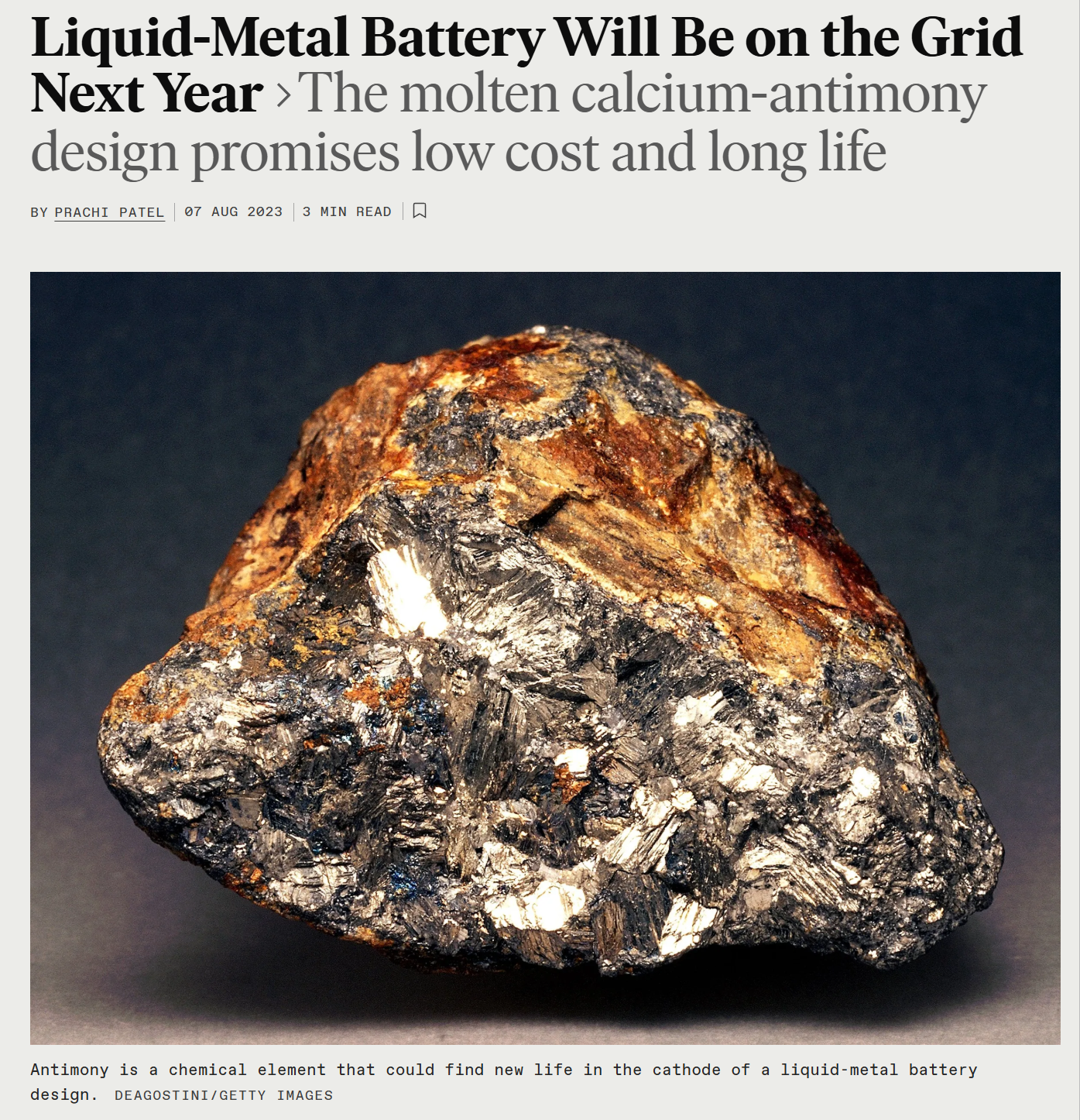
Ambri’s grid battery costs $180/kWh to $250/kWh depending on size and duration, the company says. But its projected cost is about $21/kWh by 2030
Phil, what a fascinating post today! One thought popped into my overworked mind: context. This is a word I was instructed to use by the law firm that coached me prior to my 2023 congressional testimony, where I held a Master Class on Harvard’s history of Antisemitism. In the context of today’s post, I wonder if “fails” depends on the context (I am dumbfounded that an enterprise backed by the Great One William Henry Gates III failed).
Thank you, Claudine, for reminding us that the context is always Bill Gates’s humanitarian intentions. Instead of paying federal (and now Washington State!) capital gains tax on his Microsoft profits, Bill graciously allows the peasants to fund federal and state government while he wisely “invests” in Africa and in battery-shaped holes in the ground for unnecessary cash.
Claudine, any updates on whether or not Larry Summers is still “stepping back”? His leadership in economics could help work out the viability of manufacturing these batteries in the U.S.
samue, so Wonderful to hear from you! What a special day. I am sad to report that Larry has “stepped back” even further. He recently texted me while flying on the Gulfstream jet of William Henry Gates III to let me know they were together and headed to a small island in the Caribbean for a reunion with some young friends. While I’m not an expert in Economics, my stature and reputation might allow me to step in for Larry to help work out the “viability” of these batteries?
The billionaires are interested in keeping West Palm Beach viable because it’s their prime hunting ground for underage sex masseuses. Liquid batteries don’t meaningfully contribute to any sex-or-eugenics-related commerce, so you wouldn’t expect to hear much about them.
SM: Wouldn’t a billionaire seeking the companionship of a younger-than-18 female be more likely to go to Maskachusetts (age of consent: 16; prostitution (money paid after sex): conventional) or Germany (age of consent: 14; prostitution: legal)? What would be the rationale for concentrating one’s energies in a place (Florida) where age of consent is 18 and there is a history of prosecution?
As the U.S. transitions to Sharia, though, maybe the Florida laws will be updated to reduce the minimum age of marriage from 17/18 to 9 (consistent with the Hadiths, e.g., Sahih al-Bukhari 5134). As you can see from the photos at the end of
https://philip.greenspun.com/blog/2025/12/06/harry-potter-pinball-machine-review-and-the-free-play-florida-experience/
there is already a gradual Islamicization going on near Orlando.
@Philip, our peaceful Muslim brothers and sisters come from countries where cold weather is far less common, let alone freezing rain or foots of snow. So, one would assume that Muslim immigrants would prefer warmer, southern states.
Yet many Muslim in the U.S. are concentrated in northern states, such as New York, Illinois, New Jersey, Michigan, Massachusetts, and Minnesota to name some [1]. California is an exception: it has one of the largest Muslim populations in the country, thanks to Gavin Newsom and the Liberals for welcoming sharia laws into their homes.
[1] https://worldpopulationreview.com/state-rankings/muslim-population-by-state
@philg
I take it you are a decent human being. I was as surprised to find this out as you may be: These rich and powerful people could, if all they wanted to do was have sex with an underage person (or regular sex worker), absolutely go do it where it’s legal or tolerated. However, a big part of the draw is that it’s transgressive. Breaking the rules with (some) impunity is part of the “fun”. Why do you think Epstein had an island, a ranch, and a jet? It was to carve out a zone of impunity for revolting acts. He could absolutely have flown to Southeast Asia or parts of Latin America where they don’t give a damn.
Why do think Billionaire sports team owner Jed York got busted for a $140 transaction in a trailer park recently? You don’t think he has other options? Remember when, Hugh Grant, an A list celebrity at the top of his career, got busted with a streetwalker? The sleaze is part of the thrill. It’s not economically rational.
I heard that Arthur C. Clarke’s “Superiority” was once required reading at MIT. I wonder what they replaced it with.
https://archive.org/details/Fantasy_Science_Fiction_v002n04_1951-08_AK/page/n3/
2001: A Space Odyssey? Probably not. “Disengage the self-driving mode, Tesla HAL.” “I’m afraid I can’t do that Phil.”
https://en.wikipedia.org/wiki/2001:_A_Space_Odyssey_(novel)