money illusion: In economics, money illusion, or price illusion, is a cognitive bias where money is thought of in nominal, rather than real terms.
A tale to warm the hearts of those who are celebrating National Economic Education Month (a web site from the experts at controlling inflation)….
As a 165 lb. 6′-tall teenager in 1978, I could afford to indulge in a Lindt chocolate bar every day or two. These were 99 cents at a drug store that was on my way home from work at NASA Goddard Space Flight Center and school at George Washington University. I think they might have been 125g. CVS back in April was selling 150g bars for $8.49. That’s an inflation rate per gram of about 615%, which seems staggering but can be accomplished by compounding 4.3% per year for 47 years.
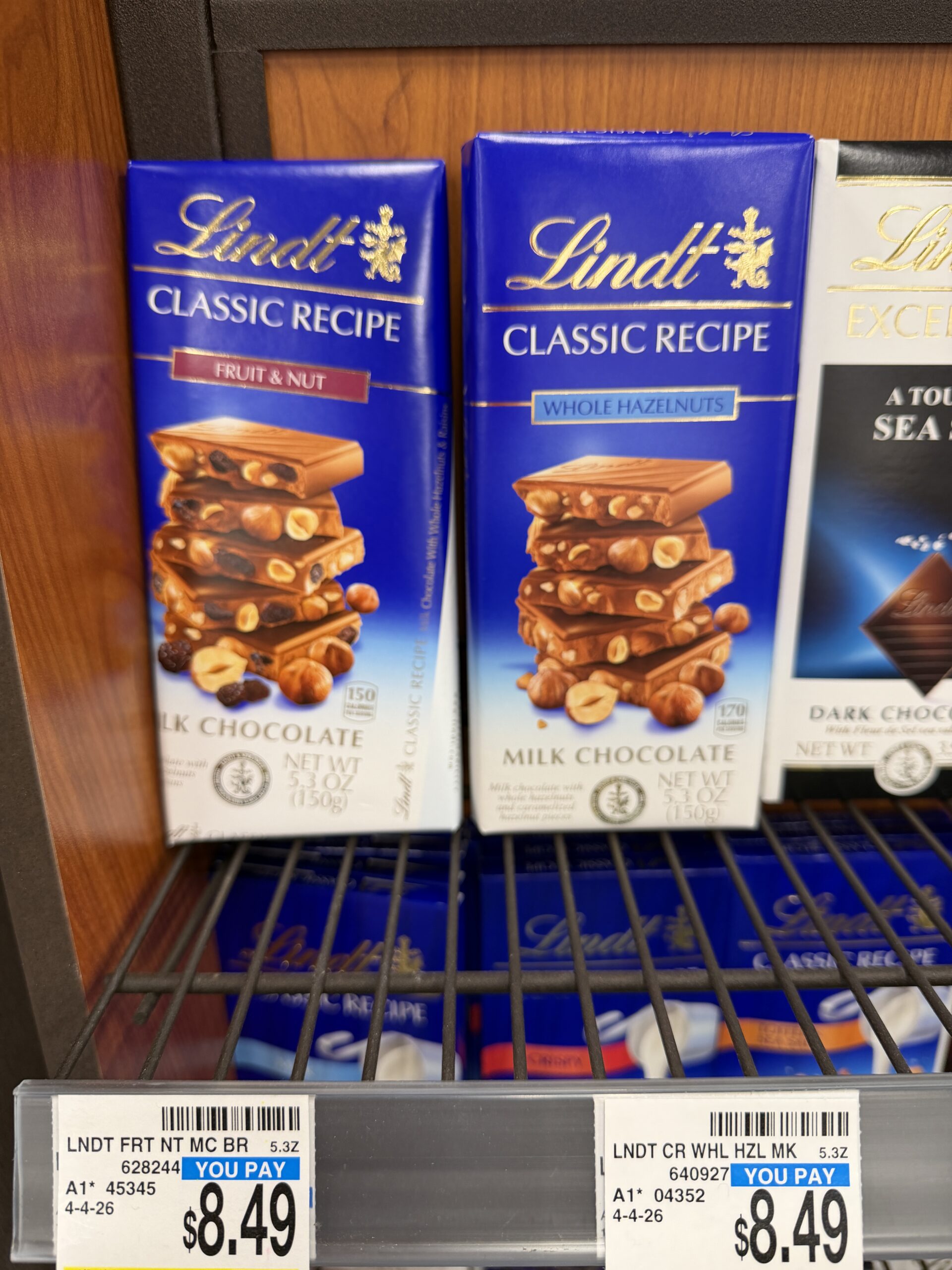
(note that the size also had to inflate, along with average American BMI, from 125g to 150g!)
Note that October is also Lesbian, Gay, Bisexual, Transgender and Queer/Questioning (LGBTQ) History Month. According to Wikipedia, there’s a Florida angle to this observance: “In 2012, for the first time, two American school districts celebrated LGBTQ History Month. The Broward County school district in Florida signed a resolution in September in support of LGBTQ Americans, and later that year the Los Angeles school district, America’s second-largest, also signed on.”
Here’s a question for you related to today’s post (inflation has been a recurring theme, so clearly interests you…and it should interest everyone!).
Would you and the rest of us prefer some level of general inflation (say 4.3%, to pick your candy bar #) or the same amount of deflation and why?
HE: Gradual deflation would be okay, I think. Your typical productive/solvent American has some debt (mortgage) and some assets (stocks) so the effects would mostly balance. The government wouldn’t like it because it would be the end of easy capital gains taxation. If there were 4% deflation annually and also companies on average had a real return of 4% that wasn’t paid out in dividends, the result would be stocks that just held a constant nominal value. (Of course, the big capital gains fish such as Bill Gates don’t pay capital gains tax because they stuff their money into a foundation before sending it to Africa.) The 20% of Americans who are smart enough to refrain from work wouldn’t care because most of their taxpayer-funded benefits are received in kind (housing, health care, Obamaphone). Their quasi-cash benefit of SNAP/EBT might never be reduced in nominal dollars (imagine the headlines in the NYT!) so they’d be buying A5 Wagyu. Per usual, it would be the working class who get totally screwed. They may have mortgage debt and, certainly, auto loans.
Phil, the learned students at Wesleyan University encourage you to expand your inclusivity and use the abbreviation LGBTTQQFAGPBDSM for this month’s Celebrations.
Phil, as a New American I often have questions (along with my four wives-ages 8, 9, and two at 11-all of whom I purchased in Kabul last year) and I often find you have answers for me. To that end, I see the abbreviations noted here and I have found it difficult remember this alphabet soup of letters, so am wondering if I can lump them all into the “Buttfucker” bucket that is so familiar to those of us from Peaceful and Inclusive Islamic Countries?
Spent $3 on a commenter grade candy bar, 2 days ago. More satisfying when it’s the currency losing value instead of a price increase. PCE still came in at a low 3% because of falling wages. Most everyone expects a conversion to a digital currency now. $100,000 will buy a digital coin with the buying power of $50,000.
Would lions have pride if they found out Food Lion was lioness owned? They round to the nickle, so stuff is at least 5X higher than when the penny had value.
What sort of questions come from “Queer/Questioning”? Perhaps best not to know.
Also, why are only the poor Q sharing their letter? Surely there are many other identities that would like to share the L, G, B and T.
I think they might have been 125g. CVS back in April was selling 150g bars for $8.49. That’s an inflation rate per gram of about 615%, which seems staggering but can be accomplished by compounding 4.3% per year for 47 years.
I like statistics like this as they serve as a reality check on official inflation statistics.
According to Claude, CPI-U has increased 436% or 3.4% annually since 1978. It sounds like your candy bar had a hedonic 20% quality improvement (125g->150g) over 48 years, which lowers candy bar inflation to 4.1% annually.
Much of the gap between the CPI-U of 3.4% and the Greenspun Index of 4.1% adjusted for portionflation is explained by hedonics and manufactured goods. Goods inflation has mostly underperformed the CPI-U including apparel at 1.1% and vehicles at 2.4%.
It’s nice to know that even including Carter and Bidenflation, that 10% inflation rates truly are transitory.
My personal chocolate demand is very inelastic with respect to price. Q (for quality, not queer as in folk) has been the problem for me. I used to eat Toberlone, but the last one I bought at Wal*Mart had nougat so hard that it nearly cracked my molar. Some $6.00 Lindt bars I’ve eaten could be described as a chalky, chocolate-like substance. The best, cheapest ones are Food Lion store brand — made in Switzerland, high quality, $2.50 a bar on sale — but always out of stock. My shopper savings card is probably flagged as “chocoholic” when I buy 8 bars at a time. I’ve also been buying Hersey nugs from Costco, which are so-so, but at least edible and more reasonable in price. Coffee is another commodity which has skyrocketed in price. I blame Al Gore for habitat loss for the beans, due to the energy consumed by the lighting of his Nobel Peace Prize display case.
With all due respect to our brothers, sisters, and binary-resisters in New Hampshire, I’m not convinced that the $6 domestic Lindt bars (made close enough to KPSM to pick up fumes from the KC-46A tankers based there) are as good as the $8+ Lindt bars made by the Gnomes of Kilchberg.
Good news: https://foodlion.com/product/food-lion-milk-chocolate-bar-with-hazelnut-pieces-3-5-oz-bar/353850 is in stock in at least one Food Lion.
Better news: taxpayers will pay for this if you’re smart (“SNAP Eligible”).
Is chocolate from the low bidder in Switzerland truly awesome? Trader Joe’s sells some and AI says that it is pretty good, though sweeter than Lindt’s milk chocolate. Trader Joe’s just dumps 30% whole hazelnuts into one of their “Swiss” milk chocolate bars. That seems like too much. Google AI says that Lindt’s is 20-26% (their “classic recipe” with chopped hazelnuts, which I’m sure tastes better, is 10-15%). https://www.foodandwine.com/news/aldi-chocolate-taste-test says that Aldi’s low-bidder bars are all pretty bad (German-made, not Swiss, and I personally don’t like German chocolate).
My brother-in-law made fun of me buying a personal half kilogram Belgian chocolate bar at Trader Joes. It is possible to have too much chocolate, my mom used to work in a nursing home, and a resident with dementia got into the pantry and ate pounds of the stuff and started hallucinating. She probably would have stopped with a couple squares of chalk-tastic nu-chocolate.
Loosely related to economics, inflation, and Europe:
> Europe’s Housing Crisis Is An Immigration Crisis, Berlin Data Confirms … Across the West, native Europeans are dying out but rental prices continue to go up every year. While the left would like to point the finger at capitalists and greedy landlords, the primary factor driving the housing affordability crisis is mass immigration … Should more housing even be built? As Western cities race to replace their native European populations, the question becomes whether life really becomes better in a crowded multicultural city when it means more traffic, longer waiting times at hospitals, crowded classrooms, and imported crime – just to name a few ills.
https://www.zerohedge.com/markets/europes-housing-crisis-immigration-crisis-berlin-data-confirms
Anon & Phil, I read Anon’s comment with dismay and concern (along with my four wives-ages 8, 9, and two at 11-all of whom I purchased in Kabul last year). Could it be that the Germans are souring on Peaceful Islamic Immigrants like me and my family. After all, I am a family man and bring new and Nourishing Values to Western countries: Child Rape, Enslavement of Women (including, of course, clothing them in head-to-toe black rags), beheading of Buttfuckers, Eradication of Jews and so much more. What should we make of these clearly Racist Germans, and others too?
@Muhammad, be careful what you wish for. If you ever decide you want to “talaq” one of your many wives, you might discover that things don’t quite work that way here in the great USA [1].
[1] https://www.thecentersquare.com/texas/article_b9f89cd3-e8c9-47bd-aaea-94874a2925c8.html
Thank you, Muhammad, for enriching both Germany and this blog. Sihhatun wa ‘afiyah to you, your wives, and any of your children that the German taxpayer is now supporting. I hope that you’re not being affected by the affordable housing crisis in Germany, which I understand is caused by a paucity of low-skill migrants. If only Angela Merkel could have lived and ruled forever.
Greetings from Germany
100g milk chocolate for 0.39 Euro
Lidl home brand (Fin carre).
0.39 Euro equals 0.44 United States Dollar (final price, all taxes included)
https://www.instagram.com/p/Dd632IctKSH/
https://www.prospektguru.de/storage/images/uploads/item/280926/fin-carre-tafel-schokolade-alpenmilch-IsBHe.jpg
Ok, ok – it’s probably for a limited time.
Then it goes back to almost 80 cent (around 90 US cents).
And it’s not Lindt.
But chocolate is so much better in cold, dark, grey, miserable Germany (depression and suicide month November is getting close) than in hot and humid Florida.
Andreas: Thank you (or “Jazak Allah khairan”, as they say in Berlin). I had thought that Germany had some strict rules about what could and couldn’t go into “chocolate” that prevented German chocolate factories from using the same ingredients and processes that are used across the border in Switzerland. I’ve always thought that the Swiss-made product had an edge over German-made. But ChatGPT says that this might be all in my head:
Germany’s Kakaoverordnung, implementing the EU chocolate directive, defines milk chocolate primarily by minimum composition. To be sold as Milchschokolade, it must have at least 25% total cocoa solids, 14% milk solids, 2.5% nonfat cocoa solids, 3.5% milk fat, and 25% combined cocoa butter + milk fat.
Lindt’s U.S. chocolate already clears the German 25% cocoa threshold comfortably. Lindt’s UK Classic Recipe, apparently the European version of essentially this formula, explicitly lists 30% cocoa and 20% milk solids, which also comfortably clears Germany’s 14% milk-solids requirement.
Germany does impose some restrictions that could matter to other chocolate recipes. Non-cocoa vegetable fats are limited to specified fats such as palm, shea, sal, illipe, kokum and mango-kernel fat, generally up to 5%; flavorings cannot imitate chocolate or milk-fat flavor; and there are restrictions on starches and cereal products. But none of those prevents the basic Lindt formula of sugar + cocoa butter + cocoa mass + milk solids + lecithin + malt/vanilla-type flavoring.
Nor did I find a German rule requiring a different manufacturing process—different conching, refining, roasting, etc. Lindt itself describes its Kilchberg, Switzerland process as mixing cocoa mass with milk powder, cocoa butter, sugar and vanilla, refining it, and then conching it. That’s perfectly compatible with German law.
There is an especially strong piece of real-world evidence: Lindt Germany itself sells Swiss-made Lindt chocolate in Germany. Its German site sells a “Swiss Classic Collection” described as Schweizer Schokolade, with the familiar Swiss recipes. It also sells German products advertised as being made according to “Originalrezepten von Lindt & Sprüngli Schweiz.”
The math checks out (about 7.15x per gram, or 4.3% a year), but the title may be more literal than intended: a big part of it is the franc rather than the chocolate. The dollar bought roughly 1.8 Swiss francs in 1978 and buys around 0.8 now, so the franc is up about 2.2x against the dollar. Strip that out and the bar’s price in francs rose only about 3x over the same 47 years, roughly 2.5% a year, which is close to ordinary inflation. US CPI over the same stretch is up about 5x, around 3.5% a year. So the Lindt premium over CPI is mostly a story about the dollar’s purchasing power against the franc, with the recent cocoa price spike adding a bit on top. Chocolate is just an unusually honest exchange-rate index.