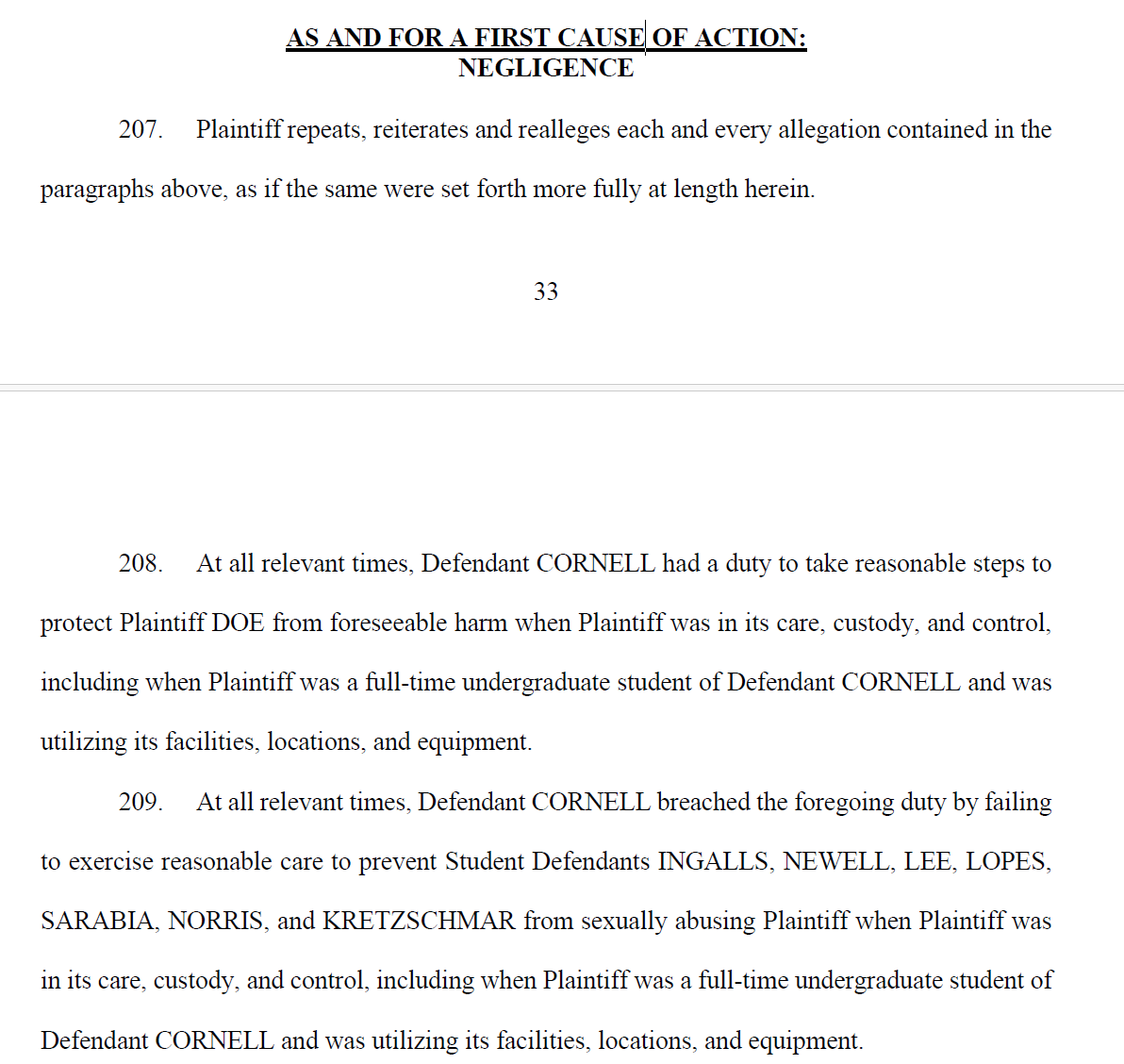
Jane Doe, also known, depending on what media someone consumes, as “the Cornell Plaintiff”, “Jane Hoe”, “the Cornell Skank”, “the Cornell Genocide Survivor,” and/or “Lucy Craig”, alleges, in the first count of her cash-seeking civil lawsuit, that Cornell University was negligent:
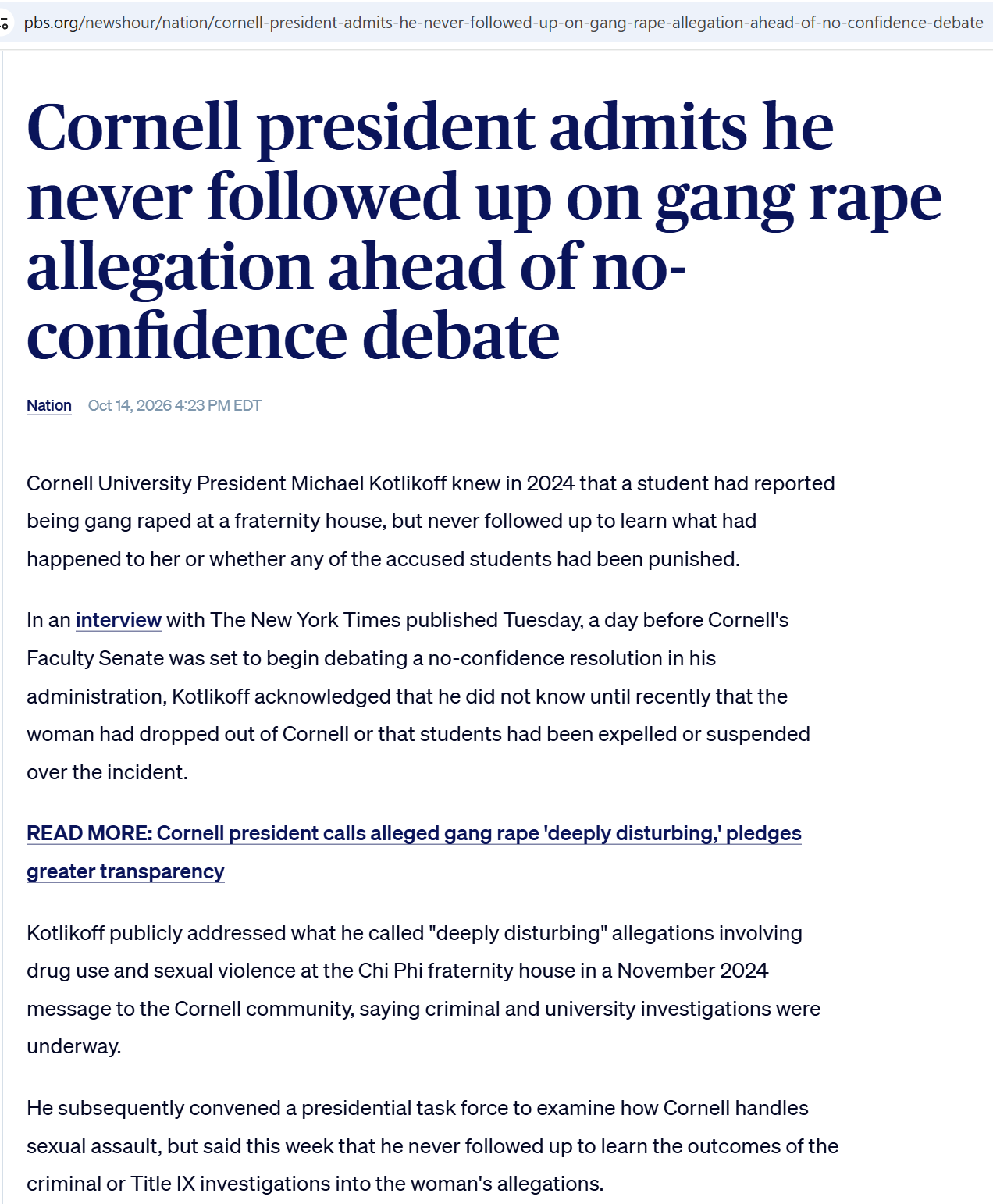
Cornell’s top executive has admitted that Cornell was negligent. From state-sponsored PBS:
Fair to predict that the Cornell Plaintiff is going to be the richest person ever to have attended Cornell? At this point, a jury’s only job will be to figure out what percentage of Cornell’s $12+ billion she gets. Assuming a normal amount of hatred of the university by average Ithaca residents, we’re witnessing the creation of a billionaire? (I wonder if AI has exacerbated town/gown hatred. Cornell is jammed full of humans who are less intelligent than ChatGPT and who yet have guaranteed $500,000/year compensation packages for the rest of their lives. What could be more insufferable to a member of the jury who works at an honest job, e.g., electrician?)
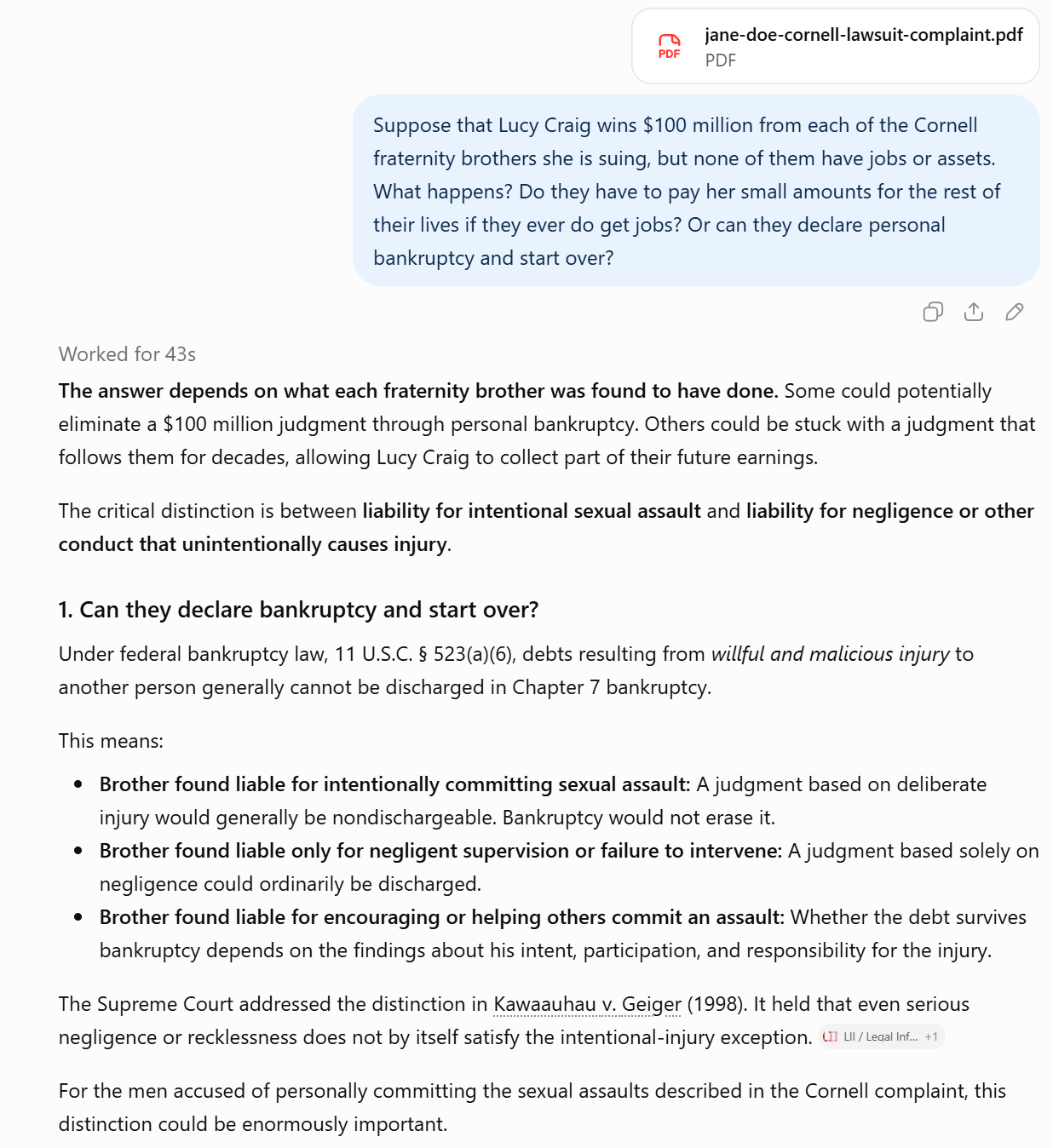
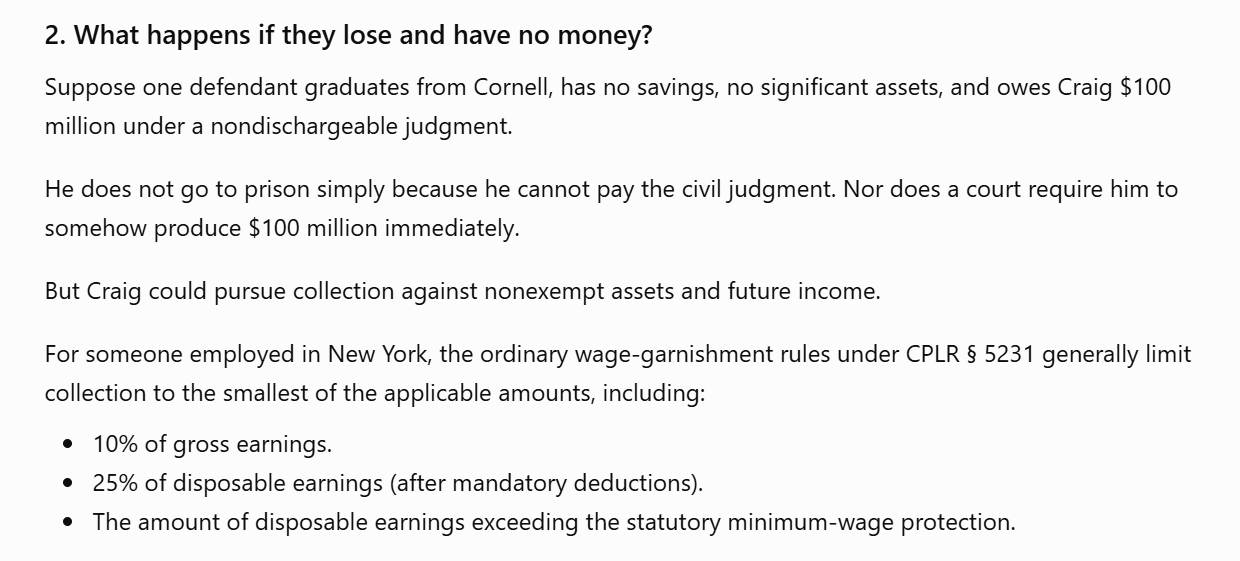
I think that all of the money has to come from the institutional defendants, such as Cornell, the sorority she was a member of, and the fraternity. By explicitly naming all of her purported attackers, the anonymous-until-the-NY-court-messed-up plaintiff is ensuring that none of them will ever have any money because none of them are going to be able to get white-collar jobs. ChatGPT, Esq.:
Here’s Jane Doe’s perspective on the executive who has admitted negligence (and my response, which connects the survivor Kristin Krouse to the Cornell Genocide victim):
It will be interesting to see what the jury decides, if it gets to a jury. I think there’s a good chance Cornell will settle before trial so as to sweep it under the rug and be done with it.
Related, if a jury were to initially side with Lucy, I think she would ultimately lose if Cornell were hell bent on appealing all the way up the court system because Lucy’s case actually looks pretty weak on the facts. The problem for Cornell (in both court and the court of public opinion) is that they already look like they’ve taken her side to some extent, based on their recent comments and actions.
I am confident in my prediction that she will never have to work her mind or body for the rest of her life. That’s purely based on what Cornell pays out. The rest of the defendants are gravy!
Just to be clear, I agree she is going to get a huge payout from Cornell, I just think the most likely scenario is from a large settlement before it ever gets to trial.
I think other defendants will fight to the end, and though may lose initially in a jury trial, are very likely to prevail on appeal because her case is so weak on the facts.
LL: I think you’re right. In fact, given what their president has said I think Cornell should write the check today.
Yes, exactly…agreed that given Cornell’s actions and comments the most rational thing would be to settle today! They appear entirely clueless.
Astonishing to me that Lovely Lucy didn’t realize Cornell’s administration are a bunch of fools and file the lawsuit long ago. She could have had that large settlement invested in the stock market while she contemplated her next scam.
It is indeed incredible that a 22-year-old is smarter than the entire Cornell administration put together. How can Cornell still charge $400,000 for a degree when their most senior employees are so plainly less intelligent than a $20/month ChatGPT subscription?
What states do not allow garnishment of income for payment of court judgments?
Gemini: “Four U.S. states completely prohibit private creditors from using wage garnishment to collect ordinary civil court judgments: North Carolina, Pennsylvania, South Carolina, and Texas.”
I am not 100% sure this would be considered an ordinary civil court judgment, but I believe it is if they were found guilty of negligence rather than the actual rape.
For this reason, I expect these people can work in these states and not have ordinary income attached. However, they most avoid putting any money into normal accounts. Paying down a homestead or putting it towards a 401K should be protected as those are exempted. I also expect in Texas or the Carolinas they can find places that might offer them employment, especially if they are skilled and motivated, which I bet they will be.