The idea of ever-larger-and-more-compassionate government seems to have fallen out of favor lately in Central and South America. Here’s a graphic attributing the shift to the dismantling of USAID (source):
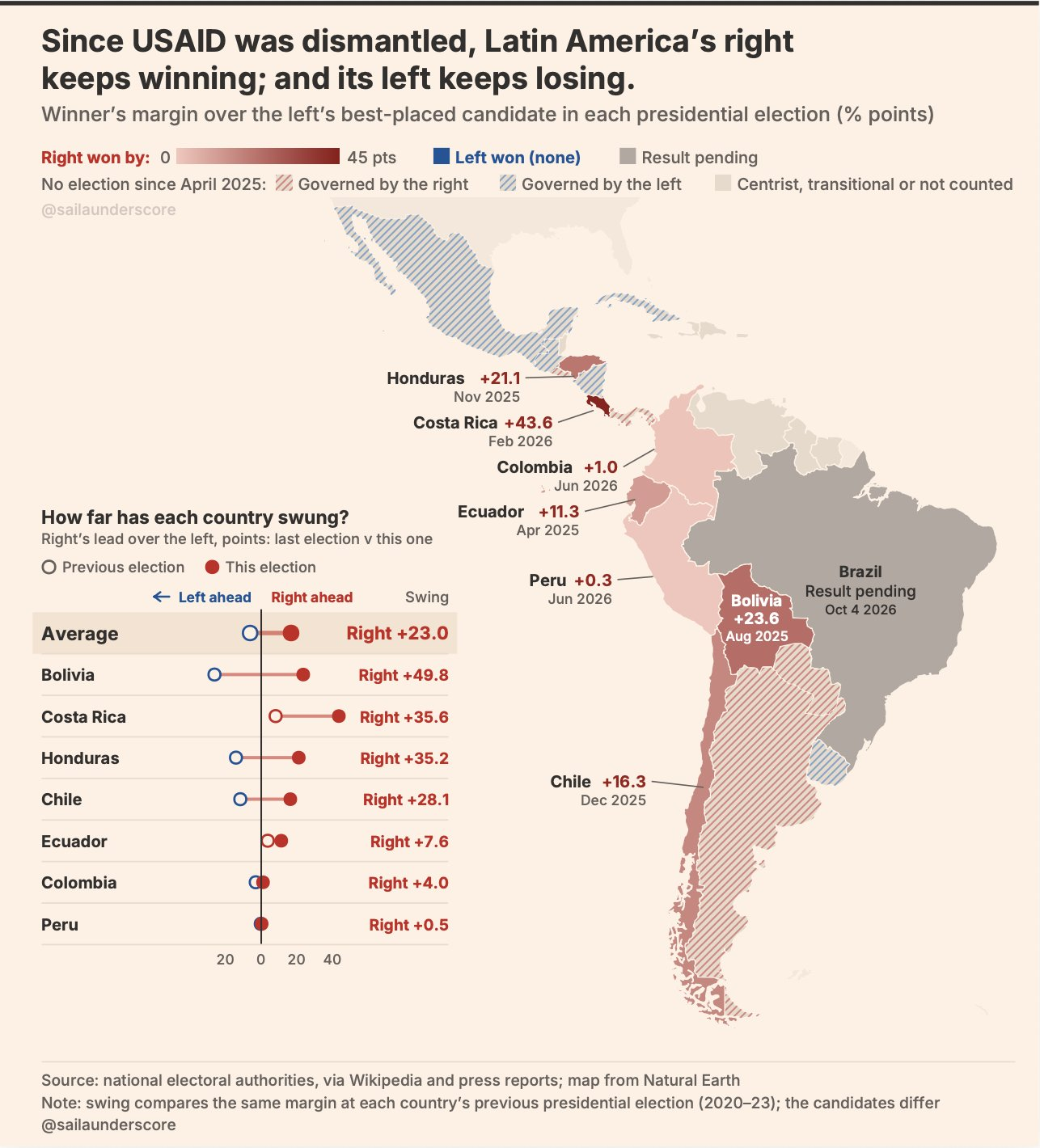
What if the reason is the Biden-Harris administration’s open border policy? Suppose that everyone in Central and South America who wanted to live in a cradle-to-grave work-optional welfare state migrated to the U.S. in 2021-20244. The voters who are left behind are, therefore, the conservative ones.
Separately, how are people feeling about yesterday’s election in Brazil? If it didn’t take a few weeks to count the votes and include a last-minute reversal can it be considered in any way free or fair by California standards? Also, I thought that the U.S. was the only democracy in which an 80-year-old could win the demanding chief executive job but, per usual, was apparently wrong.
(It looks like Lula won using some of the same tactics that Democrats have used recently in the U.S. AP: “Legislation to reduce the country’s workweek from six days to five and weekly working hours from 44 to 40 without reducing pay was approved by Congress 10 days before the runoff. … In September, Lula announced a 15% increase in payments under Brazil’s main welfare program, Bolsa Família, which bases benefits on family size and the number of children. The increase took effect this week, days before the election, and will benefit nearly 50 million people. … Lula on Wednesday endorsed credit relief and tax incentives for small businesses, giving them access to low-interest government loans through public banks and allowing them to renegotiate some of their debt. … Lula also is sending to Congress a bill to establish zero-fare public transportation on weekends.” Question: How is Lula going to argue that Elon Musk will pay for it all? Also, maybe this could be a positive for the U.S.? Brazil right now has a much lower personal income tax rate than the U.S. does, about 27.5% vs. over 50% for Californians and successful New Yorkers. With all of the new state-administered transfers, Brazil might raise its top tax rates and, thus, become less of a competitive threat to the U.S. for certain kinds of enterprises. France is the only nation with a larger welfare state, as a percentage of GDP, than the U.S. and they’re not much of a competitor.)
Related to the human export angle, “Caracas Is Eerily Safe. State Death Squads Made Sure of It.” (New York Times) mostly attributes improved safety in Venezuela to Delcy Rodríguez and Nicolás Maduro killing suspected criminals, but the open borders may also have been critical:
It’s undeniable that security has improved in Caracas and much of the rest of the country, but criminologists expressed skepticism over that figure, which would give Venezuela one of the lowest murder rates in the Americas.
Mass migration also played a role, with gang members constituting a small percentage of the millions who fled Venezuela’s economic collapse.
And just where did Venezuela’s most criminally-adept citizens end up? The NYT doesn’t say, nor do they mention José Antonio Ibarra, the Venezuelan enricher who killed Laken Riley. U.S. taxpayers will be funding Mr. Ibarra’s room, board, health care, and security for approximately the next 60 years. Mr. Ibarra won’t be able to vote in any Venezuelan elections due to his residence-for-life here in the U.S. (source)
Loosely related, If the dark days don’t have you in a suicidal mood… (quoting a Michel Houellebecq novel):
Are you from Brittany?” he asked. “Yes—from Saint-Brieuc!” she replied happily. “But I really like Brazilian dance,” she added, obviously trying to absolve herself for her disinterest in African dance. Much more of this and Bruno would really get irritated. He was starting to get pissed off about the world’s stupid obsession with Brazil. What was so great about Brazil? As far as he knew, Brazil was a shithole full of morons obsessed with soccer and Formula One. It was the ne plus ultra of violence, corruption and misery. If ever a country were loathsome, that country, specifically, was Brazil. Sophie,” announced Bruno, “I could go on vacation to Brazil tomorrow. I’d look around a favela. The minibus would be armor-plated; so in the morning, safe, unafraid, I’d go sightseeing, check out eight-year-old murderers who dream of growing up to be gangsters; thirteen-year-old prostitutes dying of AIDS. I’d spend the afternoon at the beach surrounded by filthy-rich drug barons and pimps. I’m sure that in such a passionate, not to mention liberal, society I could shake off the malaise of Western civilization. You’re right, Sophie: I’ll go straight to a travel agent as soon as I get home.”
In the Department of Election Predictions, it is the 10th anniversary of this tweet:
Yes, Phil! Your thesis is entirely correct. I am indeed a far-right-wing conservative and that is what the good people of Brazil voted for. Watch as the remainder of the Americas follow the trailblazing winners in Brazil.
Congratulations, Mr. Silva! But your victory may not be inconsistent with the drift-via-migration-of-welfare-enthusiasts. Brazilians haven’t benefited from truly enlightened U.S. enrichment welcome policies, such as Temporary Protected Status. Possibly as a consequence, a smaller percentage of Brazilians live in the U.S. vs. the countries where politicians characterized as “right-wing” have won.
Obrigado, Phil! Having read your blog for years, I know that you are a Proud and Loud Citizen of Portugal, so we both speak the same language in so many ways. How are the “students” behaving in your new country of Portugal?
And, you note that “Brazilians haven’t benefited from truly enlightened U.S. enrichment welcome policies.” Of course they haven’t! Why would they leave a country where my policies have resulted in GDP per capita ranking 85th globally vs. only 10th in the U.S.? And, even bigger numbers are on the way. Can we get to 95th? I think so!
“Legislation to reduce the country’s workweek from six days to five and weekly working hours from 44 to 40 without reducing pay was approved by Congress 10 days before the runoff
It looks like a matching 10% pay cut came through today as the Real is down 10%…
https://finance.yahoo.com/quote/BRLUSD=X/
Is that a real tweet by Clinton? It cannot be that she is that self-congratulating and entitled.
I think that it is real. Presumably by a staffer who was more adept with social media. I think we can give Hillary credit for not deleting it the way that the Islamic politicians typically delete their most vivid Jew-hating tweets (example: https://www.i24news.tv/en/news/international/americas/1580027008-rashida-tlaib-deletes-re-tweet-accusing-jews-of-kidnapping-drowning-arab-boy “Rashida Tlaib, Palestinian-American Representative from Michigan, has deleted a re-tweet of a post blaming Jewish settlers for kidnapping and drowning an Arab boy. … The boy was found by the police earlier on Saturday in a flooded ditch in East Jerusalem after an intense search operation and proclaimed dead.”; see also https://www.foxnews.com/politics/rashida-tlaib-deletes-tweet-blaming-white-supremacy-for-jersey-city-shooting ).