A year ago, Pascual Restrepo published the best-titled AI-related related paper ever: “We Won’t be Missed: Work and Growth in the AGI World” (NBER). Abstract:
Artificial General Intelligence (AGI) … makes it feasible to perform all economically valuable work using compute. I distinguish between bottleneck and supplementary work—tasks that are essential versus non-essential for unhindered growth. As computational resources expand: (i) the economy automates all bottleneck work, (ii) some supplementary work may be left exclusively to humans, (iii) output becomes linear in compute and labor and its growth is driven by the expansion of compute, (iv) wages converge to the opportunity cost of computational resources required to reproduce human work, and (v) the share of labor income in GDP converges to zero.
The ideas aren’t new, but the Yale econ professor proves via the title that the Queers for Palestine League faculty can add valuable gloss.
Based on observing our neighbors decorate their houses for Halloween and Christmas, sometimes spending up to $10,000 on professional light installation just for Christmas, my own theory is that the economy can expand to accommodate currently-impractical/unaffordable activities such as wrapping cars with seasonal decorations every few months. We’ve already seen that demand for landscaping and horticulture is essentially unlimited. I grew up in a neighborhood where all of the houses had simple landscapes that the homeowners could maintain themselves. Some people would pay a high-school student to mow their lawns, but paying a gardener circa 1970 wasn’t part of an upper-middle-class lifestyle. Due to a combination of the U.S. becoming wealthier and labor becoming cheaper (the miracle of the low-skill immigration wave that began in the mid-1960s), we now have upper-middle-class neighborhoods that can’t be maintained without intensive specialized labor and machines. Imagine the Japanese gardens that people would have if Optimus ownership became the norm!
Are we on Prof. Restrepo’s track yet? Regarding the final and most dire-sounding prediction of labor share going to zero, some progress has been made:
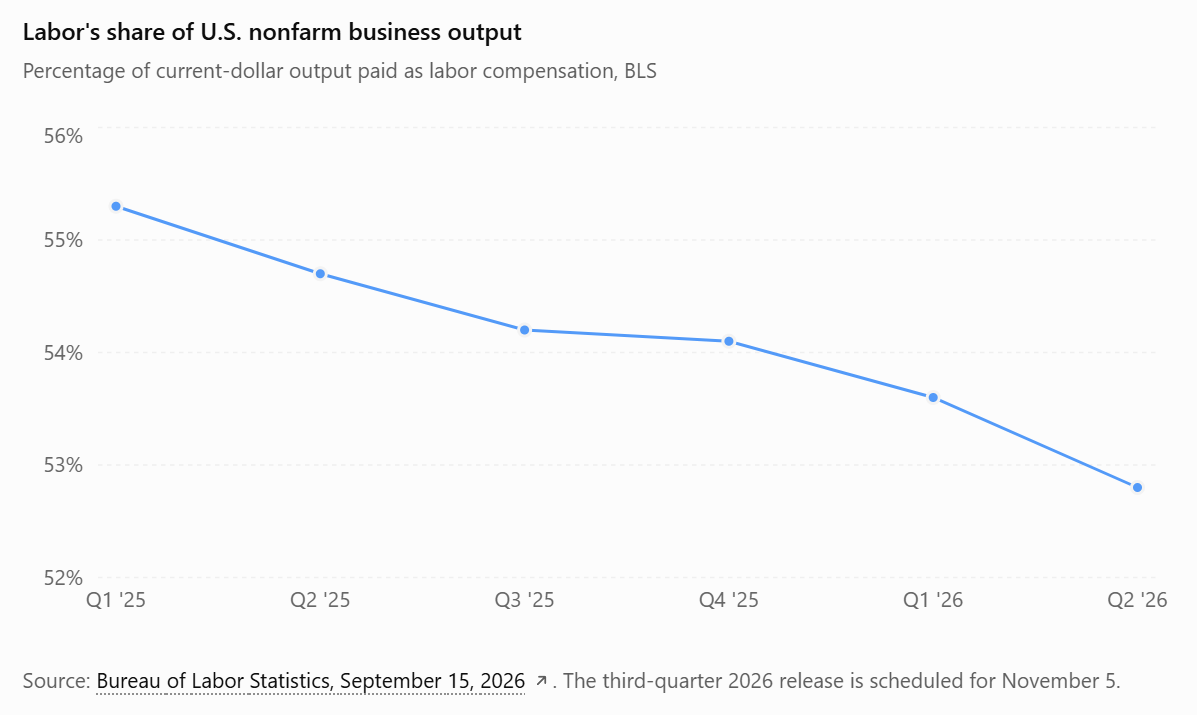
We should expect to hear politicians trumpeting this stat before every election? No matter how large the economic pie and even if we’re way better off, envy will make a falling labor share seem like an unfairness emergency to the average voter. A simpler formulation of the situation is that the economy always has to be divided between labor and capital. Machines are part of capital and machines have been getting smarter. American humans, on the other hand, are becoming less capable. (See “Gen Z — the first generation officially dubbed dumber than the last” (NY Post) and “American IQ Scores Have Rapidly Dropped, Proving the ‘Reverse Flynn Effect'” (Popular Mechanics 2023); note that these data are tough to square with the religion of Enrichment via Immigration because IQ rose between 1924 and the Hart-Celler Act of 1965, decades during which the U.S. was not enriched) We should expect markets to give machines more and humans less.
But is the simple statistic misleading in our “means-tested everything” transferist political system? Consider a “single mom” cruelly forced to work 80 hours/month once her youngest child turns 14 (no need to work at all before then). She gets paid minimum wage times about 18 hours per week, but her total compensation from the economy includes at least the following extras: (a) housing that might be worth $30,000+ per year, (b) health insurance (Medicaid) for herself and her kids (another $30,000/year at market rates), (c) food via SNAP/EBT, and (d) an Obamaphone. The extras are primarily funded by financially successful Americans and those folks get a lot of their income by investments in capital. “In San Francisco, a Family Earning $325,000 Qualifies for Government Aid” (New York Times):

(The couple featured is also a good example of how a lot of wages aren’t set by the market: “Mr. Marman, 36, brings in about $135,000 as a therapist for the city”. The government can pay its workers whatever it wants to pay. (How hard did the New York Times have to work to find a Black husband/Asian wife couple? Grok says that this pairing is 0.08% of U.S. married couples, though likely somewhat higher in SF.))
How about the automation prediction? “No Widespread Displacement, but the AI Employment Gap for Young Workers Has Widened to 19%” (Stanford August 2026):
… young workers in AI-exposed occupations are increasingly falling behind their less-exposed peers. Employment among workers ages 22–25 in highly AI-exposed occupations now stands about 19% below where it would be if it had kept pace with employment among similarly aged workers in less-exposed occupations. Experienced workers show no comparable gap. … the shortfall was 15% at the July 2025 data vintage and is 19% as of June 2026. The adjustment appears to operate primarily through reduced hiring of young workers rather than increased separations.
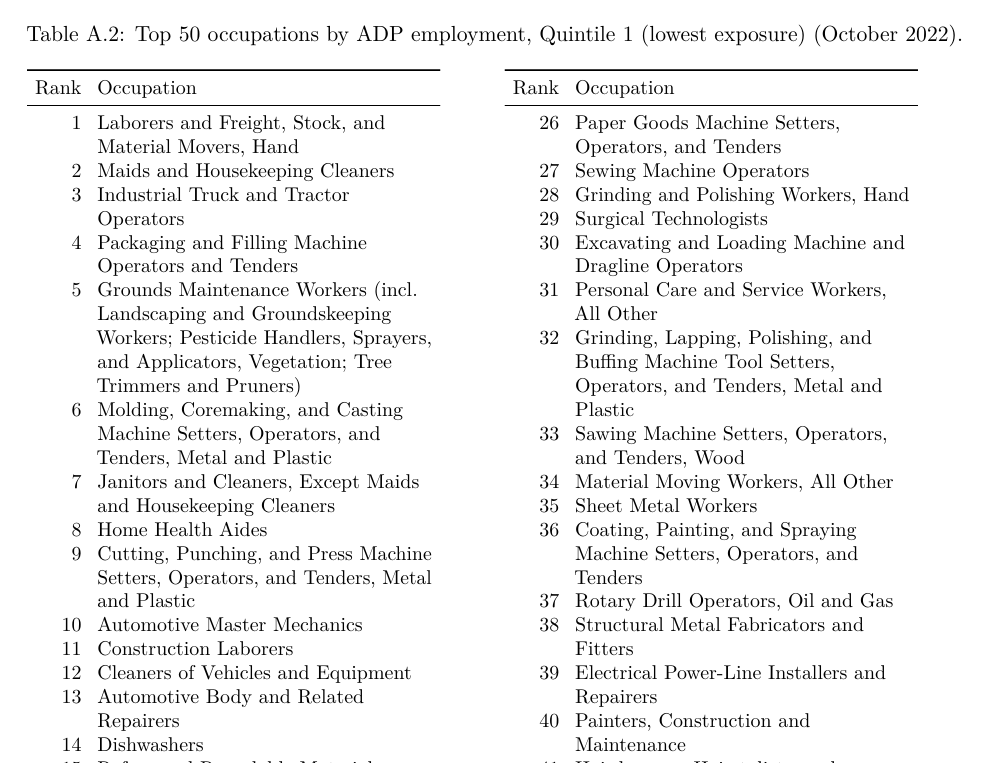
What constitutes “AI-exposed”? That’s in the appendix (page 52 of the PDF). Some of the stuff that I think should be easy to automate, e.g., fitness training, is listed as “lowest exposure” (why can’t a phone app count reps and, via its camera, microphone, and speaker, keep someone on an exercise routine?). The Stanford geniuses think that our neighbors will continue having to pay their mobile detailers (“Cleaners of Vehicles and Equipment”):
Bad news for computer nerds. We’re among the most exposed:
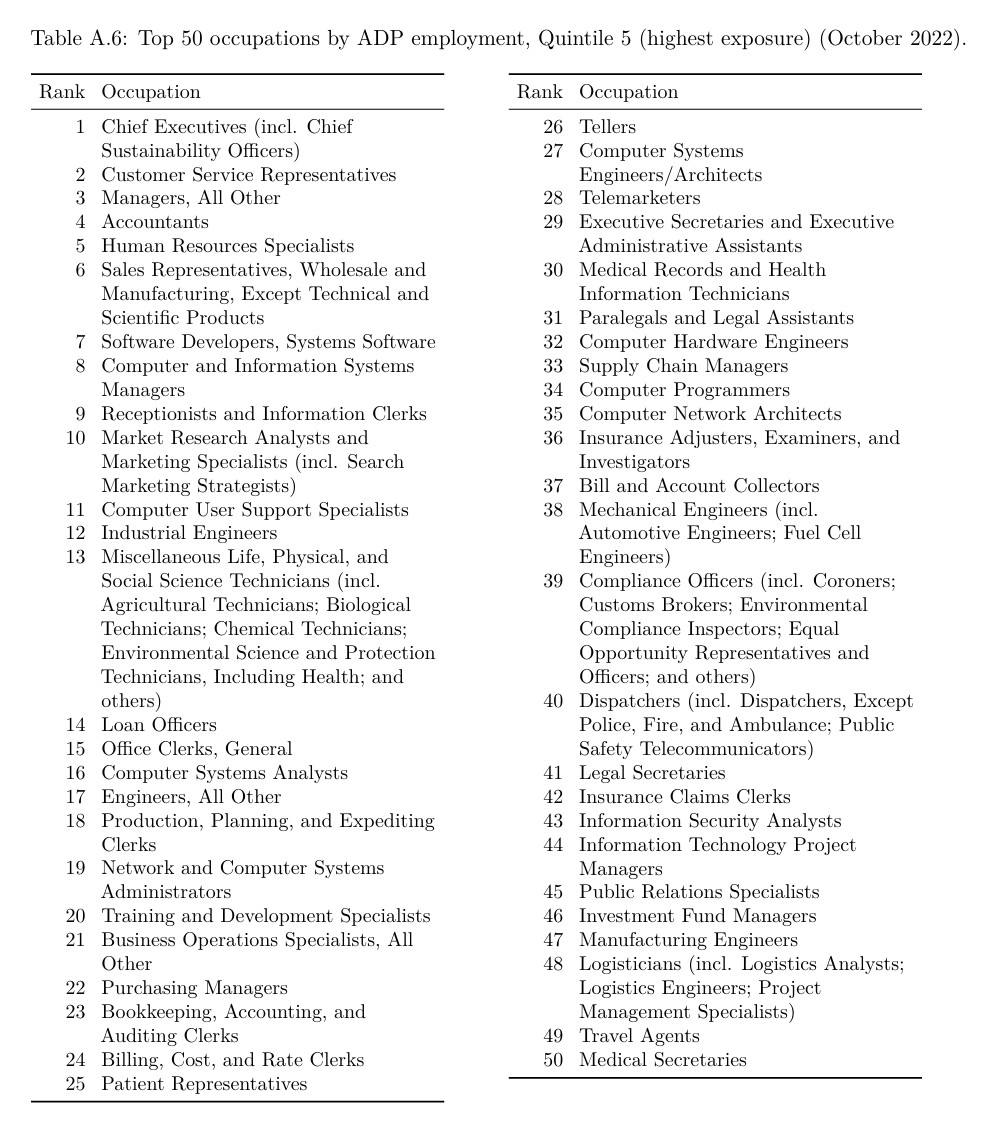
(I don’t think the Stanford authors are considering what would happen if Elon Musk’s promises regarding Optimus turn out to be true. They’re looking at AI without robotics.)
Who wants to predict where things will be in one year? I’ll say that through a combination of market forces and AI and the expansion of the welfare state distorting statistics with more means-tested benefits, the headline labor share falls to 50% by Q3 2027.
> Graeber classifies a job as bullshit if society would be no worse off (or even notice) if such job(s) disappeared, and names five classes of meaningless jobs: flunkies, goons, duct tapers, box tickers, and taskmasters. He argues that the association of labor with virtuous suffering is recent in human history and proposes universal basic income as a potential solution which would allow individuals to choose how they would like to contribute to humanity.
https://en.wikipedia.org/wiki/Bullshit_Jobs
Seems like jobs stoopid AI was made for. Our AI overlords will probably retain bullshit jobs done by AI rather than pass the savings of reform on to humans via UBI.
Phil, we both really enjoyed today’s post! Thankfully, neither of our occupations or skills are listed on the “highest exposure” list, but we just wanted to check with you to make sure. Recall that Lucy is an expert gangbanger, and also loves snorting ketamine on penises. Kristin, on the other hand, loves engaging in gang rapes. Do we both have a place in the new “SI” world?
XOXO, Lucy and Kristin.
https://x.com/TheLone08157926/status/2115801720059990504
https://x.com/colonelkurtz99/status/2115534171464691832
> Do we both have a place in the new “SI” world?
“The horror, the horror.” — J. Conrad
Thank you, Lucy and Kristin. It is an honor to have brave survivors commenting on this blog. Without your courage, the world might never have learned of the genocide against women perpetrated daily by men, especially men with white privilege.
Since the only source of revenue is the recycling of text by language models, blog commenting is actually 100% of the economy.
“A penny for your thoughts, Leo…” Which is exactly nothing, in post-Biden-flation currency.