Sad day for aviation in Florida, A 2004 Learjet 60 en route from Texas to the Bahamas crashed into a neighborhood here in Palm Beach County, about 30 miles south of us. The crash of N722BD is reported (NY Post) to have occurred shortly after 1 pm, 1300 local or 18Z. Here’s the archived radar from November 1, 2026 at 18Z:
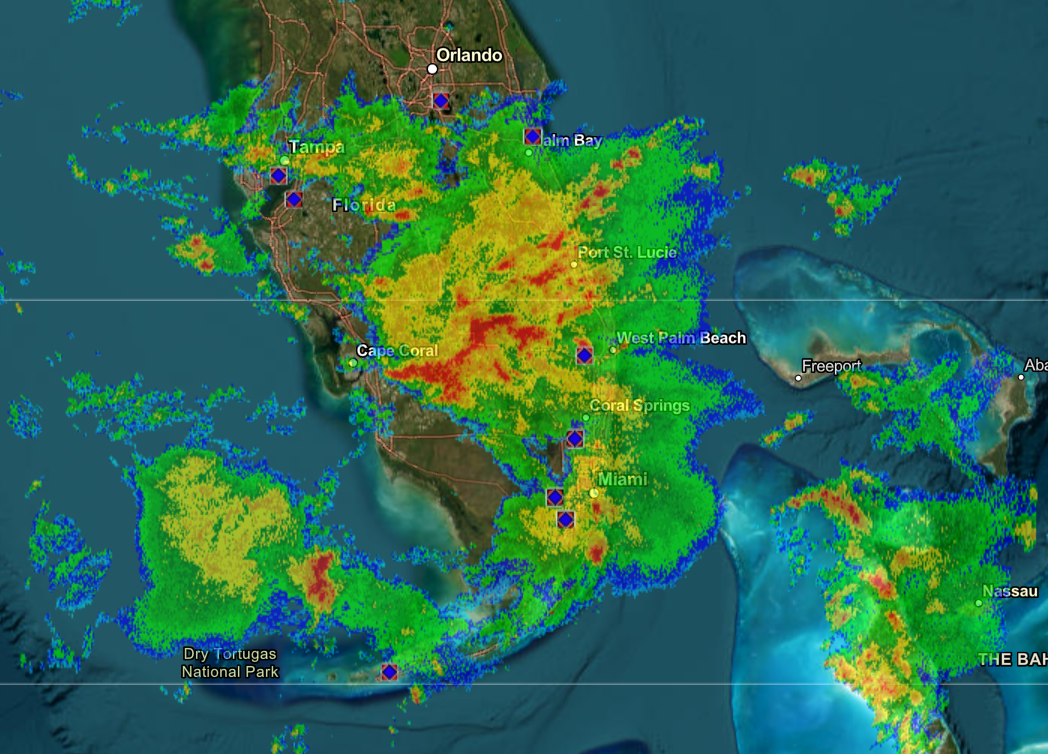
(The crash was just southwest of the W in “West Palm Beach.” I’m a huge chicken/coward so if I had been coming from Texas with in-flight NEXRAD and seen the above image I would have flown around it all to the north, stopping to fuel in Orlando if necessary, and then proceeded offshore to head south to the Bahamas.)
Anecdotally, it has been rainy all day here.
There is some horrific ATC video that is so bad it sounds as though it might be AI:
If we believe the audio to be genuine, the plane was getting hit by some pretty bad turbulence (up and down at least 600′), consistent with being on top of or next to a thunderstorm. What’s confusing is that the pilot monitoring (a Learjet 60 is a two-pilot aircraft and, therefore, it is not the pilot on the controls who communicates with ATC) reports “we’re managing the ice” (i.e., the plane’s hot wings are preventing ice from accumulating) and also that the outside air temperature was -47C, We’re normally taught that icing tends to be prevalent when flying through heavy clouds at between 0 and -20C. The official government story is that icing can happen down to -40C.
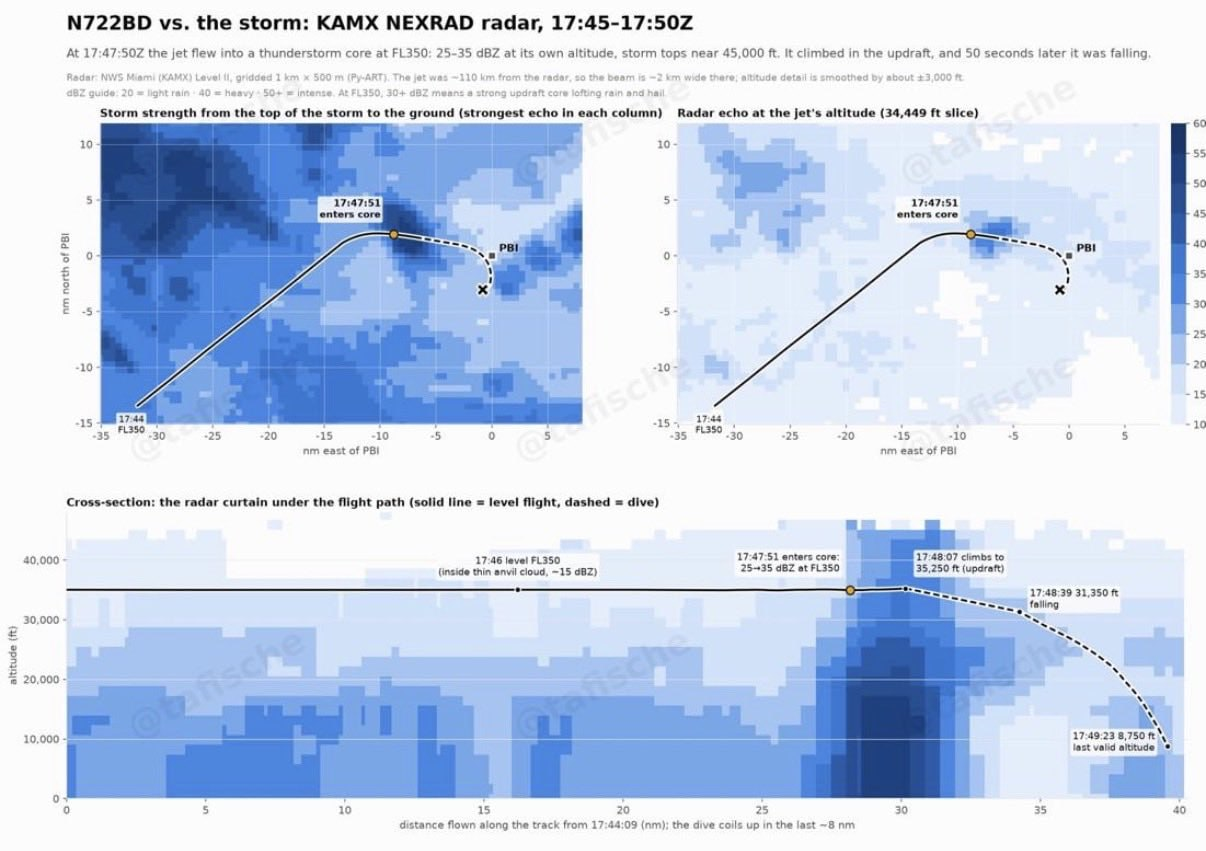
An aviation friend sent me this, but I’m not sure what his source is:
Assuming no mechanical problems, what could have brought a Learjet down in these conditions? Turbulence can become so severe that, unless the pilots have anticipated it and slowed down quite a bit, a plane is damaged or comes apart. Icing can become so severe, with supercooled liquid droplets, that it overwhelms even a fully certified flight-into-known-icing (FIKI) system. A tailplane stall is theoretically recoverable, but if not corrected will result in a nosedive. Ordinarily a plane’s wing’s pull up while the horizontal stabilizer of the tail pushes down. This is what gives a standard (non-canard) aircraft its stability. If the tail stalls, e.g., due to ice formation, the plane can pitch down. Partial failure of a jet’s anti-icing system, which depends on running compressed hot air from the engines (“bleed air”) into the wing, engine nacelles, and tail leading edges, can result in an uncontrollable bank and/or spin (on wing producing dramatically more lift than the other). The Lear 60 is unusual in having electric heat for the horizontal stabilizer rather than engine bleed air, but it comes on with the same switch as the bleed air anti-ice and shouldn’t have been a factor. Also, tailplane stalls are more common during approach when flaps are extended because the result is an increased angle of attack for the tail.
Whether upset by turbulence or a tailplane stall, a slippery is much more challenging to recover than a four-seat piston-powered airplane. The jet can quickly get into mach tuck, for example, if pitched nose down from a normal cruise speed. Flying at FL350 rather than FL410, their cruising altitude over the Gulf (see below), gave the plane a larger range of acceptable speeds.
Anyway, a sad day. Based on a search, the plane was actually based here in South Florida at KFXE and, therefore, the pilots should have been more than familiar with thunderstorm hazards. So the crash is a mystery at this point, but almost surely the weather played an important role.
Update: An ADS-B-tracking web service shows that the crew were successfully avoiding the most severe weather, but not slowing down to a speed that would have resulted in the airplane stalling before it became overstressed by turbulence. They blundered into a narrow but severe cell at full cruise speed shortly before impact. Some people who have reviewed dashcam footage of the crash are saying that the horizontal stabilizer (tailplane) was entirely missing as the plane crashed into the ground (even worse effect than a tailplane stall).
Even small turbojet airliners have been brought down by thunderstorms. Braniff 250 was an 80-seat airliner that experienced structural failure in 1966 due to turbulence even though the pilots had slowed down almost to the recommended turbulence penetration speed (source). This would be much less likely today because Air Traffic Control now has access to high quality weather radar.
You might reasonably ask “Why would anyone be crazy enough to try to get through weather like this?” One answer is that if you’re going to fly in Florida or Texas and aren’t willing to try to get through ugly convective weather you’re not going to be able to fly on a schedule. That’s not a problem for private aircraft owners, but for airlines and charter pilots the passengers expect the schedule to kept. The second answer is that most of the time it is possible to stay in clear air and navigate around the worst cells visually. One thing that investigators will want to look at is why ATC gave them a descent when they were over Naples, Florida and why the crew accepted the descent. They’d been at 41,000′ (“FL410”) over the Gulf of Mexico and apparently descended to 35,000′ (FL350) on arrival in Florida. Why not stay as high as possible until past all of the ugly weather? Altitudes gives pilots the best chance of staying visual and avoiding the tallest buildups. It is possible to be assertive with ATC, though when above 18,000′ ATC has the authority to say “Well, if you can’t accept lower then I’m going to have to vector you to Cuba and back”. It’s possible that, knowing things were likely to get bumpy, they descended in order to give themselves a larger range of speeds at which the airplane would fly safely.
(Weather is much lower in New England than in Florida. I was with a friend in a Pilatus PC-12 turboprop coming back towards Bedford, MA (KBED) from Ohio. There was some ugly stuff on the in-cockpit NEXRAD over western-central Massachusetts. I insisted on staying at our cruising altitude (25,000′?) because that would keep us from entering the tops of the clouds. Everyone else on Boston Center was an airliner and ATC pushed us with “Everyone else is going through it.” I responded with “Well, they’re Boeings and Airbuses and we’re not. If we have to circle to lose altitude once we’re clear of this that’s okay.” They plainly thought we were absurdly conservative/chicken, but let us do what we asked for, eventually entering a rapid descent once clear. Our little 9-seater probably could have handled the tops of the rain clouds painted by NEXRAD, but why subject our passengers to the turbulence and ourselves to the stress if we didn’t have to?)
Update 2: Some weather experts posted detailed radar data and analysis (in Fahrenheit). Piecing together the most relevant parts from their follow-ups:
At 12:36 p.m., the thunderstorm cell was 33,000 feet tall. By 12:56 p.m., it was 48,300 feet tall. That’s an increase [of] 15,000 feet in 20 minutes. signifying VERY intense updrafts … Ordinarily, that would be too cold to support robust icing. (Clear glaze is most prevalent between 14 and 32 degrees [F], with mixing of clear/rime ice at colder temperatures. … Rime ice is a danger below 0 Fahrenheit, but once you get to colder temperatures, there aren’t many supercooled water droplets left. HOWEVER, a rapidly-growing thunderstorm cloud can lift warmer temperatures, and more liquid water content, vertically upward. That can lead to extremely rapid icing in environments at altitudes where it otherwise would be a lesser concern.
Related:
- “How Airplanes Survive In Extreme Turbulence” (Simple Flying) explains why slowing down should prevent turbulence from bending or destroying an airplane
- “In-Flight Emergencies: Surviving a ride in a thunderstorm” (AOPA, 1999 (before onboard weather and the enhancement of ATC consoles)): “Slow to VA (maneuvering speed)”
- a sales listing for this plane at some point after July 2021
- below, a confusing incident involving the same aircraft a few months ago. The pilots reported “moderate chop” and also that they couldn’t hold altitude, thus leading me to wonder if something was wrong with the plane’s autopilot (jets are typically flown on autopilot). The controller correctly notes that an inability to hold altitude is “severe turbulence”, not “moderate chop”. We don’t hear any other planes on the frequency complaining of turbulence, including a plane that was close enough to them to be called out as conflicting traffic.
I have been a private pilot since the late 70s. I have been monitoring NTSB reports for decades and have seen and heard quite a lot of horrific videos and audio recordings. This was, by far, the worst. My guess, just a guess, is that the plane lost its stabilizer.
Usually these are highly accomplished, large egoed pilots in weather, declaring their frame of reference superior to the incompetent instruments. The instruments always win. The gootubers now all recommend avoiding weather unless it’s part 121.
My first thought was that it fits many of the characteristics of a tailplane stall.
It’s not always easy to figure out which is which, and the recovery technique for a tail stall is extremely counterintuitive for a properly trained fixed wing pilot: full aft elevator input in order to reduce AOA on the stalled airfoil.
Regarding the weather: things aren’t what they used to be. For decades I crisscrossed the country and never saw storm tops above FL450. Nowadays it’s not unheard of to see tops at FL650 or higher. Just astounding energy in a system that tall. I’ve seen plenty of that flying across Africa or other parts of the ITCZ, but not domestically. That part is new.
Ron: Weren’t thunderstorms in Texas always winding their way to FL600? That’s what I remember from circa 2000.
Hi Ron.
This stuff about the tail stall I don’t understand. Maybe you can explain it.
The tailplane is pushing down to counteract the forward moment created by the center of gravity being forward of the center of lift.
This makes the rear horizontal surface act as an upside down airfoil.
If you pull back on the yoke in an event of a tailplane stall it would deflect the elevator upward creating more lift downwards by INCREASING the angle of attack.
Pelle: I can try to answer your question. The horizontal stabilizer is an upside-down wing. It flies at a negative angle of attack. Assuming no change in relative wind (constant flight path) and no trim to change the stabilizer’s angle relative to the fuselage, pitching the airplane up 1 degree, therefore, increases the wing’s angle of attack by 1 degree (closer to the stall) and also increases the tail’s angle of attack by 1 degree, resulting in a negative number of small absolute value (e.g., from -3 to -2) and thus bringing the tail farther away from the stalling angle of attack.
(I don’t know the numbers for the Learjet 60’s airfoils, but suppose that the wings stall at +15 and the horizontal stabilizer at -15. Then consider that ice disrupting the airflow can reduce these to +8 and -8.)
Non-plane expert here: why did they fly directly through what looks like horrendous weather instead of avoiding it? Pilot error?
That’s what I was just thinking. Was going to the Bahamas on a business jet so necessary that it couldn’t wait for better weather? I could understanding if it was the opposite way.
Rest in peace to those involved.
*understand
Here’s one experienced pilot that seems to lean towards pilot error. As another non-aviation expert, it seems crazy to me that they flew directly into these violent storms when they could have easily avoided them by flying around them.
https://x.com/BillAckman/status/2117051265716744310
PE: If you’re not willing to try to thread your way through some ugly convection then you can’t go anywhere in Florida or Texas on a schedule. So airline and charter pilots do it regularly. ATC is supposed to be a helpful partner and onboard weather radar is supposed to help one avoid the worst cells, but it is difficult to interpret for beginners. (The latest Honeywell and Garmin business jet radars try to make it simpler.) I’m sure that if the Internet is correct and this plane was based at KFXE the crew had tackled some fairly similar weather before and come through with a planeload of happy passengers.
(We’re supposed to be in our dry season right now in Florida and it hasn’t been all that hot lately so it would also be surprising to get caught by a high-energy thunderstorm. The monster storms are mostly in July and August.)
I listen to all the crashes on YouTube. This was a bad one but not the worst. I still have occasional nightmares about crashes because I am a Norfolk VA native and Navy jets crash here now and then with horrific stories. They fly over me from time to time, extremely powerful, the ground shakes and things are rattling on the plane, and in my room. We are also next to ORF but passenger jets are tame. Whatever they are flying out of the Navy bases in this area cause mini earthquakes. And they always sound like they are about to crash, things are rattling.
Here is the weird thing. Norfolk is loud AF, and my room literally vibrates and shakes. But most Norfolk residents never notice and have no idea what I am talking about. By the same token, when they deploy, it becomes blissfully quiet. And again, few notice.
I have had flightsim set up for days now. I have the Honeycomb rudder pedals and flight controls purchased and in my room. I am super interesting in learning to fly but never do it. Hard to explain but when you retire you will understand that you are more busy than ever LOL. (My still working friends laugh when I tell them my day.)
There’s video from a rear facing dashcam: https://x.com/BNONews/status/2116984177510031612
I’m a pilot, my Honda Jet is based at FXE and my TBM is based at PMP. I struggle to understand how they were crossing known turbulence so fast. I surmise that a gust of turbulence broke a control surface and they lost control because they were so fast. I don’t think that it’s reasonable to think that icing was the main issue. I think the -47C means icing was highly unlikely. It’s so sad. 😭
Don’t watch YouTube.
Once again, thank you for the time you take to assemble some quick facts and offer some technical analysis. I really appreciate. I love aviation and it is painful to see general aviation take yet another hit.
Nathalia Gadelha, 20, was piloting the Learjet 90 on Sunday when it crashed near West Palm Beach.
How is it possible unless a family member ?
The female voice on the radio was a pilot and she was apparently typed in the Lear 60, though not to serve as pilot-in-command. But because she was on the radio it is almost certain that she wasn’t on the flight controls (actually at those altitude the use of autopilot is required by regulation, but she wouldn’t have been the manipulator of or primary person monitoring the autopilot; when I, as pilot monitoring on some of my earliest Canadair Regional Jet flights, touched an autopilot knob out of habit, the training captain in the left seat would ask “Who’s fucking this sheep?”).
https://www.aircraft.com/aircraft/218513241/n722bd-2004-learjet-60 is a sales listing for the plane. It has the Collins WXR-840, which doesn’t build a 3D picture of the weather ahead like the latest Garmin and Honeywell products.
This is one area where her youth may have played a role. It takes many years to become proficient in the use of onboard weather radar. The people who really know how to do this are 60-year-old airline captains. At Delta/Comair they showed us a video on how to use the radar, but we newbies weren’t able to find anything with it other than cities (“ground clutter”). We relied on staying above the clouds and navigating around buildups that we could see.
Apparently: Minimum Age for a Commercial License: You must be at least 18 years old to hold a commercial pilot license and fly for hire.
Finally listened to the ATC audio from Dan Gryder’s upload. X is assumed to be all AI now. Wonder if the pilot in command was similarly losing it or just the one on the radio. Always assumed nobody flew through thunderstorms after the crash videos 50 years ago. Nobody except Greenspun Yeager.
lion: If you check AWC and Flightaware you’ll see that tons of airplanes are flying through a similar system right now (convective sigmets cover nearly all of South Florida). https://aviationweather.gov/gfa/#sigmet
> I’m a huge chicken/coward so if I had been coming from Texas with in-flight NEXRAD
No you aren’t. “He who fights and runs away, lives to fight another day!” — Daffy Duck
Wanted to share the 2026 Thomas Wolfe Award recipient for excellence by North Carolina artists. I’d go home again for her, for realz. (Looks like she might be a single mom, tho, I’d have to do my due diligence.) Back to listening to Biohazard, “We are about the music, not the music business. Hah.”
Incredibly sad event. Hopefully, there will be something useful gained by a careful analysis of this particular crash. I am amazed (and glad) that it crashed in an area where it didn’t cause massive casualties. Maybe because it came down nearly vertically (and so the impact was fairly confined)? When people say don’t listen to the ATC audio of this, I am reminded first of the recent LA helicopter stall/crash and secondly of Werner Herzog saying, “You must never listen to this,” after listening to the audio recording of the fatal bear attack on Timothy Treadwell in his 2005 documentary Grizzly Man. 🙁
Paul, I listened to the ATC audio and wish I had not. Incredibly painful, and can never be “unheard.” RIP to all the victims.
I know the ATC recording is grim, but instant and painless isn’t the worst way to go.
0:54 climbing to 37,000
0:56 descending 8000 ft/m
1:08 descending 20000 ft/m
1:42 look outside Jeff (overcast 5000 scattered 2500)
1:45 we’re out of time (communication lost)
35k in 51 seconds is 41000 ft/m or ~470 mph average descent
The rear dash video appears to show final vertical speed 600mph = 58.67ft learjet / (2 frames / 30 fps) it would have been all overcast until the final six seconds.
Steve, but none of these victims had to “go.” As Phil made clear, this was entirely avoidable.
RIP to those who perished. And yes, that audio is truly grim and deeply unsettling. But let’s not forget the air traffic controller who was communicating with the pilot. You can hear him maintaining his professional composure throughout the exchange. Yet I have little doubt that he was also experiencing significant shock and may need emotional support and counseling.
Everyone is saying how horrific this recording is. I know it is terrible but it did not make me flinch. I have listened to so many far, far more horrific aviation tragedies on YouTube. This one is terrible, but does not rate. Makes me realize that those of us who watch aviation videos on YouTube are the weird ones. Normal people do not watch aviation videos.
But the good thing is I went through the horror, and determination to never fly again, to wanting to learn to fly. I want one of those STOL aircraft that the farmers fly out of their backyards. Those guys are having the best time.
They (non rich) say the real tragedy in a limo wreck is the driver.
I’m not sure if this is the right way to say it or if it is what happened here, but the PIC should never be second-guessed on a conservative “no go”. Like by anyone. Maybe in war, but not in commercial air travel. It isn’t worth it.
Interesting post, apparently from an experienced Lear 60 pilot:
https://x.com/HangryDBowman/status/2117336657095508069