From 2025 (pre-Knouse)… “The Dark Tetrad in Women” by Hannah Spier, MD:
Why psychology keeps asking how she feels instead of what she gains
“Hell hath no fury like a woman scorned” names a truth we have grown reluctant to acknowledge. Nowhere is this more visible than in so-called high-conflict separations, where relational rejection can produce behaviours so counterintuitive that fathers and the professionals struggle to recognise what they are dealing with.
Most fathers enter custody disputes with a simple, deeply held belief: that maternal instinct sets a moral floor on behaviour. However angry or wounded a mother may be, surely, she would not deliberately damage her child’s relationship with their father. This assumption is not arbitrary. It is anchored in evolutionary psychology, where maternal investment has historically aligned care, protection, and the child’s long-term interests. What is less acknowledged is how this assumption has been institutionalised and rendered exploitable.
Therapists, courts, and cultural narratives all begin from the assumption that maternal motivation is inherently child-centred. When outsiders ask, often with genuine disbelief, what must be wrong with the mother who weaponizes her children to punish an ex-partner, the question itself exposes the problem. It presumes that harmful behaviour can only arise from emotional dysregulation or distress. In many of the most severe alienation cases, that presumption is wrong.
This is where modern psychology repeatedly reaches for the wrong explanatory tools. Family-court psychology relies heavily on diagnostic frameworks, particularly Cluster B pathology, that are designed to identify inner suffering. Cluster B asks: how is she feeling? Dark Tetrad asks: what is she gaining?
Is it time for an new version of this modern classic? “The Dark Tetrad in Women, Kristin Knouse edition”? I would love to hear what Dr. Spier, M.D. has to say about Prof. Dr. Knouse, M.D., Ph.D.! Let’s try to see if MIT’s best-known biologist fits this profile…
The Dark Tetrad, narcissism, Machiavellianism, psychopathy, and sadism, does not describe illness. It describes traits. These traits are measurable, widespread, and most importantly, distributed equally throughout the general population. They do not require anxiety, depression, or impaired functioning, because the behaviour is not dysregulated or reactive. It’s strategic and coherent.
Machiavellianism as the best fit?
When these traits appear in women, they tend to express differently. Not through physical aggression or confrontation, but through relational manoeuvring, reputation damage, and leveraging systems.
Kristine Knouse wasn’t in family court where Dark Tetrad is apparently a path to victory, but she was in a Title IX court, of sorts.
Female dark traits operate through concern, process, and narrative. They thrive in environments that reward emotional language and penalise confrontation. And nowhere is this environment more accommodating than the therapeutic and family-court ecosystem. Therapy does not neutralise this asymmetry. It often reinforces it.
Whitehead and MIT had quite a bit of process!
Men are routinely expected to prove benign intent before they are afforded credibility. Women, by contrast, are granted presumed innocence and interpreted through a care-first lens; their narratives are taken at face value unless disproven.
Whitehead, MIT, and their crack team of Harvard Law graduate “investigators” certainly took Knouse’s narrative at face value and didn’t notice the substantial gaps in the text message record that she had produced to them.
I placed a comment on the article asking the author to update it with her thoughts on this modern standard-bearer for academic integrity.
In the meantime, a 2022 NYT article, from before David Sabatini fled to Czech Republic:
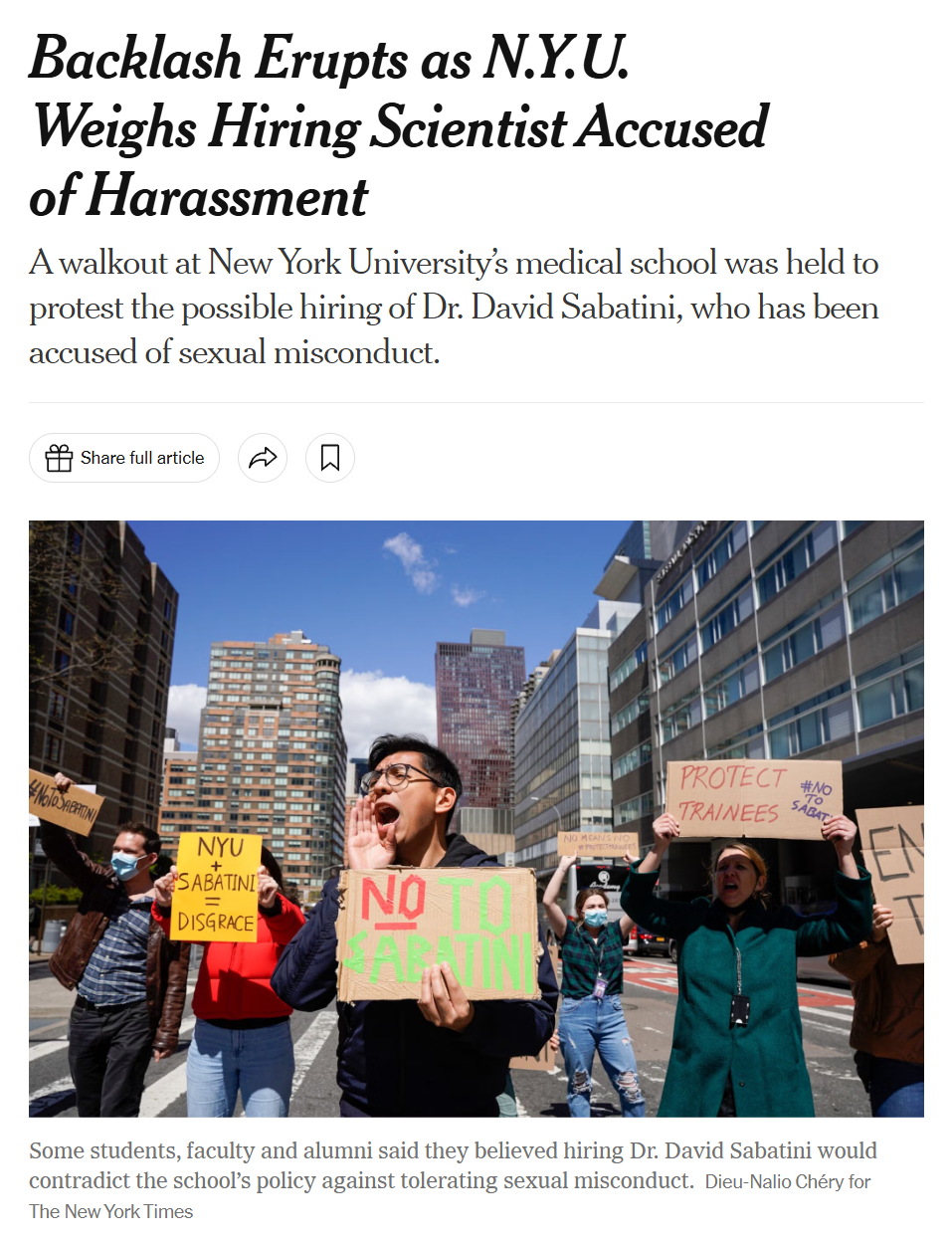
A male #Ally:
“I hope he doesn’t get hired,” said Grant Hussey, a graduate student at the medical school. “The track record is clear.”
Summary of the unpersoning:
Last August, Dr. Sabatini was placed on administrative leave at the Massachusetts Institute of Technology, where he ran a research lab through the Whitehead Institute of Biomedical Research, after an investigation into allegations of sexual harassment made against him — conducted by a law firm separate from the university — found he had violated the institute’s sexual misconduct policy.
On the same day, Dr. Sabatini also resigned from the Whitehead Institute and was fired by the Howard Hughes Medical Institute, which had been funding his work at M.I.T.
No matter what text messages were sent or what kind of sex was engaged in (things you’ll never learn about from New York Times coverage, but it’s all on X and in the Daily Mail!), there is always a DEI angle:
At the protest, Megan Kirchgessner, a postdoctoral fellow at the medical school, said she was disappointed that the school would consider hiring a person facing accusations of sexual harassment when the role could have been offered to someone from an underrepresented background in science.
Why Machiavellianism?
> Machiavellianism is a personality trait characterized by strategic manipulation, emotional detachment, a cynical view of human nature, and a calculated focus on self-interest.
Machiavellianism assumes self-interest. What was her self-interest? Playing the victim so that promotions and grants are easier in the future?
If she had something to gain she definitely showed psychopathy towards the potential Nobel prize candidate.
> Psychopaths are social predators who charm, manipulate, and ruthlessly plow their way through life, leaving a broad trail of broken hearts, shattered expectations, and empty wallets. Completely lacking in conscience and in feelings for others, they selfishly take what they want and do as they please, violating social norms and expectations without the slightest sense of guilt or regret.
If she was Machiavellian, we can rule out sadism since the cause of pain was indifference not intention.
According to the Schopenhauer, an abstract representation of the offspring is the love (now sexual attraction) between a couple, and the will to live of the offspring causes the so called ‘travails of love’. This force of nature can make people do things that they didn’t properly think through, and wouldn’t have done if they weren’t experiencing that force. So, can we totally rule out that this wasn’t just a adulthood phase instead of a manifestation of some undiagnosed personality traits?