The dust-up at Nvidia provides us with a great illustration of the value of engineering experience education. A person with four decades of experience as an EE nerd and bachelors and masters degrees in electrical engineering has been replaced by someone with finance experience and an MBA. “Before His Ouster, Jensen Huang Belittled the Executive Replacing Him” (WSJ):
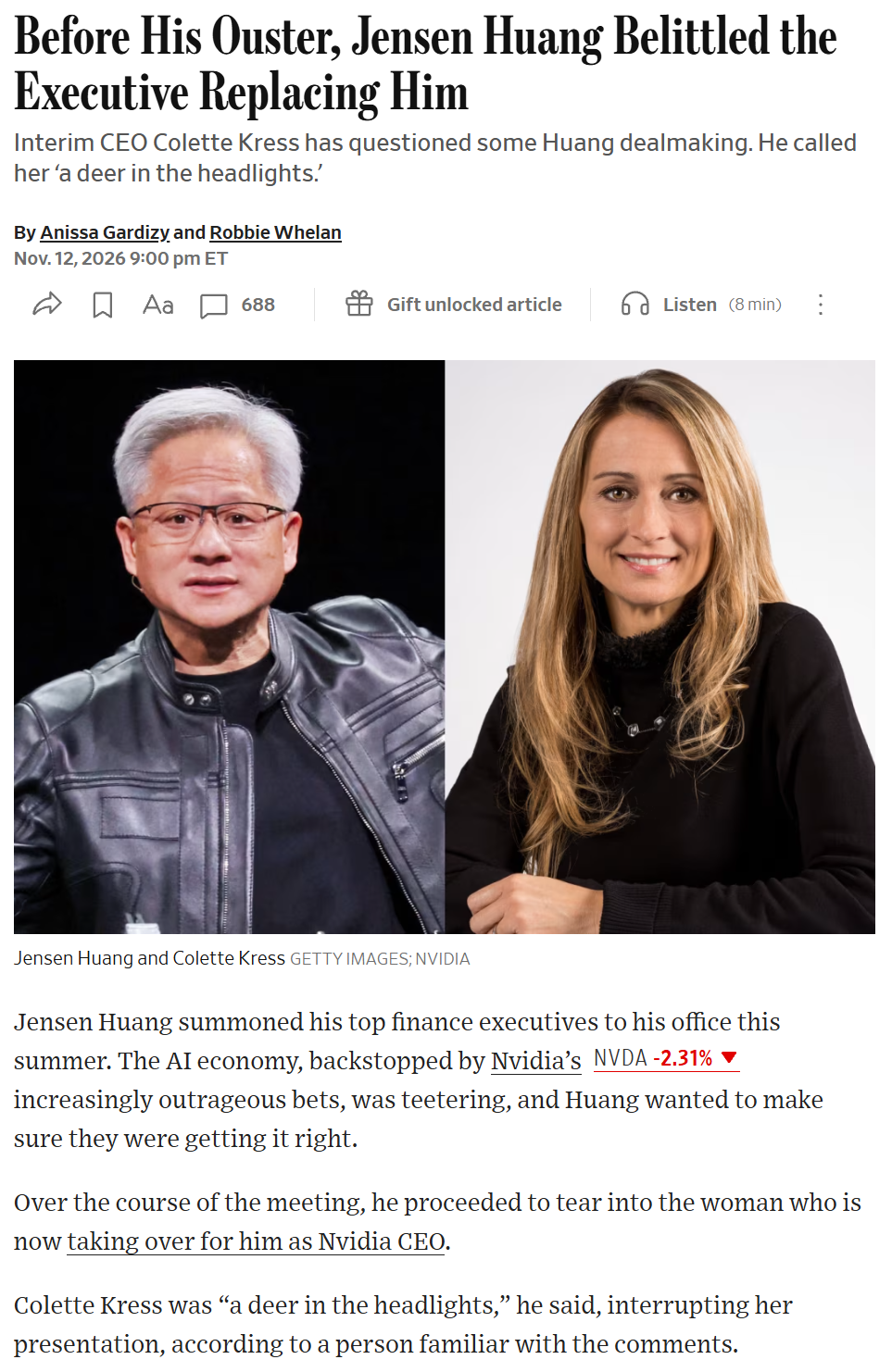
How much does someone intelligent have to know about EE to do the CEO job? Apparently, nothing:
A graduate of the University of Arizona, she got her M.B.A. from Southern Methodist University in 1996, according to her LinkedIn page.
It’s a little tough to know what to believe out of recent press reports. Coverage of Nvidia and Jensen went from 100% positive to 100% negative with a suddenness that would have impressed George Orwell. The latest version of “We have always been at war with Eastasia”:
He had summoned Kress and his senior finance team to diagnose a ballooning problem: Nvidia was in talks to provide billions of dollars of guarantees to companies that couldn’t afford its chips. That included deals led by Huang’s son-in-law, Nico Caprez, who had been offering upstart cloud providers and data-center developers financing in the hopes of turning them into long-term customers.
Huang had launched a dealmaking spree and was now starting to question whether it had gone too far, according to people familiar with the matter.
Kress was a “reporting CFO,” not someone who could help him define a strategy or make decisions, Huang said during the August meeting.
Then he went on to describe the situation the company was in. Major cloud providers were running away from Nvidia, making plans to use alternative chips and lessen their reliance on the firm. Even worse, Huang said, the vast supply of chip wafers and memory Nvidia had committed to buying were coming at him like an “avalanche.”
Kress now has to steer Nvidia through that avalanche—and a bigger one. She was named interim chief executive Thursday, taking over for Huang, who resigned after revelations of two extramarital affairs, including one with a suspected Chinese spy and another with an employee.
The second-to-last paragraph includes a restatement of the question that I’ve been asking for the last few years: “Why don’t the LLM companies recompile their code to target a GPU that doesn’t require giving 30-60% profit margins to Nvidia?” The heroic journalists of the WSJ don’t answer the obvious question, though: To where are these major cloud providers “running”? What competitor has now gained enough market share to show that I wasn’t, in fact, stupid?
Speaking of stupid, the article portrays Jensen as too stupid to understand the risks that he was taking while Mrs. Kress intelligently perceived them:
In the spring, Huang’s son-in-law Caprez and another vice president Raj Mirpuri told prospective business partners that Nvidia could arrange credit-support deals within a couple of weeks. Dozens of companies lined up for this program, hoping Nvidia’s backing would lower their borrowing costs. In exchange for providing credit support, Nvidia proposed that cloud providers share a cut of their revenue.
Amid the rollout of the program, Kress raised questions including how to decide which deals to pursue, how to value the guarantees, and how to calculate the return on investment, a person familiar with the matter said. Behind the scenes, she tried to rein in Huang’s son-in-law, who had been promoted to a vice president in January, people who worked with her said.
… Though Nvidia and OpenAI had been close to closing the deal, over the next couple of weeks, Kress reworked the deal and cut Nvidia’s initial financial commitment to OpenAI in half, people familiar with the deal said. And Nvidia and OpenAI signed the downsized deal on Aug. 17.
One part of the article that makes zero sense to me is the implication that Nvidia has too much manufacturing capacity reserved:
Even worse, Huang said, the vast supply of chip wafers and memory Nvidia had committed to buying were coming at him like an “avalanche.”
Now that we’ve always been at war with Eastasia, holding a big reservation on something for which there is a worldwide shortage is “even worse” than other challenges. Does this mean that memory and SSD will soon come down from its price of 4X what it was a year ago? (That’s was the SSD price, as of September, according to someone I know who runs a cloud business.)
Circling back to the headline… if you have tech experience and technical degrees, remember that you can be replaced tomorrow by an MBA!