Happy Día del Descubrimiento de Puerto Rico for those who celebrate Denier-of-Science Christopher Columbus. (See “Columbus’s Geographical Miscalculations Columbus based his ‘Enterprise of the Indies’ on three massive metrological errors.” (IEEE); he rejected what local experts said regarding the circumference of the Earth in favor of “doing his own research.”)
Back in 2015, I wrote Can Puerto Rico be a laboratory for the future of the rest of the U.S.?:
The federal minimum wage of $7.25 per hour is 77% of the median wage (comparable to a $13 per hour minimum wage in May 2014 (BLS data showing median hourly wage of $17.09 nationwide)). In other words, it is illegal for companies to hire a large percentage of Puerto Ricans at what would be a market-clearing wage for their particular skills. The result is that labor force participation in Puerto Rico is 43 percent, which means a much higher percentage of the population needs to find something to do every day other than work.
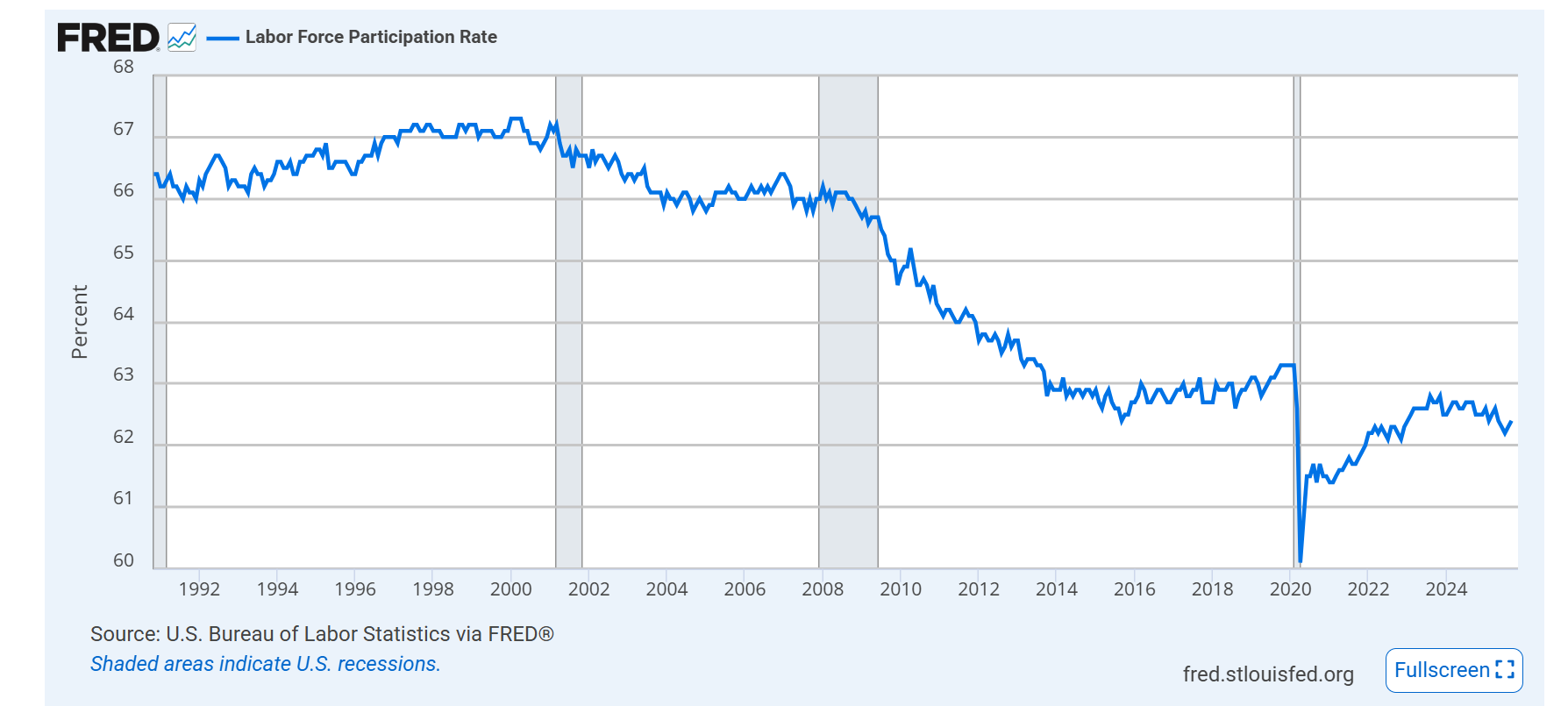
Labor force participation in the U.S. has been declining ever since the U.S. welfare state was expanded by President Obama and it fell further after the coronapanic enhancements to welfare:
If the reason that Puerto Rico’s rate was so much lower than the rest of the country was the federal minimum wage, PR’s rate should have increased after Bidenflation rendered the constant-in-nominal-dollars federal minimum wage substantially lower in real dollars. Did PR’s rate go up starting in 2021? Unfortunately for economists who love “natural experiments”, the experiment was muddied. In 2021, Puerto Rican politicians passed a territory law making it illegal for anyone to work for less than $8.50/hour, rising to $10.50/hour in 2024 (where it is today).
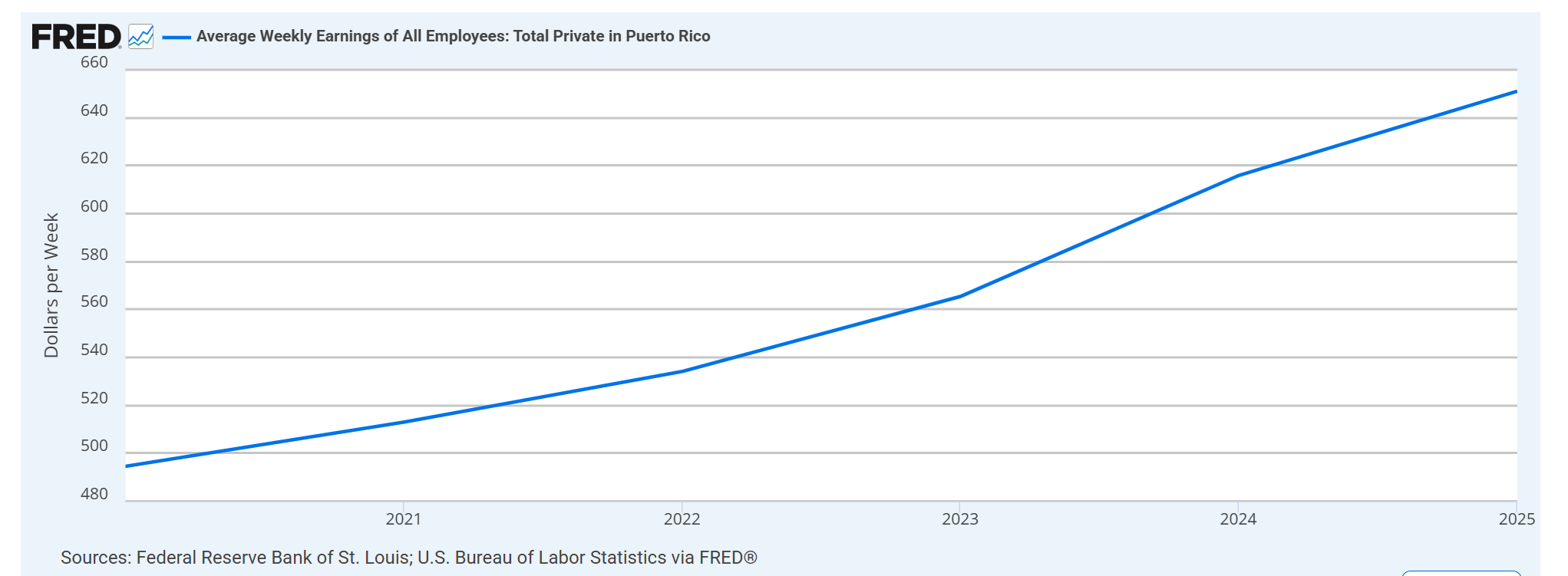
Did wages go up? We can look at weekly earnings, not adjusted for Bidenflation (after adjusting for national CPI, this is essentially flat):
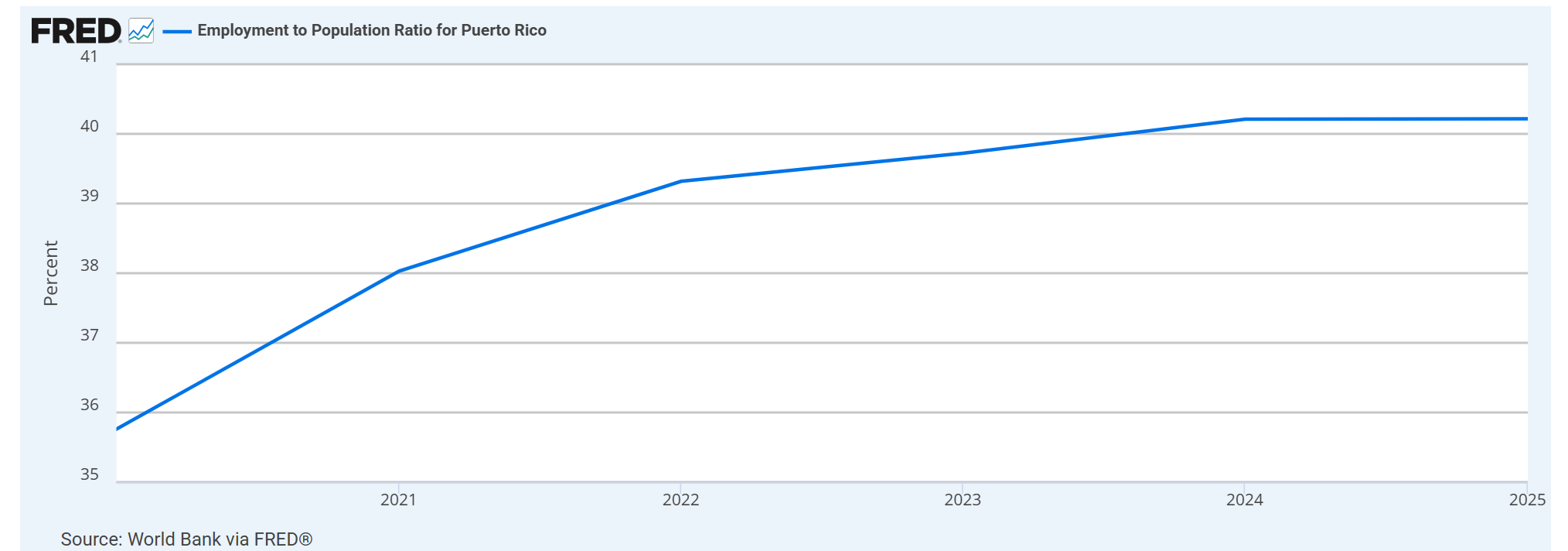
It looks like the employment-to-population ratio did go up slightly, but now has flattened. (This doesn’t show a dip during coronapanic because I think there is just one number per year available.)
This could simply be from people who love the welfare lifestyle moving to Maskachusetts (top of the charts!), though. Holyoke, MA is now 45% Puerto Rican. Springfield, MA is home to 59,000 Puerto Ricans.
The chart for the U.S. overall, covering (I think) the same time period, shows that a much higher proportion of mainland Americans work vs. Puerto Ricans, but the proportion is still lower than it was before coronapanic:
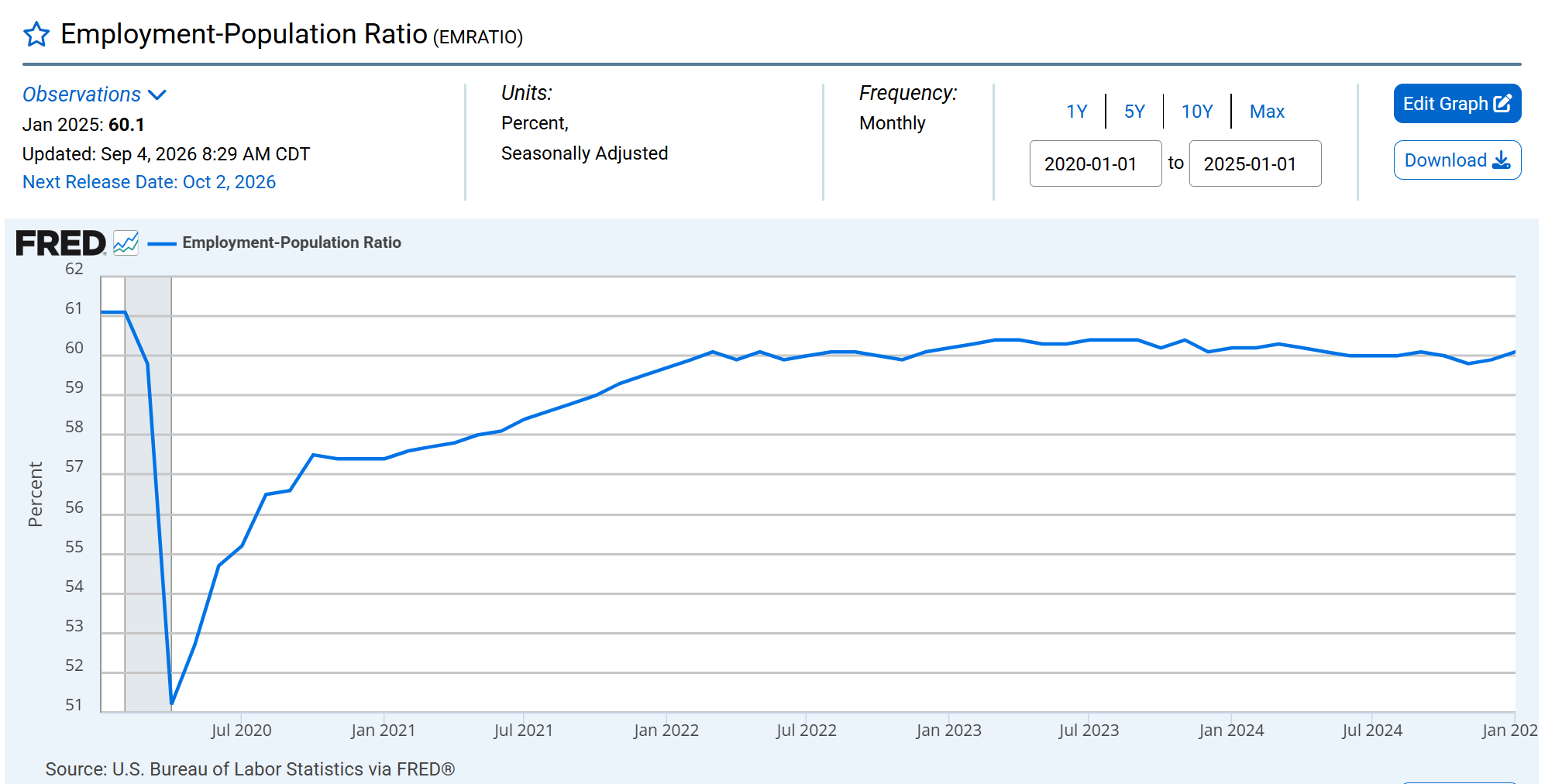
So we’ll perhaps never know whether Puerto Ricans could somehow be transformed into a society where the majority of people work (and this is further complicated by Puerto Rico becoming gradually older; about 25 percent over 65 vs. 18 percent nationwide).
Still don’t get your obsession with people working vs not working. If you are libertarian on all other issues, why not this one as well?
Or maybe to steelman your argument, you are fine with a tech worker who decides at 30 to live on 20k a year and just walks away from the rat race to live on his earnings. But you are not happy with Americans who walk away from the rat race to live off of other peoples’ earnings?
I still don’t get your obsession with all that though. It is a terrible life at the bottom of the ladder. SNAP is a thousand bucks for four people and you can’t even buy candy with it anymore. Public housing sucks. And really if you are a healthy working age adult, you cannot live a taxpayer funded lifestyle indefinitely.
Anon, your commiseration for my “terrible life” makes me emotional and brings tears to my eyes. Why is it that I keep living this way, along with the growing percentage of other Amerikans? Please can you also send me some candy for my toddlers?
Many Puerto Ricans are moving to the mainland US for work, Puerto Rico labor rate trends are not necessary indicative of the entire US as Americans can not easily move somewhere to improve their standards of living. Even if labor participation rates move in the same direction, causes are not necessary the same.
What about Puerto Rico birth rates, before economic migration to the US? If labor participation is lower because of legacy population stay at home moms then it would be real progress.