Happy Thanksgiving to everyone.
If you want to feel grateful to be home with family, I recommend reading or listening to With the Old Breed: At Peleliu and Okinawa by E.B. Sledge (“Sledgehammer” to his fellow Marines).
Tomorrow marks the 82nd anniversary of the Battle of Peleliu being declared officially over. This was a strategically pointless campaign, initiated due to General MacArthur’s strategically pointless campaign to retake the Philippines (see General MacArthur in Manila 1945 and Israel in Gaza today). The Navy wanted to bypass this entire region in favor of taking Okinawa and then the Japanese mainland. As noted by the WWII Museum in New Orleans,
Perhaps the most notable military result came months later when a PV-1 Ventura patrol plane flying out of Peleliu spotted the survivors of USS Indianapolis. The ship had just delivered atomic bomb parts to Tinian and was subsequently sunk by a Japanese submarine on July 29, 1945. With Indianapolis maintaining radio silence, the discovery of the ship’s survivors by the Peleliu-launched PV-1 was sheer luck, saving 316 lives out of the ships original complement of 1,195.
(Like a lot of history presented to the current generation, this is false. The Indianapolis broadcast distress calls before sinking. Wikipedia: “Declassified records later showed that three stations received the signals but none acted upon the call. One commander was drunk, another had ordered his men not to disturb him, and a third thought it was a Japanese trap.” The Navy did not notice or take action in response to the massive cruiser failing to arrive on schedule in Leyte, thus dooming the majority of the survivors to be eaten by sharks. (see “Jaws” and also The most beautiful warbird at Oshkosh this year (PBY Catalina)) To paper over its incompetence in failing to warn the cruiser of submarine activity, failing to escort the valuable cruiser, and failing to initiate search and rescue, the Navy court-martialed Captain McVay for “failing to zigzag” and dragged Mochitsura Hashimoto, commander of the Japanese submarine that sunk the cruiser, over to the U.S. to testify against McVay. Hashimoto testified that it wouldn’t have made any difference whether the Indianapolis was zigzagging. The Navy’s coverup was finally exposed by “a 12-year-old Florida boy” in 1998 (New York Times))
Keep in mind that the book was written by someone who considered himself and his cohort to be weaker than the “old breed” of Marines who’d served in World War I.
Boot camp:
During the first few days, [Drill Instructor Corporal] Doherty once asked one of the recruits a question about his rifle. In answering, the hapless recruit referred to his rifle as “my gun.” The DI muttered some instructions to him, and the recruit blushed. He began trotting up and down in front of the huts holding his rifle in one hand and his penis in the other, chanting, “This is my rifle,” as he held up his M1, “and this is my gun,” as he moved his other arm. “This is for Japs,” he again held aloft his M1; “and this is for fun,” he held up his other arm. Needless to say, none of us ever again used the word “gun” unless referring to a shotgun, mortar, artillery piece, or naval gun. A typical day in boot camp began with reveille at 0400 hours. We tumbled out of our sacks in the chilly dark and hurried through shaves, dressing, and chow. The grueling day ended with taps at 2200. At any time between taps and reveille, however, the DI might break us out for rifle inspection, close-order drill, or for a run around the parade ground or over the sand by the bay. This seemingly cruel and senseless harassment stood me in good stead later when I found that war allowed sleep to no man, particularly the infantryman. Combat guaranteed sleep of the permanent type only.
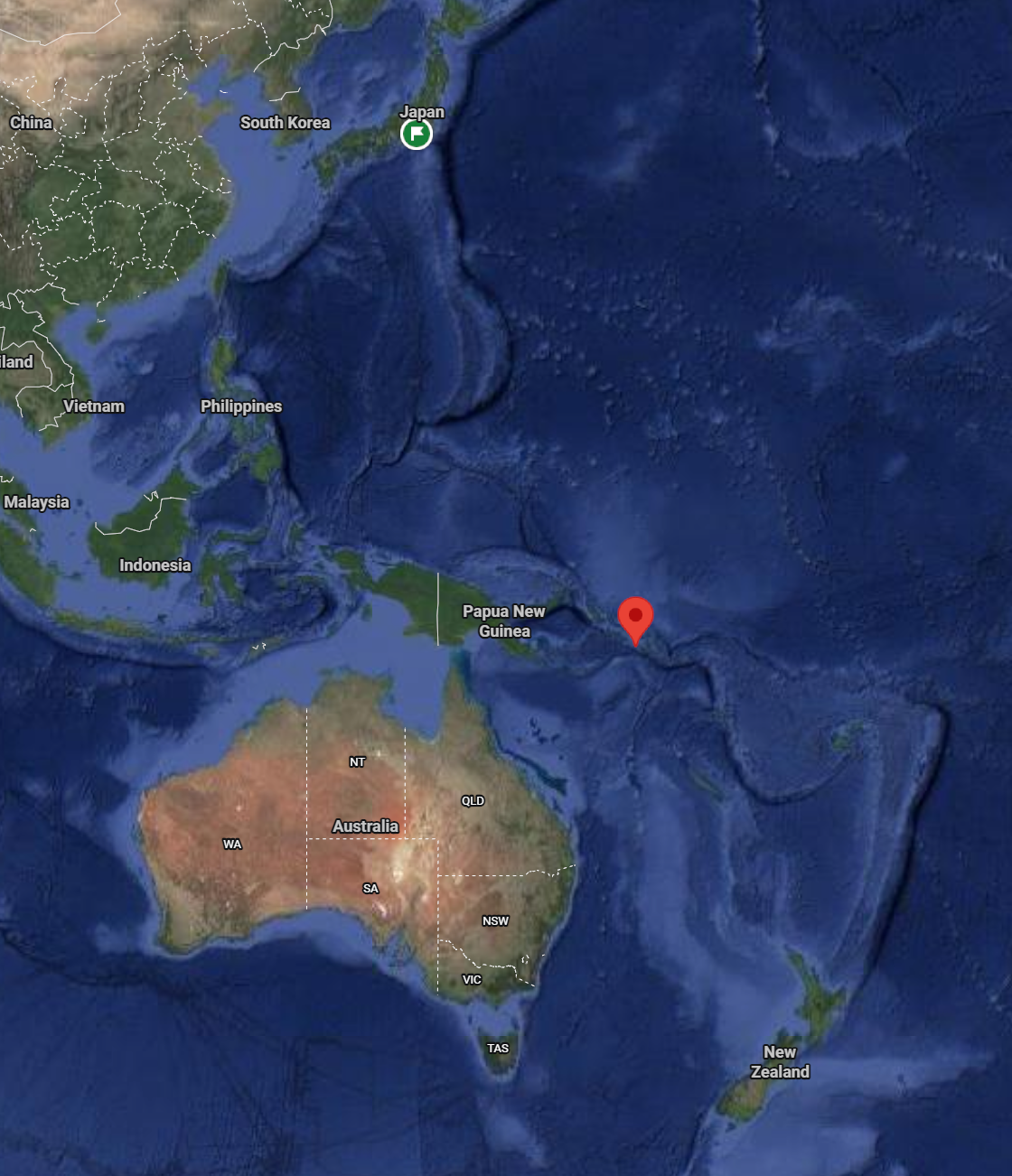
Sledge goes for additional stateside training in 60mm mortar operation and then is shipped out to Nouméa and Pavuvu (Solomon Islands) for combat training. Pavuvu is shown in red, below:
Life in the division HQ at Pavuvu:
The most loathsome vermin on Pavuvu were the land crabs. Their blue-black bodies were about the size of the palm of a man’s hand, and bristles and spines covered their legs. These ugly creatures hid by day and roamed at night. Before putting on his boondockers each morning, every man in the 1st Marine Division shook his shoes to roust the land crabs. Many mornings I had one in each shoe and sometimes two. Periodically we reached the point of rage over these filthy things and chased them out from under boxes, seabags, and cots. We killed them with sticks, bayonets, and entrenching tools. After the action was over, we had to shovel them up and bury them, or a nauseating stench developed rapidly in the hot, humid air.
The bread made by our bakers was so heavy that when you held a slice by one side, the rest of the slice broke away of its own weight. The flour was so massively infested with weevils that each slice of bread had more of the little beetles than there are seeds in a slice of rye bread. We became so inured to this sort of thing, however, that we ate the bread anyway; the wits said, “It’s a good deal. Them beetles give you more meat in your diet.”
I griped as loudly as anyone about our living conditions and discipline. In retrospect, however, I doubt seriously whether I could have coped with the psychological and physical shock and stress encountered on Peleliu and Okinawa had it been otherwise. The Japanese fought to win. It was a savage, brutal, inhumane, exhausting, and dirty business. Our commanders knew that if we were to win and survive, we must be trained realistically for it whether we liked it or not.*
Why was the fight on Peleliu so costly?
Peleliu also was important to the remainder of the Marines’ war in the Pacific because of the changes in Japanese tactics encountered there. The Japanese abandoned their conventional all-out effort at defending the beach in favor of a complex defense based upon mutually supporting, fortified positions in caves and pillboxes extending deeply into the interior of the island, particularly in the ridges of Umurbrogol Mountain. In earlier battles, the Japanese had exhausted their forces in banzai charges against the Marines once the latter had firmly established a beachhead. The Marines slaughtered the wildly charging Japanese by the thousands. Not a single banzai charge had been successful for the Japanese in previous campaigns.
But on Peleliu the Japanese commander, Col. Kunio Nakagawa, let the Marines come to him and the approximately 10,000 troops of his proud 14th Infantry Division. From mutually supporting positions, the Japanese covered nearly every yard of Peleliu from the beach inland to the center of Nakagawa’s command post, deep beneath the coral rock in the center of the ridge system. Some positions were large enough to hold only one man. Some caves held hundreds. Thus the Marines encountered no one main defense line. The Japanese had constructed the perfect defense-in-depth with the whole island as a front line. They fought until the last position was knocked out.
What was the weather like 7 degrees north of the equator?
The heat was incredibly intense. The temperature that day reached 105 degrees in the shade (we were not in the shade) and would soar to 115 degrees on subsequent days. Corpsmen tagged numerous Marines with heat prostration as being too weak to continue. We evacuated them. My boondockers were so full of sweat that my feet felt squishy when I walked. Lying on my back, I held up first one foot and then the other. Water literally poured out of each shoe.
The author meets a future U.S. senator while (a) under artillery fire, and (b) trying to move lift 55-gallon drums of water from an “amtrac“.
“You fellows need any help?” asked a Marine who appeared from the rear. We hadn’t noticed him before he spoke. He wore green dungarees, leggings, and a cloth-covered helmet like ourselves and carried a .45 caliber automatic pistol like any mortar gunner, machine gunner, or one of our officers. Of course, he wore no rank insignia, being in combat. What astonished us was that he looked to be more than fifty years old and wore glasses—a rarity (for example, only two men in Company K wore them). When he took off his helmet to mop his brow, we saw his gray hair. (Most men forward of division and regimental CPs were in their late teens or early twenties. Many officers were in their mid-twenties.)
When asked who he was and what unit he was in, he replied, “Capt. Paul Douglas. I was division adjutant until that barrage hit the 5th Marines’ CP yesterday, then I was assigned as R-1 [personnel officer] in the 5th Regiment. I am very proud to be with the 5th Marines,” he said. “Gosh, Cap’n! You don’t have to be up here at all, do you?” asked one of our detail in disbelief as he passed ammo boxes to the fatherly officer.
“No,” Douglas said, “but I always want to know how you boys up here are making out and want to help if I can. What company are you fellows from?”
This is only footnoted in the book, but Douglas was an economics professor who joined the USMC at age 50(!) as a private. Check out his biography and compare to whoever you just voted for Senate. (If you’re a Democrat in Florida, you voted for Angie Nixon, who earns $270,000 per year and won’t pay her federal taxes or student loans. She has no record of any military service.)
I’ll let everyone read the combat parts of the book for themselves, but the overall psychological effect gives us something to be thankful for:
We were resigned to the dismal conclusion that our battalion wasn’t going to leave the island until all the Japanese were killed, or we had all been hit. We merely existed from hour to hour, from day to day. Numbed by fear and fatigue, our minds thought only of personal survival. The only glimmer of hope was a million-dollar wound or for the battle to end soon. As it dragged on and on and casualties mounted, a sense of despair pervaded us. It seemed that the only escape was to be killed or wounded. The will for self-preservation weakened. Many men I knew became intensely fatalistic. Somehow, though, one never could quite visualize his own death. It was always the next man. But getting wounded did seem inevitable. In a rifle company it just seemed to be a matter of time. One couldn’t hope to continue to escape the law of averages forever.
Invariably the not-so-seriously hurt were in high spirits and relieved. They were on their way out of hell, and they expressed pity for those of us left behind. With the more seriously wounded and the dying, we carried the stretcher as fast as possible to an amtrac or ambulance jeep, which then rushed them to the battalion aid station. After getting them into a vehicle, we would throw ourselves down and pant for breath.
Daily life during the 2.5-month battle:
Added to the awful stench of the dead of both sides was the repulsive odor of human excrement everywhere. It was all but impossible to practice simple, elemental field sanitation on most areas of Peleliu because of the rocky surface. Field sanitation during maneuvers and combat was the responsibility of each man. In short, under normal conditions, he covered his own waste with a scoop of soil. At night when he didn’t dare venture out of his foxhole, he simply used an empty grenade canister or ration can, threw it out of his hole, and scooped dirt over it next day if he wasn’t under heavy enemy fire. But on Peleliu, except along the beach areas and in the swamps, digging into the coral rock was nearly impossible. Consequently, thousands of men—most of them around the Umurbrogol Pocket in the ridges, many suffering with severe diarrhea, fighting for weeks on an island two miles by six miles—couldn’t practice basic field sanitation. This fundamental neglect caused an already putrid tropical atmosphere to become inconceivably vile. Added to this was the odor of thousands of rotting, discarded Japanese and American rations. At every breath one inhaled hot, humid air heavy with countless repulsive odors. I felt as though my lungs would never be cleansed of all those foul vapors. It may not have been that way down on the airfield and in other areas where the service troops were encamped, but around the infantry in the Umurbrogol Pocket, the stench varied only from foul to unbearable.
In this garbage-filled environment the flies, always numerous in the tropics anyway, underwent a population explosion. This species was not the unimposing common housefly (the presence of one of which in a restaurant is enough to cause most Americans today to declare the place unfit to serve food to the public). Peleliu’s most common fly was the huge blowfly or bluebottle fly. This creature has a plump, metallic, greenish-blue body, and its wings often make a humming sound during flight. The then new insecticide DDT was sprayed over the combat areas on Peleliu for the first time anywhere. It supposedly reduced the adult fly population while Marines were still fighting on the ridges, but I never noticed that the flies became fewer in number. With human corpses, human excrement, and rotting rations scattered across Peleliu’s ridges, those nasty insects were so large, so glutted, and so lazy that some could scarcely fly. They could not be waved away or frightened off a can of rations or a chocolate bar. Frequently they tumbled off the side of my canteen cup into my coffee. We actually had to shake the food to dislodge the flies, and even then they sometimes refused to move. I usually had to balance my can of stew on my knee, spooning it up with my right hand while I picked the sluggish creatures off the stew with my left. They refused to move or to be intimidated. It was revolting, to say the least, to watch big fat blowflies leave a corpse and swarm into our C rations.
Even though none of us had much appetite, we still had to eat. A way to solve the fly problem was to eat after sunset or before sunrise when the insects were inactive. Chow had to be unheated then, because no sterno tablets or other form of light could be used after dark. It was sure to draw enemy sniper fire. Each morning just before sunrise, when things were fairly quiet, I could hear a steady humming sound like bees in a hive as the flies became active with the onset of daylight. They rose up off the corpses, refuse, rocks, brush, and wherever else they had settled for the night like a swarm of bees. Their numbers were incredible. Large land crabs crawled all over the ridges at night, attracted by corpses. Their rustling through dry debris often was indistinguishable from prowling enemy soldiers. We responded by tossing a grenade at the sound.
Was it any worse than World War I in Europe?
[The European battlefields] were nothing like the crazy-contoured coral ridges and rubble-filled canyons of the Umurbrogol Pocket on Peleliu. Particularly at night by the light of flares or on a cloudy day, it was like no other battlefield described on earth. It was an alien, unearthly, surrealistic nightmare like the surface of another planet.
The way that the Japanese fought was also different:
Late one afternoon a buddy and I returned to the gun pit in the fading light. We passed a shallow defilade we hadn’t noticed previously. In it were three Marine dead. They were lying on stretchers where they had died before their comrades had been forced to withdraw sometime earlier. (I usually avoided confronting such pitiful remains. I never could bear the sight of American dead neglected on the battlefield. In contrast, the sight of Japanese corpses bothered me little aside from the stench and the flies they nourished.)
As we moved past the defilade, my buddy groaned, “Jesus!” I took a quick glance into the depression and recoiled in revulsion and pity at what I saw. The bodies were badly decomposed and nearly blackened by exposure. This was to be expected of the dead in the tropics, but these Marines had been mutilated hideously by the enemy. One man had been decapitated. His head lay on his chest; his hands had been severed from his wrists and also lay on his chest near his chin. In disbelief I stared at the face as I realized that the Japanese had cut off the dead Marine’s penis and stuffed it into his mouth. The corpse next to him had been treated similarly. The third had been butchered, chopped up like a carcass torn by some predatory animal.
My emotions solidified into rage and a hatred for the Japanese beyond anything I ever had experienced. From that moment on I never felt the least pity or compassion for them no matter what the circumstances.
Sledgehammer went on to fight in Okinawa, which was almost as bad from his perspective as Peleliu. He was further scheduled to take part in the invasion of the Japanese home islands, but that was cut short by the atomic bomb-motivated surrender.
With the Old Breed: At Peleliu and Okinawa is worth reading even if you’re already grateful that you don’t have to be in a foxhole in 115-degree heat plus humidity.
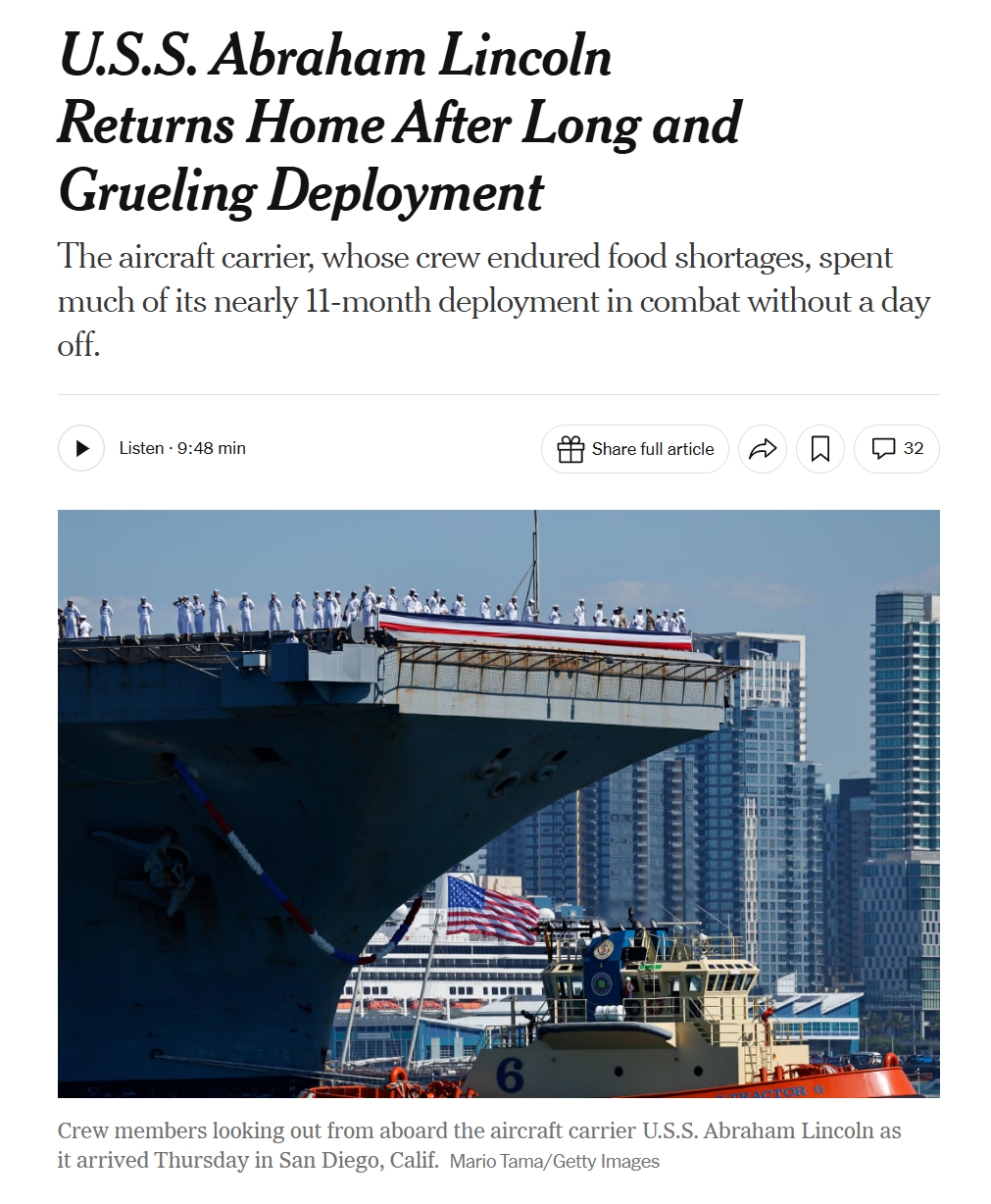
Related, the New York Times has found modern-day air-conditioned military heroes who suffered much more than the Marines at Peleliu: “U.S.S. Abraham Lincoln Returns Home After Long and Grueling Deployment”.
Today is the 50th anniversary of the release of “Anarchy in the U.K.” by The Sex Pistols. Modern-day Johnny Rotten declaims not actually endorsing anarchy. He should be happy that it has thrived and is almost ubiquitous world wide. Some people are never satisfied, even Antichrists. Ingrates.
We’ll probably watch A Charlie Brown Thanksgiving, and save books with gross stuff about war for another time. We already listened to Alice’s Restaurant, with Arlo’s sanctimonious anti-war message. (Looking forward to Phil singing folk songs about high-end Japanese restaurants, given his current editorial arc.) When I was a kid (< 30 years old), I thought the Peanuts gang was really lame for not wanting to eat popcorn and candy as Thanksgiving dinner. Peppermint Patty invited her damn self over to Chuck's house, what the hell did she expect? (My father used to have a popcorn maker for the wood fireplace, which made a great treat on Thanksgiving.) I'm personally thankful my ancestors left England and New England, and I'm having a relatively anarchy free day.