While waiting for $17-plus-tax-and-tip sandwiches at Buccan, the 11-year-old and I popped across the street to see what Hästens was and why they had a horse in their logo. It turned out to be “Sweden’s oldest bed mattress manufacturer”. I’m loyal to Stearns and Foster, but am a member of the Church of Sweden so I inquired about the prices, starting with the one that was surrounded with velvet ropes:
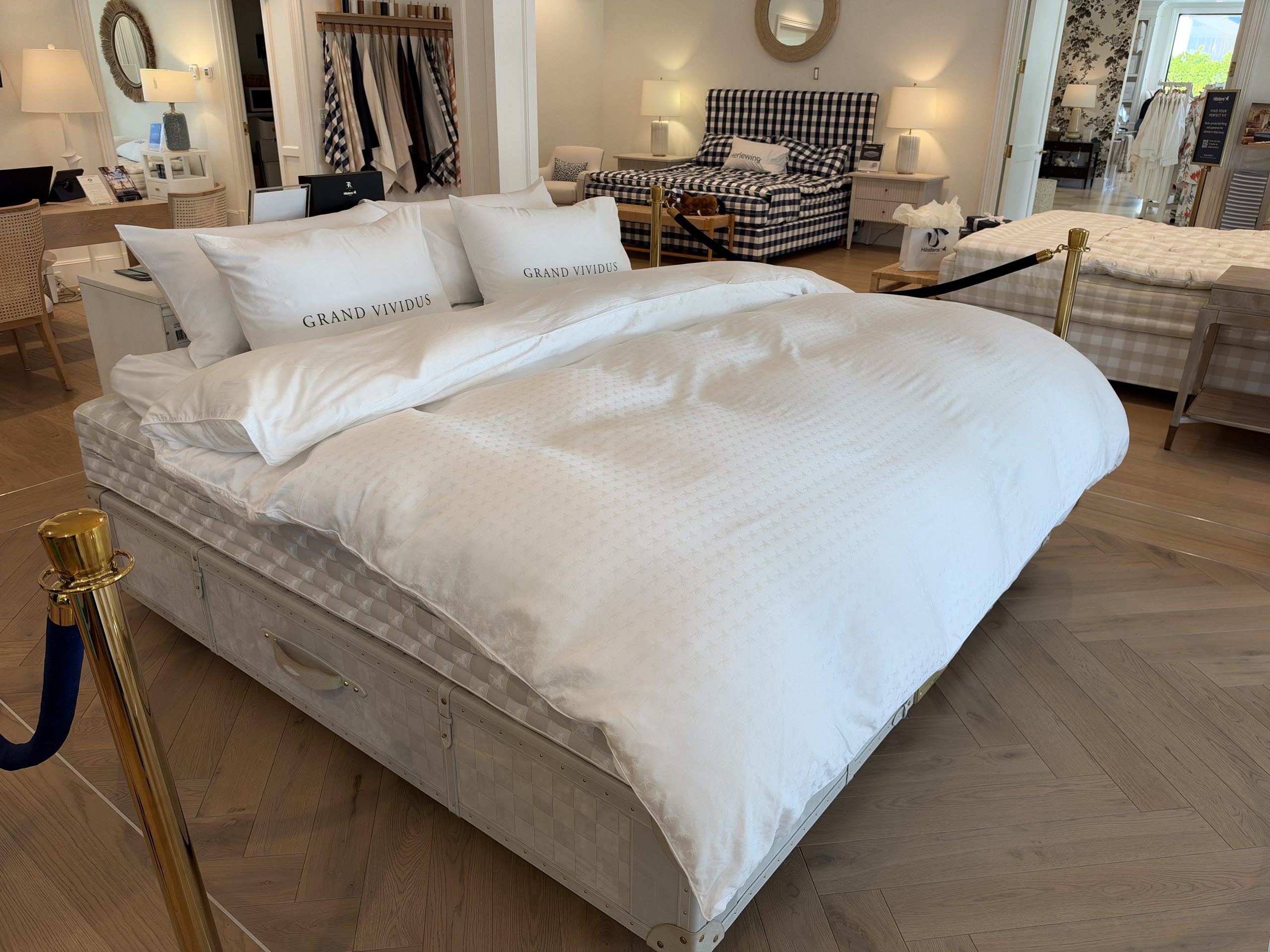
“It’s $870,000,” said the saleslady, very pleasant and patient despite the fact that walking in with an 11-year-old isn’t the typical configuration of a serious shopper, “but if you want the headboard it is over $1 million.” Maybe the blue one would be more aligned with our household budget? “That’s $430,000.”
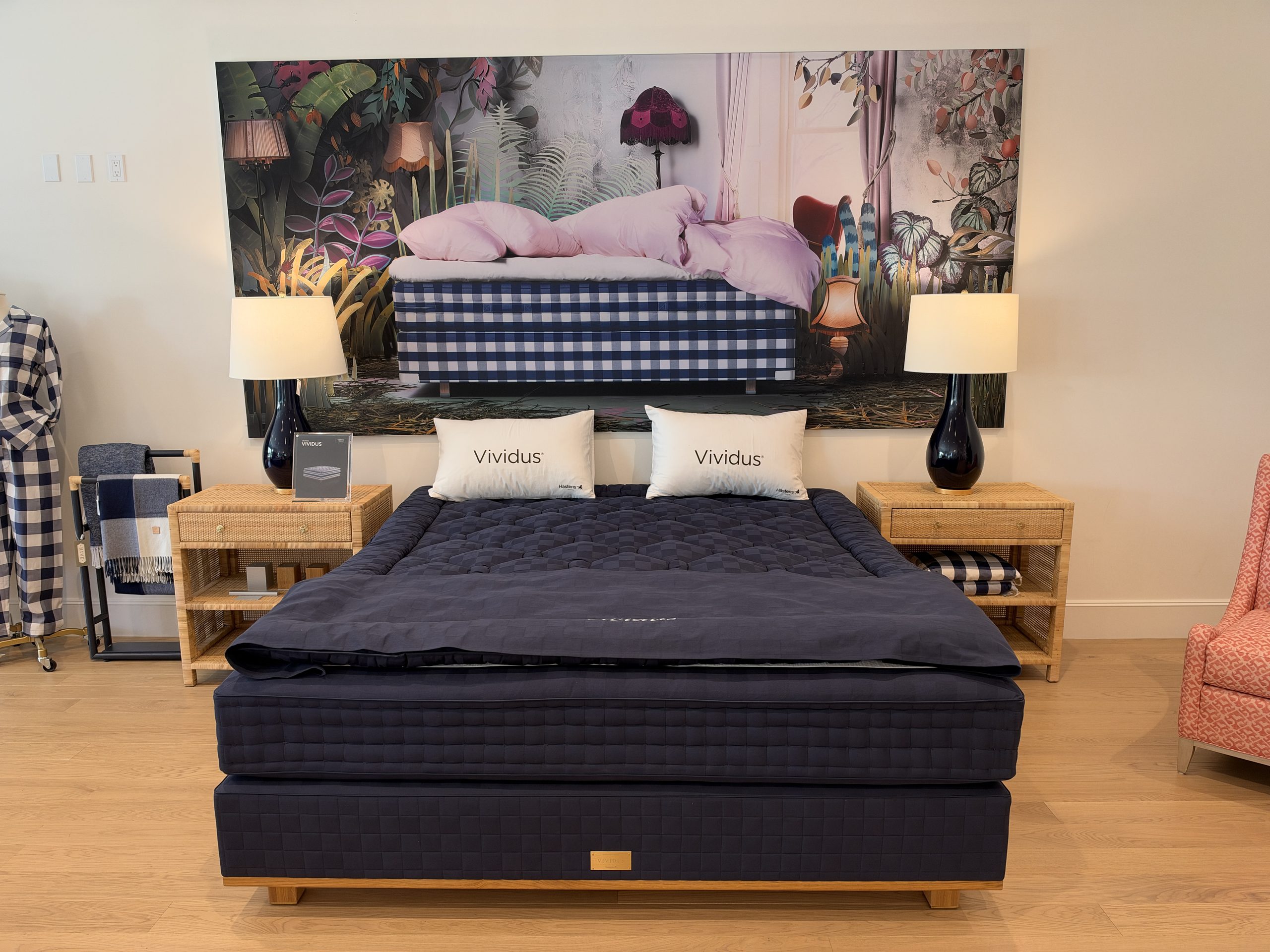
The company does offer some entry-level mattresses at closer to $20,000, but I’m not sure that anyone buys them. It would be like driving a five-year-old Maybach.
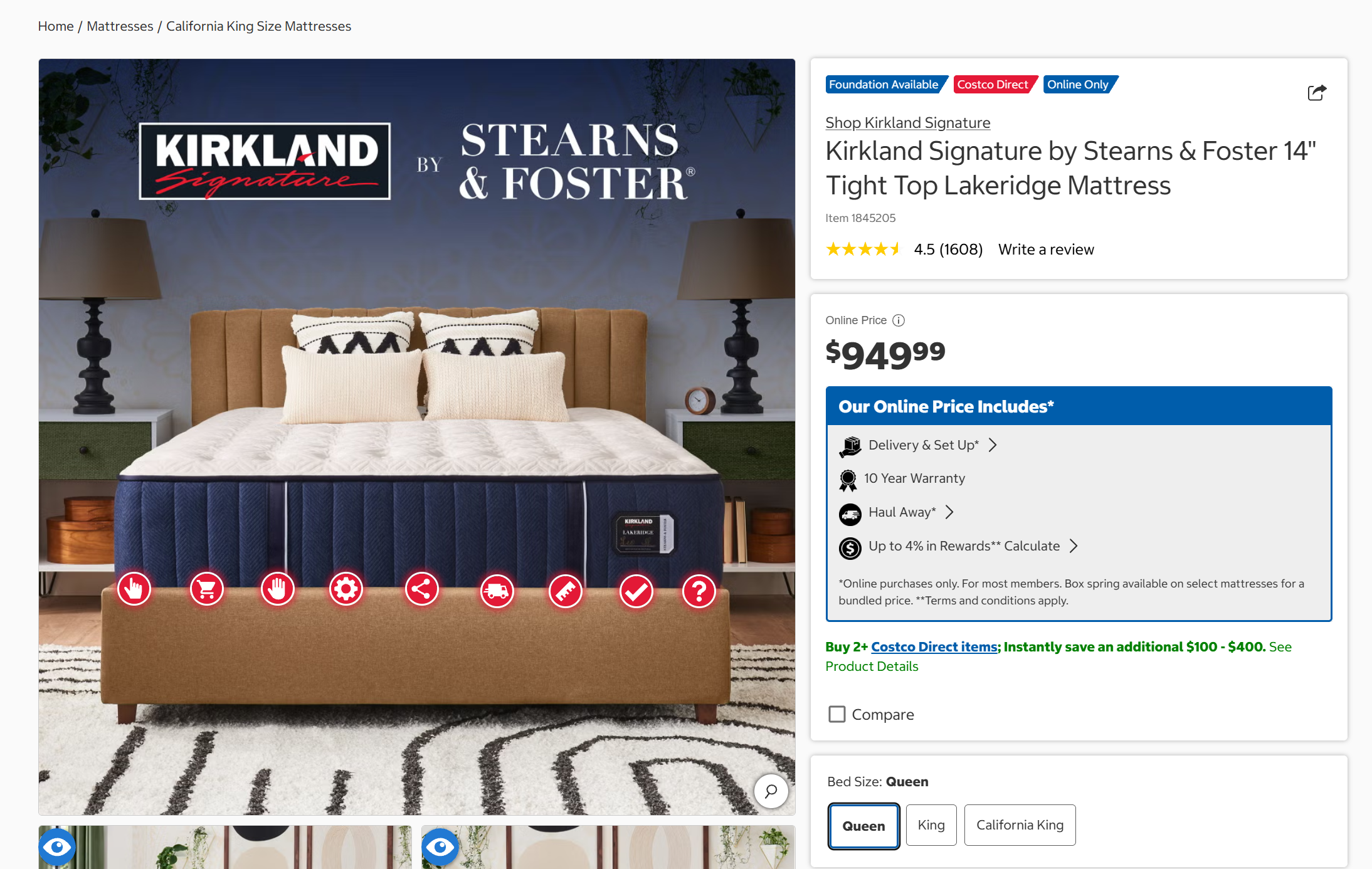
I then reflected that a customer who is sold on Hästens will likely have to multiply the above prices by 3 or 6 because even a Man of the People such as Bernie has 3 houses and, after experiencing the perfection of Hästens, it wouldn’t be possible to spend half of one’s nights on a sub-$1000 Kirkland Signature (made by Stears & Foster! Have to love those Costco buyers! This is maybe half the price of the same mattress in the average store):
I’m wondering if Bernie should do a campaign event in front of one of this company’s 19 retail locations in the U.S. (three are in SE Florida; one is in Boston! (Yankee thrift is over?)). Just as nobody needs more than 3 houses, Bernie could argue that nobody needs to spend more than $400,000 on a mattress (actually $1.2 million, as noted above, because one must have the same bed in each of one’s 3 houses).
I asked Grok to explain the practical advantages of a Hästens mattress,
Hastens coils are hand-tied with cotton or linen thread in a grid, each one individually pocketed, so they move independently without transferring motion across the bed. That’s the old European craft method that machine manufacturing largely abandoned because it’s slow and expensive. The springs give you a responsive, bouncy feel — the opposite of the slow-sinking memory foam — and the hand-tied construction is what justifies a chunk of that price tag.
I pointed out that this sounded like what Simmons Beautyrest touts.
Simmons did popularize that. They called it Pocketed Coil back in the nineteen-twenties and it became the industry standard for motion isolation. The difference is Simmons did it with machines at scale for a mass market, while Hastens does the same basic idea by hand with higher-grade steel, more coils per square foot, and those natural fiber comfort layers on top. So you’re not buying a technology Simmons didn’t have — you’re buying the same idea executed at a level where every step is slower and more expensive.
Did anyone ever compare a $3,000 Simmons to a $300,000 Swedish hand-built confection?
Not that I can find. The closest things out there are Hastens versus Vispring or Savoir — other hand-built European luxury brands — and those comparisons focus on feel and materials, not on Simmons. Simmons’ top line, the Beautyrest Black, runs about five thousand for a queen with eighteen hundred fifty coils, while Hastens starts around thirty thousand. At that gap, reviewers treat them as different categories entirely rather than competitors worth testing side by side.
One thing worth knowing: Hastens’ own owner-satisfaction data sits around seventy-seven percent versus a seventy-three percent industry average for all mattresses. So even Hastens’ fans are only getting a modest measurable edge for the money — which tells you the premium is mostly about the experience and the story, not a dramatically better night’s sleep.
What Stearns and Foster’s coil tech?
Stearns & Foster’s is called IntelliCoil. It’s a coil inside a coil — a softer outer spring responds to light pressure like when you’re shifting position, and a firmer inner spring kicks in under your full weight for deeper support. Simmons pockets each spring individually in fabric so they move independently, which is where the motion isolation comes from. IntelliCoil doesn’t isolate as well because the coils are connected in a grid, but it gives you that progressive, supportive feel that hotels love. So Simmons is better for couples who don’t want to feel each other move, Stearns & Foster is better if you want bounce and spinal alignment over pure isolation.
(Note the failure of the AI to consider the needs of throuples. It assumes “couples” without any prompting.)
Then I asked Grok who makes the best mattresses on the market right now for those on a more typical budget. It came back with “the Saatva Classic for hotel-style luxury hybrid feel with a three-hundred-sixty-five-night trial” among other suggestions, none of which were from what I would consider the major brands. I asked how Saatva could be better than Stearns and Foster and Grok came back with
It isn’t better across the board. Stearns & Foster’s IntelliCoil and Simmons’ pocketed coil tech are genuinely sophisticated. Saatva wins on the stuff around the mattress — no retail markup, a year-long trial instead of ninety days, lifetime warranty, free white-glove delivery with old bed removal. That’s a better deal, not a better bed.
Pressed with “Are you sure that Stearns and Foster isn’t better than Satva?”:
On pure construction, yes — Stearns & Foster uses higher-grade materials, hand-tufted covers, and that coil-within-a-coil design that most direct-to-consumer brands can’t match at any price. Where Saatva pulls ahead is durability policy and trial length, not the mattress itself. If you plan to keep a bed for ten-plus years and value the craft, Stearns & Foster is the stronger build.
(That makes Saatva a terrible deal because it is more expensive than the Kirkland Signature Stearns and Foster!)
Grok goes on to reveal that Saatva’s great warranty doesn’t apply unless the bed deteriorates far beyond the point where most people would replace it:
You submit photos showing sagging or body impressions deeper than about an inch and a half, and Saatva’s team reviews them. If it looks like normal softening from years of use, they’ll call it wear and deny the claim. The warranty really only kicks in for things like seam splitting, foam crumbling apart, or a collapsed coil. So it’s less a guarantee of comfort forever and more a guarantee the bed won’t fall apart. … The measurement has to be taken with nobody on the bed — a straightedge across the dip with a ruler showing the gap.
In other words, Saatva is garbage.
Now that I’ve been into Hästens, let me give thanks that our Stearns and Foster mattress is still in good shape and that we don’t have to spend $25,000+ on an entry-level replacement mattress.
I guess they are really living up to the “one sale per month keeps us afloat” business?