Why do we care about COVID-19 deaths more than driving-related deaths?

Working with third-year medical students involves much struggling with SQL, R, and data, but also chatting about the topics of the day. This year it is coronavirus, of course. Of the nine M3s that I work with most commonly, at least one believes that he has already had COVID-19 and recovered. Absent significant testing capability for infection or antibodies, however, these bright young people are as much in the dark as anyone else.

Leaving aside the true alarmists, estimates of likely U.S. deaths from COVID-19 seem to range from 50,000 to 500,000 in a “life goes on” scenario. The prospect of this many deaths has motivated us to shut down society and mobilize for what people say is a “war” (let’s hope it isn’t like any of the wars that the U.S. has fought and lost since 1960, e.g., Vietnam War, War on Cancer, War on Poverty, Iraq War, Afghanistan War, etc.).

This is as it should be, right? Let’s take a mid-range estimate. The prospect of 275,000 people dying is terrible and should motivate us to bold action. Yet roughly 36,500 Americans die every year in motor vehicle-related accidents (NHTSA data from 2018, the latest available).

This led to a discussion regarding human psychology. We are pretty confident that there will be more than 275,000 car-related deaths over the next 8 years in the U.S. Maybe this should motivate us to bold action, but it actually does motivate us to do almost nothing.

In the 24th year of the smartphone, we don’t bother with a car-to-smartphone communication system, for example, that would reduce pedestrian fatalities (since the car would know where all of the pedestrians were; I wrote about this in 2016; ordinary Bluetooth range seems to be roughly 100 meters outdoors). Considering the nation as a whole, we don’t invest much in separated (e.g., with a curb) bike lanes like they do in Denmark and Holland. We don’t cut the speed limit on the Interstate back to 55 or lower. We don’t say that cars have to have electronic governors so that it simply is impossible to speed (“I’m sorry, Dave, I feel you pressing the accelerator, but I can’t go faster than 35 mph on this stretch of road”). We don’t re-engineer the road network to eliminate traffic lights in favor of (a) traffic circles, and (b) overpasses. We don’t put in a car-to-traffic light communication system so that the car knows when the light is red and will hit the brakes before we inadvertently drive through an intersection (imagine a traffic light that broadcasts in Bluetooth “I am the light at Massachusetts Avenue and Vassar St. and am currently green for Vassar St.”). We don’t ask America’s nerds to stop working on clever Internet ad technology and try to come up with innovative ideas for reducing the carnage on our roads. We’re willing to invest $trillions to reduce the death toll from coronaplague, but hardly a dime to build centerline dividers on more of our two-lane roads so as to eliminate head-on collisions.

As with most discussions about psychology, we came to no conclusion!

Readers: What is the answer? Why do we accept that hundreds of thousands of Americans will die in the next 10-20 years because of our failure to invest in engineering and infrastructure today, but we can’t accept that up to hundreds of thousands of Americans will die in the next year because we didn’t do a sufficiently thorough shutdown?

Related:

  • Sweden’s Vision Zero, kicked off in 1997, which worked to reduce fatalities until it stopped working in 2013.

Full post, including comments

About 2.5 percent of Boston hospital beds occupied by COVID-19 patients

Friends who work at Boston’s biggest hospitals (MGH and Brigham and Women’s) get the information that the public would surely love to have, i.e., what percentage of hospital beds are occupied by patients stricken with COVID-19. The answer as of this morning? About 2.5 percent, with perhaps an additional 2-4 percent “under investigation” (can’t get test results even for inpatients?).

Is that good news for those worried about contracting the coronavirus? Maybe not. The LA Times says that ICU beds at their hospitals were already full with non-COVID-19 patients. As you might expect from the three-month wait that was required for a non-elite to see a doctor in the U.S. in 2019, the health care system as experienced by the 99.8% did not have any headroom.

And, of course, if we believe that hospitalization follows infection by at least two weeks (but does it, on average?), the surge may be yet to come. The folks who heeded New York City Mayor Bill de Blasio’s March 2 call to join him in a crowded movie theater “despite Coronavirus”, and their new Tinder friends, and the new Tinder friends of those Tinder friends, may yet arrive in the ED.

Readers: Has anyone found a good source for mean time from infection to hospitalization and/or mean time from infection to requiring a ventilator? Dyson will begin cranking out ventilators by “early April” (CNN).

[Update: I talked to a physician at Emerson Hospital in Concord, Massachusetts. This serves Middlesex County, the hardest hit county in Massachusetts (a profitable place to be a family court plaintiff though; having sex with an already-married medical specialist will pay about as well as going to medical school and working as a primary care doctor). There are 179 beds, 6 of which are occupied by victims of the coronaplague (3.34 percent).]

[Update, evening 3/27, text message from friend: “I asked [physician wife] how her nurse friend is doing at the hospital. She said she has not worked in a week because the ER is so dead she can’t get hours. The hospitals are empty.”]

Full post, including comments

Full range of coronaplague opinions

From Sunetra Gupta, professor of theoretical epidemiology at Oxford, via the Daily Mail:

Coronavirus could already have infected HALF the British population and been spreading in the UK since JANUARY, Oxford University study claims

‘We need immediately to begin large-scale serological surveys – antibody testing – to assess what stage of the epidemic we are in now,’ she said.

The Oxford university research offers a contrasting view on the disease to the study that is informing government policy. It was carried out by experts at Imperial College London.

‘I am surprised that there has been such unqualified acceptance of the Imperial model,’ Professor Gupta told the Financial Times.

The Imperial study has led to the Government imposing the extraordinary shutdown on the basis that, without such rules, the disease could claim up to 250,000 lives.

Who wants to bet whether these “Oxford experts” get interviewed by the folks at the New York Times who say that Donald Trump should let the “experts” speak?

From Wuhan on the Hudson, on the other hand, “Coronavirus: New York Infection Rate Is ‘Doubling About Every 3 Days,’ Cuomo Says” (NPR):

The rate of new coronavirus cases in New York is “doubling about every three days” and is speeding up even more, Gov. Andrew Cuomo said Tuesday. “That is a dramatic increase in the rate of infection.”

The new estimates are “troubling and astronomical numbers,” the governor said. He added that the apex of the curve of rising coronavirus cases in New York is still 14 to 21 days away, according to the latest projections. The governor also said New York is in urgent need of ventilators and other vital resources.

“We need the federal help, and we need the federal help now,” Cuomo said.

(If Federal help is critical and Trump has the discretion to allocate that help among states, perhaps Cuomo now regrets telling Donald Trump “good riddance” when he moved to Florida, thus escaping New York State and City taxes? When one quarter of the economy is the Federal government, is it helpful to state residents to pick a fight with the guy who has some amount of control over the $5 trillion?)

Facebook friends who voted for Hillary love Governor Cuomo, by the way. A sampling of perspectives:

Gov. Andrew Cuomo. For all his state’s problems, and they are life and death problems….he still inspires, like a true leader does. No childish name calling. No race baiting. No ignorant rants. Just inspiration

Sick of the administration’s sideshow “press conferences?” This is what leadership looks like: honest, tough, authoritative, reassuring.

I am falling in love with Andrew Cuomo🥰🥰🥰 [The previous governor got/purchased some love from female Democrats as well, no?]

[Did Cuomo do anything tangible in terms of preparing hospitals, obtaining masks, ventilators, and PPE, starting social distancing before New York’s caseload blew up, etc., or has he been able to win hearts and minds with fine words only?]

COVID Denier Aaron Ginn needed to be kicked off Medium partly for spreading the heresy that coronavirus did not spread well in heat and humidity. Now there are heretics at M.I.T. New York Post:

Scientists at the Massachusetts Institute of Technology found that 90 percent of COVID-19 transmissions that occurred until Sunday happened in regions with low temperatures — between 37.4 and 62.6 degrees Fahrenheit.

“Wherever the temperatures were colder, the number of the cases started increasing quickly,” Qasim Bukhari, a computational scientist at the university who co-authored the study, told the New York Times. “You see this in Europe, even though the health care there is among the world’s best.”

That pattern applies in the US too, Bukhari told the paper.

The outbreak has developed more slowly in Southern states like Arizona, Florida and Texas compared to New York, Washington state and Colorado, for example, according to Bukhari.

In California, the rate is somewhere in the middle.

Epidemiologists have seen a similar pattern with other viruses — including the flu, which generally follows a November-to-April trend in the Northern Hemisphere, Dr. Deborah Birx, a member of the White House’s coronavirus task force, said during a recent briefing, according to the Times.

The four types of coronavirus that cause the common cold also pick up in the winter and drop off in the summer.

At least two other studies have come to similar conclusions — including one conducted by Chinese researchers at Beihang University and Tsinghua University.

There you have it! Maybe it will kill most of us (Professor Cuomo). Maybe it has already done most of whatever it is going to do (Professors at Oxford). Maybe it will taper down to a manageable burn by June (MIT).

(Meantime, if we believe MIT, move to Florida, Texas, or Las Vegas and then leave the air conditioning off? Check the family law situation in those states before agreeing to any move, though! Florida offers “permanent alimony” while Texas offers “no alimony”. Texas and Nevada cap child support profits, unlike most states in the frigid COVID belt.)

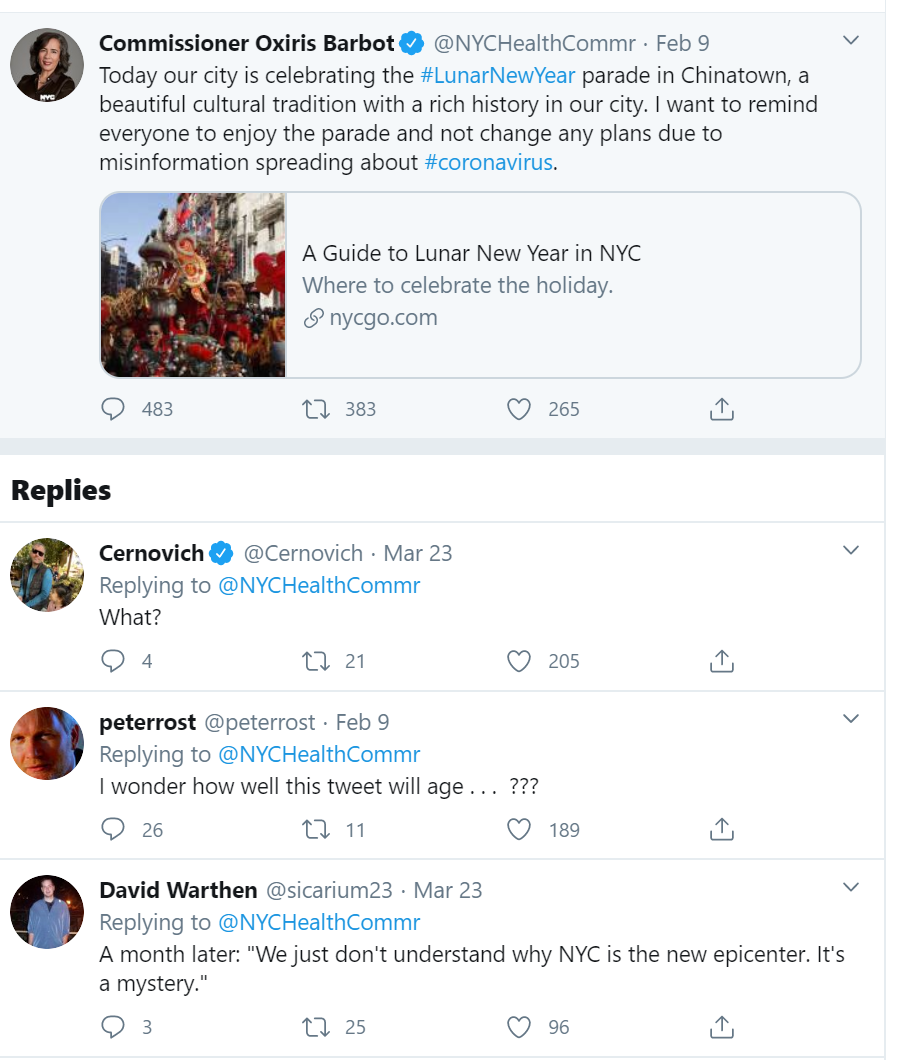
Related: A February 9 tweet from New York City’s top public health official

Full post, including comments

Elite versus Non-Elite access to COVID-19 testing

Email received from the president of Harvard, Larry Bacow, today at 1:15 pm:

Earlier today, Adele and I learned that we tested positive for COVID-19. We started experiencing symptoms on Sunday—first coughs then fevers, chills, and muscle aches—and contacted our doctors on Monday. We were tested yesterday and just received the results a few minutes ago. We wanted to share this news with all of you as soon as possible.

Two days from first symptom to test result.

Text message from an M.I.T. Ph.D. in engineering, today a little earlier:

Yes, a friend of mine in Boston had to wait 6 days to get tested, then another 4 days for the result

Ten days from symptoms to result (positive, unfortunately, and then the rest of the family caught it too, casting doubt on the 10% household transmission stat that has appeared in some articles; everyone is recovering without hospitalization).

Conversation this morning with some Harvard Medical Students:

At Partners [the Harvard-affiliated goliath of Boston-area hospital systems] we can’t order a coronavirus test unless the patient is admitted.

[Separately, the “emergency” is not so urgent as to have ruffled the feathers of the Massachusetts state government’s license raj. One of the Harvard students is 4th year and will soon be eligible for a medical license here in Massachusetts. “I don’t know how I’m going to get licensed,” he said. “There are a ton of forms that I need to give to the state and they all have to be notarized. Where will I find a notary?” I.e., the emergency is not so dire that they’re willing to give a provisional license to anyone whom Harvard Medical School verifies is a recent graduate, then sort out the rest of the paperwork after the plague has abated.]

As of September 2019, President Bacow was a cheerleader for more low-skill immigration to the U.S.. Email to the Harvard community:

Not just as a university president, but as the son of refugees and as a citizen who deeply believes in the American dream, I am disheartened by aspects of the proposed new criteria for people seeking to enter our country. They privilege those who are already educated, who already speak English, and who already have demonstrable skills. They fail to recognize others who yearn for a better future and who are willing to sacrifice and work hard to achieve it. Had these same rules been in place when my parents each immigrated, I doubt they would have been admitted, and I would not be writing this message today.

My parents, like most immigrants, loved this country in part because they had the experience of growing up someplace else. They appreciated its aspirations of freedom and opportunity for all, and never took these ideals for granted. But they were also not uncritical of their new home. They wanted it to be the very best place it could be, a goal to which we all should aspire. Indeed, it is the role of great universities to foster an environment that encourages loving criticism of our country and our world. Through our scholarship and education, through our encouragement of free inquiry and debate, we ask not just why things are as they are, but how they might be better. To be a patriot is also to be a critic and not to accept the status quo as inevitable.

The new academic year is a chance for all of us to commit ourselves to creating a community that welcomes and embraces people from across the nation and around the world, people whose distinctive voices and varied experiences are essential to our common endeavor.

At the time the email was sent, every Harvard building that I needed to access was locked down with 100% ID checks at the door by security guards assisted by RFID readers. None of the new migrants would be welcomed into a Harvard building to use the restroom or eat in the cafeteria. The University provided Bacow with a mansion in one of America’s most desirable neighborhoods; he wouldn’t be competing with the new arrivals for housing. So maybe the U.S. could grow to 400 million and Bacow’s day-to-day quality of life wouldn’t suffer.

But why would President Bacow want to see a vastly -expanded-through-low-skill-immigration United States given that it was already taking 2-4 months in the Boston area to get a non-emergency appointment with a physician, a sign of a health care system that would snap during the next breeze of demand? I guess we now know the answer: he never had to wait.

Full post, including comments

Public transit and viral plagues in the U.S.

As soon as the coronaplague hit Massachusetts, Boston’s government-run public transit system (MBTA) cut its schedule. Despite the reduced number of people trying to move around, the result was packed trains (March 17 photos), perfect for spreading more plague.

I wonder if this is a good argument for why we need completely automated trains. As the U.S. gets more and more packed with humans (see “Modern Immigration Wave Brings 59 Million to U.S., Driving Population Growth and Change Through 2065” (Pew)), coronavirus-style plagues are inevitable. If mass transit systems have to cut schedules, perhaps due to human workers choosing not to show up and expose themselves (see “With unlimited paid sick leave for coronavirus symptoms, why will anyone work?”), the result will be a government-run service spreading the plague that other government agencies, e.g., public health, are trying to contain.

New York City (“Wuhan on the Hudson”?) seems to be the worst-hit region of the United States and it is also the place where Americans are most likely to take subway trains.

(Anecdotally, U.S. trains are far more packed than the ones I rode on Chinese metro systems in Shanghai (metro population pushing 35 million) and Suzhou (comparable to Boston). The Chinese trains run so frequently, often every 1-3 minutes, that they are less crowded than Boston and New York City trains. It might also help that there are a lot of lines and that the trains are fast.)

Readers: What do you think? To reduce the impact of the next plague in the U.S., should we invest in automated transit systems that can run with good amounts of social distance during plague periods?

Related:

Full post, including comments

House call coronavirus testing in Russia

What do the Russians get up to when they’re not interfering in our elections? Thus far, stopping coronavirus pretty much dead in its tracks (see “Why does Russia, population 146 million, have fewer coronavirus cases than Luxembourg?” (CNN), in which border patrol, public health, and CDC-type workers simply do the job for which they are paid).

What’s it like on the ground in Moscow? My sources say that house calls are available for anyone who wishes to be tested. Call a phone number and a technician shows up with a small suitcase of equipment. A sample is collected. The lab result is delivered the next day. In the meantime, the person who called for the test is told to stay at home.

[Update from reader comment: the merely paranoid or curious cannot get a test. Tests are reserved for those with some risk factor, e.g., travel.]

How about here in Massachusetts? Only hospital inpatients and health care providers are tested. The testing presumably happens at some location where everyone who is likely to have coronavirus has assembled (i.e., if you didn’t have COVID-19 before you showed up for the test, you will have it a little later!).

[If Trump gets the blame for everything that has gone wrong in the U.S. with our state public health departments, state governor actions/inactions, CDC work, FDA failures to approve, lax border controls, etc., does that mean we have to credit Vladimir Putin for the diligent work of all of the low- and mid-level Russian government and health care workers? If so, does that make Putin a true savior of humanity?]

Update 3/28: “There have been 1,264 cases of coronavirus infections reported in Russia so far and four deaths.” (Moscow Times) I.e., if we believe that the testing capability is comparable (which it almost surely isn’t, since it isn’t comparable from U.S. state to U.S. state), all of Russia (144 million people) is about as badly hit as Tennessee (7 million). The article describes a variety of “flatten the curve” measures, such as a one-week paid holiday. So, ultimately, the Russian approaching to controlling the outbreak may end up not being that different from any other country’s.

Related:

  • health care spending as a percentage of GDP (U.S. spends more than 3X Russia)
  • March 31, 2020 update: “Russian plane headed for U.S. with coronavirus medical equipment” (Reuters) A U.S. official in Washington confirmed the shipment was a direct result of the phone conversation between Trump and Putin on Monday. The official said it carried 60 tons of ventilators, masks, respirators and other items. … Russia has also used its military to send planeloads of aid to Italy to combat the spread of coronavirus, exposing the European Union’s failure to provide swift help to a member in crisis and handing Putin a publicity coup at home and abroad.
Full post, including comments

The Honest Man of American Medical Research weighs in on coronaplague

“Coronavirus disease 2019: the harms of exaggerated information and non‐evidence‐based measures,” a March 19, 2020 peer-reviewed article by John Ioannidis, best-known for “Why Most Published Research Findings Are False”, cites a few issues:

  • Even major peer-reviewed journals have already published wrong, sensationalist items
  • Early estimates of case fatality rate may be markedly exaggerated
  • Reported epidemic curves are largely affected by the change in availability of test kits and the willingness to test for the virus over time

This guy is such a contrarian that Donald Trump is not mentioned even once as a cause for American and worldwide woes!

Some of his theories:

  • China data are more compatible with close contact rather than wide community spread being the main mode of transmission
  • Plain hygienic measures have the strongest evidence. Frequent hand washing and staying at home and avoiding contacts when sick are probably very useful. Their routine endorsement may save many lives. Most lives saved may actually be due to reduced transmission of influenza rather than coronavirus. [How about reduced driving-related deaths? Tough to get killed in a car accident when there is nowhere to go]
  • if only part of resources mobilized to implement extreme measures for COVID-19 had been invested towards enhancing influenza vaccination uptake, tens of thousands of influenza deaths might have been averted. Only 1-2% of the population in China is vaccinated against influenza.
  • Closure of borders may serve policies focused on limiting immigration. [He’s not a complete contrarian after all. When you’re a Bay Area Stanford-employed elite, you don’t want to stem the tide of asylum-seekers coming over the Southern Border and helping to make your fellow elites $500 billion richer each year!]
  • Leading figures insist that the current situation is a once-in-a-century pandemic. … Leaving the well-known and highly lethal SARS and MERS coronaviruses aside, other coronaviruses probably have infected millions of people and have killed thousands. However, it is only this year that every single case and every single death gets red alert broadcasting in the news.
  • Some fear an analogy to the 1918 influenza pandemic that killed 20-40 million people. Retrospective data from that pandemic suggest that early adoption of social distancing measures were associated with lower peak death rates. However, these data are sparse, retrospective, and pathogen-specific. Moreover, total deaths were eventually little affected by early social distancing: people just died several weeks later. Importantly, this year we are dealing with thousands, not tens of millions deaths.

Meanwhile, here in Massachusetts, the governor has ordered every “non-essential” business to close as of tomorrow at noon (marijuana retail is considered “essential” as well as “liquor stores”; people can be stoned and drunk while at home waiting for their government, alimony, and/or child support checks). We have no idea how widespread the infection is because the only people who get tested are hospital inpatients or medical personnel (i.e., the “new cases” figures out of Massachusetts are actually “people newly hospitalized and who test positive”).

One thing that seems to be too hot for any politician to handle is putting a price on human life. The FAA does this routinely in deciding whether to impose a new regulation. It was only $650,000 back in 1985 says the New York Times, with the average agency using $1-2 million and the EPA using the highest numbers. The Department of Transportation uses closer to $10 million today (2016 guidance). Heather Mac Donald in The Spectator:

Around 40,000 Americans die each year in traffic deaths. We could save not just one life but tens of thousands by lowering the speed limit to 25 miles per hour on all highways and roads. We tolerate the highway carnage because we value the time saved from driving fast more.

(One positive of coronaplague: For the first time in years, here in Massachusetts we have regularly been able to drive more than 25 miles per hour!)

Maybe right now the answer is “each additional day that a human can live, regardless of that person’s age and health status, is worth $infinite”? So we shut down society if there is any chance that any person sick with coronavirus won’t get the complete range of medical services that would have been available in December 2019? But we also have to make sure that everyone else who has a different medical issue also gets the complete range of services that would have been available in December 2019, e.g., a second liver transplant for an IV drug user, $2 million in cancer therapy for an imprisoned felon, weeks in the ICU billed to Medicare for a 95-year-old, etc. Therefore, if human life is truly priceless, we have to shut down whenever 10% of the hospital beds are occupied by coronavirus patients?

Related:

Full post, including comments

I figured out what happened to all of the masks

A friend’s son developed a low fever last week, a stiff neck, and some other cold/flu-type symptoms. He is a strapping college-age lad. She arranged a doctor’s appointment for him last Friday. The clinic was empty and he was met outside by a nurse who put a mask on him. He was diagnosed with “maybe a virus, possibly meningitis”. Due to his temperature being only 99, he was not given one of the scarce coronavirus tests, but he did have a range of other tests. On Saturday, the family got the test results: maybe meningitis, maybe leukemia(!). This will take some sorting out, apparently.

I’m posting this because I think it explains the mask shortage. Before the coronaplague, only the doctors and the occasional flu patient had to wear a mask. Now a mask gets used (and thrown out) every time a patient comes into the health care system for any reason.

Related:

  • memo from New York hospital: The hospital “normally uses 4,000 non-N-95 masks a day. Currently [they are] consuming 40,000 such masks per day, which is estimated to reach 70,000 per day,” Smith writes.
Full post, including comments

Would the world be any different if Li Wenliang’s whistleblowing had been heeded?

A good movie plot involves a Cassandra-like figure warning humanity and doom ensuing when the warnings aren’t heeded. Coronaplague seems to fit this narrative perfectly. From New Yorker magazine (worldwide pandemic causing them to momentarily pause their all-Trump format?):

Around 5 p.m. on December 30th, Li Wenliang, an ophthalmologist at Wuhan Central Hospital, messaged his college-classmates group on WeChat. He told them that “seven confirmed cases of sars” were in quarantine at the hospital, then followed up with a correction: it was an unspecified coronavirus, which later became known as 2019-nCoV. Li wasn’t authorized to share the information, but he wanted to warn his former classmates—mostly fellow-physicians—so that they would know to protect themselves. He asked them not to share the news outside the group, but soon the chat had spread—via screenshot, with Li’s name attached—throughout and beyond Hubei Province, of which Wuhan is the capital. Li was irritated at first, but understanding.

Eight hours later, at one-thirty in the morning, Li received a phone call summoning him to the offices of the municipal health commission, where his superiors were attending an emergency conference; there, hospital leadership questioned him about the WeChat message. Later that day, while at work, Li was called to the “inspection section”—essentially a political arm of the hospital, which concerns itself with political transgressions, as opposed to professional ones—for more disciplinary meetings. On January 3rd, Li’s local police station called and informed him that he was required to sign and fingerprint an admonition letter for spreading “untrue speech.

It was not until January 20th that President Xi Jinping issued a statement on coronavirus, vowing to “resolutely curb the spread of the epidemic.”

Why were the superiors “attending an emergency conference”? Was it possibly to investigate the same phenomenon that Li Wenliang had observed? If so, weren’t Chinese public health officials doing whatever it is they do to investigate an epidemic? The leader of the country didn’t issue a statement until three weeks later? Isn’t that close to the minimum time that we’d expect? In hindsight it seems obvious that this was going to be huge, but why would it be obvious immediately? (China had bird flu outbreaks in 2013. 2014, 2015, and 2017 that were scary, but ultimately proved to be insignificant; if the government had shut down the country sooner than the first three weeks of those flu outbreaks, it wouldn’t have been the right decision.)

If we’re going to use the benefit of hindsight, even if Li Wenliang’s message had gotten out to everyone in China and been believed, can we say with confidence that the country would have immediately taken drastic measures? European and North American countries didn’t take drastic measures, despite knowing everything that Li Wenliang was saying and a lot more, until thousands of people were surely infected.

U.S. Media loves to explain things with “China government bad”, but could what happened be explained just as easily with “Viruses are smarter than humans” combined with “Humans, especially when organized into large government bureaucracies, are not nimble”?

Full post, including comments

The economic inequality of coronavirus

The biggest inequality of coronavirus is that those who are fortunate enough to be young and healthy have the additional good fortune of being less likely to suffer serious consequences from an infection.

What about the economic inequality?

Public school teachers around the country are getting weeks of 100% paid staycation (literally). In many places they need not do any work at all (though some school districts are moving to Asian-style online learning). Pension and retirement health care entitlements (worth $millions): guaranteed by law.

Other government workers? Either 100% pay to “work from home” or 100% pay to be exposed to a deadly virus in an “essential” job. (see “Towered airports reverting to uncontrolled fields”)

Americans who studied the Work Versus Welfare Trade Off and realized that, depending on the state, they’d have roughly the same spending power on welfare compared to working a median-wage job? Continue living rent-free in public housing, continue receiving free health care, continue receiving food stamps, continue chatting on Obamaphone, continue watching Amazon Prime streaming video at half price. No pressure to leave the apartment since no job to begin with…

The roughly 5 million Americans who live on cash payments from former sex partners (alimony, child support, etc.)? Paid at 100% or the former sex partner goes to prison (in theory, the alimony or child support court order could be modified to reflect the new lower income of the defendant, but the defendant would have to go to court, file to start a full-scale lawsuit, and wait for a resolution (could take 1-2 years in Massachusetts before the plague, but now courts are mostly shut down) before the obligation to pay is reduced).

Health care workers: Revenue collapse for those in elective/routine areas (mostly ordered closed). A bit of overtime pay and near-100% certainty of getting coronavirus for those in the emergency/hospital sector of the industry.

Restaurant workers? Fired. Collect unemployment at 30-40% of former salary.

Uber drivers? 0% of former salary unless they want to risk death from contact with customers, in which case it might be 15%.

House cleaners: 30% of former salary as customers become paranoid of what infections the cleaners might bring into the house from other households?

Retail workers, including at essential stores such as grocery and pharmacy? If they go to work, they get paid roughly the same as before, but with a constant risk of exposure to a deadly virus.

Small business owners: 0% of former income as government orders the business shut. Potential to lose all wealth accumulated in business if the enterprise cannot be restarted.

Big business owners (shareholders in public companies): 60% of former wealth due to stock market collapse; 0% of former income as dividend payments are eliminated.

The percentage of Americans who are willing to take a risk in the market segment of our economy dwindles every year, but I wonder if the coronavirus will convince yet more young Americans that their best futures lie either in working for the government (higher skill young people) or collecting welfare (lower skill young people). In an increasingly densely populated country that makes epidemics inevitable, why take the huge economic risk of working in the private sector?

Full post, including comments