The Seattle Times article describes the delegation process by which an employee of Boeing can actually do a lot of the work that members of the public imagine FAA employees would be doing. Boeing is an “Organization Designation Authorization” holder (“ODA”). A Boeing employee puts on an FAA hat periodically and checks work done by fellow Boeing employees.
Putting government workers in the critical path for engineering improvements slows things down so much that safety ends up being compromised. And having people pay designated or delegated authorities cuts the cost to taxpayers. But I wonder if it is time to say that certification scrutiny should be done by an independent private engineering team, not by engineers employed by the manufacturer.
Bad Blood, the authoritative book on the rise and fall of Theranos, describes American- and British-born engineers and scientists being fired for saying “the goal is too ambitious” or quitting when realizing this. Who replaced them? According to the book, almost all immigrants from India, either folks who’d recently completed a degree in the U.S. or coming over on H-1B visas, all managed by Ramesh Balwani, Elizabeth Holmes’s boyfriend.
During the “grand fraud” stage of Theranos, therefore, it was a primarily immigrant show except for the young impresaria.
The money to fuel the craziness of Theranos seems to have been all domestic. Walgreen’s kicked in $100 million(!) as an “innovation fee” and then loaned the company another $40 million, according to the book. The credulous yet imperial CEO Steve Burd (Wikipedia shows him hanging out with Barack Obama) drained huge amounts of Safeway shareholder cash to help Theranos. The idea in both cases was that Theranos devices were supposed to be placed in these retailers’ stores.
If the end result is a tech staff that is mostly Indian, I wonder if the Silicon Valley location makes sense. Why not have all of the engineers and scientists work from Bangalore or Delhi? Instead of 8 people sharing a two-bedroom apartment in Menlo Park, each of those 8 workers can enjoy his or her own comfortable house (rent for a 3BR apartment in the center of Bangalore is about $570/month (source), 1/10th the price of Menlo Park (source)). What’s the advantage of bringing H-1B slaves over to toil on a Silicon Valley plantation compared to running the tech farm in India?
(Another interesting aspect of the book is learning just how much room there is for human error in traditional medical lab tests, e.g., in the handling of reagents. Elizabeth Holmes was not wrong in thinking that a fully automated process could potentially be more reliable.)
One of the luxuries of being out at sea in the old days was seeing stars that would never be visible from light-polluted cities. Cruise ships don’t offer this, though, because they don’t want people stumbling and falling on the upper/outer decks.
The officers of Empress of the Seas talked about trying to darken the top deck for stargazing during a ferry trip (crew-only). It turned out to be impossible. “Every time we thought we’d turned off some lights with a breaker, an emergency system would come on and replace them. We ran around for about an hour trying to turn off individual switches, but gave up.”
In case any future cruise ship engineers happen to read this… how about a system where a top deck area can be darkened for 15 minutes? Passengers can walk up there for an event. Once they’re all comfortably established on the ubiquitous lounge chairs, the crew can kill the lights.
[disabling the system] would not have been a simple matter of pushing a button. Instead, pilots said, Captain Suneja could have braced his feet on the dashboard and yanked the yoke, or control wheel, back with all his strength. Or he could have undertaken a four-step process to shut off power to electric motors in the aircraft’s tail that were wrongly causing the plane’s nose to pitch downward.
Can we consider this the first mass killing by software?
[Background: an airplane wing will suffer an aerodynamic stall, in which the airflow over the top of the wing is no longer smooth, and lose Bernoulli effect lift, if the angle between the relative wind and the wing is too large. This is what limits an airplane’s ability to hover. To generate sufficient lift, the wing has to be within about 12 degrees of level and the wing needs to keep moving. It isn’t possible to fly super slowly at a 45-degree nose-up angle and still have enough lift to remain at the same altitude. The helicopter works by spinning a conventional airfoil so that, even if the fuselage isn’t moving, the wing is still moving rapidly and generating lift.]
What are some alternatives to Boeing’s design, you might ask? The Airbus philosophy, as embodied in the A320 and subsequent airliners, is to turn everything over to the computer(s). Despite holding the stick all the way back, Captain Sully was not able to stall the A320 that landed in the Hudson River. If the fancy computers on an Airbus aren’t getting what they think is good or consistent data from the various sensors, they hand over the machine to the pilot who can look out the window or at the attitude indicators in the cockpit and do something sensible (or panic like a student pilot, as with Air France 447).
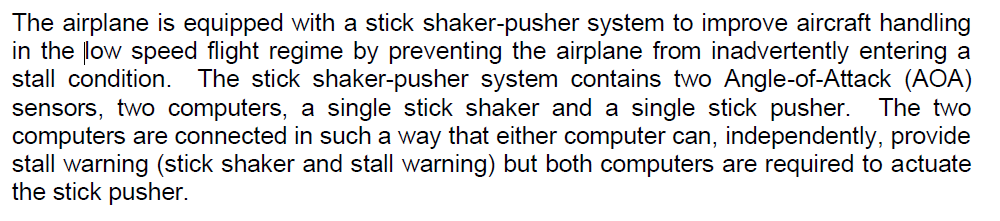
Stepping down the food chain, we have the Pilatus PC-12, a Swiss-designed 11-seat turboprop. The plane starts out with a standard light aircraft flight control system. The pilots’ yokes are connected directly to control surfaces via pushrods and cables. On top of this Pilatus has layered a stick shaker to warn pilots that the airplane is nearing a stall and a stick pusher that yanks the yoke forward. The airplane has a great safety record despite being operated into some challenging short runways and being flown, in some cases, by inexperienced pilots.
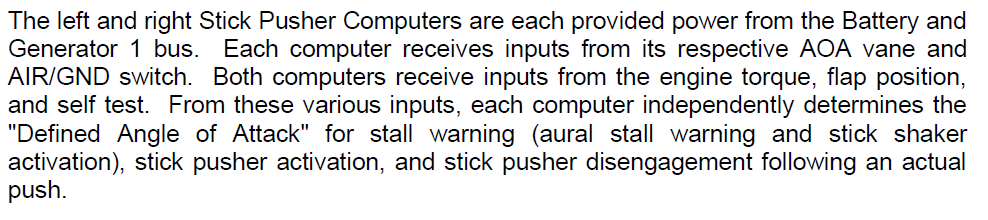
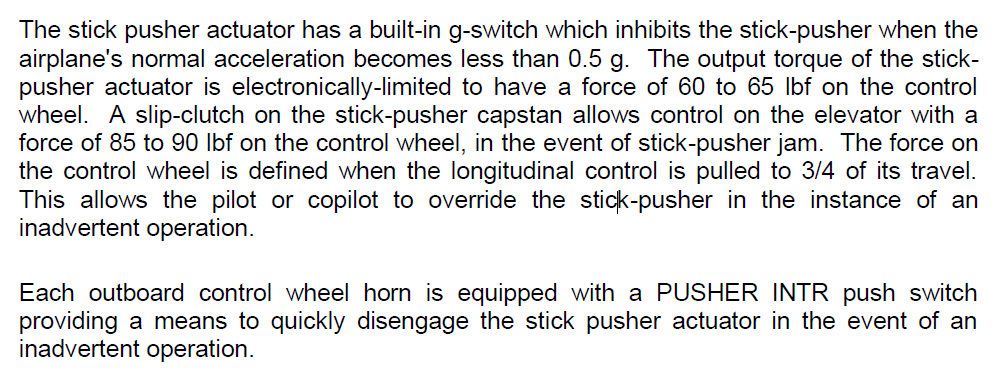
Instead of Boeing’s single AOA sensor and software to run the trim, the PC-12 has two AOA sensors and two computers. If both sides agree that it is time to go nose-down, then and only then will the stick pusher be engaged. If somehow both sensors and both computers are defective and push inappropriately, a “pusher interrupt” button is always right there on each yoke. From the AFM (“owner’s manual”):
A friend who is a Silicon Valley engineer texted me incredulously “Wouldn’t they do fusion from zillions of sensors?” My response on the FAA certification process:
It is like ISO 9000. Boeing had binders of paperwork and bureaucratic approval for their design, but the design itself may never be scrutinized.
Almost certainly if the B737 had the same system design as the PC-12 all 189 folks aboard Lion Air 610 would have arrived safely at their destination. The worst that would have happened is the pilots being briefly annoyed by a shaking stick and having to hit a checklist.
I’m not sure if this crash can fairly be attributed to a software problem, since the software presumably did function as designed. It seems that we can attribute the crash to a poor system design, but ultimately the plane was crashed into the water by software.
Related:
Wikipedia has a good article on the various aircraft flight control system alternatives
I flew the Cirrus recently to Gaithersburg, an airport that supposedly sees only 131 operations per day (airnav). On the flight from Allentown, Pennsylvania to KGAI, the controllers did not even once tell me to look for a nearby plane. I was pretty much alone in the sky at 6,000′.
Things were different within 5 miles of the destination airport. I arrived on a gusty bumpy Tuesday at 1 pm and became the fourth airplane in the pattern as this non-towered airport. I departed behind a Pilatus PC-12. The Pilatus crew waited for a small plane to land before they could depart. I asked a plane on downwind to extend slightly so that I could get out with my IFR clearance (i.e., there were at least four airplanes operating at 5 pm when I departed). Given the active flight school at KGAI and the fact that I have nearly always found myself with company in the traffic pattern there, I question the 131/day number (since there is no control tower, the statistic may not be authoritative).
There is some structure to the traffic pattern at an airport that makes it a bit easier for pilots to identify each other, but self-sequencing is not always successful. AOPA’s Air Safety Institute: “Eighty percent of the midair collisions that occurred during ‘normal’ [not formation or aerobatics] flight activities happened within ten miles of an airport, and 78 percent of the midair collisions that occurred around the traffic pattern happened at nontowered airports.”
Americans have spent billions of dollars over the last twenty years on ADS-B, partly sold as a way to avoid midair collisions. I’m wondering now, though, if ADS-B solves the wrong problem and/or the non-problem of enroute traffic conflicts.
Maybe it was too advanced an idea in the 1990s when ADS-B was conceived (with an implementation date of Jan 1, 2020!), but I wonder if it would make sense for ADS-B gear to sequence airplanes at nontowered airports. Why couldn’t the pilot press a button on the transponder and have the ADS-B software say “You are Number 3 for Runway 32. Number 2 is turning right base. Number 1 is on final”?
Factory schools teach science, math, and computers to students with the justification that “this stuff will help you, somehow, someday, maybe by getting you into the right college.” Some students are happy with this amount of motivation and some students love these subjects for their very purity, their disconnection from the concrete world. These are the students that we see at MIT and Harvard so in theory this approach is successful.
As evidenced by terrible average scores on standardized tests covering very basic material, the average high school student is not learning science, math, or computer programming to any perceptible degree. And realistically why would we expect a kid to be motivated to learn these things? They read newspaper articles about CEOs giving themselves $50 million/year salaries but flunking exams in basic accounting at their Stanford Business School refresher course. They watch television broadcasts of politicians’ speeches and there is never any reference to principles or ideas taught in their science, math, or computer programming classes.
The combination of a high degree of an abstraction and the apparent ability of people to reach the highest echelons of society in perfect ignorance of these subjects makes it tough for a lot of kids to hit the books.
Why not make it all concrete? Suppose that starting in 8th grade the kids were told “Each of you is going to design and build your own bicycle over the next 4 years. To help you do a better job, you’re going to learn some math, some physics, and how to use computers to simulate and model.”
At least 50 percent of what is taught in high school math and science can be motivated by the engineering challenge of making a bike that functions properly and weighs less than 100 kg. In particular one can dream that this project-based approach would rescue computer instruction from its current abyss. Instead of teaching the kids how to use Microsoft Office and write lame little graphics programs in VB or Java, we’d show them how computers can become analytical tools.
For the hands-on oriented kids we can let them machine their own parts and maybe do some welding, thus combining math and shop in one period! To keep the klutzes from killing themselves, though, you’d probably want a design option that included only pre-cut tubes bolted together (you could never make a commercially viable bike this way; it would be too heavy and expensive to manufacture but it would be fine to ride around flat areas and for teaching).
The actual change in the curriculum would be minimal. It is more a question of spirit and always having a concrete answer if a kid asks “Why do I need to know this?”
One of the reasons it is worth paying $1 million for a 100-year-old sagging fixer-upper starter home in Cambridge is that you run into interesting people. At a sandwich shop yesterday I encountered a friend who is a professor of Architecture. His companion asked what I was teaching this semester. “Intro circuit theory for sophomore electrical engineering majors,” was my response, “Inductors, resistors, capacitors, transistors, op-amps, feedback, impedance method.”
He was taken aback. “Why not teach something more practical?” Like what? How to build a TV? “No, I meant something more advanced and specialized, like a graduate seminar.”
I thought about it for awhile and said “Undergrads are fun to be around. They’re always in a good mood. For the average person, the likelihood that they’ll be in a bad mood is directly proportional to their age.” I asked the architecture prof to concur: “Aren’t your students in a better mood than the average working architect?” He concurred and said that in fact he has noticed that when he teaches undergrads they are happier than the grad students that he usually teaches.
At first glance you’d expect college students to be unhappy. They’re adolescents. They don’t know what they want or what makes them happy. But on second thought maybe undergrads do have a lot of reasons to be happy. They don’t have any aches or pains because their bodies are so young. They don’t have to worry about money because their parents send it to them. They don’t have to call the plumber or electrician because the university maintains their dorm. They don’t have to take their car in for service because they don’t have a car. The last two points free them to read interesting books, watch movies, play video games, indulge in sex and drugs, etc.
http://www.hushtechnologies.net/ shows a reasonably fast (933 MHz, up to 1 GB of RAM) reasonably cheap (under $1000) WinXP machine that is cooled via heat sinks rather than fans. Another very quiet PC option is the Gateway Profile, which looks like half of a laptop computer mounted on a small pedestal. My friend Doug and I removed the (pretty quiet) fans from a couple of old ones (500 MHz Celerons) and they continued to run just fine.
This evening we showed our 6.002 students the Ken Burns PBS documentary Empire of the Air. This was adapted from a book of the same name by Tom Lewis. Here are the facts that were related in two hours:
Lee De Forest, who did much to publicize the idea of using radio for broadcast rather than point-to-point communication, claimed credit for other peoples’ inventions and, through good luck and great legal talent, managed to prevail in a decades-long lawsuit against Major Edwin Armstrong, the true inventor of most of the important technologies behind radio broadcasting. De Forest ridiculed America’s entry into World War I and then became a profiteer. On the cusp of his 60th birthday, De Forest married Wife #4, a beautiful 21-year-old actress who remained devoted to him until his death at age 88. As an old man, De Forest wrote a book entitled The Father of Radio and unsuccessfully encouraged his wife to write a book entitled I Married a Genius.
Edwin Armstrong worked hard and labored through formal electrical engineering training at Columbia University, the very sort of EE torture that our students are getting in 6.002. Armstrong developed the circuits that enable using a vacuum tube as a radio transmitter and the superhet receiver, which together made it practical to transmit music and voice over AM radio, rather than Morse code. A staunch patriot, Armstrong donated a royalty-free license to all of his patents to the U.S. government for use in World War II and served in that war by designing communications systems including that used during the invasion of Normandy in 1944. Armstrong developed frequency modulation (FM), which was suppressed by David Sarnoff at RCA because it would threaten revenues from his AM radio monopoly and the emerging television. RCA eventually was forced to use FM for the federally mandated NTSC television system but they refused to pay Armstrong royalties on his patents. Armstrong committed suicide while embroiled in lawsuits attempting to force RCA to stop infringing.
David Sarnoff had no formal technical training. Through ruthless business dealings and manipulation of the federal government managed to create and sustain a magnificently profitable enterprise that included the RCA radio and TV manufacturing company and the NBC radio and TV networks. Though Armstrong’s widow eventually made him pay up a bit for his flagrant infringement of the frequency modulation patents, Sarnoff sailed unscathed through a sea of lives that he wrecked. He died an old and rich man.
The only people in the drama who made millions without taking tremendous risks, working very hard, and occasionally going bankrupt, were … the lawyers in the patent and regulatory disputes.
What are our students to make of all this? It can’t be that working hard as an MIT electrical engineering student and contributing useful innovations to society will be rewarded. If you’re walking your dog in the Harvard Law School Yard four years from now and you run into our 6.002 alumni, tell them “hi” from me.
[The video also made one wonder for whom public television programs are made. Despite having two hours the show did not attempt to explain even the simplest physics or engineering behind radio or any of the inventions that were the subject of the disputes chronicled. The biographical and historical information was narrated so slowly that it could have been sped up 3X without approaching the speed of dialog on the Simpsons, which most people seem to have no trouble following. It seems as though public TV is designed for people whose minds are not quick enough to handle the quick pace and intellectual challenge of commercial TV shows.]