High-end KitchenAid range with burner stuck on

Two months ago Whirlpool tried to explode our suburban house with natural gas (previous posting) during a failed attempt to repair a less-than-five-year-old range (and in fact it turned out that it could never have been repaired; follow-up posting). Through their KitchenAid division they then tried to burn down our Cambridge apartment with a less-than-three-year-old dual-fuel range. The range had been top-rated by Consumer Reports, which shows the danger of relying on tests done on fresh-out-of-the-box products. The knobs don’t seem to control the gas directly, unless the valves are very light [See updates below; they actually are gas valves]. You push a knob in and turn it and the gas comes on, the burner lights, and you’re cooking. What if the mechanical interlock that keeps the knob from turning, unless it is pushed in, jams? Then there is no way to turn the burner off. If the gas flow is electronically controlled you’d think that there would be an “all burners off” option on the oven control/clock panel, but there is not. With four adults in the house, two of whom have engineering backgrounds, and a pair of pliers, we managed to get the burner off after about 15 minutes of experimentation. Until that happy moment we had four adults and three kids in an apartment with an open flame that could not be extinguished.

[Note that the range had previously failed, also out of warranty, with a control board that emitted a continuous 60 Hz. buzzing (would reset if the breaker was turned off then back on). And the companion $1,500 KitchenAid dishwasher suffered from two failures in less than 12 months of use, requiring a total of at least six service visits (it now has a new control board and circulation pump and works pretty well).]

I called the KitchenAid 800-number to arrange service. They took the position that because the range was more than one year old they had no responsibility for repairing it and would charge me for an out-of-warranty repair. I was curious to see if this was the final answer so I asked to speak to a supervisor. After I asked “Can you really design a product that will burn a customer’s house down and then charge them to fix it?” I was transferred to someone in the safety department who finally agreed that Whirlpool would cover the new control knob.

As it happens, my friends’ two-bedroom rental in Beaver Creek, Colorado has a new-looking KitchenAid gas cooktop. Half of the burners won’t light. Gas flows and an igniter sparks (sometimes on a different burner, though), but there is no resulting flame.

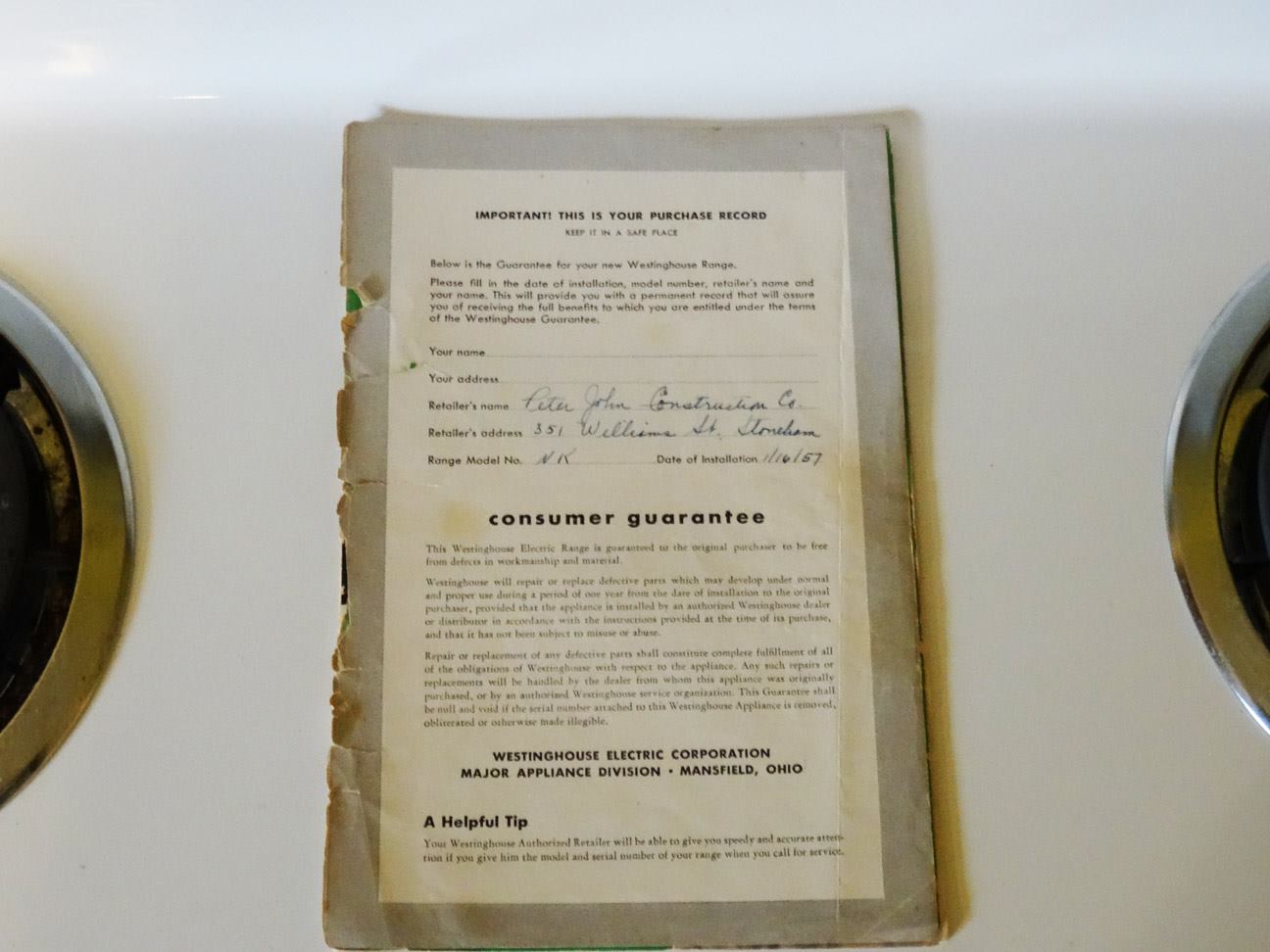
While I have been struggling with these new-and-not-cheap ranges, a friend posted these photos on Facebook:

He was replacing a White Westinghouse range, purchased in 1957, that was working perfectly at the time of its de-installation, 59 years later. He wanted a convection oven, but I am wondering if he will come to regret this decision!

Readers: I hate to sound like the old codger who claims that everything was built better in the old days, but is it time to give up on natural gas as a cooking fuel? If you combine the engineering departments of American appliance manufacturers with the expected skill level of repair technicians who are going to show up, would it make sense to say that all new ranges and cooktops should be electric? (induction?) What about foreign brands? Are Korean-engineered (Samsung and LG) or German-engineered (Miele) gas ranges more reliable and therefore, considering the power source, safer? And should we give up on high-end appliances? If the expensive ones are going to fail every few years, why not buy bottom-of-the-line products that can be replaced for about the same cost as a repair?

Update 2/19/2016: Whirlpool factory service shows up to try to fix the problem. My report of a stuck gas burner turned into a written note that the (electric on this model) baking element had failed. So the repair guy didn’t have the correct parts.

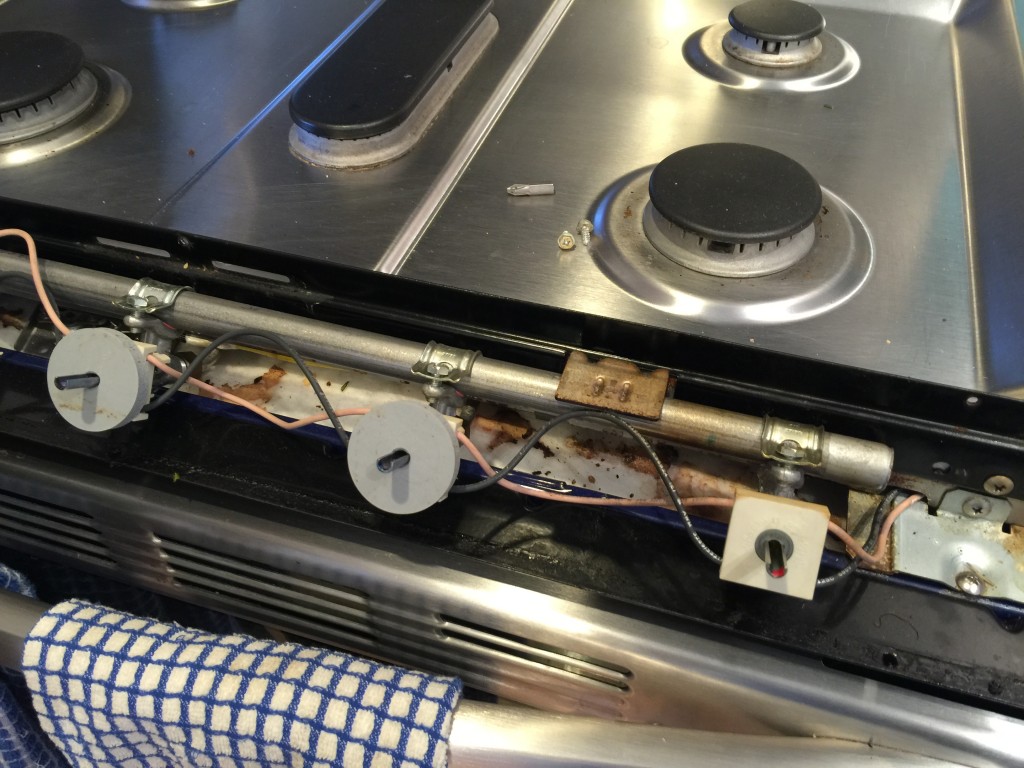
Update 2/22/2016: Whirlpool factory service shows up with the gas valve. It turns out that the knobs are directly connected to a common gas line:

2016-02-22 14.01.19 2016-02-22 14.06.04

Unfortunately, somehow the old knob wouldn’t fit onto the new valve. So the saga continues with a quest for a new knob…

Full post, including comments

Is Bernie Sanders too old to be President?

At age 74, Bernie Sanders is 20-25 years too old to be hired as a computer programmer (to judge by employers’ actual hiring practices). Is he too old to be President of the U.S.? I might have said “yes” until this week when I signed up for a group lesson at Beaver Creek, Colorado. Wink started ski instructor school at 48 and has been working full-time since then. He’s 77 years old, recently did a two-day 200-mile bike ride, and teaches every day at Beaver Creek or Vail.

2016-02-09 12.03.27 HDR

Readers: What do you think? Bernie would be working as President from age 75-79 or from 75-83? Is that too old? Or has railing against Wall Street kept him young at heart?

Full post, including comments

Mining out a divorce lawsuit defendant’s stock option value

“Stock options can affect child support order” is a Boston Herald article by Gerald Nissenbaum, the lawyer whom we interviewed for the Massachusetts chapter of Real World Divorce. Here’s the question from the reader:

My wife is dragging me back to court. She wants more alimony and child support because I made money by selling stock I got by exercising stock options in my employer’s company.

But in our divorce agreement, I agreed she’d get three-quarters of the proceeds from the sale of our marital home and I got to keep my stock options. Can she get a double dip?

The answer from Nissenbaum turns out to be “yes,” with the explanation: “search for the latest appeals court case on child support — Hoegan v. Hoegan. Then forget about trying to hold onto your wallet.”

The plaintiff here has a great strategy. Give up something that will yield income in the future in exchange for more cash now. Then get between 20 and 50 percent of that future income (11-25 percent of the pre-tax amount, but paid on a tax-free basis) via a child support modification based on the fact that the defendant’s income has changed. (And since judges are reluctant to modify child support awards downward, a plaintiff could easily end up with 200 or 300 percent of a short-term income boost if the child support is set during the period of temporarily higher income.)

[The appeals court case shows why you want to be a divorce litigator in Boston. The kids were born in 2003 and 2004. The mother sued the father in 2010. They’ve been litigating now for six years. The youngest child will yield a cashflow for whoever can hold onto primary custody through the year 2027. The cash yield from the children cannot be determined definitively without lawyers on both sides arguing in front of a judge.]

Full post, including comments

Skinomics

I’m spending the week with friends in Beaver Creek, Colorado. Hertz rented me a brand-new Kia Optima mid-size sedan, which would retail for about $21,000, for $40/day including all of the Denver airport fees.

How much does it cost to rent a set of ski gear? Boots, skis, poles, and a helmet from the resort will cost $85/day. From one of the many independent shops clustered in the nearby towns? Between $40 and $55/day. My friends tell me that the stuff being rented retails for about $1,600 total and that it is typically sold at the end of the season for about $800. If the wholesale price was $1200, this means the actual cost of the gear is recovered after 5-10 days of renting.

How to explain the much higher ratio of rental compared to purchase price in ski gear versus cars? I don’t think that it can be damage to the gear because customers are charged for that separately (and offered a damage waiver at an additional cost to the above prices). Perhaps it is more labor-intensive to rent out ski gear? But Hertz has plenty of employees, massive computer systems (if they paid healthcare.gov prices to program and run their servers, it would wipe out 100 years of profits!), shuttle buses, etc. Hertz also has huge admin costs, presumably, to clean up after minor accidents (figuring out which insurance company is responsible, getting the car fixed, hunting down the various parties for reimbursement, etc.); a cracked ski, on the other hand, can be dealt with on the spot.

Readers: Who can explain this “skinomics” question?

Full post, including comments

Massachusetts millionaire tax

People in Massachusetts are trying to decide whether or not to tax people who earn over $1 million per year at a rate, for however much they are over $1 million, that is 4 percentage points higher than the rate paid by the common rabble. (article) Moving to a California-like system of progressive state income tax rates may require an amendment to the state constitution.

As a member of the common rabble, I of course support the idea of rich people paying my bills. As most other voters probably can’t see the days ahead when (a) politicians define down the “rich” threshold to capture revenue from people formerly not thought of as rich, and (b) $1 million is also the price of a Diet Coke, I think this idea of higher taxes on “the rich” has a good chance of adoption. (Also predicted by Russell Long‘s class poem:

Don’t tax you,
don’t tax me,
tax that fellow behind the tree!

; Long also predicted my personal support for the new tax: “A tax loophole is something that benefits the other guy. If it benefits you, it is tax reform.”)

Readers: What can we expect to change for the Massachusetts economy once this does go through?

(My predictions:

  • further decline of the tech startup industry here relative to California; people who work in startups often have years of pretty low cash compensation and then one big year. If they’re going to pay California tax rates during that big year, why not just move to the center of the tech universe to begin with?
  • slowdown of the real estate craze; there will be fewer people wanting to live in a $4 million house in Weston (but I think that Boston and Cambridge will continue to be in demand due to the meltdown of the U.S. transportation system and the lack of new walkable pleasant urban environments being built in the U.S.)
  • heating up of the private jet business as more people decide that living in tax-free Florida for 183 days per year, but visiting New England frequently (rich people: watch out for “permanent alimony” in Florida compared to the theoretically limited term in Massachusetts!)
  • increased values for Portsmouth, New Hampshire real estate (walkable pleasant town; water views everywhere); rich people: watch out for unlimited child support in New Hampshire, albeit not as lucrative as in Massachusetts
  • earlier retirements for some successful folks; if you don’t need to keep working, a higher tax rate should provide encouragement to retire and move to a state with good weather and no estate tax (map). This could make Massachusetts a better place to be young and still climbing the ladder in, e.g., a big money management firm?

)


Full post, including comments

Computer program to keep telemarketers on the line

Thirteen years ago (ouch!), I posted a thesis idea for someone studying computer science:

To a master’s student looking to do something with speech, I’d say “build a system that will occupy telephone solicitors.” The challenge for the computer is to keep the phone solicitor under the impression that he or she has reached a human being for as long as possible. The beauty of this system is that if installed in a wealthy area there would be a near-endless stream of calls on which to test the quality of the result and that, if a high quality system were widely installed on PCs nationwide, it would put the phone solicitors out of business (because they’d be spending so much time and money talking to computers programmed to keep them on the line indefinitely).

Companion: National multi-school contest for the best system.

It seems that the glorious day has come to pass! Gizmodo has published “Today’s Hero Made an AI That Annoys Telemarketers For As Long As Possible” about jollyrogertelephone.com. Not a bad effort, but a lot more could be done by someone researching speech recognition.

A pretty example for direct listening: on YouTube.

Full post, including comments

Tiger Parent on Lexington, Massachusetts Public Schools

A friend sends his children to the much-vaunted Lexington, Massachusetts public schools. He denies being a tiger parent but has a PhD, is Asian-American, and the kids seem to be doing a lot of extracurricular activities. Are the schools as great as Boston-area parents think? “Most of the teachers are bad; my daughter had a terrible math teacher last year,” he responded. “There are a few good ones, especially in the AP classes. Lexington probably has more good teachers than other school systems.”

A few hours after this conversation I ran into a non-teacher employee of the Newton, Massachusetts public school system, another supposedly top choice. She said “Most schools with a great reputation are riding on something that they were doing 10 years earlier. That’s certainly true of Newton.”

What about Lexington school system insiders? I recently met a teacher in the school system who characterized the evaluation process for already-hired teachers as demanding and said that there was no job security for bad teachers. In his opinion it was easy (too easy!) for a teacher, even one with tenure, to be fired for poor performance. (See also this posting about teacher hiring and firing in a neighboring school system.)

Related:

Full post, including comments

“It can’t happen to me” and “This time it will be different,” Florida version

Chatting with a pilot in Orlando, Florida… he found a woman who had profited financially from a brief marriage and was continuing to profit by collecting child support for a young son over whom she had obtained primary custody. After a brief courtship, they were married. Seven years and about a day later (seven years is the minimum length marriage that may entitle a plaintiff to “permanent alimony” (Nolo Press)), he found himself in divorce litigation…

[Note that child support in Florida is potentially unlimited, but not nearly as lucrative as in many states in the Northeast. Where Florida shines, from a plaintiff’s point of view, is in the alimony potential.]

Question: Why do humans imagine that they are special and that the future won’t resemble the past?

Full post, including comments