Equal Rights Amendment, Bristol Palin, and Aziz Ansari
“How to Bridge That Stubborn Pay Gap” attracted 294 comments from New York Times readers. The editors select 10 as “picks” and here’s the opening of one of them:
This is a no-brainer: FIRST make women equal within the Constitution, pass the Equal Rights Amendment.
The author of the comment presumably believes that, given such an amendment, men and women would be paid the same. Here’s the text of the Equal Rights Amendment from 1972:
Section 1. Equality of rights under the law shall not be denied or abridged by the United States or by any State on account of sex.
Section 2. The Congress shall have the power to enforce, by appropriate legislation, the provisions of this article.
Section 3. This amendment shall take effect two years after the date of ratification.
This replaces the 1923 version: “Men and women shall have equal rights throughout the United States and every place subject to its jurisdiction. Congress shall have power to enforce this article by appropriate legislation.”
I wonder if this amendment, had it been fully ratified, would have lived up to the hopes expressed in the comment and the 62 other Times readers who gave it the thumbs up. Would the ERA have prohibited private employers from doing whatever it is that they are currently doing?
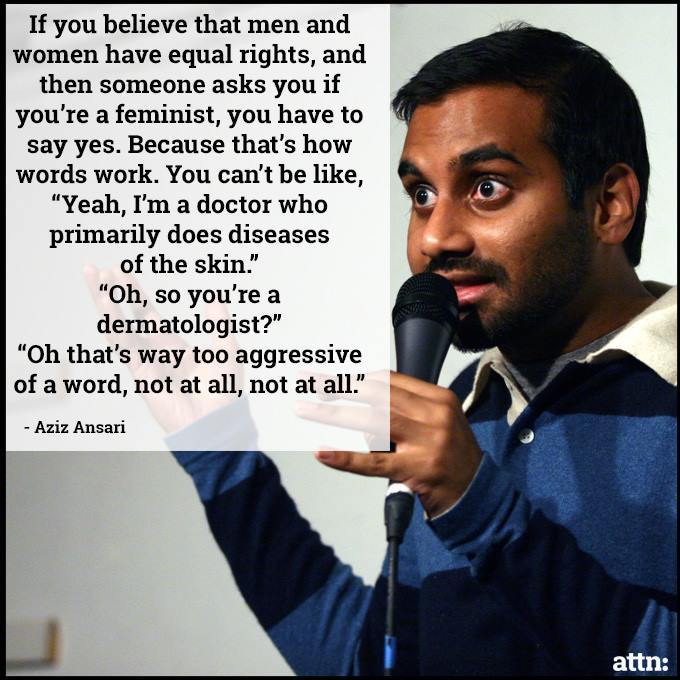
Aziz Ansari got a lot of Facebook shares with this image (text: If you believe that men and women have equal rights, if someone asks if you’re feminist, you have to say yes because that is how words work. You can’t be like, “Oh yeah, I’m a doctor that primarily does diseases of the skin.” Oh, so you’re a dermatologist? “Oh no, that’s way too aggressive of a word! No no not at all not at all.”)
What would happen if men and women actually did have equal rights under all of the laws? Bristol Palin found that out to her chagrin recently. She gave birth to a child in Alaska, the only state in the U.S. that grants fathers equal rights to mothers when it comes to custody and child support (some other states, e.g., Arizona, favor shared parenting but it is due to shared parenting studies showing that this is best for children, not because of a belief that running a court system where women win 90+ percent of the cases is unfair). She quickly found herself sued by the father, interested in a 50/50 parenting arrangement and monthly cash payments from Palin, whose income exceeds his. (Child support in Alaska is capped, however, so while a plaintiff might get 4-10X what could be obtained in Europe, there isn’t the possibility of unlimited payments as in California, Massachusetts, or Wisconsin.) The National Enquirer article on the subject:
Bristol Palin is facing an all-new disgrace as her formerly-heroic Marine fiancee files a custody claim on their out-of-wedlock baby — and even makes a grab for child support!
Now he’s filed legal documents seeking joint-custody of the 3-week-old, while also seeking child-support payments from Bristol!
The new mom’s rep, David Martin, sniffed: “My values are such that a real American hero doesn’t ask for child support.”
[Presumably the roughly 4 million Americans collecting support payments in excess of child-related costs would disagree with that last statement.]
According to the scholars whom we interviewed, Ansari is stuck in the 1970s when it comes to “feminism.” Here are excerpts from a section from the Rationale chapter of Real World Divorce:
Legislators and attorneys told us that women’s groups and people identifying themselves as “feminists” were proponents of laws favoring the award of sole custody of children to mothers and more profitable child support guidelines. Is that a recognizably feminist goal? For a woman to be at home with children living off a man’s income? Here’s how one attorney summarized 50 years of feminist progress: “In the 1960s a father might tell a daughter ‘Get pregnant with a rich guy and then marry him’ while in the 2010s a mother might tell a daughter ‘Get pregnant with a rich guy and then collect child support.'” Why is that superior from the perspective of feminism? A professor of English at Harvard said “Because the woman collecting child support is not subject to the power and control of the man.”
We interviewed Janice Fiamengo, a literature professor at the University of Ottawa and a scholar of modern feminism, about the apparent contradiction of feminists promoting stay-at-home motherhood. “It is a contradiction if you define feminism as being about equality and women’s autonomy,” she responded. “But feminism today can be instead about women having power and getting state support.”
Leigh Goodmark, a professor at the University of Maryland law school and former Co-Director of the Center on Applied Feminism at the University of Baltimore School of Law, is the author of A Troubled Marriage: Domestic Violence and the Legal System (2011, NYU Press). Professor Goodmark explains that there are three types of feminism: equality, dominance, and governance. The feminism that has been influential in shaping family law nationwide is dominance feminism:
The particular bent of domestic violence law, however, is attributable not to equality feminism, but to the prevailing feminist ideology of the 1980s and 1990s, when many of these laws were enacted: dominance feminism. Dominance feminists, led by law professor Catharine MacKinnon, contended that male domination of women in the sexual sphere was the primary vehicle for women’s continued subordination. MacKinnon argued that “our male-dominated society, aided by male-dominated laws, had constructed women as sexual objects for the use of men.”
Rejecting feminist legal theories that advocated for women’s equality with men (equality feminism) or highlighted women’s innate differences from men (cultural feminism), dominance feminism contended that the legal system’s central concern should be remedying women’s subjugation, a subjugation created and reinforced by women’s sexual subordination to men.
“I’m Not Impressed By Aziz Ansari’s Feminism” breaks down feminism into a “first wave” (which Ansari seems to have caught) and, implicitly, later waves during which it was recognized that “equal rights” is not necessarily the right thing to demand. Bristol Palin’s current troubles with Alaska’s version of the Equal Rights Amendment show some of the problems with that first wave of feminism.
How else could women lose from the passage of an ERA? Even if the Equal Rights Amendment applied only to federal and state government, those are responsible for a lot of jobs. Affirmative action programs that favor the hiring of women would have to be eliminated, at least at government employers.
What about college admissions? Could men sue under an ERA because there are more women admitted to college than men? This 2012 Forbes article says the following:
On a national scale, public universities had the most even division between male and female students, with a male-female ratio of 43.6–56.4. While that difference is substantial, it still is smaller than private not-for-profit institutions (42.5-57.5) or all private schools (40.7-59.3). The nearly 40-60 ratio of private schools was most surprising, though perhaps this is partly due to the fact that most all-female schools are private. Nevertheless, the female domination of higher education prevails across all types of schools. It should also be noted that the national male-female ratio for 18-24 year olds is actually 51-49, meaning there are more (traditionally) college-aged males than females.
What about in government-run K-12? The Rise of Women says that “Women now outperform men academically at all levels of school.” Is the government prepared to say that boys are inherently intellectually inferior to girls? If not, how could a state or local government, given an ERA, run a school system in which boys consistently do worse than girls?
What do readers think? How would our world be different today if the Equal Rights Amendment had passed? Would there be any effect on the gender pay gap of which the New York Times regularly complains?
Related:
Full post, including comments :
: , which has a smaller 1″ sensor and interchangeable lenses at a tiny fraction of the price. Customer reviews on the Amazon and B&H Photo mention problems with the water-sealing, which is not a great thing in an underwater camera…